
How Solid-State Batteries Are Rewiring the Future of Electric Vehicles
After decades of research, solid-state batteries are moving from the lab to production lines in 2026, promising to double EV range, slash charging times, and eliminate battery fires.
By Factlen Editorial Team
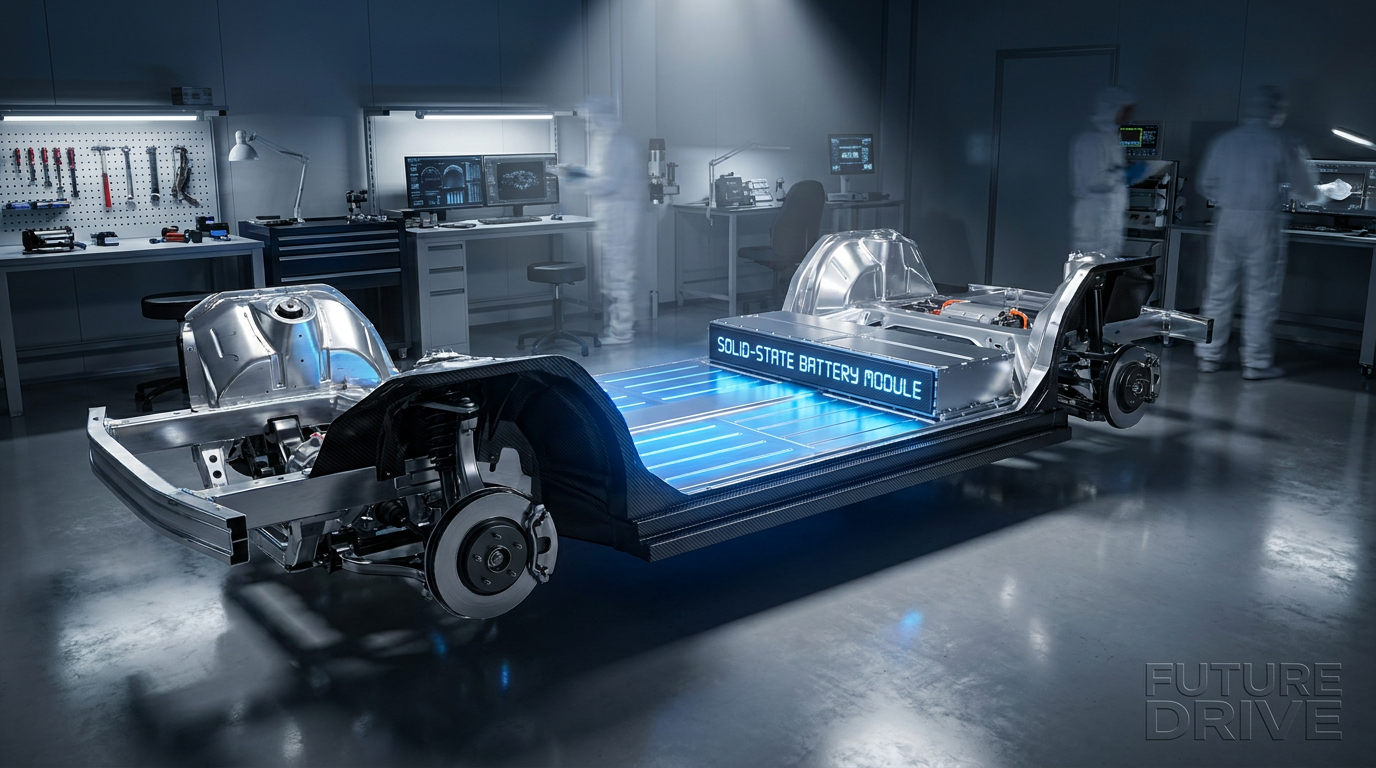
- Battery Disruptors
- Startups and pure-play battery manufacturers are pushing aggressive timelines to disrupt the lithium-ion status quo.
- Established Automakers
- Legacy brands view solid-state tech as a premium feature that must be scaled carefully to manage costs.
- Materials Scientists
- Researchers emphasize that while the chemistry is proven, mass manufacturing remains a formidable physical challenge.
What's not represented
- · Lithium-ion gigafactory operators
- · Raw material mining sector
Why this matters
Solid-state batteries solve the three biggest hurdles to mass EV adoption: range anxiety, slow charging, and safety risks. By packing more energy into a smaller, fire-proof footprint, this technology will make electric vehicles lighter, cheaper, and capable of charging in the time it takes to pump gas.
Key points
- Solid-state batteries replace flammable liquid electrolytes with solid ceramics or polymers.
- The technology promises to double EV range by reaching energy densities of 400 to 600 Wh/kg.
- Charging times could drop to just 10 to 15 minutes without degrading the battery's lifespan.
- Major automakers and startups are launching pilot production lines in 2026.
- Initial rollouts will focus on luxury vehicles and motorcycles due to high early manufacturing costs.
For decades, the "holy grail" of electric vehicles has been a battery that charges as fast as a gas tank fills, never catches fire, and drives 600 miles on a single charge. In 2026, that theoretical technology is finally rolling off production lines.[1]
The breakthrough centers on solid-state batteries, a fundamental rewiring of how energy is stored and discharged. To understand why this matters, one must look at the limitations of the lithium-ion batteries powering today's EVs, laptops, and smartphones.
Traditional lithium-ion batteries rely on a liquid or gel electrolyte—a chemical soup that allows lithium ions to swim back and forth between the battery's anode and cathode during charging and discharging. While effective, this flammable liquid is the root cause of EV range anxiety, slow charging times, and rare but intense battery fires.[2]
Solid-state batteries replace that liquid with a solid material, typically a specialized ceramic, glass, or polymer. This solid separator still allows ions to pass through, but it fundamentally changes the battery's physical and chemical limits.[2]

The most immediate benefit is safety. Liquid electrolytes are volatile and can ignite if the battery is punctured in a crash or overheats during rapid charging. Solid electrolytes are non-flammable, raising the threshold for thermal runaway from roughly 90°C (194°F) to over 240°C (464°F).[3]
This solid barrier also solves the "dendrite" problem. In liquid batteries, fast charging can cause lithium metal to form microscopic, needle-like structures called dendrites. If a dendrite grows long enough to pierce the separator, it causes a short circuit. A solid ceramic separator acts as a physical wall, suppressing dendrite growth and allowing the battery to be pushed much harder.[2]
Because they are safer and more stable, solid-state batteries can use pure lithium metal for the anode instead of the bulky graphite used today. This unlocks a massive leap in energy density—the amount of power stored per kilogram of weight.[3]
Because they are safer and more stable, solid-state batteries can use pure lithium metal for the anode instead of the bulky graphite used today.
Today's best lithium-ion EV batteries max out around 250 to 300 watt-hours per kilogram (Wh/kg). Solid-state cells entering production in 2026 are hitting 400 to 600 Wh/kg. For drivers, this means automakers can either double the range of a vehicle without increasing its weight, or cut the battery size in half to build lighter, more efficient cars.[4]

Charging speeds are seeing a similar revolution. Because the solid electrolyte resists heat and dendrite formation, the batteries can absorb electricity at staggering rates. Recent pilot tests have demonstrated solid-state cells charging from 10% to 80% in just 15 minutes, sustaining that performance over hundreds of cycles with minimal degradation.[5]
The technology also eliminates the dreaded winter range drop. Liquid electrolytes become sluggish in freezing temperatures, severely limiting power output and efficiency. Solid-state cells maintain their conductivity in extreme cold, allowing EVs to operate flawlessly at -30°C (-22°F) without significant range loss.[4]
The race to commercialize this technology has reached a tipping point in 2026. Toyota, which has invested heavily in solid-state research, recently received approval from Japanese regulators to begin manufacturing its next-generation cells. The automaker plans to gradually ramp up production, targeting luxury models first before expanding volume toward the end of the decade.[6]
In Silicon Valley, battery developer QuantumScape inaugurated its "Eagle Line" in early 2026. The highly automated pilot facility in San Jose is producing solid-state cells for automotive testing, marking what the company's CEO called the "Kitty Hawk moment" for the technology.[1][5]

Rather than building massive gigafactories itself, QuantumScape is adopting a licensing model. The company is partnering with manufacturing giants to produce its proprietary ceramic separators, aiming to distribute the technology to top-tier automakers globally.[7]
Meanwhile, Chinese manufacturers are moving aggressively to capture the market. Greater Bay Technology (GBT), backed by GAC Group, announced that its first "A-sample" all-solid-state cells have rolled off the production line. The company is targeting mass-market vehicle integration by the end of 2026, boasting cells that easily survived needle-penetration and thermal shock tests.[8]
Despite the momentum, widespread adoption faces a steep manufacturing hurdle. Building solid-state batteries requires entirely new assembly lines, specialized equipment, and extreme precision to ensure the solid layers bond perfectly without microscopic gaps.[1][7]

Because of these high initial manufacturing costs, the first solid-state batteries will appear in premium applications. Electric motorcycles, which require smaller battery packs, are already adopting the technology in 2026. In the automotive sector, the first solid-state EVs will likely be high-end luxury sedans and sports cars.[6]
As production scales and costs fall over the next five years, solid-state technology is poised to trickle down to everyday commuter cars. When it does, the compromises of early electric vehicles—long charging stops, heavy chassis, and winter range anxiety—will finally become a thing of the past.
How we got here
19th Century
Solid electrolytes are first discovered, but practical applications remain elusive due to poor conductivity.
1990s–2010s
Liquid lithium-ion batteries dominate consumer electronics and power the first wave of mass-market electric vehicles.
2023–2025
Major lab breakthroughs in ceramic and polymer separators successfully suppress dendrite growth, proving the concept viable.
Early 2026
QuantumScape and Chinese manufacturers launch pilot production lines, producing the first automotive A-sample cells.
Late 2026
The first commercial solid-state batteries begin hitting the road in electric motorcycles and pilot EV fleets.
Viewpoints in depth
Established Automakers
Legacy brands view solid-state tech as a premium feature that must be scaled carefully to manage costs.
Companies like Toyota are taking a measured approach. Because the manufacturing processes for solid-state cells are entirely new and highly capital-intensive, legacy automakers plan to introduce them first in flagship luxury vehicles and high-performance hybrids. This allows them to absorb the initial cost premium while gradually building the supply chain required for mass-market commuter cars later in the decade.
Battery Disruptors
Startups and pure-play battery manufacturers are pushing aggressive timelines to disrupt the lithium-ion status quo.
Firms like QuantumScape and Greater Bay Technology see 2026 as their breakout moment. Rather than waiting for cost parity with traditional batteries, these disruptors are launching pilot lines and pursuing licensing models. Their goal is to prove the technology in real-world conditions immediately, forcing legacy gigafactories to adapt or risk obsolescence as consumer demand shifts toward faster-charging, safer EVs.
Materials Scientists
Researchers emphasize that while the chemistry is proven, mass manufacturing remains a formidable physical challenge.
For scientists, the "holy grail" of the solid electrolyte has been achieved in the lab, but the factory floor presents new hurdles. Solid-state cells require immense precision; even microscopic gaps between the solid layers can ruin the battery's conductivity. Researchers are currently focused on perfecting automated assembly techniques, like QuantumScape's "Cobra process," to ensure the batteries can be produced reliably at gigawatt-hour scales without high defect rates.
What we don't know
- Exactly when solid-state batteries will reach cost parity with traditional lithium-ion cells for budget-friendly commuter cars.
- How the solid ceramic separators will hold up to a decade of physical vibration and extreme temperature swings on real roads.
- Which specific solid-state chemistry (polymers, sulfides, or oxides) will ultimately dominate the global market.
Key terms
- Solid Electrolyte
- A solid material, often ceramic or polymer, that allows ions to move between a battery's anode and cathode without using flammable liquids.
- Energy Density (Wh/kg)
- A measure of how much electrical energy a battery can store relative to its physical weight.
- Dendrites
- Microscopic, needle-like metallic structures that can grow inside a battery during fast charging and cause dangerous short circuits.
- Thermal Runaway
- A dangerous chain reaction where a battery overheats uncontrollably, often leading to fires in traditional lithium-ion cells.
- A-Sample
- The first fully functional prototype of a battery cell produced on an assembly line for automakers to test in real-world conditions.
Frequently asked
Will my current electric vehicle get a solid-state battery?
No. Solid-state batteries require entirely different pack designs, cooling systems, and vehicle architectures, meaning they cannot be retrofitted into existing EVs.
Are solid-state batteries completely fireproof?
While not entirely immune to extreme heat, they eliminate the flammable liquid that causes most EV fires, making them exponentially safer and highly resistant to thermal runaway.
Why did it take so long to develop?
Finding a solid material that conducts ions as easily as a liquid—while surviving the physical expansion and contraction of a battery during charging—required decades of materials science breakthroughs.
Sources
Source coverage
8 outlets
3 viewpoints surfaced







[1]InsideEVsBattery Disruptors
QuantumScape Kicks Off Pilot Production Of Solid-State EV Batteries
Read on InsideEVs →[2]Built InMaterials Scientists
What Is a Solid-State Battery?
Read on Built In →[3]IDTechExMaterials Scientists
Solid-State Batteries 2026-2036: Technology, Forecasts, Players
Read on IDTechEx →[4]NotebookCheckEstablished Automakers
Chery to beat Toyota to the first solid-state battery EV with 600 Wh/kg cells
Read on NotebookCheck →[5]ElectrekBattery Disruptors
QuantumScape inaugurates Eagle Line pilot for solid-state battery production
Read on Electrek →[6]Green Car ReportsEstablished Automakers
Toyota will ramp up EV production, move ahead with solid-state batteries in Japan
Read on Green Car Reports →[7]Battery Tech OnlineBattery Disruptors
QuantumScape CEO Details Commercialization Progress for Solid-State Batteries
Read on Battery Tech Online →China ramps up solid-state EV battery production
Read on Electrek →

Every angle. Every day.
Get automotive stories with full source coverage and perspective breakdowns delivered to your inbox.