
How Physicists Are Solving Quantum Computing's Biggest Problem: The Error Correction Breakthrough
A new milestone in trapped-ion quantum processing has demonstrated massive improvements in logical error rates, proving that quantum error correction can finally outpace the natural noise of the universe.
By Factlen Editorial Team
- Quantum Hardware Developers
- Focused on engineering the physical systems—lasers, vacuums, and cooling—needed to scale up qubit counts.
- Theoretical Physicists
- Focused on designing more efficient mathematical codes to reduce the massive physical qubit overhead required for error correction.
- Commercial End-Users
- Eager for fault-tolerant machines to solve currently intractable problems in chemistry, logistics, and materials science.
What's not represented
- · Cybersecurity experts preparing for post-quantum cryptography
- · Venture capitalists funding quantum hardware startups
Why this matters
Without error correction, quantum computers are just expensive noise generators. Solving this bottleneck is the single mandatory step before quantum machines can revolutionize drug discovery, climate modeling, and cryptography.
Key points
- Quantum computers are highly susceptible to environmental noise, causing calculation errors.
- Classical error correction involves copying data, which is physically impossible in quantum mechanics.
- A new trapped-ion experiment successfully used quantum error correction to improve reliability by up to 800 times.
- The system spreads the information of one 'logical' qubit across many physical qubits to detect errors without looking at the data directly.
- This milestone proves fault-tolerant quantum computing is physically possible, shifting the challenge to engineering and scaling.
Introduce the fundamental paradox of quantum computing: it promises to solve problems that would take classical supercomputers millennia, but the very mechanism that gives it power—quantum superposition—makes it incredibly fragile. Unlike classical bits that sit firmly as a 1 or a 0, quantum bits (qubits) exist in a delicate probability space that can be shattered by the slightest environmental interference.[5]
A stray photon, a microscopic fluctuation in temperature, or even a cosmic ray from a distant galaxy can cause a qubit to lose its state. This phenomenon, known as decoherence, has been the primary roadblock preventing quantum computers from moving out of the laboratory and into commercial data centers. For years, the industry has been stuck in the 'noisy' era of quantum development.[2]
For decades, physicists have known that the solution lies in Quantum Error Correction (QEC). However, implementing QEC has historically been a Catch-22: the extra circuitry and operations required to monitor and correct errors often introduce more noise into the system than they actually fix, leading to a frustrating plateau in performance.[3]
That paradigm is now definitively shifting. A landmark demonstration published this week in the journal Nature reveals that researchers have successfully applied quantum error-correcting codes to a trapped-ion processor, achieving logical error rates that are between 11 and 800 times better than their physical circuit baselines. It is a resounding proof of concept that error correction can work in practice, not just on chalkboards.[1]
To understand why this is a watershed moment, one must look at how classical computers handle errors. In your laptop or smartphone, information is stored in binary. If a bit flips accidentally due to a hardware glitch, classical error correction simply relies on redundancy, making multiple copies of the data to ensure accuracy.[5]
A classical system might store a '1' as '111'. If a cosmic ray flips one bit to make it '101', the computer takes a majority vote, realizes the error, and flips it back. It is a brute-force but highly effective method that makes modern digital infrastructure flawlessly reliable, allowing trillions of calculations per second without a single crash.[2]
Quantum mechanics, however, strictly forbids this approach. A foundational principle known as the 'no-cloning theorem' dictates that it is physically impossible to create an identical copy of an unknown quantum state. You cannot simply back up a qubit to a hard drive and restore it if something goes wrong.[3]

Furthermore, the act of measuring a quantum state destroys it. If a system pauses to check whether a qubit is in an error state by looking at it directly, the delicate superposition collapses into a definitive 1 or 0, ruining the calculation entirely. It is the ultimate observer effect.[5]
The genius of Quantum Error Correction lies in sidestepping both of these fundamental laws of physics. Instead of copying a single physical qubit, QEC entangles the information of one 'logical' qubit across a vast, interconnected array of physical qubits. The information is hidden in the correlations between the particles, rather than in the particles themselves.[4]
The genius of Quantum Error Correction lies in sidestepping both of these fundamental laws of physics.
By measuring the relationships—or 'parity'—between these physical qubits rather than the qubits themselves, the system can deduce where an error occurred without ever looking directly at the underlying quantum information. It is akin to figuring out the shape of an invisible object by only looking at the shadow it casts on the wall.[3]

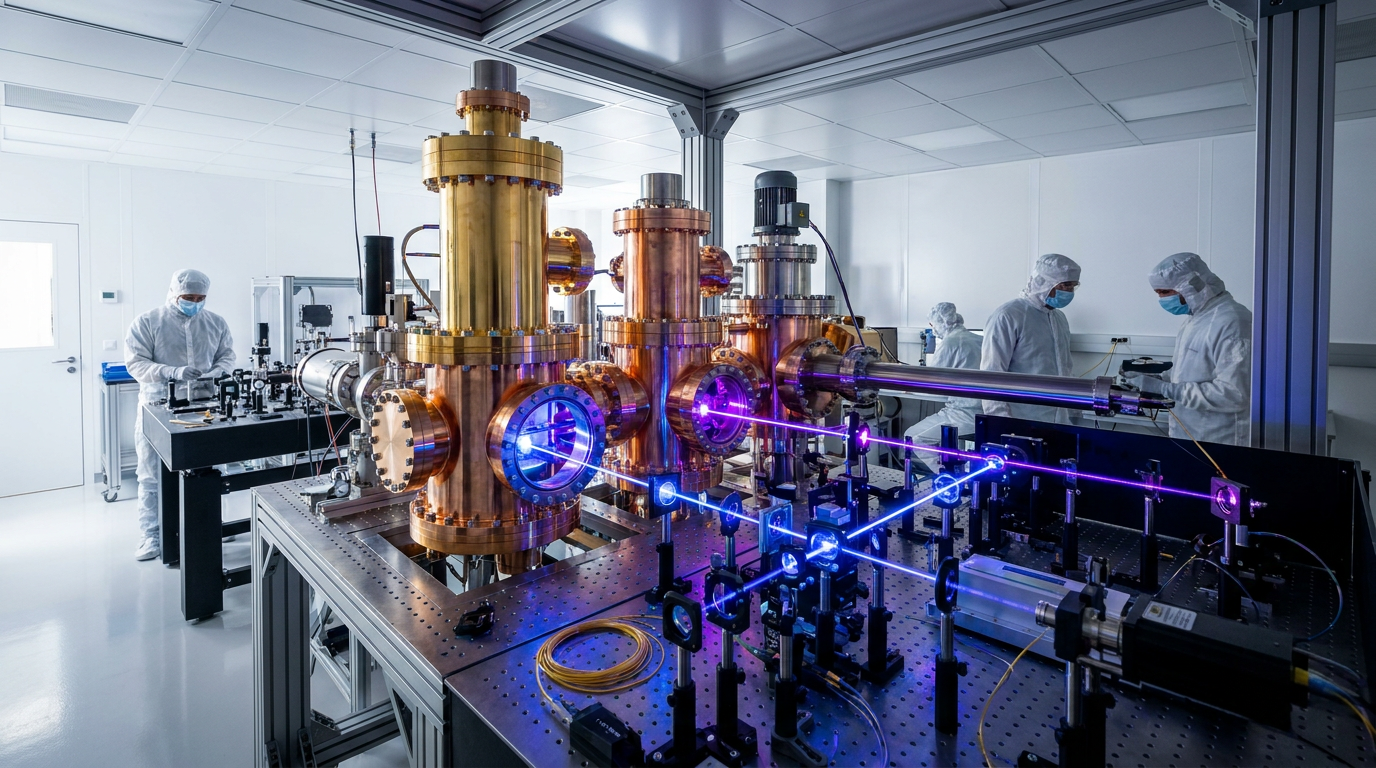
The recent breakthrough utilized a trapped-ion architecture, where individual charged atoms are suspended in a vacuum using electromagnetic fields and manipulated with precisely tuned lasers. This differs from the superconducting circuits favored by companies like IBM and Google, offering distinct advantages in how the qubits connect to one another.[1]
Trapped ions are inherently identical and boast incredibly long coherence times compared to their superconducting cousins, making them an ideal testbed for complex error correction algorithms. The researchers combined standard error correction with a technique called error detection and post-selection, creating a highly resilient computational environment.[1]
In this hybrid approach, the system actively corrects the errors it can manage, while simultaneously flagging and discarding the runs where uncorrectable errors are detected. This dual-layered defense mechanism is what drove the staggering 800-fold improvement in specific logical operations, pushing the hardware past the critical break-even point.[1]
The implications of crossing this threshold are monumental. The industry is beginning to move from the NISQ (Noisy Intermediate-Scale Quantum) era into the dawn of fault-tolerant quantum computing, where machines can finally be trusted to run deep, complex algorithms without degrading into static.[4]

Fault tolerance is the inflection point where a quantum computer can run indefinitely, correcting its own errors faster than the universe can introduce them. Once that is achieved at scale, the theoretical promises of quantum mechanics become engineering realities, unlocking computational power that classical supercomputers could never match.[2]
The first major applications will likely be in chemistry and materials science. Because nature is inherently quantum, simulating complex molecules for new pharmaceuticals, nitrogen-fixing fertilizers, or highly efficient battery materials is exponentially faster on a fault-tolerant quantum machine.[4]
Yet, significant hurdles remain before these machines sit in commercial server racks. The 'overhead' required for QEC is immense. Current estimates suggest that to maintain a single flawless logical qubit, a system might need anywhere from 100 to 1,000 physical qubits dedicated entirely to error correction and parity measurement.[3]
Scaling up from today's processors, which house a few hundred physical qubits, to the millions required for a commercially viable fault-tolerant machine will require massive leaps in control electronics, cooling infrastructure, and laser precision. The engineering challenge is comparable to the Apollo program.[2]
Despite these engineering mountains left to climb, the fundamental physics question has been answered. The recent data proves that logical qubits can indeed be made exponentially more reliable than their physical counterparts, validating decades of theoretical work and silencing skeptics who believed QEC was practically impossible.[5]
The race is no longer about whether fault-tolerant quantum computing is physically possible, but simply about who can engineer the architecture to scale it first. The era of quantum noise is beginning to end, and the era of quantum utility is finally coming into view.[4]
How we got here
1994
Peter Shor introduces the first quantum error-correcting code, proving it is theoretically possible to protect quantum information.
1996
The 'no-cloning theorem' and fault-tolerance thresholds are formally defined by theoretical physicists.
2010s
Early hardware experiments demonstrate basic error detection, but the correction process introduces more noise than it fixes.
Early 2020s
Researchers begin reaching the 'break-even' point where error correction slightly outpaces natural decoherence.
June 2026
A trapped-ion processor demonstrates an 11x to 800x improvement in logical error rates, definitively proving the viability of fault tolerance.
Viewpoints in depth
Hardware Optimists
Engineers who believe the physics is solved and the remaining challenges are purely mechanical.
For the teams building trapped-ion and superconducting processors, this breakthrough is the ultimate validation. They argue that the fundamental physics risk of quantum computing has been retired. The focus now shifts entirely to systems engineering: building better lasers, larger vacuum chambers, and faster classical control electronics to manage millions of qubits. They view the path to commercialization as a straight, albeit expensive, line.
Skeptical Theorists
Physicists who warn that the massive overhead required for error correction may make scaling economically unviable.
While celebrating the milestone, theoretical physicists caution that the 'overhead' problem remains severe. If it takes 1,000 physical qubits to create one stable logical qubit, a machine capable of breaking modern encryption or simulating complex drugs would need millions of physical qubits. Currently, the largest processors have barely crossed the 1,000-qubit mark. Theorists argue that without discovering vastly more efficient mathematical codes, the sheer size and cooling requirements of a fault-tolerant machine might relegate them to a few national laboratories.
Commercial Applications Sector
Industries waiting to use quantum computers for drug discovery and materials science.
For pharmaceutical companies and materials scientists, the shift from the 'noisy' era to the fault-tolerant era is the starting gun. They have spent years writing quantum algorithms that currently run on simulators or produce noisy, unusable results on real hardware. This breakthrough signals that their investments will eventually pay off, allowing them to simulate molecular interactions with perfect accuracy, potentially shaving years off the drug discovery pipeline and unlocking new classes of materials.
What we don't know
- Whether trapped-ion or superconducting circuits will ultimately be the easiest architecture to scale to millions of qubits.
- Exactly how many physical qubits will be required to maintain a single logical qubit in a commercial-scale machine.
- When the first fully fault-tolerant quantum computer will be available for commercial cloud access.
Key terms
- Qubit
- The basic unit of quantum information, capable of existing in a superposition of multiple states at once.
- Decoherence
- The process by which a quantum system loses its delicate state due to interaction with its surrounding environment.
- Logical Qubit
- An error-corrected, reliable unit of quantum data made up of many physical qubits working together.
- Trapped-Ion Processor
- A type of quantum computer that uses individual charged atoms, suspended in a vacuum and controlled by lasers, to perform calculations.
- Fault Tolerance
- The threshold at which a system can continuously detect and correct its own errors faster than they occur, allowing for indefinite operation.
Frequently asked
What is a logical qubit?
A logical qubit is a highly stable, error-free unit of quantum information created by grouping together many unstable 'physical' qubits to constantly check and correct each other.
Why can't we just copy quantum data to back it up?
A fundamental rule of physics called the 'no-cloning theorem' makes it impossible to create an identical copy of an unknown quantum state without destroying the original.
When will fault-tolerant quantum computers be ready?
While this breakthrough proves the physics of error correction works, engineering a machine with the millions of physical qubits required for commercial scale is still likely a decade or more away.
Sources
Source coverage
5 outlets
3 viewpoints surfaced





[1]NatureQuantum Hardware Developers
Improved quantum processor logical error rates via correction and detection
Read on Nature →[2]NISTTheoretical Physicists
Quantum Information Science and Technology
Read on NIST →[3]arXivTheoretical Physicists
Surface codes: Towards practical large-scale quantum computation
Read on arXiv →[4]QuantinuumQuantum Hardware Developers
Advancing Fault-Tolerant Quantum Computing
Read on Quantinuum →[5]Factlen Editorial TeamCommercial End-Users
Synthesis by Factlen editorial team
Read on Factlen Editorial Team →
More in science
See all 55 stories →Targeted Protein Degradation
Scientists Develop 'Molecular Glue' to Destroy Undruggable Cancer Protein
6 sources
Neural Circuits
How the Brain Physically Stores Recent History to Shape Immediate Decisions
5 sources
Interoception
The 'Sixth Sense' Transforming Mental Health: How Interoception Rewires the Brain
8 sources

Neutrino Physics
JUNO Underground Observatory Releases First Data, Achieving Record Precision on 'Ghost Particles'
6 sources
Every angle. Every day.
Get science stories with full source coverage and perspective breakdowns delivered to your inbox.