
Scientists Develop 'Molecular Glue' to Destroy Undruggable Cancer Protein
Researchers have created a novel molecular glue that targets and degrades HuR, an RNA-binding protein that drives drug resistance in BRAF-mutant colorectal cancer. The breakthrough compound has already entered Phase 1 clinical trials.
By Factlen Editorial Team
- Molecular Biologists
- Focus on the mechanism of targeted protein degradation and the breakthrough of drugging RNA-binding proteins.
- Clinical Oncologists
- Emphasize the potential to overcome rapid drug resistance in patients with BRAF-mutant colorectal cancer.
- Drug Discovery Sector
- View this as a validation of the molecular glue platform to unlock previously inaccessible therapeutic targets.
What's not represented
- · Patients currently undergoing standard BRAF therapy
- · Health insurance actuaries evaluating novel oncology drug costs
Why this matters
Roughly 10% of colorectal cancers are driven by BRAF mutations, which quickly develop resistance to standard treatments. By proving that 'undruggable' RNA-binding proteins can be destroyed using molecular glues, this research opens a new frontier for treating aggressive, drug-resistant genetic cancers.
Key points
- Roughly 10% of colorectal cancers feature a BRAF mutation, which typically develops resistance to targeted therapies within months.
- Researchers developed a 'molecular glue' that tags the drug-resistance protein HuR for destruction by the cell's own waste disposal system.
- Degrading HuR alters the genetic splicing of BRAF, creating a defective protein that cannot drive tumor growth.
- In animal models, the molecular glue showed massive synergy when combined with existing cancer inhibitors.
- A clinical-grade version of the drug, DEG6498, has entered Phase 1 human trials for advanced solid tumors.
Colorectal cancer is the second leading cause of cancer-related deaths globally, and roughly 10% of patients carry a specific genetic error known as a BRAF mutation. This mutation acts as an always-on switch for cell division, driving aggressive tumor growth and signaling a poor prognosis for those diagnosed.[2][6]
While targeted BRAF inhibitors have transformed the treatment of melanoma, they frequently fail in colorectal cancer. When treated, these tumors quickly adapt by utilizing a feedback loop involving the epidermal growth factor receptor (EGFR) to reactivate the MAPK signaling pathway. Consequently, patients often develop resistance and relapse within four to six months.[2][6]
Researchers have long known that an RNA-binding protein called HuR (encoded by the ELAVL1 gene) plays a critical role in this resistance. HuR stabilizes the messenger RNA that produces these escape pathways, allowing the tumor to survive. However, because HuR lacks the deep structural pockets required for traditional small-molecule drugs to bind, the pharmaceutical industry has historically classified it as "undruggable."[1][2]

A study published in the journal Nature by researchers at ShanghaiTech University and Degron Therapeutics has introduced a breakthrough solution to this bottleneck. Rather than attempting to block HuR's function, the team developed a "molecular glue degrader" designed to destroy the protein entirely.[1][3]
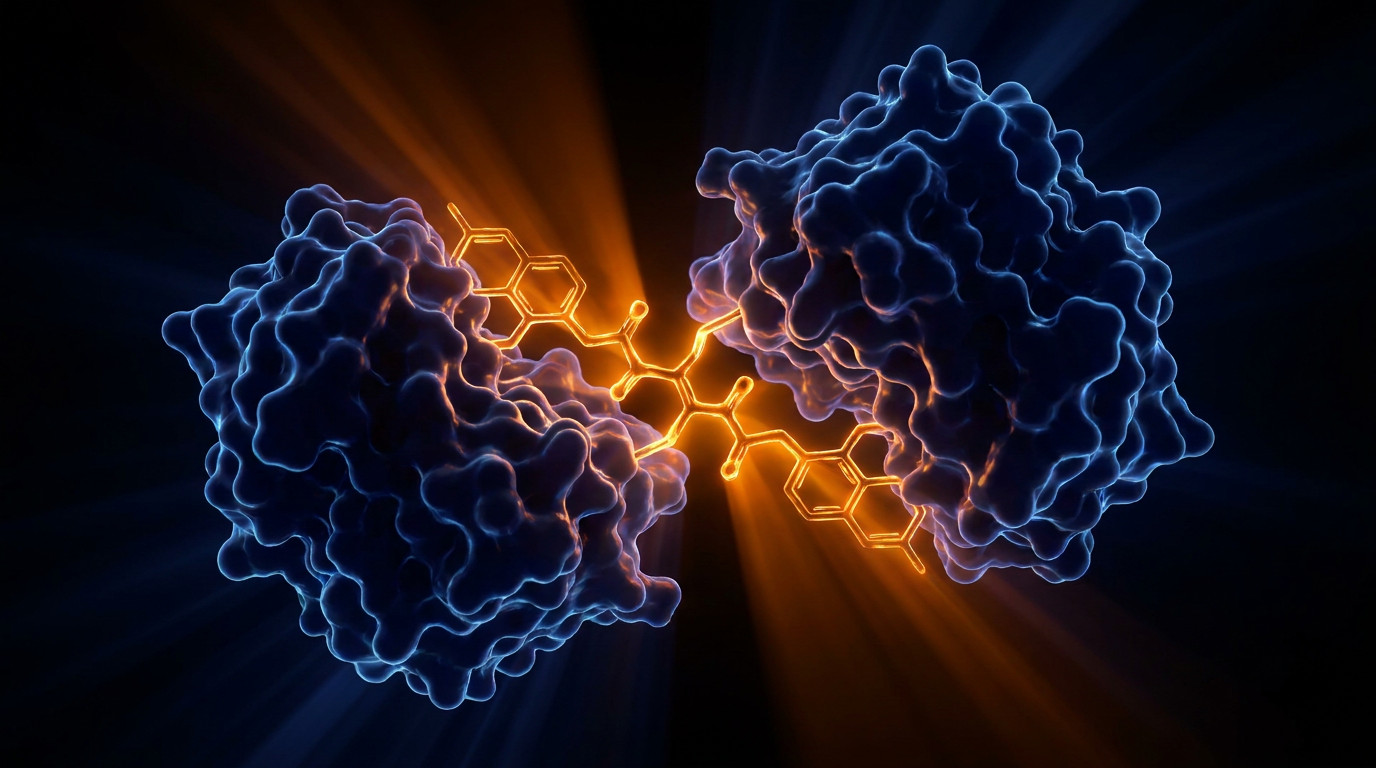
Molecular glues represent a paradigm shift in drug discovery. Instead of inhibiting a protein's active site, they act as chemical matchmakers. The newly discovered compound, optimized as dHuR-2, forces the HuR protein to bind with Cereblon (CRBN), a component of the cell's natural E3 ubiquitin ligase system.[1][2]
Cryo-electron microscopy revealed that the molecular glue uses a benzofuran core to bridge the gap between CRBN and HuR. Once this unnatural ternary complex is formed, the system tags HuR with a chain of ubiquitin molecules. This acts as a molecular "kiss of death," directing the cell's proteasome to shred the HuR protein into harmless peptides.[1][2]

The genetic consequences of destroying HuR are profound. The Nature study provides strong evidence that HuR normally binds to a specific sequence within the BRAF pre-mRNA. When HuR is degraded, the alternative splicing of the BRAF genetic instructions is severely altered, specifically causing the skipping of exon 18.[1][6]
The Nature study provides strong evidence that HuR normally binds to a specific sequence within the BRAF pre-mRNA.
This splicing error results in a truncated, highly unstable version of the BRAF protein that is incapable of driving tumor growth. Simultaneously, the degradation of HuR lowers the expression of EGFR, effectively shutting down the tumor's primary escape route and preventing the MAPK pathway from reactivating.[1][2]
Preclinical evidence demonstrates the potency of this approach. In patient-derived xenograft (PDX) models—where human colorectal tumors are grown in mice—the molecular glue showed significant anti-tumor activity on its own.[1][3]
Crucially, unbiased CRISPR screening and in vivo tests revealed that combining the HuR degrader with existing BRAF, EGFR, or MEK inhibitors creates a massive synergistic effect. The combination therapy suppressed tumor progression far more effectively than any single agent, offering a clear strategy to overcome acquired drug resistance.[1][2]

The evidence has already catalyzed clinical translation. Based on the discovery of dHuR-2, Degron Therapeutics developed a clinical-grade molecular glue candidate named DEG6498.[2][5]
This compound has received Investigational New Drug (IND) clearance from both the U.S. Food and Drug Administration and China's National Medical Products Administration. It marks a significant milestone as the first molecular glue targeting an RNA-binding protein to reach clinical development.[2][5]
A Phase 1 clinical trial is currently underway to evaluate the safety, tolerability, and preliminary efficacy of DEG6498. The study is enrolling patients with advanced solid tumors, specifically targeting those with BRAF-mutant colorectal cancer who have exhausted standard treatment options.[2][4]
Despite the robust preclinical data, transparent uncertainty remains regarding the drug's future in humans. Phase 1 trials are designed primarily to assess safety and toxicity. Because HuR is a fundamental RNA-binding protein that stabilizes various mRNAs in healthy cells, systemic degradation could potentially yield unforeseen off-target effects or dose-limiting toxicities.[4][6]
If DEG6498 proves safe and effective, the implications extend far beyond colorectal cancer. The successful degradation of HuR validates the molecular glue platform as a viable strategy for targeting the vast universe of RNA-binding proteins, potentially unlocking treatments for dozens of previously "undruggable" genetic drivers of disease.[3][6]
How we got here
Pre-2026
Researchers identify HuR as a key driver of cancer drug resistance, but fail to develop traditional small-molecule inhibitors against it.
Early 2026
Scientists screen over 10,000 compounds to identify a molecular glue capable of binding HuR to the cellular degradation machinery.
June 10, 2026
The discovery and mechanism of the HuR molecular glue are published in the journal Nature.
June 2026
The clinical candidate DEG6498 receives FDA and NMPA clearance to begin Phase 1 human trials.
Viewpoints in depth
Molecular Biologists
Focus on the mechanism of targeted protein degradation and the breakthrough of drugging RNA-binding proteins.
For molecular biologists, the significance of this study extends far beyond a single cancer type. RNA-binding proteins like HuR have long been considered the 'undruggable' dark matter of the proteome because they lack the deep, well-defined binding pockets that traditional small-molecule drugs require. By proving that molecular glues can successfully hijack the cell's ubiquitin-proteasome system to degrade these flat, elusive targets, researchers have validated a platform that could theoretically be adapted to target hundreds of other disease-driving proteins previously thought to be out of reach.
Clinical Oncologists
Emphasize the potential to overcome rapid drug resistance in patients with BRAF-mutant colorectal cancer.
From a clinical perspective, the excitement centers on breaking the cycle of acquired resistance. Oncologists frequently see BRAF-mutant colorectal tumors initially respond to targeted inhibitors, only to rapidly bypass the blockade via EGFR feedback loops within four to six months. Because the HuR degrader fundamentally alters the alternative splicing of BRAF and simultaneously lowers EGFR expression, it attacks the tumor's escape mechanism at the genetic level. Oncologists view the profound synergy seen in combination therapies as a highly promising strategy to achieve durable, long-term remission in patients who currently have dismal prognoses.
Drug Discovery Sector
View this as a validation of the molecular glue platform to unlock previously inaccessible therapeutic targets.
Industry analysts and biotech researchers view the rapid progression of DEG6498 from laboratory discovery to FDA Phase 1 trials as a major milestone for the targeted protein degradation field. The drug discovery sector has invested heavily in molecular glues and PROTACs (proteolysis targeting chimeras) over the last decade. Successfully advancing a first-in-class degrader against an RNA-binding protein into human trials signals that the technology is maturing, potentially opening the floodgates for new biotech investments and pipeline expansions aimed at genetically complex, treatment-resistant cancers.
What we don't know
- Whether the systemic degradation of HuR will cause unforeseen toxicities in healthy human tissues during Phase 1 trials.
- How long the anti-tumor effects will last in human patients before the cancer potentially develops a new resistance mechanism.
- Whether this specific molecular glue approach will be equally effective in other cancers that overexpress HuR.
Key terms
- Molecular Glue Degrader
- A type of drug that acts as a matchmaker, forcing a harmful protein to bind with the cell's garbage disposal machinery so it can be destroyed.
- BRAF Mutation
- A specific error in the BRAF gene that causes cells to grow and divide uncontrollably, driving certain aggressive cancers.
- Proteasome
- A protein complex inside cells that acts as a recycling center, breaking down damaged or unneeded proteins.
- Ubiquitination
- The process of attaching ubiquitin molecules to a protein, which flags it for destruction by the proteasome.
- Alternative Splicing
- A cellular process that allows a single gene to produce multiple different proteins by cutting and pasting the genetic instructions in different ways.
Frequently asked
What is a molecular glue?
A small molecule that forces two proteins together inside a cell, typically connecting a disease-causing protein to the cell's natural waste disposal system.
Why is BRAF-mutant colorectal cancer hard to treat?
The tumors quickly adapt to targeted therapies by using feedback loops to reactivate growth signals, usually leading to drug resistance within four to six months.
What does the HuR protein do?
It is an RNA-binding protein that stabilizes the genetic instructions for tumor growth and resistance; until now, it was considered "undruggable" because it lacks binding pockets for standard drugs.
Is this treatment available to patients yet?
Not yet. The clinical candidate, DEG6498, has just entered Phase 1 clinical trials to test its safety in humans.
Sources
Source coverage
6 outlets
3 viewpoints surfaced






[1]NatureMolecular Biologists
Molecular glue degraders of HuR suppress BRAF-mutant colorectal cancer
Read on Nature →[2]ShanghaiTech UniversityMolecular Biologists
Researchers breakthrough 'undruggable' bottleneck with novel HuR molecular glue
Read on ShanghaiTech University →[3]Upbeat BytesDrug Discovery Sector
Molecular glue degraders of HuR suppress BRAF-mutant colorectal cancer
Read on Upbeat Bytes →[4]ClinicalTrials.govClinical Oncologists
A Phase 1 Study to Evaluate the Safety and Efficacy of DEG6498 in Advanced Solid Tumors
Read on ClinicalTrials.gov →[5]Degron TherapeuticsDrug Discovery Sector
DEG6498: First-in-class HuR Molecular Glue Degrader
Read on Degron Therapeutics →[6]Factlen Editorial TeamClinical Oncologists
Synthesis by Factlen editorial team
Read on Factlen Editorial Team →
More in science
See all 55 stories →Neural Circuits
How the Brain Physically Stores Recent History to Shape Immediate Decisions
5 sources
Interoception
The 'Sixth Sense' Transforming Mental Health: How Interoception Rewires the Brain
8 sources

Neutrino Physics
JUNO Underground Observatory Releases First Data, Achieving Record Precision on 'Ghost Particles'
6 sources

Cellular Aging
Sleep and Exercise Can Reprogram Mutant Blood Cells to Prevent Heart Disease
6 sources

Every angle. Every day.
Get science stories with full source coverage and perspective breakdowns delivered to your inbox.