
How the Brain Physically Stores Recent History to Shape Immediate Decisions
A breakthrough in whole-brain imaging has revealed a specialized "attractor network" in the brain that holds onto recent experiences to guide future choices, solving a long-standing mystery about the physical mechanics of intuition and bias.
By Factlen Editorial Team
- Systems Neuroscientists
- Focus on physically mapping the exact cellular circuits and anatomical pathways that drive behavior.
- Computational Biologists
- View the discovery as validation of mathematical models regarding how biological networks process sequential information.
- Clinical Neurologists
- Interested in how these deep-brain holding patterns might explain or eventually treat repetitive behavioral disorders in humans.
What's not represented
- · Cognitive Psychologists
- · AI Architecture Developers
Why this matters
Understanding the exact physical circuitry of decision-making bias could eventually lead to better treatments for cognitive disorders, addiction, and conditions where the brain becomes trapped in repetitive behavioral loops.
Key points
- Scientists have mapped the exact physical circuit that causes our immediate past to bias our next decision.
- Using transparent zebrafish, researchers watched the entire brain operate at the cellular level in real-time.
- The brain uses an 'attractor network'—a loop of sustained neural activity—to hold onto recent history.
- This historical data is stored in the thalamus and sent to the brainstem to influence motor decisions.
- The discovery validates long-held mathematical theories about how biological systems process sequential information.
Every decision you make is subtly weighted by the one you made just moments before. Whether you are driving a car, playing a sport, or simply choosing which way to look, your brain maintains a running tally of recent history to predict what will happen next. Neuroscientists call this "history bias," and it is a fundamental feature of animal intelligence that allows creatures to navigate a continuous, predictable world rather than treating every second as an entirely new, isolated event.[5]
For decades, the physical mechanism behind this phenomenon remained a mystery. Researchers knew that the brain must have a way to temporarily store the immediate past without committing it to long-term memory, but finding the exact circuit responsible was like trying to find a specific conversation in a crowded stadium. To map a process that spans sensory input, memory holding, and motor output, scientists needed to watch an entire brain operating at once, down to the individual neuron.[2][5]
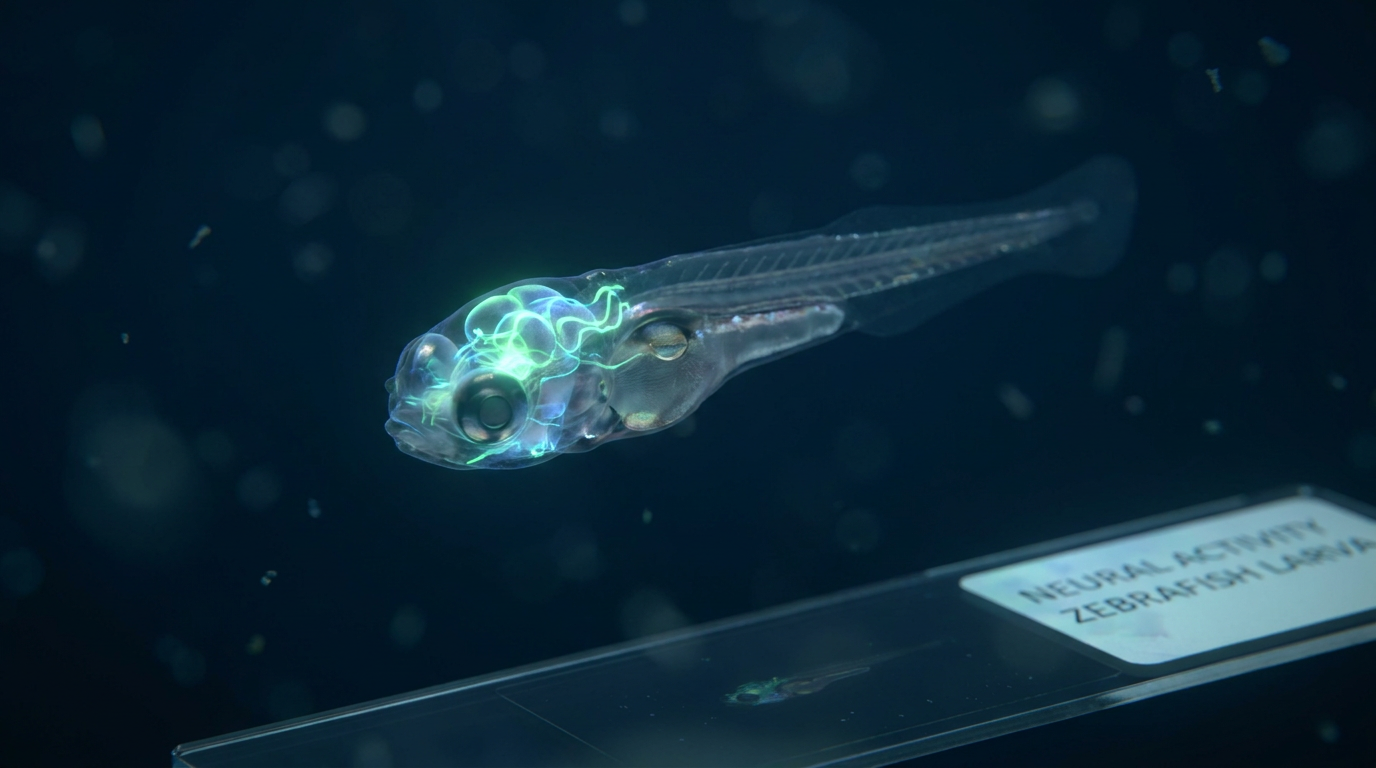
Enter the larval zebrafish. At just a few millimeters long, these tiny aquatic creatures possess a fully functioning vertebrate brain containing roughly 100,000 neurons. Crucially, they are completely transparent. By genetically modifying the fish so that their neurons emit a fluorescent glow when they fire, researchers can place them under a specialized microscope and record the activity of nearly every cell in their brain simultaneously while the fish makes active decisions.[3]
A landmark study published this week in the journal Nature has utilized this exact technique to finally isolate the physical machinery of history bias. By tracking whole-brain, cellular-resolution activity, the research team discovered a hierarchical network connecting the thalamus to the brainstem that physically encodes recent history and shapes behavioral bias in real-time.[1]
The core of the evidence pack rests on the discovery of an "attractor network" operating within this pathway. In neuroscience and computational biology, an attractor network is a specific type of neural architecture where cells are wired together in loops. Once activated, these loops sustain their own firing, maintaining a specific state or "memory" even after the original stimulus has vanished. It is the brain's equivalent of a holding pattern.[1][4]

To understand an attractor network, imagine a landscape with several deep valleys. If you drop a ball onto this landscape, it will roll into one of the valleys and stay there until a strong enough force pushes it out. In the brain, these "valleys" represent specific recent experiences or choices. The Nature study provides direct visual evidence that groups of neurons in the zebrafish brain settle into these sustained states, physically holding onto the memory of a recent event.[2][4]
The researchers mapped this activity to a specific anatomical hierarchy. The process begins in the thalamus, a deep-brain structure often described as the brain's sensory relay station. But the imaging data reveals the thalamus does more than just pass information along; it actively integrates the history of what the fish has just seen and done, acting as the primary storage site for the attractor network's "valleys."[1]
The researchers mapped this activity to a specific anatomical hierarchy.
From the thalamus, this historical bias is transmitted down to the brainstem, the region responsible for executing basic motor commands. The brainstem receives the immediate sensory input of the present moment, but it also receives the weighted historical context from the thalamus. The final decision—whether the fish darts left or right—is a mathematical collision of what is happening right now and what the thalamus remembers from a few seconds ago.[1][3]

The evidence for this mechanism is remarkably robust. By using targeted lasers, the researchers could artificially stimulate specific neurons in the thalamus, effectively "writing" a fake history into the fish's brain. When they did this, the fish's subsequent decisions were biased exactly as the attractor network model predicted, proving that this specific circuit is the causal engine of history-biased behavior.[1]
Computational biologists have long theorized that such networks must exist to explain how biological systems achieve smooth, continuous behavior. The mathematical models of history-dependent choice behavior perfectly match the physical firing patterns observed in the zebrafish. This alignment between theoretical math and biological reality is a major victory for systems neuroscience.[4]
However, the evidence pack carries transparent uncertainties. The most significant limitation is the leap from zebrafish to humans. While the thalamus and brainstem are ancient, highly conserved structures present in all vertebrates, the human brain possesses a massive cerebral cortex that adds layers of top-down control. It remains unknown exactly how our advanced cortical regions interact with or override this deep-brain attractor network during complex, conscious decision-making.[2][5]

Furthermore, the current imaging technology, while revolutionary, is restricted to observing short-term history windows—typically just a few seconds. Researchers do not yet know if the same thalamus-brainstem circuit is responsible for biases that stretch over minutes or hours, or if those longer timeframes are handed off to different memory systems entirely.[3][5]
Despite these limitations, the implications of the discovery are vast, particularly for the field of artificial intelligence. Modern AI systems, such as Recurrent Neural Networks (RNNs), use mathematical approximations of attractor dynamics to process sequential data like language. Seeing how a biological brain optimizes this exact architecture could inspire more efficient, less energy-intensive artificial neural networks.[4][5]
Clinically, mapping this circuit opens new doors for understanding psychiatric and neurological conditions. Disorders characterized by repetitive behaviors, such as Obsessive-Compulsive Disorder (OCD), or conditions involving entrenched behavioral loops, like addiction, may involve attractor networks that have become too "deep," trapping the brain's decision-making process in a single valley.[2][5]
By proving that history bias is not just a psychological concept but a physical, observable circuit, this research fundamentally changes how we view decision-making. It demonstrates that our choices are never truly made in isolation; they are the continuous, flowing output of a brain that is always holding onto the immediate past to navigate the immediate future.[1][5]

How we got here
1980s
Computational biologists first propose 'attractor networks' as a mathematical model for how neural systems might store short-term memories.
2010s
Advancements in fluorescent calcium imaging allow scientists to begin recording large populations of neurons in living animals.
Early 2020s
Whole-brain imaging of larval zebrafish becomes sophisticated enough to track behavior and cellular activity simultaneously.
June 2026
Researchers publish definitive evidence in Nature mapping the specific thalamus-brainstem attractor network responsible for history bias.
Viewpoints in depth
Systems Neuroscientists
Focus on physically mapping the exact cellular circuits and anatomical pathways that drive behavior.
For systems neuroscientists, the brain is a wiring diagram waiting to be solved. This camp views the Nature study as a monumental technical achievement. For decades, they have had to infer deep-brain connectivity through indirect measures or by studying dead tissue. The ability to watch a live, behaving animal and trace a decision from the sensory input, through the thalamic holding pattern, and down to the brainstem's motor execution represents the gold standard of their field. They argue that understanding these fundamental, conserved circuits in simple organisms is the only reliable way to eventually reverse-engineer the staggering complexity of the human brain.
Computational Biologists
View the discovery as validation of mathematical models regarding how biological networks process sequential information.
Computational biologists approach the brain as an organic computer. Long before this imaging study was conducted, this camp used complex mathematics to predict that the brain *must* use attractor dynamics to smooth out its behavior over time. To them, the physical discovery of the thalamus-brainstem network is a triumphant validation of theoretical neuroscience. They are particularly interested in the exact parameters of the network—how fast the 'memory' decays, how much energy the sustained firing requires, and how these biological algorithms might be translated into more efficient code for artificial intelligence systems.
Clinical Neurologists
Interested in how these deep-brain holding patterns might explain or eventually treat repetitive behavioral disorders in humans.
While acknowledging the gap between a microscopic fish and a human patient, clinical neurologists look at attractor networks through the lens of pathology. If a healthy brain uses these networks to temporarily hold onto a recent choice, what happens when the network malfunctions? This camp hypothesizes that conditions characterized by an inability to break a behavioral loop—such as severe OCD, Tourette's syndrome, or substance addiction—might involve attractor networks that have become pathologically 'deep' or rigid. Discovering the exact neurotransmitters and pathways involved in these circuits provides new, highly specific targets for future pharmacological or deep-brain stimulation therapies.
What we don't know
- How the advanced human cerebral cortex interacts with or overrides this deep-brain attractor network.
- Whether the same circuit is responsible for history biases that stretch over minutes or hours, rather than just seconds.
- Exactly how the network resets itself after a decision is made to prepare for the next sensory input.
Key terms
- History Bias
- The tendency for an animal or human's immediate past experiences or choices to subconsciously influence their very next decision.
- Attractor Network
- A mathematical and biological model of a neural circuit that settles into a stable, sustained pattern of activity, acting like a short-term memory buffer.
- Thalamus
- A deep-brain structure traditionally known as a sensory relay station, now shown to also integrate and store the immediate history of sensory events.
- Whole-brain Cellular-resolution Imaging
- A microscopic technique that allows scientists to simultaneously record the individual firing of nearly every single neuron in a living organism's brain.
Frequently asked
What is an attractor network?
It is a specific arrangement of neurons that loop together. Once triggered, they keep firing in a sustained pattern, acting as a short-term holding space for recent information.
Why do scientists use zebrafish for brain research?
Larval zebrafish are completely transparent and have relatively small brains (about 100,000 neurons), allowing researchers to watch every single brain cell fire in real-time under a microscope.
Does this apply to human brains?
Yes, the thalamus and brainstem are ancient structures shared by all vertebrates, including humans. However, human brains also have a large cortex that adds complex layers of conscious control over these basic circuits.
How could this help treat medical conditions?
Understanding how the brain physically gets 'stuck' in a behavioral loop could eventually help researchers develop targeted therapies for conditions like OCD or addiction.
Sources
Source coverage
5 outlets
3 viewpoints surfaced





[1]NatureSystems Neuroscientists
A thalamus–brainstem attractor network drives history-biased decisions
Read on Nature →[2]National Institutes of HealthClinical Neurologists
Attractor Dynamics in Neural Networks: Mechanisms and Functions
Read on National Institutes of Health →[3]Max Planck InstituteSystems Neuroscientists
Cellular-resolution imaging of the larval zebrafish brain
Read on Max Planck Institute →[4]arXivComputational Biologists
Computational models of history-dependent choice behavior in biological neural networks
Read on arXiv →[5]Factlen Editorial TeamClinical Neurologists
Synthesis by Factlen editorial team
Read on Factlen Editorial Team →
More in science
See all 55 stories →Targeted Protein Degradation
Scientists Develop 'Molecular Glue' to Destroy Undruggable Cancer Protein
6 sources
Interoception
The 'Sixth Sense' Transforming Mental Health: How Interoception Rewires the Brain
8 sources

Neutrino Physics
JUNO Underground Observatory Releases First Data, Achieving Record Precision on 'Ghost Particles'
6 sources
Cellular Aging
Sleep and Exercise Can Reprogram Mutant Blood Cells to Prevent Heart Disease
6 sources

Every angle. Every day.
Get science stories with full source coverage and perspective breakdowns delivered to your inbox.