
How Non-Invasive Technology is Revolutionizing Art History and Restoration
Advancements in multispectral imaging and macro X-ray fluorescence are allowing conservators to map the chemical composition and hidden layers of priceless artworks without ever touching the canvas. These non-destructive tools are uncovering lost paintings, revealing artists' hidden drafts, and transforming museum conservation into a public science.
By Factlen Editorial Team
- Conservation Scientists
- Prioritize the physical preservation, chemical stability, and material understanding of the artwork.
- Art Historians
- Value the technology for revealing the artist's creative process, hidden drafts, and verifying provenance.
- Museum Curators
- Focus on public engagement, using these technologies to tell compelling stories and demystify the conservation process.
What's not represented
- · Traditional Restorers
- · Private Art Collectors
Why this matters
By replacing destructive physical sampling with non-invasive light and X-rays, scientists are preserving priceless cultural heritage for future generations while uncovering hidden secrets and lost paintings that fundamentally rewrite art history.
Key points
- For centuries, analyzing the chemical makeup of a painting required extracting destructive physical samples from the canvas.
- Multispectral imaging (MSI) uses wavelengths from UV to infrared to peer through paint layers and reveal hidden underdrawings.
- Macro X-ray fluorescence (MA-XRF) maps the exact elemental composition of a canvas, identifying specific historical pigments.
- The Rijksmuseum's 'Operation Night Watch' is utilizing these tools and AI in a public glass chamber to restore Rembrandt's masterpiece.
- These non-invasive technologies allow researchers to discover hidden pentimenti and authenticate works without risking damage.
The traditional dilemma of art conservation has always been a paradox: to truly understand the history and material reality of a masterpiece, you often had to damage it. For centuries, analyzing the chemical composition of a specific pigment or understanding the sequence of an artist's brushstrokes required conservators to extract microscopic cross-sections directly from the canvas.[7]
This physical sampling, while yielding invaluable scientific data, inherently damaged the very cultural heritage it sought to protect. The extraction left microscopic craters in the paint layer, forcing conservators to carefully fill and retouch the sampled areas. But over the last decade, a quiet, high-tech revolution has transformed the conservation laboratory.[7]
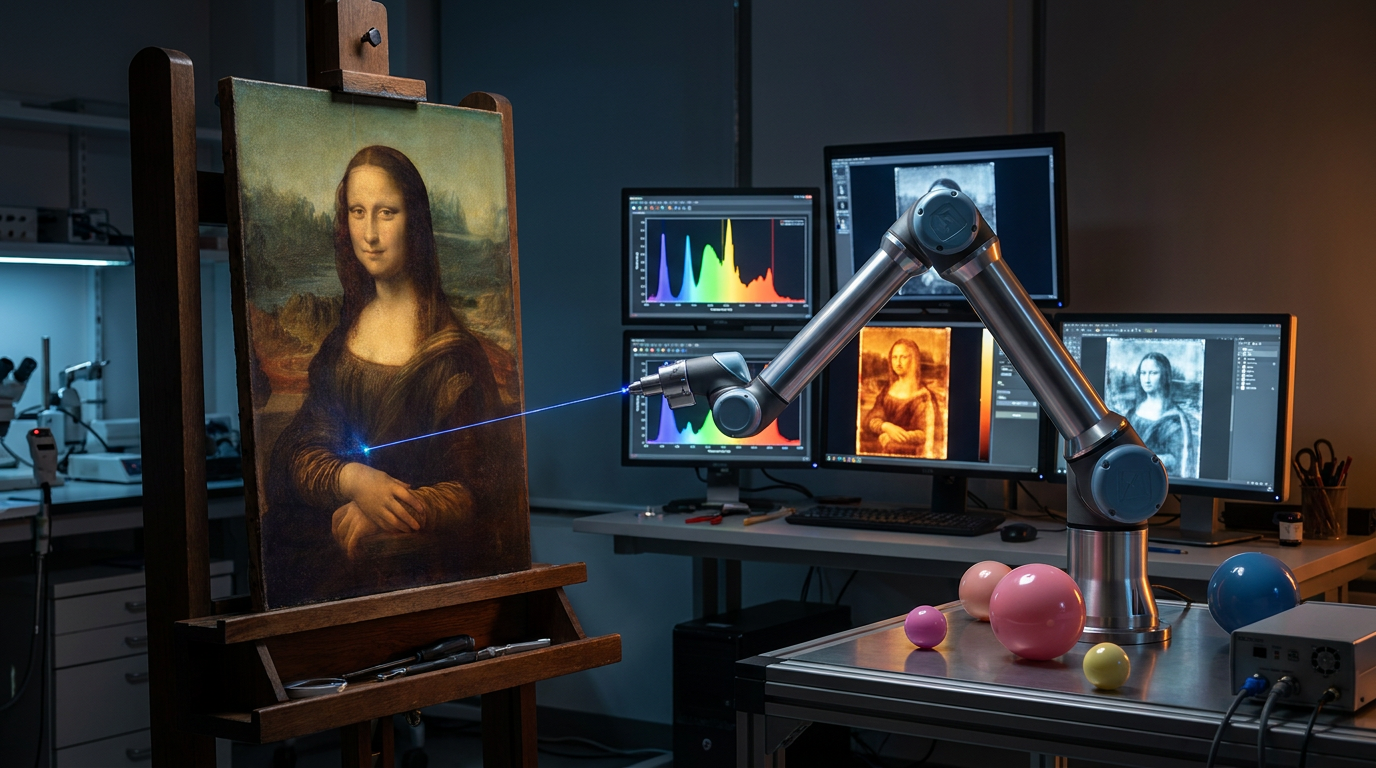
Armed with miniaturized particle accelerators, high-resolution spectral sensors, and aerospace-grade optics, researchers are now deploying a suite of non-invasive technologies that can peer through centuries of darkened varnish and thick oil paint without ever touching the artwork's fragile surface.[1][7]
The shift from scalpels to photons is fundamentally rewriting art history. By mapping the invisible stratigraphic layers of a painting, conservators are uncovering hidden underdrawings, detecting long-forgotten alterations made by the artists themselves, and identifying the exact chemical signatures of historical pigments with unprecedented precision.[2][7]
At the forefront of this non-destructive movement is Multispectral Imaging (MSI). This advanced technique captures the artwork across multiple regions of the electromagnetic spectrum, extending far beyond the narrow band of visible light that human eyes can detect.[6]
During an MSI scan, the painting is illuminated with specific wavelengths ranging from ultraviolet (UV) to near-infrared (IR). Because different historical materials absorb, reflect, or fluoresce light differently at various wavelengths, the resulting data cube allows researchers to tentatively identify pigments and map out later, undocumented retouching efforts by previous restorers.[6]

Infrared light, for instance, is particularly adept at penetrating the upper layers of oil paint. It passes through the pigments and reflects off the white ground layer typically applied to the raw canvas. If the artist sketched an initial composition using carbon-based materials like charcoal or graphite, those lines absorb the infrared light, rendering the hidden "underdrawing" clearly visible to the camera.[6]
While MSI relies on the reflection and absorption of light, another breakthrough technology—Macro X-ray Fluorescence (MA-XRF)—operates at the atomic level. Originally developed using massive, building-sized synchrotron facilities, MA-XRF has now been miniaturized into mobile scanning rigs that can be wheeled directly into museum galleries.[4]
The mechanism behind MA-XRF is elegant and highly effective: a focused beam of X-rays sweeps systematically across the surface of the painting. When these X-rays strike the atoms within the pigments, they eject inner-shell electrons. As outer-shell electrons fall in to fill the resulting gaps, they emit secondary X-rays—a phenomenon known as fluorescence.[4]
The mechanism behind MA-XRF is elegant and highly effective: a focused beam of X-rays sweeps systematically across the surface of the painting.
Crucially, every chemical element emits a unique, identifiable fluorescent energy signature. By capturing these emissions, the MA-XRF scanner generates highly detailed elemental maps of the entire canvas. A map of lead might reveal the artist's initial blocking of light and shadow using lead white, while a map of copper or mercury can pinpoint the exact locations of specific historical blues and reds.[4]
Because X-rays penetrate the entire stratigraphic depth of the painting, MA-XRF can reveal entirely different compositions buried deep beneath the surface. Conservators frequently discover "pentimenti"—the artist's own modifications and changes of mind—or even entirely different, abandoned paintings on canvases that were scraped down and reused to save money.[4]

The most spectacular demonstration of these combined technologies is currently unfolding in Amsterdam. In 2019, the Rijksmuseum launched "Operation Night Watch," the most comprehensive research and conservation project ever undertaken on Rembrandt van Rijn's colossal 1642 masterpiece.[3]
Rather than sequestering the massive, heavily guarded canvas in a hidden, off-site laboratory, the Rijksmuseum constructed a custom, climate-controlled glass chamber directly within the Gallery of Honour, allowing the public to watch the multi-year restoration process live.[5]
Operation Night Watch deployed an unprecedented arsenal of non-invasive tools. Researchers utilized high-resolution digital imaging, MA-XRF, and artificial intelligence to map the painting's chemical degradation, understand exactly how Rembrandt mixed his famous impasto layers, and safely guide the removal of yellowed 20th-century varnish.[5]
The project even utilized AI neural networks, trained on Rembrandt's specific brushstrokes and a 17th-century copy of the painting by Gerrit Lundens, to digitally reconstruct sections of the canvas that were infamously cut away in 1715 to fit the painting through a doorway at Amsterdam's City Hall.[5]

Beyond large-scale masterpieces, non-invasive technology is proving equally vital for fragile antiquities that cannot withstand any physical stress. Researchers recently utilized a combination of infrared thermography, MSI, and MA-XRF to examine a delicate 1836 post-Byzantine wooden panel icon.[2]
This multidisciplinary approach successfully mapped areas of severe varnish degradation and revealed hidden, faded inscriptions on the icon without requiring a single physical sample, proving that comprehensive structural analysis can be achieved with zero physical impact on the artifact.[2]
Despite these massive leaps, the technology introduces new logistical challenges. The primary hurdle is data management; a single high-resolution MA-XRF scan of a large painting can generate terabytes of complex spectral data, requiring advanced computational algorithms and specialized software to interpret accurately.[7]
Furthermore, while these tools provide an unprecedented, atomic-level map of the artwork's current state, they cannot halt the relentless march of entropy. Chemical degradation, pigment fading, and canvas weakening are ongoing physical processes that technology can document and help mitigate, but not entirely arrest.[7]
Nevertheless, the era of non-invasive analysis has permanently altered the landscape of cultural preservation. By illuminating the hidden depths of our shared artistic heritage, these technologies ensure that the masterpieces of the past can be fully understood, authenticated, and protected for centuries to come.[7]
How we got here
2008
Macro X-ray fluorescence (MA-XRF) is first introduced for art analysis using large-scale synchrotron facilities.
2015
Mobile, commercially available MA-XRF scanners are introduced, allowing in-situ museum analysis.
2019
The Rijksmuseum launches Operation Night Watch, the largest public restoration project in history.
2021
AI neural networks are used to successfully reconstruct the missing edges of The Night Watch.
Viewpoints in depth
Conservation Scientists
A focus on the material reality and chemical stability of the artwork.
For conservation scientists, a painting is a complex chemical system undergoing continuous, slow-motion degradation. They argue that understanding the exact chemical pathways—such as the saponification of lead-tin yellow or the fading of organic lakes—is the only way to design proper climate controls and varnishes. The massive data cubes generated by MA-XRF are their primary text, providing an atomic-level baseline that allows them to monitor the physical health of the object over decades.
Art Historians
A focus on the creative process and the artist's original intent.
Art historians view these scanning technologies as a direct window into the artist's mind. For them, the revelation of a charcoal underdrawing or a changed hand position (a pentimento) shifts the focus from the final, polished masterpiece to the human struggle and iteration that produced it. These hidden layers help scholars authenticate disputed works, trace the evolution of an artist's style, and understand the historical context of how studio assistants collaborated with master painters.
Museum Curators
A focus on demystifying science and engaging the public.
Curators view projects like 'Operation Night Watch' as a vital tool for institutional transparency and public education. By putting the conservation process in a glass box in the middle of a gallery, they transform a static viewing experience into an active, unfolding scientific drama. This approach not only keeps star attractions on display during multi-year restorations but also draws in new audiences who are fascinated by the intersection of classical art and cutting-edge technology.
What we don't know
- How to efficiently process, store, and standardize the massive terabytes of spectral data generated by a single high-resolution MA-XRF scan.
- Whether AI reconstructions of lost painting sections can ever truly capture the original artist's exact intent and emotional nuance.
Key terms
- Multispectral Imaging (MSI)
- An imaging technique that captures an object across multiple wavelengths of light, including UV and infrared, to reveal details invisible to the human eye.
- Macro X-ray Fluorescence (MA-XRF)
- A non-invasive scanning method that uses X-rays to map the exact elemental composition (like lead or copper) across the surface of an artwork.
- Underdrawing
- The initial sketch or preparatory drawing made by an artist on the canvas before applying the final layers of paint.
- Stratigraphy
- In art conservation, the study of the distinct layers of materials—such as canvas, ground, paint, and varnish—that make up a painting.
- Pentimento
- A visible trace of an earlier painting beneath a layer or layers of paint on a canvas, showing that the artist changed their mind.
Frequently asked
Does X-ray scanning damage the paintings?
No. The radiation doses used in Macro X-ray Fluorescence (MA-XRF) are carefully calibrated to be extremely low, ensuring the chemical bonds of the pigments and canvas are not altered or degraded.
What is a pentimento?
A pentimento is an alteration in a painting, indicating that the artist changed their mind during the creative process. These hidden earlier drafts are often revealed by infrared or X-ray imaging.
Can AI actually paint like Rembrandt?
AI cannot replace the artist, but neural networks can be trained on high-resolution scans of an artist's specific brushstrokes and color mixing to digitally reconstruct missing or damaged sections with high historical accuracy.
Why do museums restore paintings in public?
Public restorations, like the Rijksmuseum's Operation Night Watch, educate visitors about the complex science of conservation while ensuring that the museum's most famous masterpieces remain on display during multi-year projects.
Sources
Source coverage
7 outlets
3 viewpoints surfaced







[1]Smithsonian MagazineArt Historians
New Technology Reveals Invisible Details in Historic Artworks
Read on Smithsonian Magazine →[2]MDPI HeritageArt Historians
A Multidisciplinary Non-Invasive Approach for the Examination of a Wooden Panel Painting
Read on MDPI Heritage →[3]RijksmuseumMuseum Curators
Operation Night Watch: The biggest ever study of Rembrandt's most famous painting
Read on Rijksmuseum →[4]Northwestern University Center for Scientific Studies in the ArtsConservation Scientists
Scanning macro X-ray fluorescence (MA-XRF)
Read on Northwestern University Center for Scientific Studies in the Arts →[5]My Modern MetMuseum Curators
Rijksmuseum Begins Second Phase of Restoring Rembrandt’s ‘The Night Watch’ in Public
Read on My Modern Met →[6]Cultural Heritage Science Open SourceConservation Scientists
Multispectral Imaging (MSI) in Art Conservation
Read on Cultural Heritage Science Open Source →[7]Factlen Editorial TeamConservation Scientists
Synthesis by Factlen editorial team
Read on Factlen Editorial Team →

Every angle. Every day.
Get culture stories with full source coverage and perspective breakdowns delivered to your inbox.