
Inside the Push to Make Video Games Accessible for All Players
The video game industry is undergoing a quiet revolution as accessibility shifts from an optional afterthought to a foundational pillar of game design. Driven by adaptive hardware, engine-level software tools, and standardized storefront tags, developers are dismantling the barriers that once locked disabled players out of digital worlds.
By Factlen Editorial Team
- Accessibility Advocates
- Organizations focused on removing barriers and standardizing inclusive design.
- Hardware & Software Developers
- Studios and engine creators treating accessibility as a core technical challenge.
- Disabled Gamers
- Players focusing on practical usability, hardware flexibility, and storefront transparency.
What's not represented
- · VR Hardware Manufacturers
- · Esports Tournament Organizers
Why this matters
Gaming is no longer just a pastime; it is a primary medium for social connection and cultural participation. By standardizing inclusive design, the industry is ensuring that millions of players with disabilities are no longer locked out of these shared digital experiences.
Key points
- Accessibility is now a foundational pillar of game design, shifting from post-launch patches to engine-level integrations.
- Hardware like the Xbox Adaptive Controller and Sony Access Controller allow players to build highly customized, accessible setups.
- Software features like High Contrast Mode are crossing into competitive multiplayer games, proving accessibility doesn't compromise fairness.
- Inclusive design benefits all players, a phenomenon known as the 'curb cut effect,' which improves overall user experience.
The stereotype of the 'default gamer' as an able-bodied individual is officially dead. In 2026, the video game industry is undergoing a quiet but profound revolution, shifting accessibility from an optional afterthought to a foundational pillar of game design. This movement is reshaping how interactive entertainment is built from the ground up. For decades, millions of players with motor, visual, auditory, or cognitive disabilities were effectively locked out of digital worlds due to rigid control schemes and inflexible user interfaces. Now, a powerful combination of adaptive hardware, engine-level software tools, and standardized digital storefront tags is systematically dismantling those barriers, allowing a broader demographic to participate in the cultural zeitgeist.[2][5][7]
Accessibility in modern gaming operates on two distinct but complementary fronts. The hardware layer involves physical controllers and peripherals that translate non-standard physical movements into recognizable game inputs. Meanwhile, the software layer encompasses the in-game settings—such as high-contrast visual modes, aim assist, and subtitle scaling—that developers code directly into the interactive experience. Microsoft's Xbox Adaptive Controller, originally released in 2018, served as the watershed moment for the hardware layer. Designed to look more like a sleek, flat hub than a traditional gamepad, it features two large, easily pressable buttons and 19 different input ports along the back. This open ecosystem allows players to plug in custom switches, foot pedals, and sip-and-puff devices to create a bespoke control scheme.[3][4][7]

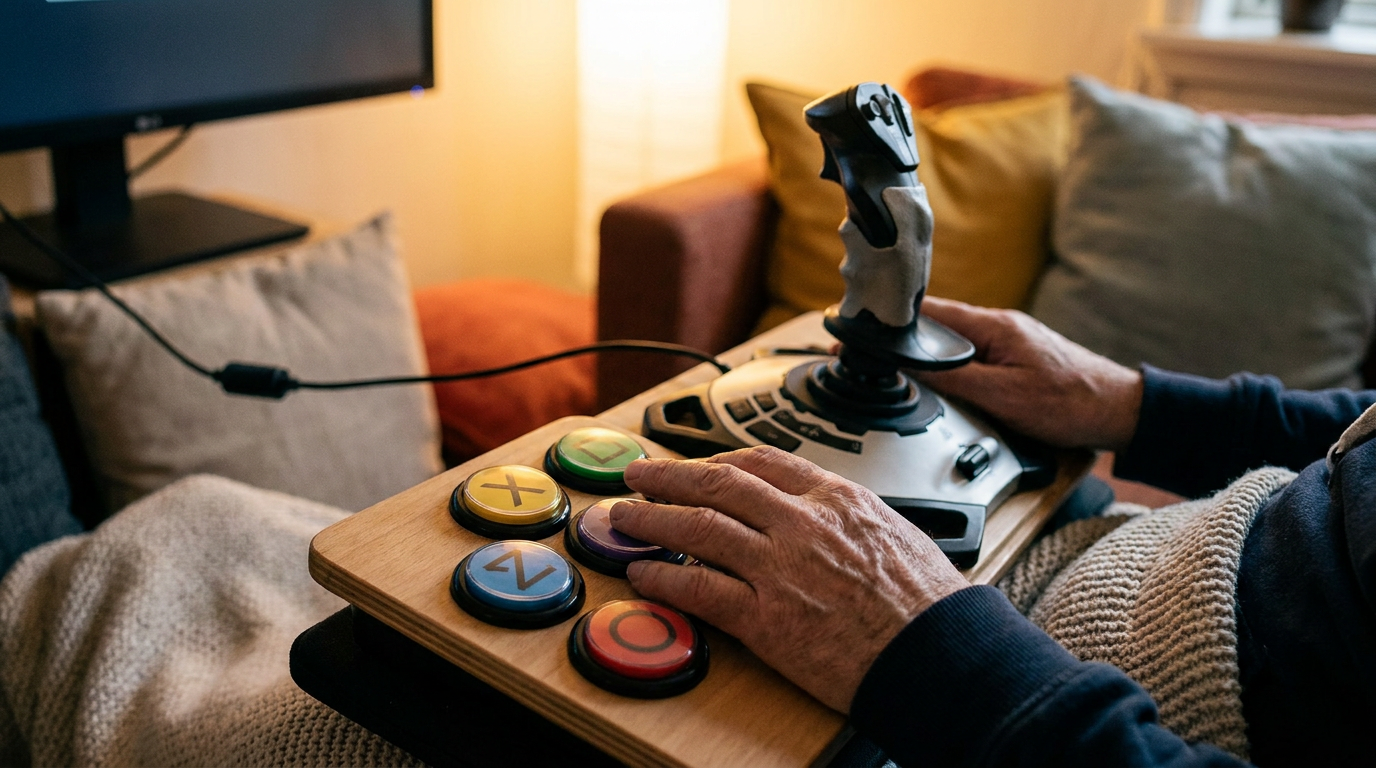
Microsoft recently expanded this inclusive ecosystem with the 2025 Xbox adaptive joystick upgrade. This specialized one-handed device can be easily mounted to wheelchairs, lap trays, or desks, providing precise directional control without requiring a two-handed grip. Furthermore, the company introduced 3D-printable thumbstick toppers to accommodate a wide variety of grip styles and specific mobility needs. Sony entered the accessible hardware space in late 2023 with the launch of the PlayStation Access Controller. Built in collaboration with accessibility experts, it features a highly customizable circular design equipped with swappable button caps and an adjustable joystick. The device is specifically engineered to rest flat on a surface, eliminating the need for players to hold a heavy controller in their hands.[3][4]
Disabled gamers have widely praised the Access Controller for its lightweight design and its wireless capability, which eliminates the frustrating tangle of cords often associated with complex adaptive setups. Players can secure the device to lap trays using Velcro and utilize the console's software to map multiple inputs to a single button press, drastically reducing the physical fatigue of extended play sessions. While adaptive hardware gets players in the door, the software layer ensures they can actually navigate and enjoy the game. The modern standard for in-game options was arguably set by Naughty Dog’s The Last of Us Part II, which launched with over 60 distinct accessibility settings. These included tailored profiles for vision, hearing, and motor accessibility, proving that complex narratives could be made universally playable.[3][4][7]
While adaptive hardware gets players in the door, the software layer ensures they can actually navigate and enjoy the game.
One of the most impactful software features to emerge from this push is High Contrast Mode. Originally utilized in single-player narrative games to highlight interactable elements and enemies in bright, solid colors against a muted gray background, the feature has proven essential for players with low vision. Recently, this tool has begun crossing over into the highly competitive multiplayer space. The release of EA Sports FC 26 made headlines by allowing High Contrast Mode to be used in online ranked matches. Players with visual impairments can now recolor team kits, referees, and the ball to stand out during chaotic moments. This implementation proved that robust accessibility tools can exist in competitive environments without compromising the fairness or integrity of the match.[2]

The push for inclusion has also moved upstream to the game engines themselves, where developers actually build the software. In 2025, the popular open-source Godot engine integrated AccessKit, a powerful translation layer. This integration allows game UI elements to communicate directly with system-level screen reader software, making it significantly easier for indie developers to make their menus blind-accessible. Similarly, Electronic Arts released IRIS as a real-time plugin for Unreal Engine, one of the industry's most widely used development platforms. This tool allows developers to detect potential photosensitivity risks—such as flashing lights or rapid pattern changes that could trigger seizures—directly within the engine. By catching these issues during development, studios avoid the need to patch dangerous visual bugs after launch.[2][6]
Finding accessible games used to require extensive external research and reliance on community forums. Now, the Accessible Games Initiative has established a set of standardized tags to clearly communicate a game's features. Digital storefronts like the Xbox store now display these tags prominently, allowing players to filter their purchases by features like 'colorblind-friendly,' 'single-stick movement,' or 'customizable subtitles' before spending their money. Advocates frequently emphasize that inclusive design ultimately benefits the entire player base, a phenomenon known as the 'curb cut effect.' Just as sidewalk curb cuts help parents with strollers as well as wheelchair users, gaming accessibility features help able-bodied players. Auto-sprint options help prevent repetitive strain injuries, while high-contrast modes assist players trying to game on small handheld screens in bright sunlight.[1][2][7]

The driving force behind many of these corporate advancements has been the relentless advocacy of the disabled gaming community. Organizations like AbleGamers and platforms like Can I Play That? have spent years consulting with studios, reviewing games strictly on their accessibility merits, and proving that disabled gamers represent a massive, underserved market. By establishing frameworks like the Accessible Player Experiences (APX) guidelines, these advocates have given developers a concrete roadmap for reducing cognitive load and increasing input flexibility. Their work has successfully shifted the industry's mindset from viewing accessibility as a charitable endeavor to recognizing it as a core component of user experience design.[1][7]
Despite these massive industry-wide strides, significant challenges remain on the horizon for the accessibility community. Retrofitting older legacy games with modern accessibility features is notoriously difficult and expensive, meaning decades of gaming history remain largely inaccessible to disabled players. Furthermore, the burgeoning virtual reality space is still grappling with how to make motion-heavy, room-scale experiences accessible to players with limited mobility or spatial awareness. Multiplayer titles also continue to face hurdles in balancing robust accessibility tools with aggressive anti-cheat software. Yet, the overall trajectory of the medium is incredibly clear: accessibility is no longer viewed as a niche request or a charitable addition, but as a fundamental metric of a video game's overall quality and commercial viability.[5][7]
How we got here
2018
Microsoft releases the Xbox Adaptive Controller, pioneering mass-market accessible gaming hardware.
2020
The Last of Us Part II launches with over 60 accessibility settings, setting a new software standard.
Dec 2023
Sony releases the PlayStation Access Controller, offering a highly customizable circular design.
2025
Major game engines like Godot and Unreal integrate built-in accessibility tools, shifting inclusive design upstream.
Viewpoints in depth
Accessibility Advocates
Organizations focused on removing barriers and standardizing inclusive design.
Groups like AbleGamers and Can I Play That? argue that gaming is a vital social lifeline, not just a solitary pastime. They emphasize that accessibility is not about making games 'easier' or compromising the creator's vision, but about removing unintentional barriers that lock players out. By championing frameworks like the Accessible Player Experiences (APX) guidelines, they provide developers with concrete strategies to reduce cognitive load and increase input flexibility, ensuring disabled players can fully participate in the cultural conversation of gaming.
Hardware & Software Developers
Studios and engine creators treating accessibility as a core technical challenge.
For developers, the focus has shifted from retrofitting old games to building inclusive tools directly into the foundational game engines. By integrating screen-reader support into Godot and real-time photosensitivity testing into Unreal Engine, developers are making accessibility a default part of the production pipeline. This upstream approach reduces the cost and technical debt associated with patching games post-launch, allowing studios to treat accessibility as a standard launch requirement rather than a 'nice-to-have' feature.
Disabled Gamers
Players focusing on practical usability, hardware flexibility, and storefront transparency.
While celebrating the release of mass-market devices like the Sony Access Controller, disabled gamers continue to highlight ongoing practical challenges. Issues such as accidental button presses on compact controllers, the high financial cost of purchasing multiple adaptive devices, and the need for standardized accessibility tags on digital storefronts remain top priorities. For this community, true accessibility means not only having the right hardware, but also having the information necessary to know if a game is playable before purchasing it.
What we don't know
- How the virtual reality (VR) industry will adapt motion-heavy, room-scale experiences for players with limited physical mobility.
- Whether competitive multiplayer games can universally balance robust software accessibility tools with aggressive anti-cheat systems.
Key terms
- APX Framework
- Accessible Player Experiences, a set of design patterns created by AbleGamers to help developers reduce cognitive load and increase input flexibility.
- Screen Reader
- Assistive software that reads aloud on-screen text and menu options for players who are blind or have low vision.
- High Contrast Mode
- A visual setting that simplifies graphics by highlighting important gameplay elements in bright colors against a muted background.
- Curb Cut Effect
- The phenomenon where features designed for people with disabilities, such as game subtitles or auto-sprint, end up benefiting the broader population.
Frequently asked
What is an adaptive video game controller?
An adaptive controller is a customizable hardware hub that allows players to plug in alternative inputs, such as foot pedals or large buttons, to play games without a standard gamepad.
What is High Contrast Mode in gaming?
High Contrast Mode is a software setting that mutes background colors to gray and highlights characters and interactable objects in bright, solid colors to assist players with low vision.
Are accessibility features allowed in multiplayer games?
Yes. Games like EA Sports FC 26 now allow visual accessibility tools like High Contrast Mode in competitive online matches to ensure players with low vision can compete fairly.
How do game engines support accessibility?
Modern game engines like Godot and Unreal Engine include built-in tools, such as screen-reader translation layers and real-time photosensitivity testing, allowing developers to build accessible features directly into the game.
Sources
Source coverage
7 outlets
3 viewpoints surfaced







[1]AbleGamersAccessibility Advocates
Accessible Player Experiences (APX) Framework
Read on AbleGamers →[2]Access-AbilityAccessibility Advocates
2025 Gaming Accessibility Advancements
Read on Access-Ability →[3]New MobilityDisabled Gamers
Sony Access Controller for PlayStation 5 Review
Read on New Mobility →[4]SociableDisabled Gamers
Advancements in gaming hardware for accessibility
Read on Sociable →[5]TestDevLabDisabled Gamers
What Does Accessibility Mean in Video Games?
Read on TestDevLab →[6]Keywords StudiosHardware & Software Developers
Ensuring Mobile Games Are Accessible
Read on Keywords Studios →[7]Factlen Editorial TeamHardware & Software Developers
Synthesis by Factlen editorial team
Read on Factlen Editorial Team →
Every angle. Every day.
Get gaming esports stories with full source coverage and perspective breakdowns delivered to your inbox.