
Why Communities Are Building 'Libraries of Things' to Share Tools, Tech, and Gear
A growing global movement is expanding the traditional library model to lend power tools, camping gear, and appliances, aiming to reduce household costs and environmental waste.
By Factlen Editorial Team
- Resource Sharing Advocates
- Focus on the environmental necessity of decoupling quality of life from hyper-consumption.
- Community Economists
- Emphasize household savings and the democratization of local wealth.
- Municipal Planners
- Focus on the logistical integration and long-term sustainability of the model.
What's not represented
- · Traditional hardware retailers and tool manufacturers whose sales models rely on individual ownership.
- · Insurance providers who underwrite the liability for community-shared equipment.
Why this matters
By shifting from individual ownership to community access, neighborhoods can save hundreds of thousands of dollars annually while drastically reducing the environmental toll of manufacturing rarely used goods.
Key points
- Libraries of Things allow communities to borrow tools, camping gear, and appliances instead of buying them.
- There are currently around 2,000 formal shared-resource libraries operating globally.
- The model saves households money and lowers barriers for local entrepreneurs and tradespeople.
- By maximizing the use of existing items, the movement drastically reduces manufacturing demand and e-waste.
- Libraries often serve as community hubs, fostering intergenerational skill-sharing and neighborhood trust.
- Scaling the model requires overcoming logistical hurdles related to storage space, liability, and maintenance.
The average household power drill is used for only a few minutes over its entire lifespan. For the rest of its existence, it sits idle in a garage or closet, representing a sunk financial cost and a permanent footprint of extracted metals, plastics, and carbon emissions. This paradox of hyper-consumerism—buying expensive items for temporary needs—has sparked a quiet but rapidly expanding counter-movement: the Library of Things.[6]
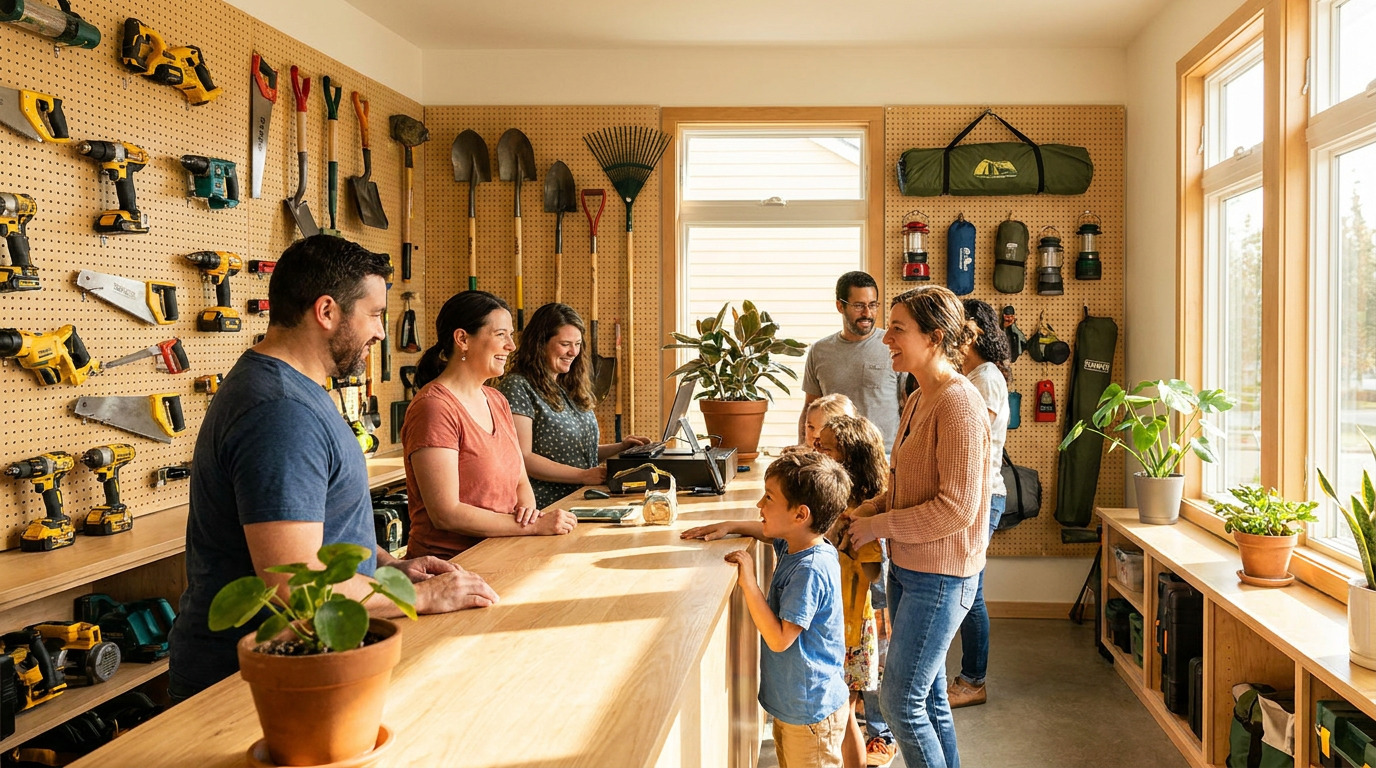
A Library of Things (LoT) applies the traditional public library model to physical objects. Instead of checking out a hardcover novel, members can borrow a pressure washer, a camping tent, a sewing machine, or a PA system for a weekend. While the concept of tool-lending libraries dates back to the 1970s, the modern iteration has evolved into a sophisticated network of community hubs and self-service kiosks.[1][5]
Today, there are roughly 2,000 formal Libraries of Things operating worldwide, alongside countless informal neighborhood sharing networks. They range from grassroots operations run out of shipping containers to sleek, app-enabled lockers integrated into traditional municipal library branches.[1][3]
The mechanics of these libraries rely on a mix of digital inventory management and community trust. Most operate on a membership model, often utilizing a sliding scale to ensure equitable access regardless of income. Digital platforms allow members to browse catalogs, reserve items online, and track availability in real-time, solving the logistical headaches that plagued earlier, paper-based sharing experiments.[1][5]

In the United Kingdom, the movement has seen significant modernization. Organizations like Library of Things UK have partnered with major tool manufacturers to stock high-quality, repairable equipment. They utilize self-service lockers placed in accessible community spaces, allowing residents to rent, collect, and return items with the ease of an automated parcel locker.[3]
The economic impact of these systems is substantial, particularly in an era of rising living costs. By providing low-cost or free access to equipment, libraries allow households to avoid taking on debt for infrequent, large purchases. In 2022, the Tool Library in Buffalo, New York, recorded over 14,000 transactions, saving its community an estimated $580,000 in new product purchases.[2]

Beyond household savings, these libraries act as incubators for local economic development. Access to professional-grade tools lowers the barrier to entry for tradespeople, landscapers, and independent entrepreneurs. A resident looking to start a small woodworking business or a neighborhood repair service can utilize the library's inventory to launch their enterprise without requiring thousands of dollars in upfront capital.[1][4]
Beyond household savings, these libraries act as incubators for local economic development.
Advocates often refer to this model as the "real sharing economy." Unlike corporate gig-economy platforms that extract profits from peer-to-peer rentals, community-owned libraries keep resources and wealth circulating locally. They democratize access to the means of production and maintenance, allowing neighborhoods to renovate homes and cultivate gardens collectively.[4]
The environmental stakes are equally pressing. At the heart of the global climate crisis is a rate of raw material extraction that far exceeds the planet's ability to regenerate. By radically increasing the utilization rate of a single manufactured item—allowing one drill to serve fifty households rather than one—Libraries of Things directly reduce the demand for new manufacturing, packaging, and global shipping.[2][5]
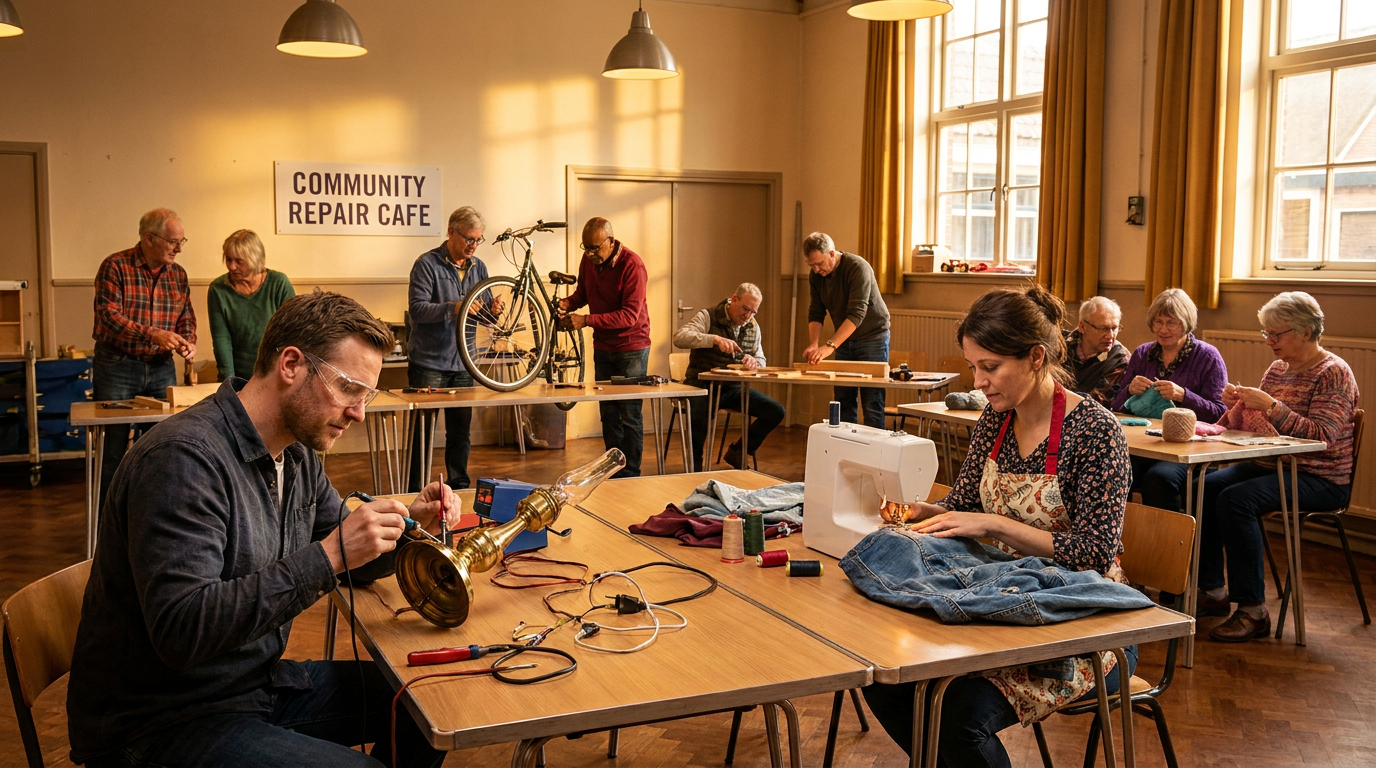
This reduction in consumption also addresses the growing crisis of municipal waste. When high-quality items are shared and maintained, fewer cheap, disposable alternatives end up in landfills. Many libraries amplify this impact by hosting "Repair Cafes," where volunteers teach residents how to fix broken electronics and textiles. In Buffalo, these complementary programs diverted over 4,200 pounds of waste from landfills in a single year.[2]

Perhaps the most unexpected benefit of the movement is its impact on the social fabric. In an increasingly isolated society, Libraries of Things serve as vital "Third Places"—community spaces outside of home and work where people can connect. They foster interactions that bridge demographic divides, creating environments where neighbors actually have to speak to one another.[4][5]
These spaces naturally facilitate intergenerational bonding and skill-sharing. It is common to see retired tradespeople volunteering their time to maintain the inventory, passing down their knowledge of carpentry or small-engine repair to younger generations who may have never held a power saw. This exchange of informal wisdom builds neighborhood resilience and a shared sense of pride.[4][6]
Despite their success, scaling these libraries presents significant operational challenges. The most pressing hurdle is physical space. Unlike books, table saws and extension ladders require substantial, secure, and accessible square footage. Finding affordable commercial real estate or convincing municipal governments to allocate public space remains a constant battle for organizers.[1][6]

Maintenance and liability also require careful management. Tools break, blades dull, and equipment must be regularly inspected to ensure user safety. This necessitates a dedicated team of skilled volunteers or paid staff, leading to the risk of burnout if the organizational burden falls on a small group of founders.[1][6]
To ensure long-term sustainability, advocates are pushing for shared resource infrastructure to be recognized and funded as a core municipal service, much like public parks or traditional libraries. As the movement matures, the vision is clear: a future where every neighborhood has access to a collective inventory, proving that communities can live richer lives while owning far less.[1][2][6]
How we got here
1979
The Berkeley Public Library establishes one of the first and longest-running municipal tool lending libraries in the United States.
2010
The West Seattle Tool Library launches, pioneering digital inventory tracking to manage thousands of shared items.
2014
A grassroots experiment in London popularizes the specific term 'Library of Things', expanding the concept beyond just tools.
2022
The Buffalo Tool Library records over 14,000 transactions, proving the massive economic impact of the model at scale.
Present
The movement expands to roughly 2,000 formal locations globally, increasingly utilizing smart lockers and municipal partnerships.
Viewpoints in depth
Resource Sharing Advocates
Focus on the environmental necessity of decoupling quality of life from hyper-consumption.
This camp argues that the current model of individual ownership is ecologically unsustainable. They point out that manufacturing millions of items that sit idle for 99% of their lifespans drives unnecessary mining, emissions, and eventual landfill waste. For these advocates, the Library of Things is a critical mechanism for transitioning to a circular economy, where the focus shifts from producing more goods to maximizing the utility of the goods that already exist.
Community Economists
Emphasize household savings and the democratization of local wealth.
Economic advocates view shared resource infrastructure as a tool for financial equity. They highlight how low-income households are disproportionately burdened by the need to purchase expensive, single-use equipment for home repairs or basic maintenance. By providing free or low-cost access, these libraries act as a form of mutual aid, allowing families to redirect funds toward essential needs while simultaneously lowering the barrier to entry for local tradespeople and small business owners.
Municipal Planners
Focus on the logistical integration and long-term sustainability of the model.
While supportive of the concept, civic planners and traditional librarians focus on the operational realities. They raise concerns about the physical space required to store bulky items, the liability associated with lending dangerous power tools, and the ongoing costs of maintenance. This camp argues that for the movement to survive long-term, it must transition from being reliant on volunteer labor and grants to becoming fully integrated into municipal budgets and existing public library infrastructure.
What we don't know
- Whether municipal governments will widely adopt and fund these libraries as core public services.
- How the insurance industry will adapt to provide affordable liability coverage for community-owned power tools and heavy equipment.
- If the model can successfully scale in highly rural areas where centralized pickup locations are less practical.
Key terms
- Library of Things (LoT)
- A community-based system that allows people to borrow, share, and collectively steward physical resources like tools, electronics, and recreational gear.
- Circular Economy
- An economic system aimed at eliminating waste and the continual use of resources by sharing, leasing, reusing, repairing, and recycling existing materials.
- Repair Cafe
- A pop-up event or dedicated space where volunteers help community members fix broken household items to prevent them from being thrown away.
- Solidarity Economy
- An economic framework that prioritizes social profitability, mutual aid, and community well-being over individual financial maximization.
- Third Place
- A sociological term for a social surrounding separate from the two usual social environments of home and the workplace, crucial for community building.
Frequently asked
What kind of items can you borrow?
Collections vary, but commonly include power tools, gardening equipment, camping gear, sewing machines, specialized cookware, and audiovisual equipment.
How much does it cost to join?
Most libraries use a membership model, often with a sliding scale based on income. Some are entirely free or integrated into the local public library system.
Who is responsible if an item breaks?
Normal wear and tear is expected and handled by the library's maintenance volunteers. Borrowers are typically only held responsible for gross negligence or loss.
How do these libraries track their inventory?
Modern libraries use specialized digital platforms that allow members to browse catalogs, reserve items online, and track availability, similar to modern book libraries.
Sources
Source coverage
6 outlets
3 viewpoints surfaced






[1]ShareableCommunity Economists
Library of Things Toolkit: How to plan, start, and grow a LoT
Read on Shareable →[2]Georgetown Environmental Law ReviewResource Sharing Advocates
The Library Economy: A Legal Pathway to Sustainable Consumption
Read on Georgetown Environmental Law Review →[3]Library of Things UKMunicipal Planners
Our mission to share more and buy less
Read on Library of Things UK →[4]Partnership for the Public GoodCommunity Economists
The Real Sharing Economy: Tool Libraries
Read on Partnership for the Public Good →[5]Center for a New American DreamResource Sharing Advocates
How to Start a Library of Things
Read on Center for a New American Dream →[6]Factlen Editorial TeamMunicipal Planners
Synthesis by Factlen editorial team
Read on Factlen Editorial Team →
Every angle. Every day.
Get community stories with full source coverage and perspective breakdowns delivered to your inbox.