
How Markets Value the Space Economy: Inside SpaceX’s $2.1 Trillion Public Debut
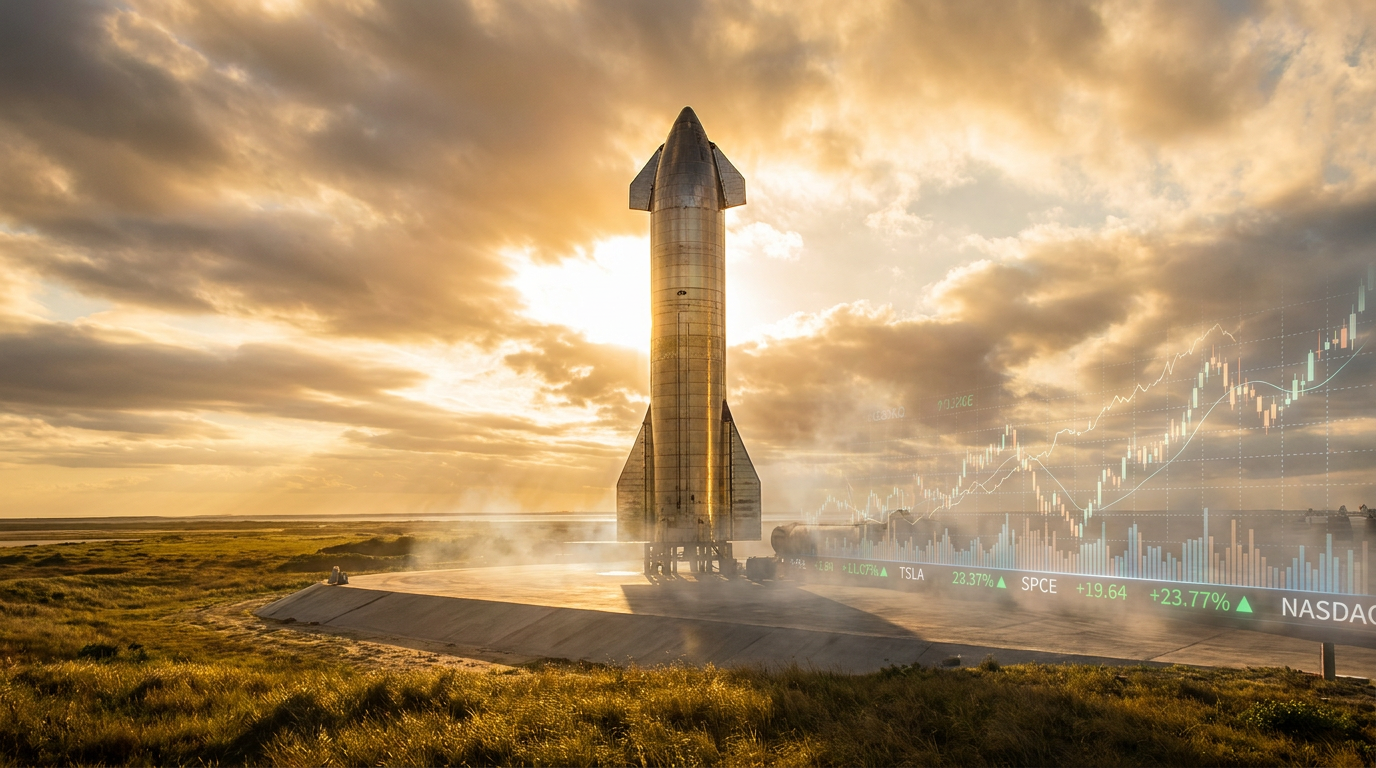
With SpaceX's record-breaking IPO pushing its valuation past $2.1 trillion, investors are navigating a new era of space-based equities. Here is how analysts calculate the financial gravity of orbital infrastructure, satellite internet, and interplanetary logistics.
By Factlen Editorial Team
- Orbital Optimists
- View space infrastructure as the next internet backbone, justifying massive valuations through recurring telecom revenue.
- Scale Skeptics
- Argue that maintaining a $2.1 trillion valuation requires flawless execution and unprecedented expansion of the total addressable market.
- Ecosystem Investors
- Focus on the downstream beneficiaries, believing smaller aerospace firms will thrive as launch costs approach zero.
What's not represented
- · Orbital environmentalists concerned about space debris
- · Legacy aerospace defense contractors
Why this matters
For decades, space exploration was funded by taxpayers and inaccessible to public markets. The arrival of a $2.1 trillion pure-play space equity fundamentally alters index weightings and opens a new, high-growth infrastructure asset class for everyday retirement portfolios.
Key points
- SpaceX's valuation has surpassed $2.1 trillion following a massive $10.7 billion underwriter option exercise.
- The bulk of the company's near-term financial value is driven by its Starlink satellite internet business, not just rocket launches.
- The IPO has legitimized the broader 'space economy,' lifting the stock prices of smaller aerospace competitors.
- Analysts project the global space industry could generate $1.8 trillion in annual revenue by the mid-2030s.
The financial world has officially breached the Kármán line. This week, underwriters for SpaceX’s record-breaking initial public offering exercised their option to purchase an additional 83 million shares, injecting another $10.7 billion into the aerospace giant. The move pushes SpaceX’s public market valuation to a staggering $2.1 trillion, cementing its status as one of the most valuable entities on Earth—and above it.[1]
But for retail and institutional investors alike, this mega-IPO represents more than just a single company's milestone. It is the formal inauguration of the "space economy" as a mainstream, liquid asset class. For the first time, everyday portfolios can directly participate in the infrastructure build-out of low Earth orbit.[6]
Valuing a company that builds reusable rockets and satellite constellations requires a different framework than valuing a traditional software or manufacturing firm. Analysts are essentially pricing in the infrastructure of a new economic domain. The core mechanism driving these astronomical valuations is the transition of space from a government-funded research theater to a commercial logistics network.[3][5]
To understand the $2.1 trillion figure, investors must separate the romance of Mars colonization from the cold, hard cash flow of Low Earth Orbit (LEO). The lion's share of SpaceX's near-term valuation is anchored not by its launch vehicles, but by Starlink, its global satellite internet service. The S-1 registration statement reveals a highly profitable, recurring revenue engine that underpins the more speculative deep-space ventures.[4]

Starlink operates on a classic telecommunications subscription model, but with a capital expenditure (CapEx) profile that was previously impossible. Because SpaceX owns the rockets that deploy the satellites, its internal cost to build and maintain the network is a fraction of what legacy telecom providers would pay to lay undersea cables or build rural cell towers. This vertical integration creates a moat that traditional financial models are only just beginning to quantify.[3][6]
However, the sheer size of the valuation introduces unique market dynamics. At $2.1 trillion, a company's stock performance becomes heavily tethered to macroeconomic forces, simply because it occupies such a large percentage of major indices. Growth at this scale requires continuous, massive expansion of the total addressable market, meaning SpaceX must constantly find new industries to disrupt.[1]
However, the sheer size of the valuation introduces unique market dynamics.
This is where the broader space economy comes into play. Financial institutions project that the global space industry could generate upwards of $1.8 trillion in annual revenue by the mid-2030s. This revenue isn't just from launching rockets; it encompasses Earth observation data, orbital manufacturing, space tourism, and deep-space logistics.[3][5]

The rising tide of the SpaceX IPO is already lifting other vessels in the sector. Smaller, specialized aerospace firms have seen their stock prices rebound sharply as retail attention floods the market. For instance, Rocket Lab, a leader in dedicated small-satellite launches, experienced a significant surge as analysts pointed out that a thriving space ecosystem requires multiple launch providers to ensure supply chain resilience.[1][2]
The initial fear among some market watchers was that a SpaceX mega-IPO would act as a black hole, sucking up all available capital and starving smaller competitors. Instead, the opposite appears to be happening. The validation of a multi-trillion-dollar anchor tenant has legitimized the entire sector, prompting mutual funds and ETFs to allocate dedicated "space infrastructure" sleeves within their portfolios.[2][6]
Yet, investing in the cosmos remains fraught with terrestrial risks. The capital required to develop next-generation launch vehicles like Starship is immense, and the regulatory environment governing orbital traffic and spectrum allocation is still in its infancy. A single catastrophic launch failure or a shift in federal regulatory posture could trigger massive volatility across the sector.[4]
Furthermore, the economics of space are fundamentally deflationary. The primary goal of reusable rocketry is to drive the cost per kilogram to orbit as close to zero as possible. While this expands the market by allowing new types of businesses to operate in space, it also means that launch providers must constantly increase their flight cadence to maintain revenue growth.[5]

This deflationary pressure is exactly what excites ecosystem investors. If the cost of accessing space drops by another order of magnitude, entirely new industries—such as orbital pharmaceuticals, zero-gravity fiber optic manufacturing, and asteroid mining—transition from science fiction to viable business plans. The launch providers are simply building the highways; the real economic value will be generated by the businesses that drive on them.[3][6]
For the everyday investor, the arrival of the space economy on public exchanges offers a rare opportunity to participate in a foundational infrastructure build-out. Much like the laying of transoceanic cables in the 19th century or the construction of cell towers in the 20th, the deployment of orbital networks will shape the global economy for decades.[6]
As options traders brace for the volatility surrounding the introduction of SpaceX contracts, the broader market is settling into a new reality. The space economy is no longer a speculative venture reserved for venture capitalists and billionaires; it is a measurable, investable, and highly scrutinized pillar of the modern financial system.[1][6]

How we got here
2002
SpaceX is founded with the goal of reducing space transportation costs.
2015
SpaceX successfully lands a Falcon 9 first stage, proving the viability of reusable rocketry.
2019
The first operational batch of Starlink internet satellites is launched into Low Earth Orbit.
June 2026
SpaceX completes its record-breaking IPO, achieving a valuation in excess of $2 trillion.
Viewpoints in depth
The Infrastructure Bulls
Investors who view space as the next foundational layer of the global economy.
This camp argues that valuing SpaceX purely as a rocket company is akin to valuing Amazon purely as a bookseller in 1999. They focus on the recurring revenue generated by Starlink and the potential for SpaceX to become the exclusive toll road to orbit. By controlling the cheapest access to space, the company can dictate the economics of future industries like orbital manufacturing and data storage, justifying a multi-trillion-dollar premium.
The Scale Skeptics
Analysts concerned about the macroeconomic weight and capital intensity of a $2.1 trillion valuation.
Skeptics do not doubt the technological achievements of the space sector, but they question the financial math. At $2.1 trillion, a company must generate hundreds of billions in free cash flow to satisfy traditional valuation metrics. This camp warns that the capital expenditure required to maintain thousands of satellites and develop interplanetary vehicles leaves little room for error, and that regulatory hurdles regarding space debris could suddenly compress margins.
The Downstream Beneficiaries
Market watchers focusing on the smaller companies enabled by cheaper access to space.
Rather than betting on the $2.1 trillion giant, these investors are looking at the ecosystem that SpaceX's cheap launches have enabled. They argue that the real alpha lies in specialized satellite manufacturers, Earth-observation data analytics firms, and secondary launch providers like Rocket Lab. As the cost of reaching orbit drops, these downstream companies can scale their operations rapidly without needing to invent their own rocketry.
What we don't know
- How international regulators will handle orbital crowding and spectrum allocation as thousands of new satellites are launched.
- Whether the deep-space exploration arm of the business (like Mars missions) will ever generate a financial return, or if it will remain a loss leader funded by telecom revenue.
- How traditional telecom giants will respond to the increasing market share of satellite broadband in rural and maritime sectors.
Key terms
- Low Earth Orbit (LEO)
- An orbit relatively close to Earth's surface (typically under 2,000 km), ideal for satellite broadband networks due to lower latency.
- Capital Expenditure (CapEx)
- Funds used by a company to acquire, upgrade, and maintain physical assets such as property, industrial buildings, or satellite constellations.
- Vertical Integration
- A business strategy where a company owns its supply chain—in SpaceX's case, building both the satellites and the rockets that launch them.
- Total Addressable Market (TAM)
- The overall revenue opportunity that is available to a product or service if 100% market share was achieved.
Frequently asked
How does SpaceX make money?
SpaceX generates revenue primarily through commercial and government launch contracts, and increasingly through subscription fees for its Starlink satellite internet service.
What is the 'space economy'?
The space economy encompasses all commercial activities in orbit, including satellite manufacturing, Earth observation data, broadband telecom, and future sectors like orbital manufacturing and tourism.
Why did other space stocks go up?
The successful mega-IPO validated the sector's financial viability, drawing institutional capital into space-focused ETFs and boosting smaller companies that provide specialized orbital services.
Sources
Source coverage
6 outlets
3 viewpoints surfaced






[1]MarketWatchOrbital Optimists
SpaceX’s stock jumps as the company reveals its IPO has raised another $10.7 billion
Read on MarketWatch →[2]BloombergScale Skeptics
Space Economy Equities Surge Following SpaceX Mega-IPO
Read on Bloomberg →[3]Morgan Stanley ResearchOrbital Optimists
The Space Economy Outlook: 2026 and Beyond
Read on Morgan Stanley Research →[4]U.S. Securities and Exchange CommissionScale Skeptics
Space Exploration Technologies Corp. Form S-1 Registration Statement
Read on U.S. Securities and Exchange Commission →[5]Space FoundationEcosystem Investors
Global Space Economy Report Q2 2026
Read on Space Foundation →[6]Factlen Editorial TeamEcosystem Investors
Synthesis by Factlen editorial team
Read on Factlen Editorial Team →

More in finance
See all 5 stories →Space Economy
How the Commercial Space Economy is Valued
0 sources
Zero-Knowledge Proofs
Zero-Knowledge Proofs Cross the 'Production Chasm': How Crypto's Privacy Tech Finally Hit the Mainstream
0 sources

Space Economy
SpaceX IPO Raises Additional $10.7 Billion as Underwriters Exercise Options, Cementing $2.1 Trillion Valuation
0 sources
Every angle. Every day.
Get finance stories with full source coverage and perspective breakdowns delivered to your inbox.