
How High-Tech Sails and Spinning Rotors Are Decarbonizing Global Shipping
Commercial cargo ships are increasingly retrofitting modern wind-assisted propulsion systems, using AI-controlled rotor sails and rigid wings to cut fuel consumption and emissions by up to 30%.
By Factlen Editorial Team
- Maritime Technology Developers
- Argue that wind is a free, abundant resource that can immediately bridge the gap to zero-carbon shipping.
- Shipowners & Operators
- Focus on the economic viability, fuel cost savings, and regulatory compliance offered by retrofitting existing fleets.
- Safety & Regulatory Bodies
- Emphasize the need for standardized safety protocols, crew training, and structural assessments as wind technology scales.
What's not represented
- · Port authorities managing clearance heights for tall sails
- · Alternative fuel producers competing for decarbonization budgets
Why this matters
Shipping accounts for roughly 3% of global greenhouse gas emissions, and zero-carbon fuels are still years away from mass adoption. Wind-assisted propulsion offers an immediate, scalable way to clean up the global supply chain without disrupting international trade.
Key points
- The maritime industry is rapidly adopting wind-assisted propulsion systems, with over 100 large vessels expected to be equipped by mid-2026.
- Technologies like rotor sails, rigid wings, and suction sails use aerodynamic principles to generate forward thrust and supplement traditional engines.
- Fully automated and controlled by AI, these modern sails can reduce a commercial ship's fuel consumption and emissions by 5% to 30%.
- The push for wind power is driven by tightening international climate regulations and the inclusion of shipping in the EU's Emissions Trading System.
- While highly effective on the open ocean, the massive deck structures require new safety protocols and folding mechanisms to navigate crowded ports.
The maritime industry is returning to its roots. For centuries, wind was the only way to move cargo across the oceans, a dominance that ended abruptly with the rise of steam and diesel power in the late 19th century. Now, facing intense regulatory pressure to decarbonize and the rising costs of fossil fuels, commercial shipping is putting a 21st-century spin on an ancient concept. Across the globe, massive bulk carriers and oil tankers are setting sail equipped with towering, high-tech structures designed to harness the ocean's breezes.
The sector is experiencing a period of exponential growth. By mid-2026, the global fleet is on track to surpass 100 large commercial vessels equipped with wind-assisted propulsion systems, with dozens more on order. These are not the canvas sails of the clipper era, which required large crews and backbreaking labor to operate. Instead, they are highly engineered structures made of steel, glass composites, and carbon fiber, designed to seamlessly supplement traditional diesel engines and push massive steel hulls through the water.[7]
The stakes for this technological revival are immense. Shipping is the undisputed backbone of global trade, responsible for transporting roughly 80% of the world's goods by volume. However, the industry also accounts for approximately 3% of global greenhouse gas emissions—a figure that is projected to rise as global trade expands. With the United Nations' International Maritime Organization targeting net-zero emissions by or around 2050, the sector is scrambling for immediate, scalable solutions to clean up its footprint.[3][6]

While the maritime industry is heavily investing in alternative green fuels like methanol and ammonia, fully zero-carbon ships and the global bunkering infrastructure required to support them are still years away from mass deployment. Wind, by contrast, is a free, globally available energy source that requires no new pipelines or specialized port storage. For shipowners, harnessing the wind offers a way to immediately reduce the environmental impact of their existing fleets without waiting for next-generation fuel technologies to mature.[4][6]
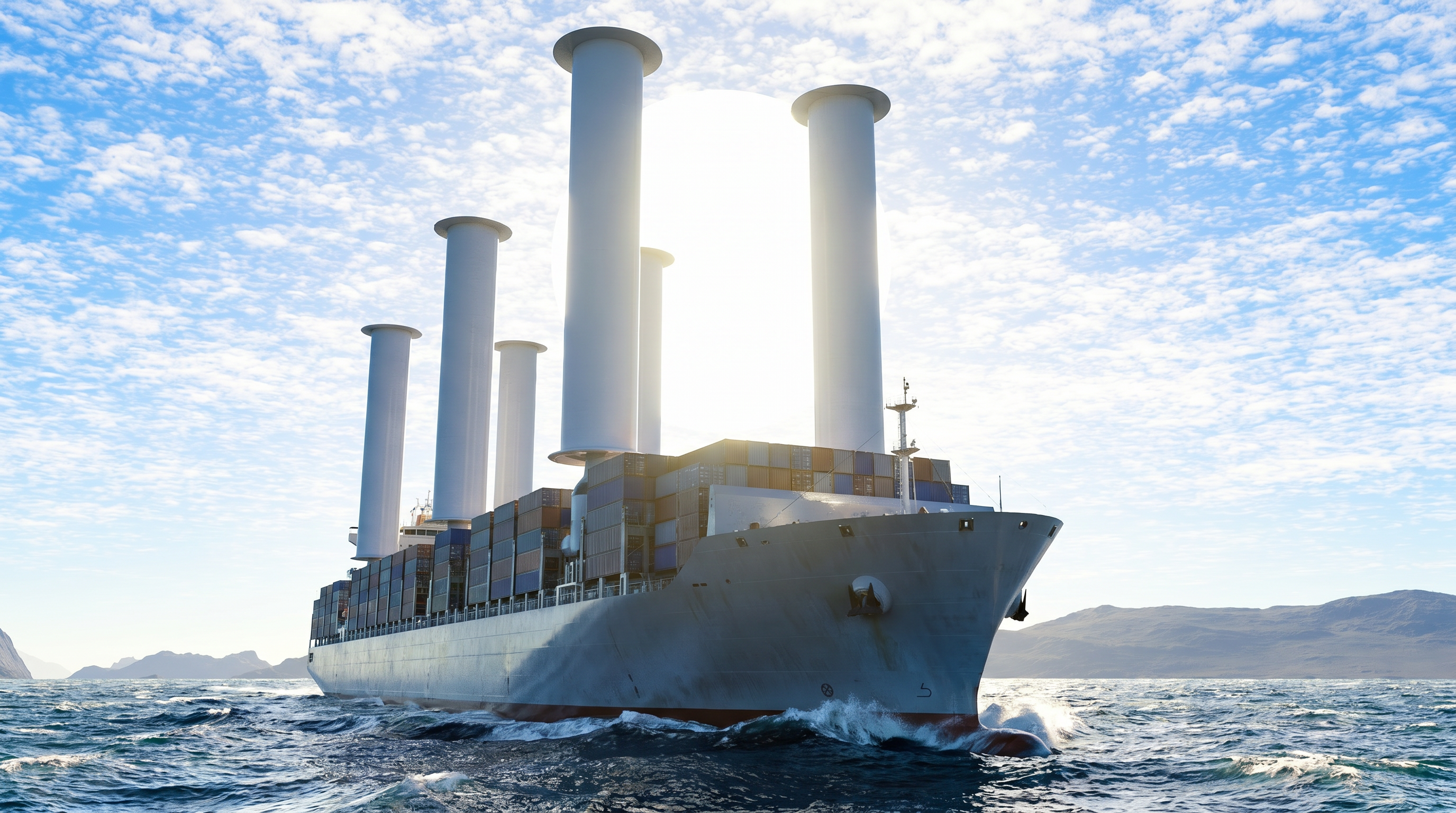
The most prominent technology currently being retrofitted onto bulk carriers and tankers is the rotor sail, also known as a Flettner rotor. At first glance, these devices do not look like sails at all; they resemble massive industrial smokestacks mounted vertically on the deck of a ship. However, these towering cylinders—which can reach up to 35 meters in height—are actually highly sophisticated aerodynamic devices capable of generating immense propulsive force.[3][5]
Rotor sails operate on a principle of physics known as the Magnus effect. The cylinders are motorized and spin rapidly. When the natural wind hits the spinning cylinder, the air accelerates on one side and slows down on the other. This creates a severe pressure differential, generating a powerful aerodynamic lift that pushes the ship forward. It is the exact same physical phenomenon that causes a curveball to swerve in baseball, applied on an industrial scale to move tens of thousands of tons of steel.[5]

Rotor sails operate on a principle of physics known as the Magnus effect.
Another major approach mimics the aviation industry. Rigid wing sails, such as the WindWings system deployed on the Pyxis Ocean bulk carrier, look and function like airplane wings standing upright on the deck. These massive structures catch the wind to generate lift that pulls the ship forward. Constructed from durable wind-turbine materials, they are designed to withstand the brutal conditions of the open ocean while providing a massive surface area to capture passing breezes.[3][6]
A third emerging technology is the suction sail. These vertical, wing-like structures use internal fans to draw in air across their surface, smoothing the airflow and creating a highly efficient aerodynamic lift with a smaller physical footprint. The technology is rapidly gaining institutional backing; in June 2026, Lloyd's Register signed a landmark agreement with K Shipbuilding and bound4blue to develop a 50,000-ton tanker specifically optimized from the ground up for suction sail technology.[1]
Crucially, modern mariners do not need to know how to sail to operate these vessels. The new generation of wind-assisted propulsion is fully automated. Artificial intelligence and an array of onboard sensors continuously monitor wind speed, direction, and sea conditions. The software automatically adjusts the angle of the rigid wings or the rotation speed of the rotor cylinders to maximize thrust, requiring zero manual intervention from the crew on the bridge.[3]
The financial and environmental returns of this automation are significant. Depending on the size of the vessel, the specific route, and prevailing weather conditions, wind-assisted propulsion can reduce a ship's fuel consumption and emissions by 5% to 30%. On a massive crude oil tanker or dry bulk carrier, a double-digit percentage reduction translates to thousands of tons of fuel saved annually, fundamentally altering the operating economics of a long-haul voyage.[3][5]

This efficiency is rapidly transitioning from a competitive advantage to a financial necessity. In 2024, the European Union expanded its Emissions Trading System to include maritime shipping, effectively putting a hard price on maritime carbon emissions. Ships that burn less fuel now save money twice: once at the bunker fuel pump, and again on mandatory carbon taxes. Furthermore, wind retrofits help older ships comply with strict new international Carbon Intensity Indicator ratings, preventing them from being forced into early retirement.[3][4]
Despite the immense momentum, the transition to wind-assisted shipping is not without operational hurdles. Integrating massive aerodynamic structures onto vessels designed for unobstructed decks introduces new complexities. In May 2026, the maritime association BIMCO and the Maritime Technologies Forum published comprehensive new guidelines highlighting the safety and operational challenges of wind propulsion, emphasizing the need for updated risk assessments and crew training.[2]
The primary challenges occur in and around ports. Massive sails can obstruct the line of sight from the navigation bridge, complicating maneuvering in crowded shipping lanes. They also present logistical challenges during cargo operations, where towering structures must clear low bridges and avoid interfering with massive port cranes. To mitigate these issues, many modern rotor and wing sails are designed to tilt or fold down flat against the deck when the ship is in port or passing under infrastructure.[2][5]
While wind alone will not entirely replace the massive diesel engines that power global trade, it has proven to be an immediate, scalable bridge to a greener future. By combining ancient principles of navigation with cutting-edge materials and artificial intelligence, the shipping industry is proving that sometimes the best way forward is to look to the past. Harnessing the ocean winds is no longer a historical curiosity; it is a vital component of a sustainable global economy.
How we got here
1920s
German inventor Anton Flettner patents the rotor sail, though cheap diesel fuel prevents widespread adoption.
2018
Norsepower installs rotor sails on a Maersk tanker, proving the modern viability of the technology.
August 2023
The Pyxis Ocean bulk carrier completes its maiden voyage fitted with massive rigid WindWings.
January 2024
The European Union includes the maritime shipping industry in its Emissions Trading System, financially penalizing heavy polluters.
June 2026
Lloyd's Register signs an agreement to develop next-generation tankers fully optimized for suction sail technology.
Viewpoints in depth
Maritime Technology Developers
Argue that wind is an abundant, free resource that can immediately bridge the gap to zero-carbon shipping.
Engineers and technology firms view wind-assisted propulsion as the most pragmatic immediate solution to maritime emissions. While alternative fuels like green methanol require entirely new global supply chains and bunkering infrastructure, wind is universally available. Developers emphasize that modern lightweight composites and AI routing have solved the inefficiencies of historical sailing, making wind a highly predictable and measurable asset for modern logistics.
Shipowners and Operators
Focus on the economic viability, fuel cost savings, and regulatory compliance offered by retrofitting existing fleets.
For the companies operating global fleets, the appeal of wind technology is largely economic. The expansion of carbon pricing, such as the EU's Emissions Trading System, means that burning heavy fuel oil is becoming prohibitively expensive. Shipowners view rotor and wing sails as a way to extend the operational lifespan of their existing vessels, achieving the 10% to 30% efficiency gains necessary to maintain favorable Carbon Intensity Indicator (CII) ratings without scrapping billions of dollars in assets.
Safety and Regulatory Bodies
Emphasize the need for standardized safety protocols, crew training, and structural assessments as wind technology scales.
Classification societies and maritime organizations are focused on the operational risks introduced by towering deck structures. Organizations like BIMCO highlight that massive sails can obstruct bridge visibility, alter a ship's maneuverability in high winds, and complicate emergency procedures. Their priority is establishing robust safety management systems to ensure that the rush to decarbonize does not compromise the physical safety of crews or port infrastructure.
What we don't know
- How quickly global port infrastructure will adapt to accommodate the massive deck structures of wind-assisted vessels during cargo loading.
- The long-term maintenance costs and durability of high-tech composite sails after decades of exposure to harsh open-ocean storms.
- Whether wind propulsion will remain a primary focus once alternative zero-carbon fuels like green methanol become cheaper and more widely available.
Key terms
- Wind-Assisted Propulsion Systems (WAPS)
- Modern mechanical systems, such as rotor sails or rigid wings, installed on ships to harness wind energy and reduce reliance on engine power.
- Rotor Sail (Flettner Rotor)
- A tall, spinning cylinder mounted on a ship's deck that uses the aerodynamic Magnus effect to generate forward thrust.
- Magnus Effect
- An aerodynamic phenomenon where a spinning object drags air with it, creating a pressure difference that results in a propulsive force.
- Suction Sail
- A vertical wing-like structure that uses internal fans to draw in air, creating a highly efficient aerodynamic lift to propel the ship.
Frequently asked
Do these ships still have traditional engines?
Yes. Wind-assisted propulsion systems are designed to supplement, not replace, traditional diesel or dual-fuel engines, allowing the ship to throttle down and save fuel.
How much fuel do rotor sails actually save?
Depending on the ship's size, the route, and weather conditions, modern wind systems typically reduce fuel consumption by 5% to 30%.
Do crews need to know how to sail?
No. Modern wind-assisted systems are fully automated and use artificial intelligence to adjust to wind conditions without manual intervention from the crew.
Sources
Source coverage
7 outlets
3 viewpoints surfaced







[1]Lloyd's RegisterShipowners & Operators
LR signs MoU for wind-assisted MR tanker design
Read on Lloyd's Register →[2]BIMCOSafety & Regulatory Bodies
New guidelines support safe uptake of wind-assisted propulsion
Read on BIMCO →[3]The Washington PostMaritime Technology Developers
Cargo ships are putting a new spin on an ancient technology
Read on The Washington Post →[4]ForbesShipowners & Operators
Wind Power For Ships Reaches Exponential Growth
Read on Forbes →[5]WärtsiläMaritime Technology Developers
A deep dive into flexible, energy-saving rotor sail technology
Read on Wärtsilä →[6]Earth.orgShipowners & Operators
Are Wind-Powered Cargo Ships the Future of the Shipping Industry?
Read on Earth.org →[7]Royal Institution of Naval ArchitectsSafety & Regulatory Bodies
Wind Propulsion 2026 Conference
Read on Royal Institution of Naval Architects →
More in transportation
See all 7 stories →Wind Propulsion
Cargo Ships Are Returning to Wind Power to Slash Global Emissions
8 sources
Hydrail Tech
How Hydrogen Trains Work and the Race to Decarbonize Global Rail
6 sources

Aircraft Design
The End of the Tube-and-Wing: How Blended-Wing Aircraft Are Reshaping Aviation
7 sources
Battery Tech
Sodium-Ion Batteries Enter Mass Production, Promising Cheaper and Cold-Resistant EVs
8 sources

Every angle. Every day.
Get transportation stories with full source coverage and perspective breakdowns delivered to your inbox.