
How Decentralized Social Media Actually Works in 2026
Open protocols like ActivityPub and the AT Protocol are finally reaching mainstream adoption, fundamentally changing who owns your digital identity.
By Factlen Editorial Team
- Open-Web Advocates
- Believe that true digital sovereignty requires separating the application from the underlying data.
- Big Tech Adopters
- Argue that open protocols need corporate scale to reach the average consumer.
- Protocol Developers
- Focus on the technical challenges of scaling decentralized networks and building seamless interoperability.
What's not represented
- · Average non-technical users who prioritize convenience over data ownership
- · Advertisers and brands trying to navigate marketing in a decentralized ecosystem
Why this matters
For the first time in the history of social media, users have the power to own their followers and move between apps without starting from zero. This shift protects your digital life from corporate algorithms, sudden bans, and platform shutdowns.
Key points
- Decentralized social media separates the application layer from the protocol layer, giving users ownership of their data.
- ActivityPub and the AT Protocol have emerged as the two dominant standards for the open web in 2026.
- Meta's Threads has integrated with ActivityPub, exposing millions of mainstream users to the Fediverse.
- Bluesky's AT Protocol allows users to change hosting providers without losing their username or followers.
The era of "rented land" on the internet is coming to an end. For the past two decades, social media users have built their digital lives, businesses, and communities on platforms owned by massive centralized corporations. In this model, the platform holds all the leverage. If a company decides to change its algorithm, introduce aggressive advertising, or shut down entirely, users have no recourse. They lose their followers, their content, and their connections.[1]
But in 2026, a fundamental architectural shift has finally reached the mainstream consumer: decentralized social media, often referred to as "DeSoc." Driven by the explosive growth of independent networks and the surprising cooperation of Big Tech, the concept of owning your digital identity is no longer a niche experiment reserved for privacy advocates and developers. With platforms like Bluesky surpassing 44 million users and Meta integrating its massive user base into the open web, decentralization is now a central pillar of the modern internet.[4][5][7]
To understand how decentralized social media works, it helps to look at one of the internet's oldest and most successful protocols: email. You can use a Gmail account, your coworker can use Microsoft Outlook, and a privacy advocate can run their own independent mail server in their basement. Because all of these services speak the same underlying language—the Simple Mail Transfer Protocol (SMTP)—everyone can send messages to each other seamlessly, regardless of which corporate entity built their software.[2]
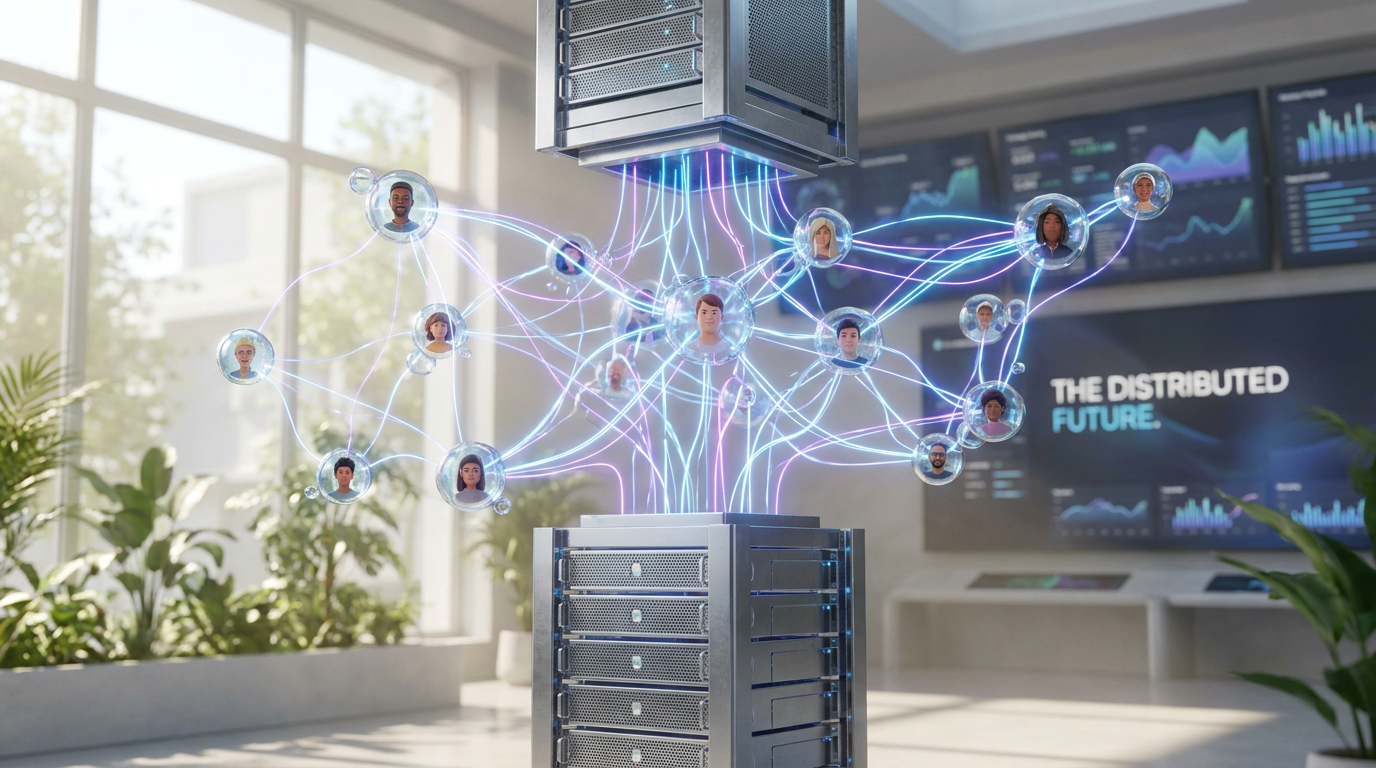
Decentralized social networks apply this exact logic to your timeline and social graph. Instead of a single company controlling the servers, the user data, and the feed algorithm, the ecosystem is split into distinct, interoperable layers. The "protocol layer" defines the universal rules for how servers communicate, while the "application layer" is the actual software interface you download on your phone. This separation of powers ensures that no single entity can monopolize the network or dictate its future.[1][2]

This architectural shift solves the biggest vulnerability of modern social media: the hostage situation of the "social graph." In traditional, centralized systems, your followers and connections are locked inside a proprietary database. If you decide to leave the platform because you disagree with its direction, you are forced to start from zero somewhere else. The platform uses your own community as leverage to prevent you from leaving.[1]
In a decentralized system, your identity and your connections are entirely portable. If you dislike an application's new moderation policy, its user interface, or its ad load, you can simply pack up your profile and plug it into a different application. Your followers come with you, and you never lose touch with your community. It is the digital equivalent of changing your cell phone provider without having to change your phone number or lose your contacts.[1][4]
Two heavyweight protocols are currently fighting to become the definitive standard for this new era of the internet: ActivityPub and the AT Protocol. While both share the ultimate goal of decentralization, they operate on fundamentally different technical philosophies and cater to slightly different visions of what the open web should look like.[4][7]
Two heavyweight protocols are currently fighting to become the definitive standard for this new era of the internet: ActivityPub and the AT Protocol.
ActivityPub is the older, more established standard. It powers the "Fediverse"—a sprawling network of thousands of independent, interconnected servers running software like Mastodon for microblogging, Pixelfed for photo sharing, and PeerTube for video hosting. In January 2026, the World Wide Web Consortium (W3C) launched a new Social Web Working Group to formally update the ActivityPub specification for the first time since 2018, signaling its maturity as a permanent piece of internet infrastructure.[2][3][4]

The biggest boost to ActivityPub's mainstream credibility came from an unlikely source: Meta. By integrating its Threads application into the Fediverse, Meta allowed its massive user base to follow and be followed by people on entirely different, independent servers. This unprecedented move exposed millions of everyday consumers to the mechanics of decentralized networking for the first time, proving that federated architecture can scale to support hundreds of millions of concurrent users.[3][5]
On the other side of the ring is the AT Protocol (Authenticated Transfer Protocol), the technical engine behind the rapidly growing Bluesky network. Originally incubated as an internal research project within Twitter before spinning out as a fully independent organization, the AT Protocol is currently undergoing formal standardization by the Internet Engineering Task Force (IETF). Where ActivityPub focuses heavily on federating distinct, community-run servers, the AT Protocol prioritizes seamless account portability.[7]
On Bluesky and other AT Protocol apps, your digital identity is not tied to a specific server domain. You can move your underlying data between different hosting providers without your username changing or your followers ever noticing a disruption. This creates a frictionless onboarding experience that feels identical to signing up for a traditional Web 2.0 platform, removing the technical intimidation factor that has historically held back decentralized alternatives.[4][7]

The AT Protocol also introduces the revolutionary concept of "composable moderation." In traditional social media, a central trust-and-safety team dictates what content is acceptable for the entire global user base. Decentralized protocols decouple moderation from the network infrastructure entirely. Users can subscribe to independent "labelers"—third-party services that automatically tag, blur, or hide content based on specific, transparent community standards.[4][7]
Similarly, the feed algorithm itself is a choice rather than a corporate mandate. If a user is exhausted by an engagement algorithm that optimizes for outrage and doomscrolling, they can simply swap it out. Decentralized platforms allow users to select from a marketplace of custom feeds—ranging from strictly chronological timelines to feeds that only show posts containing links, or feeds curated by specific professional communities.[4][7]
Despite this incredible momentum, the decentralized web still faces significant hurdles in 2026. The most pressing technical challenge is interoperability between the two major protocols. Currently, ActivityPub and the AT Protocol cannot natively speak to each other, creating a fractured landscape where users must choose a side. While experimental third-party "bridges" exist to translate posts between Mastodon and Bluesky, they are often clunky and raise complex ethical questions about user consent.[4]

There is also the looming, unresolved question of financial sustainability. Centralized platforms offer free services by harvesting vast amounts of user data to power highly targeted advertising networks. Decentralized protocols, which inherently protect user data, must find alternative ways to fund server costs and ongoing protocol development. Yet, despite these growing pains, the transition from walled gardens to open protocols is well underway, ensuring that the next generation of the social web is built on user agency rather than corporate control.[1][2][8]
How we got here
October 2022
Bluesky launches the AT Protocol as a decentralized alternative to traditional social media.
July 2023
Meta launches Threads, promising future integration with the open Fediverse.
March 2024
Bluesky opens federation, allowing independent servers to join its network.
June 2024
Threads begins rolling out ActivityPub integration, allowing users to share posts to Mastodon.
January 2026
The W3C launches a new Social Web Working Group to formally update the ActivityPub standard.
May 2026
Bluesky surpasses 44 million users as decentralized networks reach mainstream adoption.
Viewpoints in depth
Open-Web Advocates
Believe that true digital sovereignty requires separating the application from the underlying data.
This camp argues that the "rented land" model of Web 2.0 was a historical anomaly. They champion protocols over platforms, insisting that users should have a fundamental right to pack up their social graph and leave an app without penalty. For them, decentralization is a human rights issue, protecting free expression from billionaire owners and opaque algorithmic manipulation.
Big Tech Adopters
Argue that open protocols need corporate scale to reach the average consumer.
While purists prefer independent servers, this group points out that most users will not navigate complex server setups. They view Meta's integration of Threads into ActivityPub as a massive victory, arguing that corporate resources and polished user interfaces are necessary to bring the benefits of decentralization to billions of people, even if it means compromising on absolute independence.
Privacy Purists
Fear that corporate integration will inevitably co-opt and ruin the open web.
This faction is deeply skeptical of platforms like Threads joining the Fediverse. They argue that Meta's history of "embrace, extend, and extinguish" poses an existential threat to independent instances. Many in this camp advocate for "defederating" (blocking) corporate servers entirely, prioritizing small, high-trust communities over massive, unmoderated scale and data harvesting.
What we don't know
- Whether the AT Protocol and ActivityPub will ever achieve native, seamless interoperability without relying on clunky third-party bridges.
- How decentralized networks will sustainably fund their server and development costs without resorting to the targeted advertising models of Web 2.0.
- If Meta's integration of Threads into the Fediverse will ultimately empower the open web or lead to corporate dominance of the ActivityPub standard.
Key terms
- Fediverse
- A portmanteau of "federation" and "universe," referring to the network of independent servers that can communicate with each other.
- ActivityPub
- An open, decentralized social networking protocol established as a standard by the W3C, used by Mastodon and Threads.
- AT Protocol
- The Authenticated Transfer Protocol, an open-source framework powering Bluesky that emphasizes account portability.
- Social Graph
- The map of a user's digital relationships, including their followers, the people they follow, and their community connections.
- Instance
- A single, independently hosted server within a federated network, complete with its own rules and community.
Frequently asked
Can I move my Instagram followers to the Fediverse?
Not directly. Because traditional platforms are closed systems, you cannot export your followers. However, once you build an audience on a decentralized protocol, you can move them freely between compatible apps.
Do I have to pay to use decentralized social media?
Most decentralized apps are free to use, though some independent servers rely on community donations or Patreon subscriptions to cover their hosting costs.
Can Mastodon users talk to Bluesky users?
Not natively. Mastodon uses ActivityPub while Bluesky uses the AT Protocol. While experimental third-party bridges exist, the two networks are currently separate ecosystems.
Who moderates content on decentralized networks?
Moderation is handled at the server or user level. On Mastodon, server administrators set the rules. On Bluesky, users can subscribe to third-party 'labelers' to filter their own feeds.
Sources
Source coverage
8 outlets
3 viewpoints surfaced








[1]ChainUpOpen-Web Advocates
What Is Decentralized Social Media? DeSoc and SocialFi Explained
Read on ChainUp →[2]ElestioOpen-Web Advocates
The Fediverse Is Growing: Why Decentralized Social Media Matters in 2026
Read on Elestio →[3]Connected PlacesProtocol Developers
Fediverse Report – #149 – On Protocol Governance
Read on Connected Places →[4]BsKy BlogProtocol Developers
Bluesky vs Mastodon: Which Platform Wins in 2026?
Read on BsKy Blog →[5]Fast CompanyBig Tech Adopters
Threads is going all-in on the fediverse, and users have some questions
Read on Fast Company →[6]BufferBig Tech Adopters
Your Complete Guide to Social Media Marketing in 2026
Read on Buffer →[7]WikipediaProtocol Developers
AT Protocol
Read on Wikipedia →[8]Factlen Editorial TeamOpen-Web Advocates
Synthesis by Factlen editorial team
Read on Factlen Editorial Team →

More in technology
See all 61 stories →Decentralized Web
How Decentralized Social Media is Breaking the 'Walled Garden' Era
7 sources
Sustainable Cloud
How 'Zero-Water' Liquid Cooling is Solving the AI Cloud's Thirst
7 sources

Spam Prevention
AI Assistants and Mandatory Caller ID: How India is Defeating the Spam Call Epidemic
8 sources

Agentic AI
Microsoft and Xiaomi Open-Source New Architectures to Fix AI Agent Amnesia
7 sources

Every angle. Every day.
Get technology stories with full source coverage and perspective breakdowns delivered to your inbox.