
How Cold-Climate Heat Pumps Became the Standard for Home Heating in 2026
Advancements in inverter technology and low-GWP refrigerants have transformed heat pumps into the dominant residential heating solution, capable of operating efficiently even at -22°F.
By Factlen Editorial Team
- HVAC Engineers & Installers
- Focused on technical performance, proper sizing, and the necessity of building weatherization.
- Energy Policy & Climate Advocates
- View heat pumps as the critical linchpin for decarbonizing the residential sector.
- Cost-Conscious Homeowners
- Prioritize upfront installation costs, utility bill savings, and return on investment.
What's not represented
- · Natural Gas Utility Companies
- · Renters unable to upgrade building infrastructure
Why this matters
Heating and cooling account for the largest portion of a home's energy use. The maturation of cold-climate heat pumps allows homeowners in almost any region to drastically cut their utility bills and carbon footprint without sacrificing winter comfort.
Key points
- Heat pumps have surpassed gas furnaces in annual sales, driven by major technological breakthroughs.
- Modern cold-climate models maintain 100% capacity at 5°F and operate down to -22°F.
- Because they move heat rather than generate it, heat pumps are 300% to 400% efficient.
- Homeowners typically save 25% to 45% on annual heating costs compared to a gas furnace.
- A 2026 transition to low-GWP refrigerants like R-290 makes the systems even more environmentally friendly.
The era of the basement furnace is quietly drawing to a close. Across North America and Europe, heat pumps have officially surpassed gas furnaces in annual sales, marking a fundamental shift in how residential buildings are conditioned. This transition is not merely a policy-driven mandate; it is the result of a technological breakthrough that has fundamentally rewritten the economics of home heating.[7]
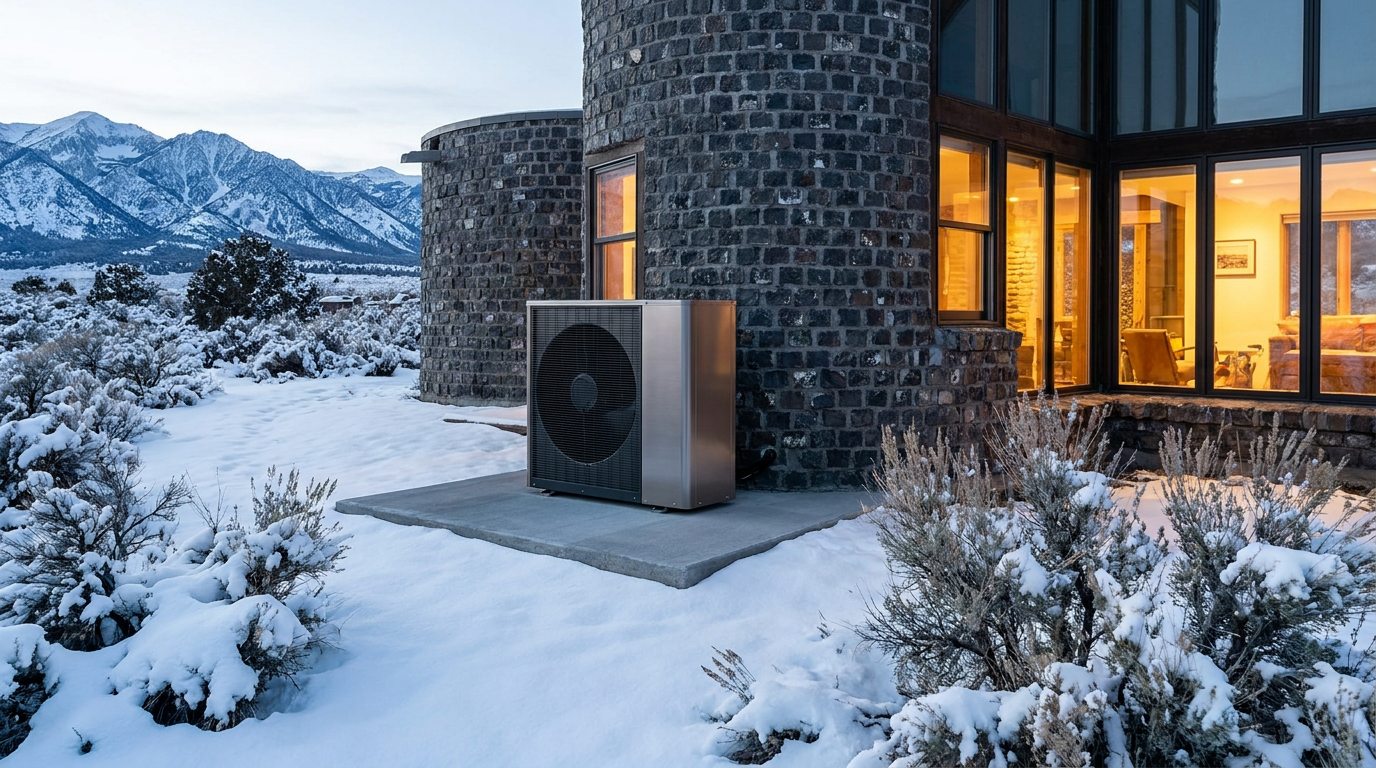
For decades, the conventional wisdom held that heat pumps were strictly for mild climates—perfect for the American South or the Mediterranean, but entirely inadequate for a New England or Midwestern winter. In 2026, that limitation has been engineered out of existence. Modern cold-climate heat pumps (CCHPs) now maintain 100% of their heating capacity at 5°F and continue operating efficiently at temperatures as low as -22°F.[3]
To understand this shift, it is necessary to look at the fundamental mechanism of the technology. Traditional heating systems, such as gas furnaces or electric baseboards, generate heat. A furnace burns natural gas to create a flame, which heats a metal exchanger, while a blower pushes that warmed air into the home. This process is bound by the strict limits of physics: a system can never output more energy than it consumes in fuel. The absolute best gas furnaces max out at roughly 98% efficiency.[4]
Heat pumps, by contrast, do not generate heat; they move it. Operating on the same thermodynamic principles as a household refrigerator, a heat pump uses electricity to drive a refrigerant cycle that extracts ambient thermal energy from the outside air and transfers it indoors. Because moving heat requires significantly less energy than creating it from scratch, heat pumps routinely achieve efficiencies of 300% to 400%.[1][5]

This efficiency is measured by the Coefficient of Performance (COP). A COP of 3.0 means that for every one unit of electrical energy consumed, the system delivers three units of heat energy to the home. Even when the outside air feels freezing to the human skin, it still contains abundant thermal energy. Absolute zero is -459.67°F; anything warmer than that holds extractable heat.[4][5]
The challenge, historically, was capturing that heat when the temperature dropped below freezing. Standard heat pumps would lose 40% to 60% of their rated capacity below 35°F, forcing reliance on expensive, energy-hogging electric resistance backup strips. The solution came through advanced inverter-driven compressors and vapor-injection technology.[3]
Unlike older single-stage compressors that simply blast on at 100% and then shut off, modern variable-speed inverters act like a car's accelerator pedal. They continuously modulate their speed to match the exact heating load of the house. When combined with vapor injection—which shoots a burst of refrigerant back into the compressor to cool it and increase its pressure—the system can extract heat from deeply sub-zero air without losing capacity.[3][7]
Unlike older single-stage compressors that simply blast on at 100% and then shut off, modern variable-speed inverters act like a car's accelerator pedal.
This technological leap was accelerated by the U.S. Department of Energy's Cold Climate Heat Pump Challenge. Launched to spur innovation, the initiative partnered with major manufacturers like Carrier, Trane, and Bosch to develop next-generation units. By 2025, companies were rolling out systems that not only met the DOE's stringent low-temperature specifications but also operated at whisper-quiet sound levels as low as 55 decibels.[1][2]

The year 2026 also marks a critical regulatory milestone for the industry: the transition to low-Global Warming Potential (GWP) refrigerants. Older systems relied heavily on R-410A, a chemical with a high environmental impact if leaked. The new generation of heat pumps utilizes refrigerants like R-32, R-454B, and R-290 (propane). R-290 is particularly revolutionary; with a near-zero GWP of 3, it can produce much higher water temperatures, making it ideal for retrofitting older homes that rely on traditional high-temperature radiators.[3]
Beyond the hardware, the integration of heat pumps into Home Energy Management Systems (HEMS) has unlocked new operational efficiencies. Smart thermostats can now pair heat pump operation with real-time utility pricing, solar panel production, and localized weather forecasts. By pre-heating the home slightly during off-peak hours when electricity is cheap, the system can coast through expensive peak-demand periods without sacrificing comfort.[6]
The financial equation has consequently tilted heavily in favor of electrification. While the upfront installation cost of a high-efficiency heat pump can be $2,000 to $5,000 higher than a standard gas furnace, the operating savings quickly close the gap. In moderate to cold-mixed climates, a heat pump costs roughly $800 to $1,400 per year to run, compared to $1,200 to $2,200 for a gas furnace.[4]

This translates to an average annual savings of 25% to 45% on heating costs. Over a 10-year lifespan, homeowners can expect to save between $4,500 and $13,000, depending on local utility rates. Furthermore, because a heat pump provides both heating and cooling, it eliminates the need to purchase and maintain a separate central air conditioning unit.[4]
Upfront costs are also being heavily subsidized by a web of state and federal incentives. Programs like Mass Save in Massachusetts offer up to $9,500 in rebates for whole-home heat pump conversions, while Efficiency Maine provides up to $8,000. These localized incentives, combined with broader federal tax credits, often make the net installation cost of a premium heat pump lower than that of a mid-tier fossil fuel system.[4]
For homes in the most extreme northern climates, or those with poor insulation, a hybrid or dual-fuel approach remains a popular stepping stone. In this configuration, a heat pump handles 80% to 90% of the winter heating load at maximum efficiency, while an existing gas furnace remains in place to take over automatically only during the most severe polar vortex events.[3][4]
Ultimately, the maturation of cold-climate heat pumps represents one of the most significant consumer-level climate victories of the decade. By untethering residential comfort from fossil fuel combustion, the technology offers a rare convergence: a substantial reduction in household carbon emissions paired directly with a superior, more cost-effective product.[7]
How we got here
Pre-2020
Standard heat pumps lose significant capacity below freezing, requiring electric backup heat.
2021–2022
The DOE launches the Cold Climate Heat Pump Challenge to spur sub-zero innovation.
2023
New SEER2 and HSPF2 federal efficiency testing standards take effect.
2025
Major manufacturers successfully deploy units operating at 100% capacity at 5°F.
Jan 2026
Industry-wide transition to low-GWP refrigerants like R-290 and R-32 begins.
Viewpoints in depth
HVAC Engineers & Installers
Focused on technical performance, proper sizing, and the necessity of building weatherization.
For the professionals designing and installing these systems, the focus is heavily on load calculations and building envelopes. They emphasize that a heat pump's efficiency is only as good as the home's insulation. Installers advocate for the 'fabric first' approach—sealing drafts and upgrading insulation before sizing the heat pump—to ensure the system doesn't overwork. They also heavily prioritize the new SEER2 and HSPF2 ratings to guarantee performance in sub-zero conditions.
Energy Policy & Climate Advocates
View heat pumps as the critical linchpin for decarbonizing the residential sector.
Climate advocates and policymakers focus on the macro-level impact of electrification. Because heat pumps run on electricity, their carbon footprint shrinks every year as the broader power grid transitions to renewable energy sources like wind and solar. This camp champions aggressive state-level rebates and the phase-out of natural gas hookups in new construction, arguing that ending residential fossil fuel combustion is non-negotiable for meeting 2050 net-zero emissions targets.
Cost-Conscious Homeowners
Prioritize upfront installation costs, utility bill savings, and return on investment.
For the consumer, the primary driver is the bottom line. While the environmental benefits are a bonus, the decision to switch is largely motivated by the 25% to 45% reduction in monthly heating bills. This camp closely tracks the availability of state rebates like Mass Save to offset the higher initial equipment costs. They are also the primary adopters of 'dual-fuel' hybrid systems, preferring the financial security of keeping a gas backup for extreme cold snaps rather than fully committing to electric-only heating.
What we don't know
- How quickly the electrical grid in older neighborhoods can adapt to the increased winter load of mass electrification.
- Whether federal tax incentives will be renewed or expanded in the latter half of the decade.
Key terms
- Coefficient of Performance (COP)
- A metric of heating efficiency that measures how many units of heat a system produces for every one unit of electricity it consumes.
- SEER2
- Seasonal Energy Efficiency Ratio 2, the updated federal standard for measuring a heat pump's cooling efficiency over a typical summer season.
- HSPF2
- Heating Seasonal Performance Factor 2, the updated federal metric for measuring a heat pump's heating efficiency over a typical winter season.
- Inverter Compressor
- A variable-speed motor that allows a heat pump to continuously adjust its output to match the home's exact heating or cooling needs, rather than simply turning on and off.
- Low-GWP Refrigerant
- Chemical cooling fluids, such as R-290 (propane), that have a significantly lower Global Warming Potential compared to older hydrofluorocarbons.
Frequently asked
Do heat pumps really work in freezing weather?
Yes. Modern cold-climate heat pumps use advanced inverter compressors to maintain 100% of their heating capacity down to 5°F, and can continue operating efficiently at temperatures as low as -22°F.
How much money does a heat pump save compared to a gas furnace?
In moderate to cold climates, homeowners typically save 25% to 45% on their annual heating bills, translating to roughly $400 to $800 in yearly savings depending on local utility rates.
What is the difference between a heat pump and an air conditioner?
A heat pump is essentially an air conditioner that can run in reverse. In the summer, it extracts heat from inside your home and pushes it outside; in the winter, it extracts heat from the outside air and pushes it inside.
What is a dual-fuel or hybrid heating system?
A hybrid system pairs a high-efficiency heat pump with a traditional gas furnace. The heat pump handles the vast majority of the winter heating, while the gas furnace automatically kicks on only during extreme cold snaps.
Sources
Source coverage
7 outlets
3 viewpoints surfaced







[1]U.S. Department of EnergyEnergy Policy & Climate Advocates
Residential Cold Climate Heat Pump Technology Challenge
Read on U.S. Department of Energy →[2]Facilities DiveHVAC Engineers & Installers
Carrier completes DOE Cold Climate Heat Pump Challenge
Read on Facilities Dive →[3]EcoHomeHVAC Engineers & Installers
The 2026 Guide to Cold Climate Heat Pumps and Refrigerants
Read on EcoHome →[4]NuWatt EnergyCost-Conscious Homeowners
Heat Pump vs Gas Furnace: Annual Running Cost Comparison
Read on NuWatt Energy →[5]UK GovernmentEnergy Policy & Climate Advocates
Record numbers choosing to install clean heating systems
Read on UK Government →[6]HomeyCost-Conscious Homeowners
Integrating a Heat Pump into Your Smart Home
Read on Homey →[7]Factlen Editorial TeamCost-Conscious Homeowners
Synthesis by Factlen editorial team
Read on Factlen Editorial Team →
Every angle. Every day.
Get home stories with full source coverage and perspective breakdowns delivered to your inbox.