
How AI Data Analysis is Compressing Centuries of Materials Science into Days
Advanced predictive models from DeepMind and Microsoft have analyzed millions of chemical combinations, discovering hundreds of thousands of stable new materials and synthesizing a low-lithium battery prototype.
By Factlen Editorial Team
- Computational Scientists
- Argue that AI and machine learning fundamentally change the paradigm of discovery, shifting the bottleneck from finding materials to testing them.
- Experimental Material Scientists
- Emphasize that computational predictions are only the first step, and that physical synthesis, stability testing, and commercial scalability remain massive hurdles.
- Energy & Climate Strategists
- Value the rapid discovery of alternative materials as a critical pathway to securing supply chains for the renewable energy transition.
What's not represented
- · Mining Industry Representatives
- · Commercial Battery Manufacturers
Why this matters
The global transition to renewable energy is currently bottlenecked by a reliance on scarce critical minerals like lithium. By using AI to compress centuries of materials research into mere days, scientists are rapidly discovering alternative, highly efficient materials that could make batteries, solar panels, and computer chips cheaper and more abundant.
Key points
- AI models are compressing centuries of materials science research into days by predicting the stability of novel chemical structures.
- DeepMind's GNoME model identified 380,000 new stable crystals, expanding humanity's catalog of known materials by nearly an order of magnitude.
- Microsoft and PNNL used AI to filter 32 million candidate materials down to 18 in just 80 hours.
- PNNL successfully synthesized the top candidate, creating a working solid-state battery prototype that uses 70% less lithium.
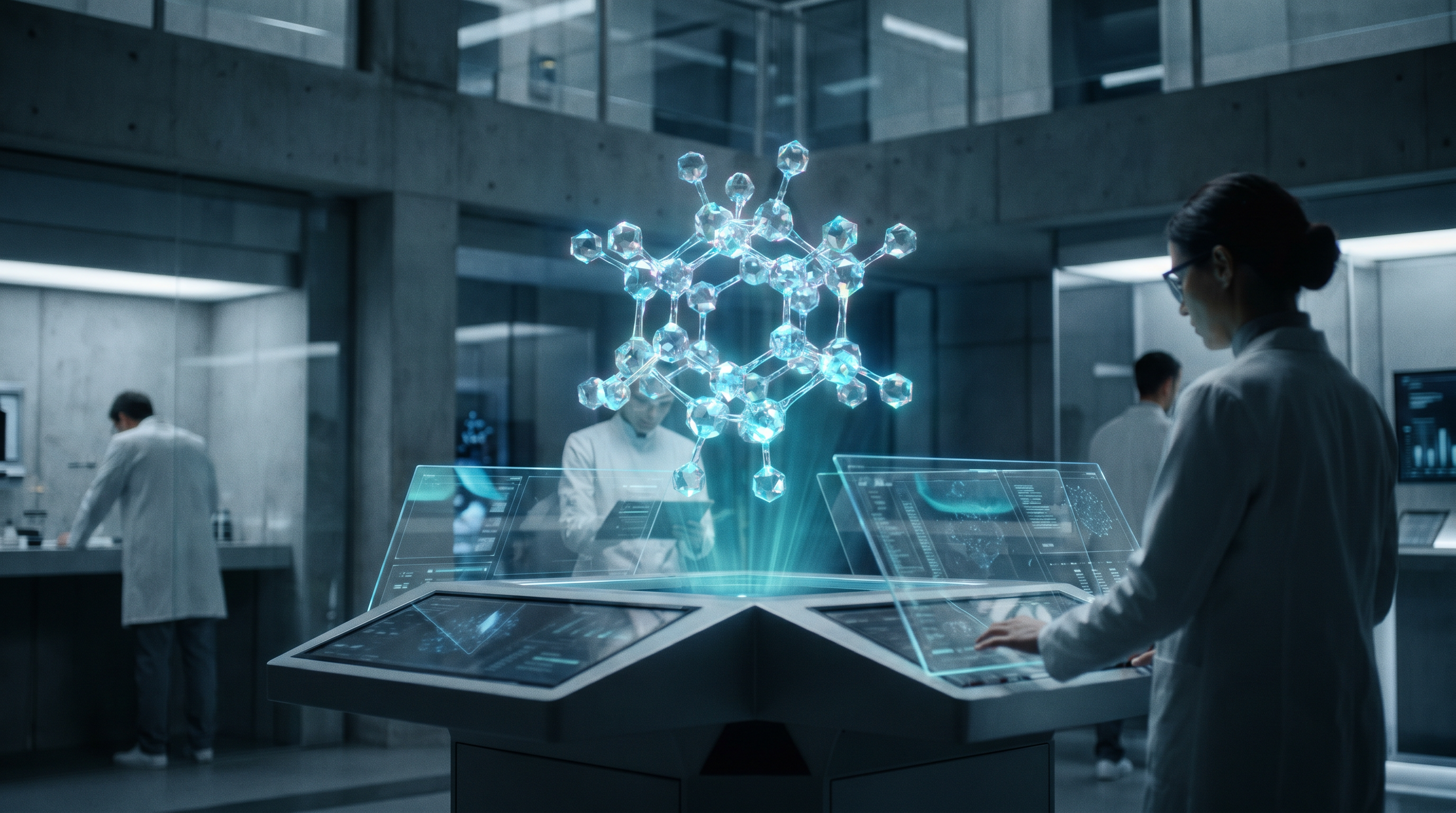
For centuries, the discovery of new materials has been a painstaking process of physical trial and error, with breakthroughs often taking decades to move from the laboratory to commercial application. Today, advanced artificial intelligence and high-performance data analysis are upending that timeline. By processing massive datasets of atomic structures and chemical properties, AI models are compressing hundreds of years of traditional research into a matter of days. This computational shift is not just theoretical; it is already yielding physical prototypes that could reshape the global energy transition and semiconductor manufacturing.[3][4]
The primary claim driving this shift is that machine learning can accurately predict the stability of novel crystal structures at an unprecedented scale, bypassing the need to physically synthesize every candidate. The most significant evidence for this comes from Google DeepMind's Graph Networks for Materials Exploration (GNoME). Trained on existing material databases, GNoME analyzed complex atomic arrangements to predict 2.2 million new hypothetical materials.[3][5][7]
Of those 2.2 million predictions, the AI identified 380,000 structures as highly stable and viable for real-world application. Before this data analysis breakthrough, scientists had cataloged roughly 48,000 stable inorganic crystals. In a single computational leap, the AI expanded humanity's known repository of stable materials by nearly an order of magnitude, generating what researchers equate to 800 years of traditional scientific output.[3][5]

A parallel claim is that AI filtering can rapidly isolate specific, high-value materials from millions of candidates to solve targeted engineering problems. Microsoft's Azure Quantum Elements platform provided the evidence for this capability during a partnership with the US Department of Energy's Pacific Northwest National Laboratory (PNNL). The research team tasked the AI with finding a more efficient, less resource-intensive solid-state electrolyte for batteries.[1][2]
The data analysis pipeline began with 32 million potential material combinations. Traditional physics-based models, even running on high-performance supercomputers, were too slow to assay such a massive dataset for stability. Instead, Microsoft deployed machine learning models to replace traditional quantum chemistry calculations, accelerating the simulation process by up to 500,000 times. Within 80 hours, the AI filtered the 32 million candidates down to just 18 promising options.[1][2]

The data analysis pipeline began with 32 million potential material combinations.
The critical test for any computational data analysis is whether its virtual predictions hold up in the physical world. The evidence here is strong but developing. PNNL researchers took the top candidate identified by Microsoft's AI—a material previously unknown to nature—and successfully synthesized it in the lab. They used it to create a functional solid-state battery prototype that requires up to 70% less lithium than conventional lithium-ion batteries.[1][2][4]
Similarly, the physical validation of DeepMind's GNoME database is already underway. Independent research laboratories and automated robotic synthesis facilities, such as the A-Lab at the Lawrence Berkeley National Laboratory, have successfully synthesized at least 736 of the new materials predicted by the AI. These include potential new layered compounds similar to graphene, which hold significant promise for superconductor physics and advanced electronics.[5][7]
However, a transparent assessment of the evidence reveals significant uncertainties regarding commercial scalability. While the computational data analysis is highly robust, physical manufacturing remains a bottleneck. PNNL researchers explicitly caution that while their new low-lithium battery material works in a laboratory setting, it may not prove viable or cost-effective for mass production. The transition from a synthesized prototype to a globally deployed technology still requires years of rigorous testing.[2][4]

Furthermore, the gap between computational novelty and practical synthesis remains steep. Although DeepMind's AI identified 380,000 stable materials, the fraction that has been physically validated by independent laboratories is currently less than one percent. The sheer volume of data generated by these AI models now vastly outpaces the physical capacity of the world's laboratories to test and commercialize them.[5][7]
Despite these scaling challenges, the underlying mechanism of AI-driven materials discovery represents a permanent shift in scientific methodology. Graph neural networks learn the fundamental rules of chemistry from existing data, allowing them to intuitively predict how novel combinations of atoms will behave. When paired with high-performance computing, these models allow researchers to simulate millions of experimental scenarios in a virtual environment, eliminating dead ends before a single physical experiment is conducted.[6][7]
The stakes for this data analysis revolution are immense. The global transition to renewable energy heavily depends on critical minerals, with lithium demand projected to soar by more than 900% by 2050. By using AI to rapidly discover alternative materials that rely on abundant elements like sodium, researchers can alleviate supply chain bottlenecks and reduce the environmental impact of mining.[2][4]
Ultimately, the integration of AI into materials science marks the beginning of a new era in data analysis. The bottleneck of innovation is no longer the discovery of new concepts, but rather the physical engineering required to bring them to market. As these predictive models continue to refine their accuracy, they promise to accelerate the development of everything from high-capacity solar panels to next-generation computer chips, fundamentally altering the pace of human technological advancement.[3][6]
How we got here
Late 2023
DeepMind announces GNoME, predicting 2.2 million new materials and expanding known stable crystals by nearly an order of magnitude.
Jan 2024
Microsoft and PNNL announce the discovery and synthesis of a new low-lithium solid-state battery material using AI.
2025–2026
Independent laboratories successfully synthesize hundreds of AI-predicted materials, validating the computational models in the physical world.
Viewpoints in depth
Computational Scientists
This camp views AI as a fundamental paradigm shift that solves the discovery bottleneck.
Researchers developing these models argue that the era of trial-and-error chemistry is over. By training graph neural networks on the fundamental laws of physics and existing material databases, scientists can now explore the vast, uncharted territories of chemical combinations in a virtual environment. They emphasize that the sheer volume of data generated—hundreds of thousands of stable materials—proves that computational analysis can achieve in days what would take human researchers centuries.
Experimental Material Scientists
This camp emphasizes the steep gap between a computer simulation and a mass-produced product.
While experimentalists welcome the influx of new candidate materials, they caution against overstating the immediate impact. A material that is computationally stable in a simulation may still be incredibly difficult, expensive, or toxic to synthesize in a physical laboratory. Furthermore, creating a single working prototype (like PNNL's low-lithium battery) does not guarantee that the material can be manufactured at the scale required for global commercial deployment. For this group, the bottleneck has simply shifted from discovery to physical engineering.
Energy & Climate Strategists
This camp focuses on the geopolitical and environmental stakes of finding new materials.
For strategists focused on the energy transition, the exact mechanism of the AI is less important than the outcome: breaking the reliance on scarce critical minerals. With lithium demand projected to skyrocket, the ability to rapidly discover alternative battery chemistries that use abundant materials like sodium is viewed as a national security and environmental imperative. They argue that accelerating this data analysis pipeline is essential to meeting global climate targets without triggering a supply chain crisis.
What we don't know
- Whether the new low-lithium battery material discovered by Microsoft and PNNL can be manufactured cost-effectively at a commercial scale.
- How many of DeepMind's 380,000 predicted stable materials will actually possess useful real-world properties once synthesized.
- How quickly automated robotic laboratories can scale up to physically test the massive backlog of AI-generated material candidates.
Key terms
- Graph Neural Network (GNN)
- A type of artificial intelligence designed to analyze data that can be represented as a graph, making it highly effective at understanding the complex 3D relationships between atoms in a molecule.
- Solid-State Battery
- A type of battery that uses a solid electrolyte instead of the liquid or polymer gel electrolytes found in conventional lithium-ion batteries, potentially offering higher energy density and safety.
- Density Functional Theory (DFT)
- A quantum mechanical modeling method used in physics and chemistry to investigate the electronic structure of atoms and molecules, traditionally requiring massive computational power.
- High-Performance Computing (HPC)
- The use of supercomputers and parallel processing techniques to solve complex computational problems faster than standard computers.
- Electrolyte
- A substance that produces an electrically conducting solution, serving as the catalyst that makes a battery work by allowing ions to move between the cathode and anode.
Frequently asked
How does AI discover new materials?
AI models, specifically graph neural networks, analyze massive databases of known atomic structures to learn the rules of chemistry. They then predict how novel combinations of atoms will behave and calculate their stability without needing to physically create them first.
What did DeepMind's GNoME discover?
DeepMind's AI predicted 2.2 million new crystal structures, identifying 380,000 of them as highly stable. This expands the number of known stable materials by nearly an order of magnitude.
Has anything actually been built using these AI predictions?
Yes. Microsoft and PNNL used AI to discover a new solid-state battery material and physically synthesized a working prototype. Additionally, independent labs have synthesized over 700 of the materials predicted by DeepMind.
Will this replace human scientists?
No. AI acts as a highly efficient filter, eliminating millions of dead ends. Human scientists are still required to physically synthesize the materials, test their real-world performance, and figure out how to manufacture them at scale.
Sources
Source coverage
7 outlets
3 viewpoints surfaced







[1]ForbesExperimental Material Scientists
Microsoft Uses AI And HPC To Analyze 32 Million New Materials
Read on Forbes →[2]ComputerworldExperimental Material Scientists
AI enables Microsoft and PNNL to discover new battery material
Read on Computerworld →[3]PYMNTSEnergy & Climate Strategists
Google AI Discovers 800 Years' Worth of Industrial Materials in One Click
Read on PYMNTS →[4]Latitude MediaEnergy & Climate Strategists
Armed with AI, Microsoft found a new battery material in just two weeks
Read on Latitude Media →[5]Silicon RepublicComputational Scientists
DeepMind discovers millions of potential materials using AI
Read on Silicon Republic →[6]Microsoft ResearchComputational Scientists
AI meets materials discovery: The vision behind MatterGen and MatterSim
Read on Microsoft Research →[7]NatureComputational Scientists
Scaling deep learning for materials discovery
Read on Nature →

More in data analysis
See all 9 stories →Data Visualization
Do Interactive Charts and 'Chartjunk' Actually Work? The Evidence on Data Visualization
8 sources

Synthetic Data
Does Synthetic Data Actually Work? The Evidence Behind AI's New Training Paradigm
8 sources
Workplace Science
The Evidence Behind the Four-Day Workweek: What Global Trials Actually Show
7 sources

Urban Data
How EIU, Mercer, and Monocle Define the World's Most Livable Cities
6 sources

Every angle. Every day.
Get data analysis stories with full source coverage and perspective breakdowns delivered to your inbox.