
How AI and Robotics Are Finally Making Vertical Farming Profitable
After years of high energy costs and high-profile bankruptcies, artificial intelligence and robotic automation are transforming indoor agriculture into a sustainable, economically viable solution for global food security.
By Factlen Editorial Team
- Agri-Tech Innovators
- Argue that AI and robotics are essential for making indoor farming profitable and solving global supply chain and labor challenges.
- Academic Researchers
- Focus on the underlying machine learning models and quantify the exact energy and resource savings achieved by smart systems.
- Market Analysts
- Emphasize the economic viability, capital intensity, and the projected multi-billion-dollar growth of the vertical farming sector.
What's not represented
- · Traditional field farmers facing competition
- · Independent small-scale indoor growers priced out of AI tech
Why this matters
By drastically reducing the energy and labor costs associated with indoor agriculture, AI is turning a niche, expensive farming method into a scalable solution that can produce fresh food year-round in urban centers and climate-stressed regions.
Key points
- AI climate control systems can reduce the energy consumption of indoor farming by up to 25 percent.
- Machine learning models create micro-climate zones and shift heavy electricity usage to cheaper, off-peak hours.
- Robotic harvesters equipped with computer vision are solving severe agricultural labor shortages.
- Precision AI irrigation reduces nutrient waste by 20 to 30 percent while using 97 percent less water than field farming.
- The global vertical farming market is projected to grow from roughly $7.8 billion in 2025 to over $60 billion by 2035.
For years, the promise of vertical farming—growing massive quantities of pesticide-free produce indoors, year-round, regardless of the weather outside—was overshadowed by a glaring economic reality. The electricity required to power thousands of LED grow lights and the labor needed to manage complex hydroponic systems made the cost of a head of indoor lettuce astronomically high. Between 2021 and 2025, the industry saw a wave of high-profile bankruptcies as early pioneers failed to overcome these fundamental unit economics.[4][7]
But in 2026, the narrative has shifted dramatically. The integration of artificial intelligence, machine learning, and advanced robotics has transformed controlled environment agriculture (CEA) from an energy-intensive experiment into a highly optimized, data-driven food production system. By handing the reins of climate control, resource management, and even harvesting over to autonomous systems, the industry is finally achieving the scale and profitability that eluded its first generation.[3][4][7]
The most significant breakthrough has come in energy management, historically the Achilles' heel of indoor farming. Traditional climate control systems operated on static setpoints, blasting air conditioning or heating to maintain a uniform temperature across a massive warehouse. This brute-force approach wasted vast amounts of electricity.[1][7]
Today's AI-driven environmental controls are vastly more sophisticated. Researchers at Cornell University demonstrated that integrating AI into plant factories can reduce overall energy consumption by 25 percent. In their models, the energy required to produce one kilogram of indoor-grown lettuce dropped from 9.5 kilowatt-hours using traditional technology to just 6.42 kilowatt-hours under AI management.[1]

This efficiency is achieved through the creation of micro-climate zones. Instead of treating a 100,000-square-foot facility as a single room, AI algorithms ingest data from thousands of distributed sensors monitoring temperature, humidity, and CO2 levels. The system then makes real-time, localized adjustments, ensuring that each specific plant receives exactly what it needs for its current growth stage without wasting energy on empty space.[1][3]
Furthermore, these systems are now economically self-aware. Transformer-based predictive models allow AI controllers to monitor real-time electricity pricing grids. When energy prices spike during peak afternoon hours, the AI can temporarily dim supplemental lighting or delay energy-intensive dehumidification cycles, shifting that workload to cheaper, off-peak hours overnight without compromising crop health.[3]
At the University of California, Davis, researchers are pushing this predictive capability even further. By training Long Short-Term Memory (LSTM) machine learning models on multivariate climate and crop data, engineers are creating tools that anticipate a greenhouse's behavior before it happens. These models can forecast plant water demand and yield outcomes based on shifting environmental conditions, allowing growers to transition from reactive management to proactive optimization.[2]
At the University of California, Davis, researchers are pushing this predictive capability even further.
Beyond energy, AI is drastically reducing the waste of physical resources. Vertical farming already boasts a massive advantage over traditional field agriculture, utilizing up to 97 percent less water and land area. However, AI-powered precision irrigation is pushing those boundaries further.[5][6]
Advanced irrigation systems now utilize machine learning to analyze soil moisture, transpiration rates, and plant growth stages simultaneously. By delivering exact micro-doses of water and nutrients precisely when the plant's root system is most receptive, these systems can reduce nutrient waste by an additional 20 to 30 percent. This targeted approach not only saves money but prevents the chemical runoff associated with traditional farming.[3][6]
While AI optimizes the environment, robotics are solving the industry's other massive bottleneck: labor. The agricultural sector globally is facing a severe workforce shortage, and the repetitive, delicate work of harvesting indoor crops has historically required an army of human workers.[6][7]
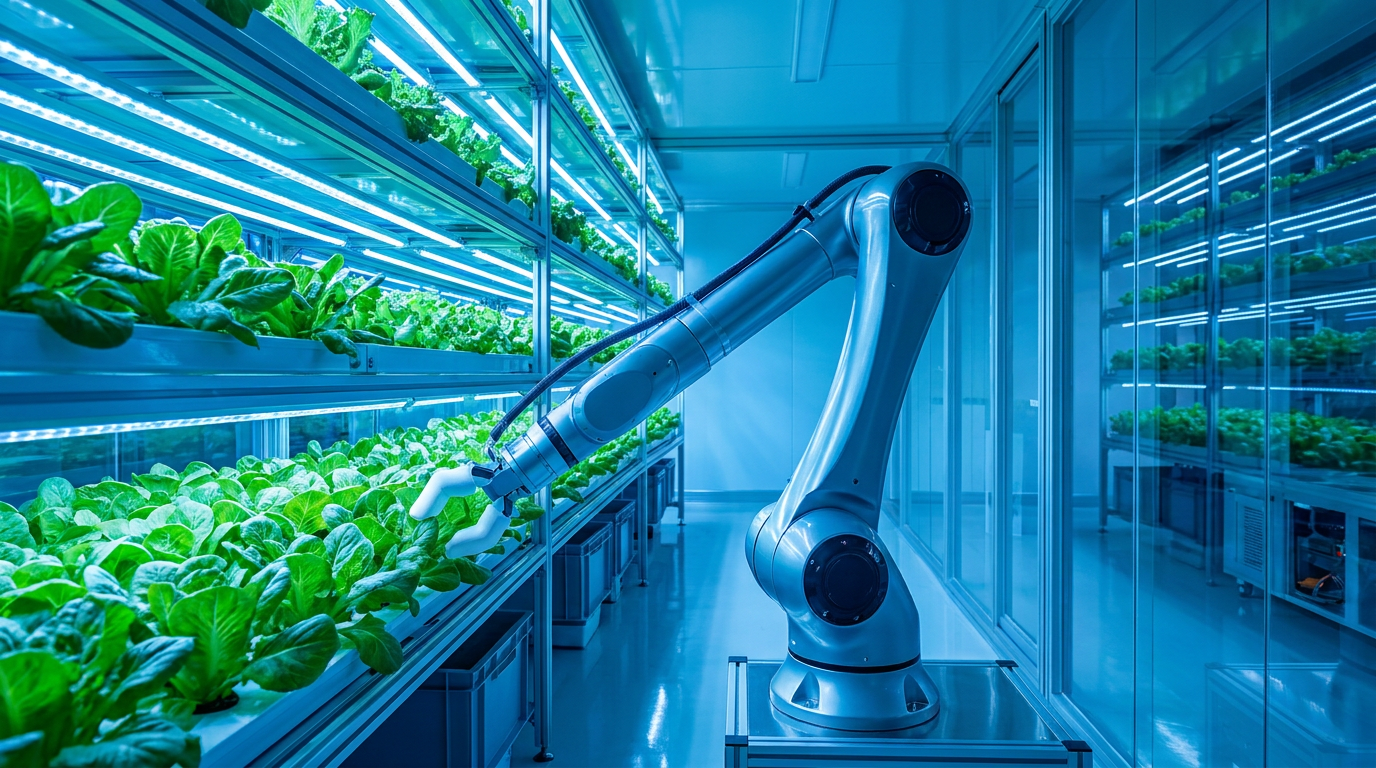
The latest generation of robotic harvesters utilizes advanced computer vision—combining RGB, multispectral, and hyperspectral cameras—to assess crop ripeness in real-time. Convolutional neural networks process these images instantly, allowing a robotic arm equipped with a soft, specialized gripper to identify and pluck a delicate strawberry or head of lettuce without bruising the produce.[6][7]

These autonomous machines can operate continuously, 24 hours a day, in the tightly packed, multi-tiered racks of a vertical farm where human navigation is difficult. By automating the harvest, farms are able to redirect their human workforce toward higher-value tasks, such as facility management and crop strategy, while maintaining a consistent, predictable output for retail partners.[6]
The commercial impact of this technological convergence is undeniable. Leading operators in 2026, such as Bowery Farming and Plenty, are running their facilities on proprietary AI operating systems that ingest billions of data points to orchestrate everything from seed placement to harvest timing. These are no longer just farms; they are highly calibrated biological manufacturing facilities.[4]
Market analysts project explosive growth as these efficiencies take hold. The global vertical farming market, valued at roughly $7.8 billion in 2025, is now forecast to exceed $60 billion by 2035, growing at a compound annual rate of over 22 percent. This growth is heavily concentrated in regions facing climate stress, water scarcity, or dense urbanization where traditional farming is impossible.[5]

Challenges certainly remain. The initial capital expenditure required to build an AI-driven, fully automated vertical farm is immense, meaning the technology is currently restricted to well-funded corporate operators rather than independent family farmers. The industry must also continue to decarbonize its energy sources, as even highly optimized indoor farms draw significantly more power from the grid than a sunlit field.[4][7]
Yet, the trajectory is clear. By successfully marrying the biological needs of plants with the computational power of artificial intelligence, the agricultural technology sector has built a resilient, climate-proof method of food production. As the global population climbs toward 9.7 billion, these autonomous indoor farms will be critical to ensuring that fresh, sustainable food is available exactly where it is needed most.[1][7]
How we got here
Early 2020s
Vertical farming experiences a boom in investment, but operators struggle with massive electricity and labor costs.
2023–2025
A wave of bankruptcies hits the sector as early pioneers fail to achieve profitable unit economics.
Late 2024
Cornell University publishes research proving AI can reduce indoor farming energy consumption by 25 percent.
2026
AI and robotic automation become standard in commercial facilities, driving the sector toward a projected $60 billion valuation.
Viewpoints in depth
Agri-Tech Innovators
Technology developers view AI as the only viable path to scaling indoor agriculture.
For the companies building these systems, traditional farming is too vulnerable to climate change, and early vertical farming was too vulnerable to electricity prices. Innovators argue that by removing human guesswork and manual labor from the equation, AI transforms agriculture into a predictable manufacturing process. They point to proprietary operating systems that manage billions of data points daily, ensuring that crop yields are consistent enough to secure massive, long-term contracts with national grocery chains.
Academic Researchers
Scientists focus on the precise environmental and resource efficiencies unlocked by machine learning.
Researchers at institutions like Cornell and UC Davis are less focused on corporate profitability and more interested in the underlying math of sustainability. Their studies validate that AI isn't just a buzzword in agriculture; it provides measurable, peer-reviewed reductions in kilowatt-hours and water usage. By training complex LSTM models to anticipate plant transpiration and shifting weather patterns, academics are proving that controlled environments can eventually become a net-positive for global resource conservation.
Market Analysts
Financial observers highlight the sector's rapid growth but warn of high barriers to entry.
Market analysts acknowledge that the integration of AI has saved the vertical farming industry from its mid-2020s slump, projecting a massive compound annual growth rate through 2035. However, they caution that the capital expenditure required to build a fully autonomous, AI-driven facility is staggering. This dynamic is expected to consolidate the market, leaving food production in the hands of a few heavily funded corporate operators while pricing out smaller, independent farmers who cannot afford the robotics required to compete.
What we don't know
- Whether the high initial capital costs of AI-driven farms will ever drop low enough for independent, small-scale farmers to adopt them.
- How quickly national energy grids can supply enough renewable power to make these highly electrified farms truly carbon-neutral.
Key terms
- Controlled Environment Agriculture (CEA)
- A technology-based approach to food production that optimizes indoor growing conditions, such as temperature, humidity, and lighting, to maximize yield.
- Long Short-Term Memory (LSTM) model
- A type of artificial intelligence designed to spot complex patterns and make predictions over time, used in agriculture to forecast greenhouse climates.
- Multispectral Imaging
- Camera technology that captures image data across specific wavelength ranges, allowing robotic systems to assess plant health and ripeness beyond what the human eye can see.
- Aeroponics
- A method of growing plants in an air or mist environment without the use of soil, often utilized in high-tech vertical farms.
Frequently asked
How does AI reduce energy costs in vertical farming?
AI analyzes real-time sensor data to create micro-climate zones, delivering precise temperature and lighting only where needed. It also monitors electricity prices to shift energy-intensive tasks to cheaper, off-peak hours.
Can robots harvest delicate crops without damaging them?
Yes. Modern agricultural robots use multispectral computer vision to identify ripe produce and employ specialized soft grippers to handle delicate items like berries and leafy greens without bruising them.
Is vertical farming actually profitable?
Historically, it struggled with high energy and labor costs, leading to bankruptcies. However, the integration of AI and automation has significantly lowered the cost per unit, making scaled operations profitable in 2026.
How much water does vertical farming save?
Vertical farms typically utilize up to 97 percent less water than traditional field agriculture, and AI-driven precision irrigation is reducing nutrient and water waste even further.
Sources
Source coverage
7 outlets
3 viewpoints surfaced







[1]Cornell UniversityAcademic Researchers
Artificial Intelligence Can Regulate Light and Climate Systems to Reduce Energy Use in Plant Factories
Read on Cornell University →[2]UC DavisAcademic Researchers
Forecasting greenhouse behavior using Long Short-Term Memory models
Read on UC Davis →[3]AgEYE TechAgri-Tech Innovators
AI indoor farming automation is real, and it's delivering measurable results
Read on AgEYE Tech →[4]OmdenaAgri-Tech Innovators
Top Vertical Farming Companies Operating at Scale in 2026
Read on Omdena →[5]Cervicorn ConsultingMarket Analysts
Vertical Farming Market Size 2026 to 2035
Read on Cervicorn Consulting →[6]Trax TechnologiesAgri-Tech Innovators
Data-driven agricultural operations and precision irrigation
Read on Trax Technologies →[7]Factlen Editorial Team
Synthesis by Factlen editorial team
Read on Factlen Editorial Team →

More in ai
See all 86 stories →Local AI
The Rise of Local AI: How to Run Frontier Models on Your Own Hardware
6 sources

AI Governance
US Pivots to Voluntary AI Security Framework as EU Delays High-Risk Compliance
7 sources

Drug Discovery
New AI Model Speeds Up Drug Discovery Simulations 10,000 Times
7 sources

Enterprise AI
Why Enterprises Are Abandoning Massive AI for 'Small Language Models'
7 sources

Every angle. Every day.
Get ai stories with full source coverage and perspective breakdowns delivered to your inbox.