
Global Shutter Explained: The Camera Tech Changing Photography in 2026
Global shutter technology captures every pixel simultaneously, eliminating motion distortion and revolutionizing flash photography. Here is how the biggest sensor breakthrough in a decade actually works, and whether you need it.
By Factlen Editorial Team
- Action & Sports Photographers
- Value speed, zero distortion, and blackout-free shooting above all else.
- Cinema & Video Professionals
- Value the elimination of the jello effect and LED banding for smooth cinematic motion.
- Landscape & Studio Photographers
- Prefer traditional sensors for maximum dynamic range and low-light fidelity.
What's not represented
- · Casual smartphone photographers who rely on computational photography rather than sensor hardware.
- · Third-party flash manufacturers adapting to new sync speed requirements.
Why this matters
For years, fast-moving subjects and artificial lighting caused warped images and banding due to how camera sensors read light. Global shutter eliminates these physical limitations, allowing photographers and videographers to capture flawless high-speed action and sync flashes at unprecedented speeds.
Key points
- Traditional rolling shutters scan images row-by-row, causing distortion in fast-moving subjects.
- Global shutters expose every pixel simultaneously, freezing motion perfectly.
- The technology eliminates the 'jello effect' in video and banding from LED lights.
- Global shutters allow flash synchronization at any shutter speed, up to 1/80,000s.
- Trade-offs include a higher base ISO and a slight reduction in dynamic range.
- The tech is currently aimed at high-end sports, action, and hybrid video shooters.
For decades, digital photography has been bound by an invisible physical limitation: the way a camera sensor reads light. As cameras transitioned from mechanical film to digital sensors, the industry adopted an architecture that prioritized image quality and cost-efficiency over absolute speed.[1][6]
Most modern cameras use what is known as a "rolling shutter." When you take a photo or record a video, the sensor does not capture the entire frame at once. Instead, it scans the image sequentially, reading the pixel data row by row, from top to bottom.[2]
While this scanning happens in tiny fractions of a second, it is not instantaneous. If a subject is moving incredibly fast—like a golf club mid-swing or an airplane propeller—the subject actually changes position before the sensor finishes reading the bottom rows of the frame.[1][2]
This slight delay creates motion distortion. Straight lines bend, fast-spinning wheels become ovals, and fast-panning video suffers from the notorious "jello effect," where the entire background appears to wobble and skew unnaturally.[2][5]

Rolling shutters also severely limit flash photography. Because the sensor is never fully exposed all at once at high speeds, photographers are typically capped at a "sync speed" of around 1/250th of a second when using artificial strobes.[1][4]
To shoot faster with a flash, photographers must use High-Speed Sync (HSS), a workaround that pulses the flash rapidly as the sensor scans. However, this drains the strobe's power, making it difficult to overpower bright sunlight or freeze intense action.[3][4]
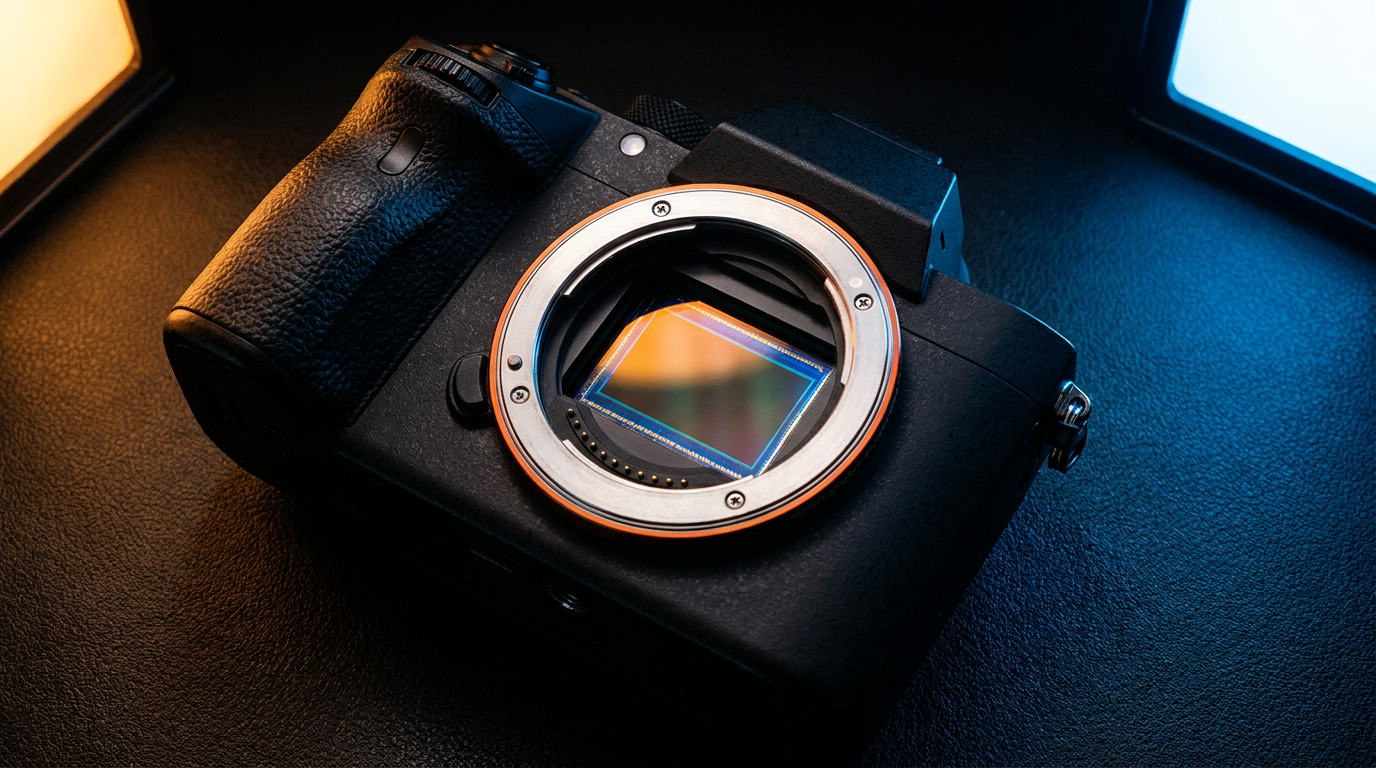
Enter the global shutter. Unlike a rolling shutter, a global shutter exposes every single pixel on the sensor simultaneously. It acts like a true snapshot, freezing a perfect slice of time with zero scanning delay.[1][2]
When the exposure ends, the pixel data is transferred to a readout buffer all at once, and then processed row by row. Because every pixel records light at the exact same moment, motion distortion is entirely eliminated from the final image.[2]

When the exposure ends, the pixel data is transferred to a readout buffer all at once, and then processed row by row.
The engineering required to achieve this in a high-resolution, full-frame sensor is immense. Global shutter pixels require complex additional circuitry to hold the electrical charge simultaneously, which generates more heat and takes up valuable physical space on the silicon.[5]
This is why global shutters were historically restricted to low-resolution industrial machine vision, robotics, and drone mapping, where distortion-free capture is mathematically critical for computer vision algorithms.[2][5]
However, the technology has finally crossed into mainstream professional photography. Sony's A9 III became the first full-frame mirrorless camera to feature a global shutter, capable of shooting 120 frames per second with zero blackout and flawless autofocus.[3]
For flash photography, the global shutter represents a paradigm shift. Because the entire sensor is exposed at once, the camera can sync with a flash at any shutter speed—up to an astonishing 1/80,000th of a second.[3][4]
This allows photographers to shoot wide open at f/1.4 in broad daylight, using a fraction of their strobe's power to perfectly illuminate a subject while dramatically darkening the ambient background.[4]
Videographers also reap massive benefits. Beyond eliminating the jello effect during fast camera movements, global shutters eradicate the ugly banding artifacts caused by flickering LED lights and stadium screens.[1][5]

But this technological leap comes with distinct trade-offs. Because the complex pixel architecture leaves less room for light-gathering, first-generation full-frame global shutters suffer a slight penalty in dynamic range.[5]
The base ISO on these sensors typically starts higher—around ISO 250—meaning they cannot capture the same extreme shadow-to-highlight detail as a traditional rolling shutter sensor at ISO 100.[4][5]
They also tend to exhibit slightly more noise in low-light conditions, making them less ideal for landscape, studio, or astrophotography where absolute image fidelity is paramount.[5]

How we got here
Early 2000s
CCD sensors, which featured a form of global shutter, are largely replaced by cheaper, higher-quality CMOS rolling shutters.
2010s
Global shutter CMOS sensors are developed but restricted to low-resolution industrial and scientific cameras.
November 2023
Sony announces the A9 III, the world's first full-frame mirrorless camera with a global shutter sensor.
Spring 2024
The Sony A9 III hits the market, proving the viability of global shutters for professional sports and flash photography.
2026
Global shutter technology begins expanding into higher-resolution drone mapping and specialized video applications.
Viewpoints in depth
Action & Sports Photographers
Professionals who prioritize speed and distortion-free capture above all else.
For photographers shooting the Olympics, motorsports, or erratic wildlife, the global shutter is a revelation. The ability to shoot 120 frames per second without the viewfinder blacking out means they never lose track of a subject. More importantly, they no longer have to worry about a golf club bending unnaturally or a baseball warping mid-flight. For this camp, the slight hit to dynamic range is a negligible price to pay for absolute motion accuracy.
Cinema & Video Professionals
Filmmakers who need smooth motion and artifact-free footage.
Videographers have battled rolling shutter since the dawn of DSLR filmmaking. Fast pans traditionally resulted in vertical lines leaning diagonally, ruining the cinematic feel of a shot. Furthermore, modern venues are filled with LED screens and lighting that flicker at frequencies out of sync with rolling shutters, causing ugly banding across the footage. Global shutters eliminate both the jello effect and LED banding, making them highly coveted for documentary and commercial video work.
Landscape & Studio Photographers
Creators who prioritize absolute image quality, dynamic range, and low-light performance.
For photographers shooting static subjects—like landscapes, architecture, or controlled studio portraits—the global shutter offers little practical benefit. These camps rely heavily on recovering shadow detail and preserving highlights, which requires maximum dynamic range. Because global shutter sensors currently have a higher base ISO and slightly more noise, landscape and studio shooters generally prefer traditional rolling shutter sensors that offer cleaner, more malleable raw files.
What we don't know
- How quickly global shutter technology will trickle down to entry-level consumer cameras.
- Whether future sensor designs can completely close the dynamic range gap with rolling shutters.
- How third-party flash manufacturers will adapt their hardware to keep up with 1/80,000s sync speeds.
Key terms
- Rolling Shutter
- A method of image capture where the sensor records light sequentially, row by row, which can cause distortion in fast-moving subjects.
- Global Shutter
- A sensor architecture that exposes every pixel to light at the exact same time, eliminating all motion distortion.
- High-Speed Sync (HSS)
- A flash mode that pulses light rapidly to accommodate a rolling shutter at high speeds, though it significantly reduces the flash's overall power.
- Dynamic Range
- The ratio between the darkest and brightest parts of an image that a camera sensor can capture without losing detail.
- Jello Effect
- A visual artifact in video where fast camera movement causes the image to wobble or skew diagonally due to rolling shutter scanning.
Frequently asked
Why do airplane propellers look bent in my photos?
This is caused by a rolling shutter. The propeller moves significantly between the time the camera sensor starts scanning the top of the frame and finishes at the bottom.
Do I need a global shutter for portrait photography?
Generally, no. Portrait photographers usually benefit more from the higher dynamic range and lower base ISO provided by traditional rolling shutter sensors.
Can I use my old flash with a global shutter camera?
Yes, but you may run into limitations with the flash's duration. At extreme shutter speeds like 1/80,000s, the camera is faster than the time it takes for the flash bulb to fully discharge its light.
Does a global shutter improve low-light performance?
No. In fact, first-generation global shutters often have slightly more noise and a higher base ISO than rolling shutters due to the complex circuitry required on the sensor.
Sources
Source coverage
6 outlets
3 viewpoints surfaced






[1]DPReviewLandscape & Studio Photographers
What is global shutter and what does it mean for photographers?
Read on DPReview →[2]e-con SystemsCinema & Video Professionals
Global Shutter or Rolling Shutter: Which Camera Do You Need?
Read on e-con Systems →[3]PCMagAction & Sports Photographers
Hands On: Sony's Speedy a9 III Has a Global Shutter
Read on PCMag →[4]FstoppersAction & Sports Photographers
Should You Buy the Sony a9 Mark III?
Read on Fstoppers →[5]Daily Camera NewsCinema & Video Professionals
Global Shutter Sensors: The End of Rolling Shutter?
Read on Daily Camera News →[6]Factlen Editorial TeamLandscape & Studio Photographers
Synthesis by Factlen editorial team
Read on Factlen Editorial Team →

Every angle. Every day.
Get shopping stories with full source coverage and perspective breakdowns delivered to your inbox.