
SpaceX Shatters Global IPO and Options Records in Historic $85.7 Billion Market Debut
Elon Musk's space exploration company executed the largest public offering in history, minting thousands of employee millionaires and sparking an unprecedented frenzy in the options market.
By Factlen Editorial Team
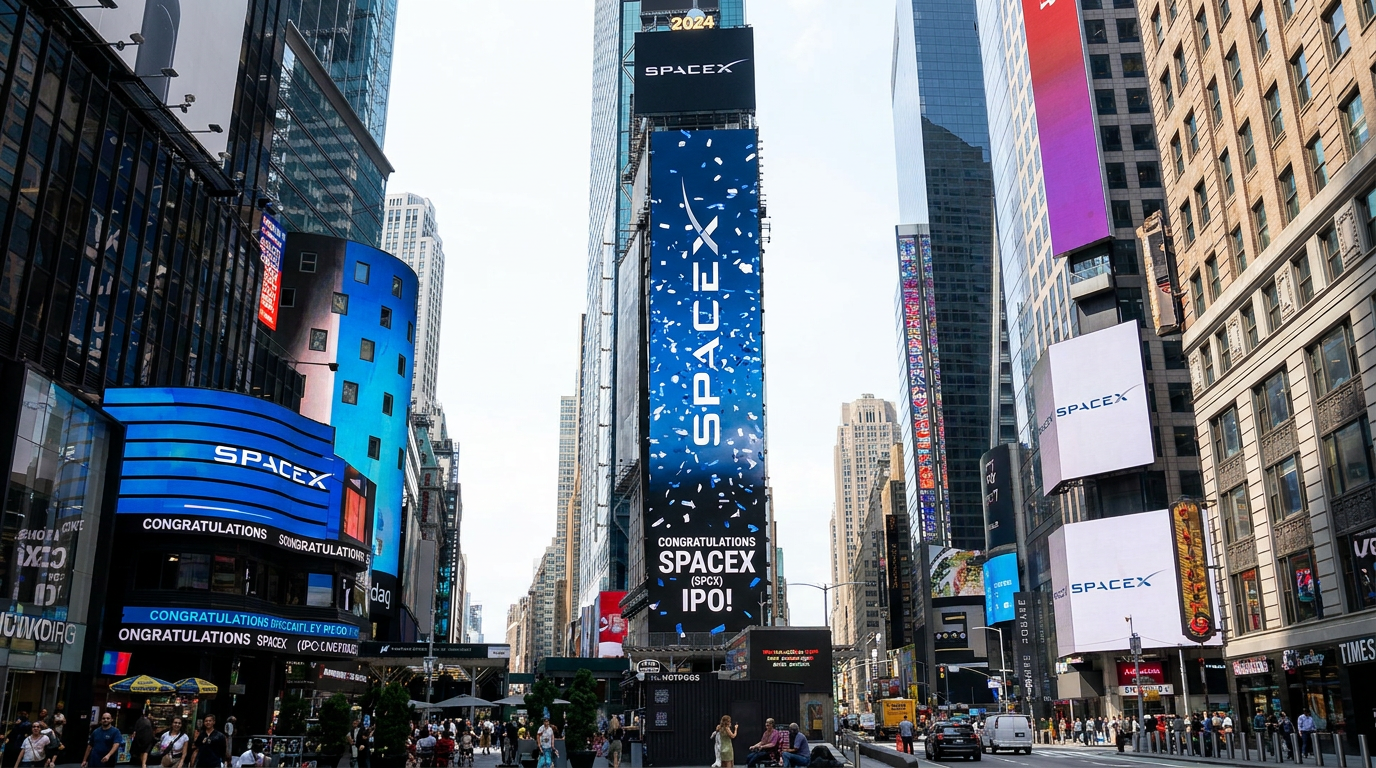
- Institutional Investors
- Large financial institutions and exchange operators view the IPO as a triumph of market infrastructure and a massive liquidity event.
- Retail & Speculative Traders
- Retail investors and speculative traders view the SpaceX IPO as a generational wealth-building opportunity, driving unprecedented volume in call options.
- Fundamental Analysts
- Traditional market analysts urge caution, pointing to the massive disconnect between SpaceX's $2.1 trillion valuation and its current lack of profitability.
What's not represented
- · Retail investors who were locked out of the fixed-price allocation
- · Competitors in the aerospace sector facing a newly capitalized giant
Why this matters
SpaceX's debut proves that public markets can still absorb and reward generational mega-cap tech listings. The sheer scale of the capital raised will accelerate the commercialization of space, while the stock's inclusion in major indexes means millions of retail retirement accounts will soon hold a stake in the orbital economy.
Key points
- SpaceX raised a record-breaking $85.7 billion in its IPO, surpassing Saudi Aramco to become the largest public listing in history.
- The company's stock surged 19.2% on its first day of trading, pushing its market capitalization past $2.1 trillion.
- Options trading for the newly listed stock shattered records, with 1.8 million contracts changing hands on the first day.
- The massive liquidity event minted roughly 4,400 employee millionaires and delivered historic paper gains to early venture capital backers.
- Despite the record-breaking valuation, analysts note the company remains unprofitable as it invests heavily in space infrastructure.
The public debut of SpaceX has rewritten the record books of global finance, transforming Elon Musk's rocket and satellite conglomerate into a $2.1 trillion publicly traded juggernaut. Trading under the ticker SPCX, the company's initial public offering raised an unprecedented $85.7 billion, obliterating the previous global record set by Saudi Aramco in 2019.[1][2]
The sheer scale of the listing tested the structural limits of the U.S. equity markets, yet the execution was remarkably seamless. After pricing at $135 per share, the stock opened on the Nasdaq at $150 and closed its first day at $160.95, a 19.2% surge that cemented its mega-cap status.[2][5]

"It wasn't just Nasdaq, it was the whole community," noted Nasdaq President Nelson Griggs, pointing to the highly coordinated effort required to process more than 500 million shares of trading volume without triggering a single volatility pause.[2]
To streamline the massive, internationally dispersed investor pool, SpaceX bypassed traditional IPO mechanics in favor of a fixed-price model. Nasdaq CEO Adena Friedman explained that setting a firm valuation allowed investors to make clear decisions without the typical pre-market price discovery chaos.[2]
The historic equity debut was immediately followed by an equally staggering milestone in the derivatives market. When SpaceX options officially launched on Tuesday, investors traded roughly 1.8 million contracts, making it the busiest first day of options trading ever recorded for a newly listed company.[3][4][6]
The volume shattered the previous record of 364,000 contracts set by Meta Platforms following its 2012 market debut. In dollar terms, analysts estimated that roughly $2.8 billion worth of options premium changed hands during the session, indicating intense speculative and institutional interest.[3]

"We're seeing record first day of trading activity in SpaceX options—traded about 10,000 contracts per minute early on," noted Henry Schwartz, vice president of derivatives market intelligence at Cboe.[4]
The options frenzy was heavily skewed toward bullish bets, with the put-call ratio sitting at roughly 0.7. The most actively traded contracts were call options tied to ambitious share price targets, including heavy volume in $380 strike calls due to expire within the week.[3][4][6]
The options frenzy was heavily skewed toward bullish bets, with the put-call ratio sitting at roughly 0.7.
However, derivatives experts caution that not all of this activity is pure speculation. Given the heavy volume and SpaceX's relatively small free float—only about 4% of total shares are currently available to trade—many of these out-of-the-money calls are likely being used by institutional investors as part of complex, multi-leg risk management strategies.[4]
Beyond the trading floor, the IPO triggered one of the largest wealth-creation events in corporate history. According to pre-IPO trading platform Hill.com, the listing minted roughly 4,400 current and former SpaceX employees as millionaires, with about 400 holding stakes worth more than $100 million.[7]
Early institutional backers also booked some of the largest paper gains in venture-capital history. Founders Fund, which invested $20 million in 2008 after SpaceX suffered three failed rocket launches, now sits on a position worth more than $75 billion. Alphabet and Fidelity, which invested in 2015, saw their stakes balloon to $75 billion and $44 billion, respectively.[7]

For Musk, who retains 82.4% of the company's voting power, the successful listing pushed his personal net worth past the $1.1 trillion mark, making him the world's first trillionaire.[1][5]
Despite the euphoria, some market analysts point to the company's underlying financials as a reality check. While SpaceX boasts a $2.1 trillion valuation, it remains unprofitable, having lost $8.7 billion between the start of 2025 and March 2026.[5]
"Alphabet, Apple and Nvidia are producing annual after-tax profits of more than $100 billion a year," noted Jay Ritter, an IPO expert at the University of Florida. "There's a long way to go to catch up with the profitability of those mega caps."[5]
Nevertheless, investors appear more focused on the company's monopolistic grip on the space economy and its rapidly expanding Starlink satellite internet business. SpaceX Chief Financial Officer Bret Johnsen confirmed that the $85.7 billion capital injection will directly fund long-term infrastructure deployments, including space launch capabilities and frontier artificial intelligence.[2]
As SpaceX shares prepare to join major indexes like the Nasdaq 100 and Russell indices in the coming days, the stock is expected to see another wave of mandatory buying from passive funds. For Wall Street, the successful launch proves that the market's appetite for ambitious, capital-intensive technological leaps remains stronger than ever.[5]
How we got here
2008
Founders Fund invests $20 million in SpaceX after the company suffers three consecutive failed rocket launches, a stake now worth over $75 billion.
2015
Alphabet and Fidelity invest in SpaceX at a $10 billion valuation, securing stakes that would eventually yield massive paper gains.
May 2026
SpaceX publicly discloses its IPO paperwork, revealing plans to raise $75 billion at a record $1.77 trillion valuation.
June 12, 2026
SpaceX officially debuts on the Nasdaq, with shares surging 19% on the first day of trading to close at $160.95.
June 15, 2026
Underwriters exercise their greenshoe option, bringing the total IPO capital raised to a record-shattering $85.7 billion.
June 16, 2026
SpaceX options officially launch, shattering the previous first-day trading record with 1.8 million contracts changing hands.
Viewpoints in depth
Retail & Speculative Traders
Retail investors and speculative traders view the SpaceX IPO as a generational wealth-building opportunity, driving unprecedented volume in call options.
This camp is responsible for the staggering 1.8 million options contracts traded on the first day, heavily skewed toward bullish call options with strike prices as high as $380. For these traders, SpaceX represents the ultimate "moonshot" stock, offering pure-play exposure to the burgeoning space economy, satellite internet, and frontier AI. They are less concerned with current profitability and more focused on the company's monopolistic market position and Elon Musk's track record of scaling disruptive technologies.
Institutional Investors & Underwriters
Large financial institutions and exchange operators view the IPO as a triumph of market infrastructure and a massive liquidity event.
For Wall Street banks and exchange operators like Nasdaq, the seamless execution of a $85.7 billion listing—bypassing traditional pricing mechanics for a fixed-price model—proves the structural resilience of U.S. capital markets. Institutional players are aggressively accumulating shares to match benchmark weightings ahead of SpaceX's inclusion in major indices like the Nasdaq 100. In the options market, institutions are utilizing the heavy liquidity not for speculation, but to construct complex, multi-leg hedges to manage risk around their massive new equity positions.
Fundamental Analysts & Skeptics
Traditional market analysts urge caution, pointing to the massive disconnect between SpaceX's $2.1 trillion valuation and its current lack of profitability.
Skeptics highlight that while SpaceX's technological achievements are unparalleled, its financial fundamentals do not yet justify a valuation that rivals Apple or Nvidia. The company lost $8.7 billion between early 2025 and March 2026, generating a fraction of the revenue seen by other mega-cap tech giants. This camp warns that the stock's low free float (only 4% of shares available to trade) is artificially inflating the share price through a supply-demand imbalance, leaving retail investors vulnerable to a sharp correction once lock-up periods expire and more shares flood the market.
What we don't know
- How the stock will perform once the initial lock-up periods expire and insiders are permitted to sell their shares.
- Whether the unprecedented options volume will lead to extreme price volatility or 'gamma squeezes' in the coming weeks.
- How quickly SpaceX can transition its capital-intensive Starlink and launch operations into consistent, mega-cap-level profitability.
Key terms
- Initial Public Offering (IPO)
- The process by which a private company offers shares of its stock to the public for the first time, allowing it to raise capital from public investors.
- Options Contract
- A financial derivative that gives an investor the right, but not the obligation, to buy (call) or sell (put) a stock at a specific price before a certain date.
- Greenshoe Option
- A provision in an IPO underwriting agreement that allows the underwriters to sell more shares than originally planned if investor demand is higher than expected.
- Free Float
- The portion of a company's shares that are freely available to be traded by the public on the open market, excluding locked-in shares held by insiders.
- Put-Call Ratio
- A measurement of trading volume in put options (bets that a stock will fall) compared to call options (bets that a stock will rise), used to gauge market sentiment.
Frequently asked
How much did SpaceX raise in its IPO?
SpaceX raised a record-breaking $85.7 billion, far surpassing the previous global record of $29 billion set by Saudi Aramco in 2019.
What is SpaceX's stock ticker symbol?
SpaceX trades on the Nasdaq Stock Exchange under the ticker symbol SPCX.
Why was the options trading volume so high?
Investors traded 1.8 million options contracts on the first day, driven by a mix of retail traders making speculative bets on the stock's upside and institutional investors using complex strategies to manage risk.
Is SpaceX currently a profitable company?
No. Despite its $2.1 trillion valuation, SpaceX remains unprofitable, having reported an $8.7 billion loss between the start of 2025 and March 2026 as it invests heavily in infrastructure.
How did the IPO impact Elon Musk's net worth?
The successful listing and subsequent stock surge pushed Elon Musk's net worth past $1.1 trillion, making him the world's first trillionaire.
Sources
Source coverage
7 outlets
3 viewpoints surfaced







[1]ForbesInstitutional Investors
SpaceX Says Historic IPO Raised More Than $85 Billion
Read on Forbes →[2]NasdaqInstitutional Investors
SpaceX Makes History, Raising $85.7 Billion through Nasdaq Listing
Read on Nasdaq →[3]Fortune IndiaFundamental Analysts
Elon Musk's SpaceX smashes first-day options trading record after historic IPO
Read on Fortune India →[4]MarketWatchRetail & Speculative Traders
Investors pile into moonshot SpaceX bets as first-day options trading shatters records
Read on MarketWatch →[5]CBS NewsFundamental Analysts
SpaceX stock soars 19% on first day of trading following record-breaking $75 billion IPO
Read on CBS News →[6]Fox BusinessRetail & Speculative Traders
SpaceX IPO SHATTERS Records as Options Trading Explodes
Read on Fox Business →[7]Trending TopicsInstitutional Investors
SpaceX IPO Made 4,400 Employees Millionaires
Read on Trending Topics →

More in finance
See all 5 stories →SpaceX IPO
SpaceX Shatters Wall Street Records With $85.7 Billion IPO and Unprecedented Options Debut
7 sources
Wealth Protection
The One-Page Pledge That Forces Your Financial Advisor to Put You First
6 sources

Financial Advice
The One-Page Pledge That Forces Your Financial Adviser to Put You First
6 sources

Every angle. Every day.
Get finance stories with full source coverage and perspective breakdowns delivered to your inbox.