
The End of the 'Paper Ceiling': How to Build a Skills-First Resume for 2026
With 70% of employers now prioritizing demonstrated abilities over college degrees, the traditional chronological resume is becoming obsolete. Here is how to restructure your application to match the new era of skills-based hiring.
By Factlen Editorial Team
- Skills-First Advocates
- Argue that dropping degree requirements democratizes the labor market and allows candidates to be judged on actual capabilities.
- Labor Market Analysts
- Emphasize that while the rhetoric around skills-based hiring is loud, actual corporate follow-through requires structural changes to HR systems.
- Corporate Recruiters
- Focus on the practical need to widen talent pools and find adaptable workers who can keep pace with rapid technological changes.
What's not represented
- · University Career Counselors
- · Traditional Degree Holders
Why this matters
The rules of getting hired have fundamentally changed. If you are still relying on a traditional chronological resume that highlights your education and past job titles over your actual capabilities, you are likely being filtered out by modern screening systems before a human ever sees your application.
Key points
- 70% of employers now use skills-based hiring for entry-level positions.
- GPA screening has dropped significantly, falling from 73.3% in 2019 to 42.1% in 2026.
- A skills-first resume flips the traditional format by leading with a targeted cluster of competencies.
- Job seekers must replace passive duty descriptions with measurable, quantified outcomes.
- Companies that successfully implement skills-based hiring see a 10% boost in employee retention.
The traditional resume was a timeline of pedigree. It highlighted where you went to school, what your grade point average was, and presented a chronological list of past job titles. For decades, this "paper ceiling" dictated who secured an interview and whose application was quietly discarded into the rejection pile.
In 2026, that formula is officially inverted. Driven by a rapidly evolving technological landscape and a desperate need for adaptable talent, the corporate world is abandoning the degree-first filter in favor of a more meritocratic approach known as skills-based hiring.
The data reveals a structural transformation in how companies screen candidates. According to the National Association of Colleges and Employers (NACE), 70 percent of employers now utilize skills-based hiring for entry-level roles.[4]
Conversely, the traditional markers of academic success are losing their gatekeeping power. NACE reports that GPA screening—which was used by 73.3 percent of employers in 2019—has plummeted to just 42.1 percent in 2026.[4]

This shift extends far beyond entry-level roles. A recent survey highlighted by CBS News found that one in three U.S. companies have eliminated bachelor's degree requirements from various job postings, with another 25 percent planning to follow suit.[2]
Why the sudden pivot? The answer lies in the pace of innovation. Work is changing faster than traditional education can adapt, and a four-year curriculum designed years ago often struggles to keep pace with the tools required today, particularly in artificial intelligence and data analytics.[1]
Employers increasingly favor specific technical skills, hands-on experience, and adaptability over generalized graduate credentials. When a company needs a team to deploy a new machine-learning model or manage a cloud migration, they need proof of capability, not just a framed diploma.[5]
However, labor market analysts caution that corporate pronouncements do not always equal immediate change. A joint report by the Harvard Business School and the Burning Glass Institute found that while many companies drop degree requirements "in name only," those that genuinely overhaul their hiring practices reap massive rewards.[3]
However, labor market analysts caution that corporate pronouncements do not always equal immediate change.
These dedicated organizations experience a 10-percentage-point boost in retention among non-degreed workers compared to their degree-holding peers. Furthermore, non-degreed workers hired into these roles see an average salary increase of 25 percent, proving the model's economic viability for both sides of the desk.[3]
For job seekers, this macroeconomic shift requires a micro-level response: the complete teardown and rebuild of the traditional resume. You can no longer afford to bury your capabilities beneath a timeline of past employers.
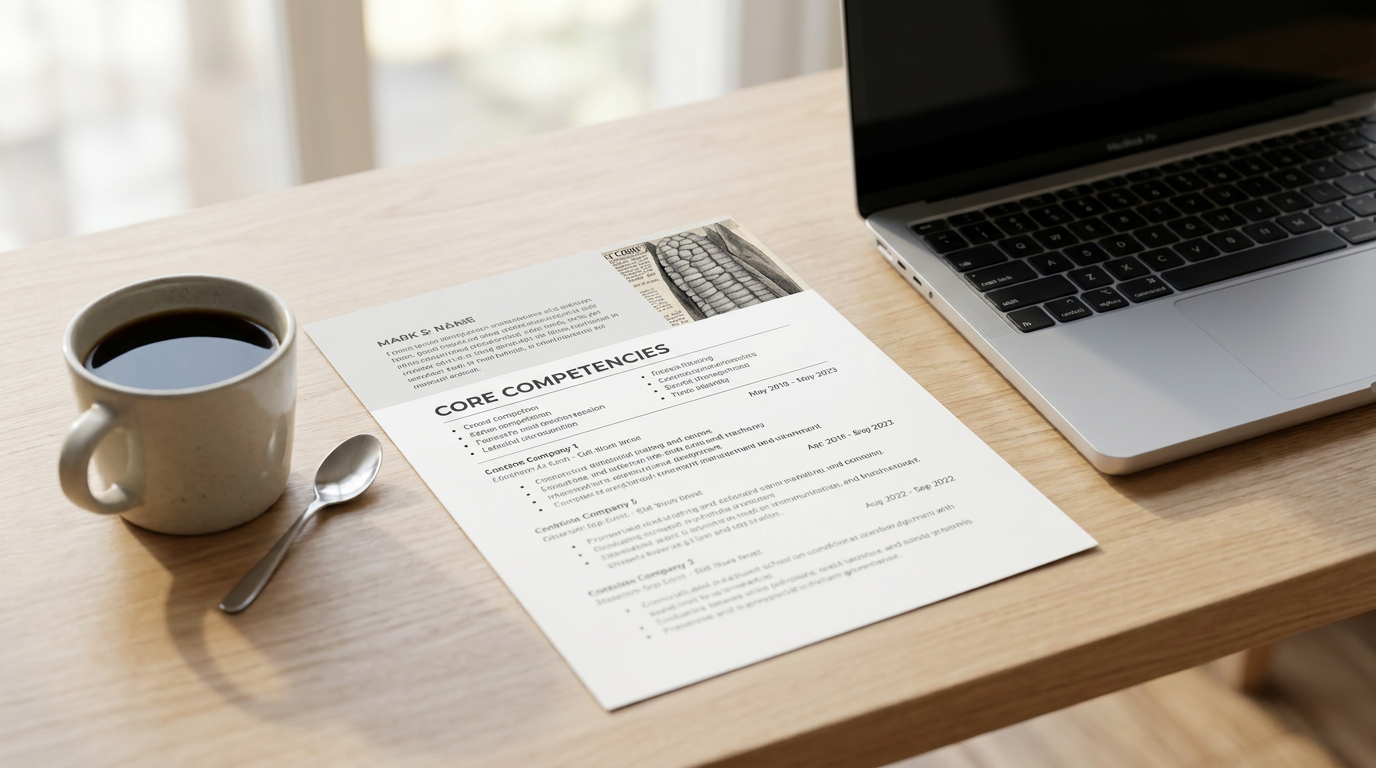
Enter the "skills-first resume." This format flips the traditional structure, leading with a robust, prioritized skills overview rather than a chronological work history. It tells the story of what you can do, rather than just where you have been.[6]

The transformation begins at the top of the page. Career experts advise replacing generic professional summaries with a targeted skills cluster that mirrors the exact vocabulary of the job description.[6]
If an employer is looking for data visualization, SQL, and stakeholder management, those exact terms must appear prominently in the top third of the document. This is not just for human eyes; it is critical for passing the automated software that parses resumes for keyword alignment.[6]
The experience section also requires a philosophical shift. Instead of listing passive duties—such as being responsible for managing client accounts—a skills-first resume demands measurable outcomes.
"Show, don't tell" is the new mandate. A bullet point must serve as evidence for the skills claimed at the top of the page, quantifying results with metrics like revenue generated, hours saved, or efficiency improved.[6]

This format is particularly empowering for career pivoters and those with non-traditional backgrounds. By leading with transferable skills—such as project management or conflict resolution—candidates can prove their value before a recruiter ever scrutinizes their past job titles.[6]
While the college degree is not dead, it is no longer the universal VIP pass it once was. In the 2026 labor market, potential is measured by proof, and continuous learning is the ultimate credential.
By adopting a skills-first resume, candidates can bypass the paper ceiling entirely, presenting themselves not as a collection of historical credentials, but as a highly capable solution to an employer's immediate needs.
How we got here
2019
Nearly three-quarters of employers (73.3%) rely on GPA to screen entry-level candidates.
2022
Major corporations begin publicly announcing the removal of degree requirements to widen talent pools.
2024
One in three U.S. companies officially eliminate bachelor's degree requirements for certain job postings.
2026
Skills-based hiring becomes the dominant screening method, utilized by 70% of employers for entry-level jobs.
Viewpoints in depth
The Skills-First Advocates' view
Focuses on how dropping degree requirements democratizes the labor market and empowers capable candidates.
Advocates for skills-based hiring argue that the traditional "paper ceiling" artificially restricted the talent pool and penalized capable individuals who could not afford a four-year university. By shifting the focus to demonstrated competencies, companies can build more diverse and resilient teams. Proponents emphasize that the skills-first resume is the ultimate equalizer, allowing career pivoters and self-taught professionals to prove their value through measurable outcomes rather than relying on institutional prestige.
The Labor Market Analysts' view
Highlights the gap between corporate pronouncements and actual changes in hiring behavior.
Labor market researchers caution that while the rhetoric surrounding skills-based hiring is overwhelmingly positive, actual implementation remains uneven. Studies from institutions like Harvard Business School reveal that many companies drop degree requirements "in name only" without updating their internal HR software or retraining hiring managers. However, analysts note that the organizations that do successfully overhaul their systems—the "Skills-Based Hiring Leaders"—are rewarded with significantly higher employee retention and better overall performance.
The Corporate Recruiters' view
Emphasizes the practical necessity of finding adaptable workers who can keep pace with rapid technological shifts.
For corporate recruiters, the shift away from GPA and degree screening is a matter of survival in a fast-moving economy. With the rapid integration of artificial intelligence and new software tools, a curriculum completed four years ago is often less relevant than a candidate's ability to learn and adapt today. Recruiters are increasingly relying on technical assessments, portfolio reviews, and skills-first resumes to quickly identify candidates who can make an immediate impact on the job.
What we don't know
- Whether the remaining companies that still require degrees will eventually be forced to drop them to remain competitive.
- How universities will adapt their four-year curricula to better align with the immediate demands of skills-based employers.
Key terms
- Skills-Based Hiring
- A recruitment strategy that evaluates candidates based on their practical abilities and competencies rather than their formal educational credentials.
- Paper Ceiling
- The invisible barrier that prevents workers without a bachelor's degree from advancing into higher-paying corporate roles.
- Applicant Tracking System (ATS)
- Software used by employers to scan, sort, and rank incoming resumes based on keyword matches and formatting.
- Transferable Skills
- Abilities and competencies acquired in one job or industry that can be effectively applied to a completely different role.
Frequently asked
What is a skills-first resume?
A skills-first resume is a format that prioritizes your demonstrated abilities, tools, and competencies at the top of the document, rather than leading with a chronological list of past job titles and education.
Do employers still care about college degrees?
While degrees remain important in specialized fields like medicine or law, they are no longer the default filter for many corporate roles. One in three U.S. companies have recently dropped bachelor's degree requirements for certain positions.
How do I prove my skills without a degree?
You can demonstrate capability through measurable outcomes in your past roles, industry certifications, project portfolios, and by passing technical assessments during the interview process.
Will Applicant Tracking Systems (ATS) reject a skills-based resume?
No, provided it is formatted cleanly. In fact, a skills-first resume that prominently features keywords from the job description is highly optimized for ATS software.
Sources
Source coverage
6 outlets
3 viewpoints surfaced





[1]ForbesSkills-First Advocates
The New Talent Pipeline: Why Skills Are Outpacing Degrees
Read on Forbes →[2]CBS NewsCorporate Recruiters
Companies are dropping college degree requirements for more jobs
Read on CBS News →[3]Harvard Business SchoolLabor Market Analysts
Skills-Based Hiring: From Pronouncements to Practice
Read on Harvard Business School →[4]NACECorporate Recruiters
Employer Use of Skills-Based Hiring Is Growing
Read on NACE →[5]Seeking AlphaLabor Market Analysts
Graduate degrees lose edge in skills-first labor market
Read on Seeking Alpha →[6]PrettyResumeSkills-First Advocates
Skills-Based Hiring Is Now Standard. Here's How to Rewrite Your Resume Around Skills.
Read on PrettyResume →


Every angle. Every day.
Get careers work stories with full source coverage and perspective breakdowns delivered to your inbox.