
Community Land Trusts Hit Historic Milestones as Neighborhoods Buy Back Their Blocks
Across the United States, the Community Land Trust movement is reaching historic milestones in 2026, transitioning from a niche housing experiment into a mainstream strategy for permanent affordability. From a landmark commercial acquisition in Brooklyn to first-generation homeowners securing property in Texas, communities are successfully removing real estate from the speculative market.
By Factlen Editorial Team
- Community Organizers
- Argue that removing land from the speculative market builds neighborhood power and prevents displacement.
- First-Generation Homebuyers
- Value the model as a crucial stepping stone to build equity and break generational cycles of renting.
- Municipal & Financial Backers
- See CLTs as a high-return, permanent investment for public funds that doesn't expire like traditional subsidies.
What's not represented
- · Traditional real estate developers who often compete with CLTs for available land.
- · Market-rate homeowners in adjacent neighborhoods who may have concerns about property values.
Why this matters
As median home prices continue to outpace wage growth, traditional affordable housing programs often expire after a set period, leaving residents vulnerable. The Community Land Trust model permanently locks in affordability, ensuring that working-class families and local businesses can remain in their neighborhoods across generations without the constant threat of displacement.
Key points
- The East New York Community Land Trust is purchasing a $2.3 million commercial property, the first acquisition of its kind in New York City history.
- The Fort Worth Community Land Trust celebrated its first homeowner, backed by a $1.1 million philanthropic grant from JPMorgan Chase.
- Municipalities in Los Angeles and Baltimore are injecting millions of dollars into trust funds specifically designed to support community-owned real estate.
- Rural land trusts are expanding in New Hampshire and California to preserve local workforces and protect open farmland.
The affordable housing crisis has long felt intractable, but a quiet revolution in how Americans own property is hitting a tipping point in the summer of 2026. Community Land Trusts (CLTs)—nonprofit organizations that acquire and hold land for the benefit of a neighborhood—are celebrating a string of historic victories from coast to coast. Transitioning from a niche housing experiment into a mainstream strategy for permanent affordability, these trusts are successfully removing real estate from the speculative market. By prioritizing collective stewardship over maximum profit, communities are proving that they can halt gentrification and secure their own futures.[3][7]
The fundamental innovation of a Community Land Trust is the separation of land ownership from the physical building. The trust retains ownership of the land itself, while individuals or local businesses purchase the structures built upon it at significantly below-market rates. Homeowners agree to a shared-equity resale formula that allows them to build modest wealth over time, while legally capping the resale price to ensure the home remains affordable for the next buyer. This mechanism effectively locks in the initial public or philanthropic subsidy forever, serving generation after generation.[3][7]
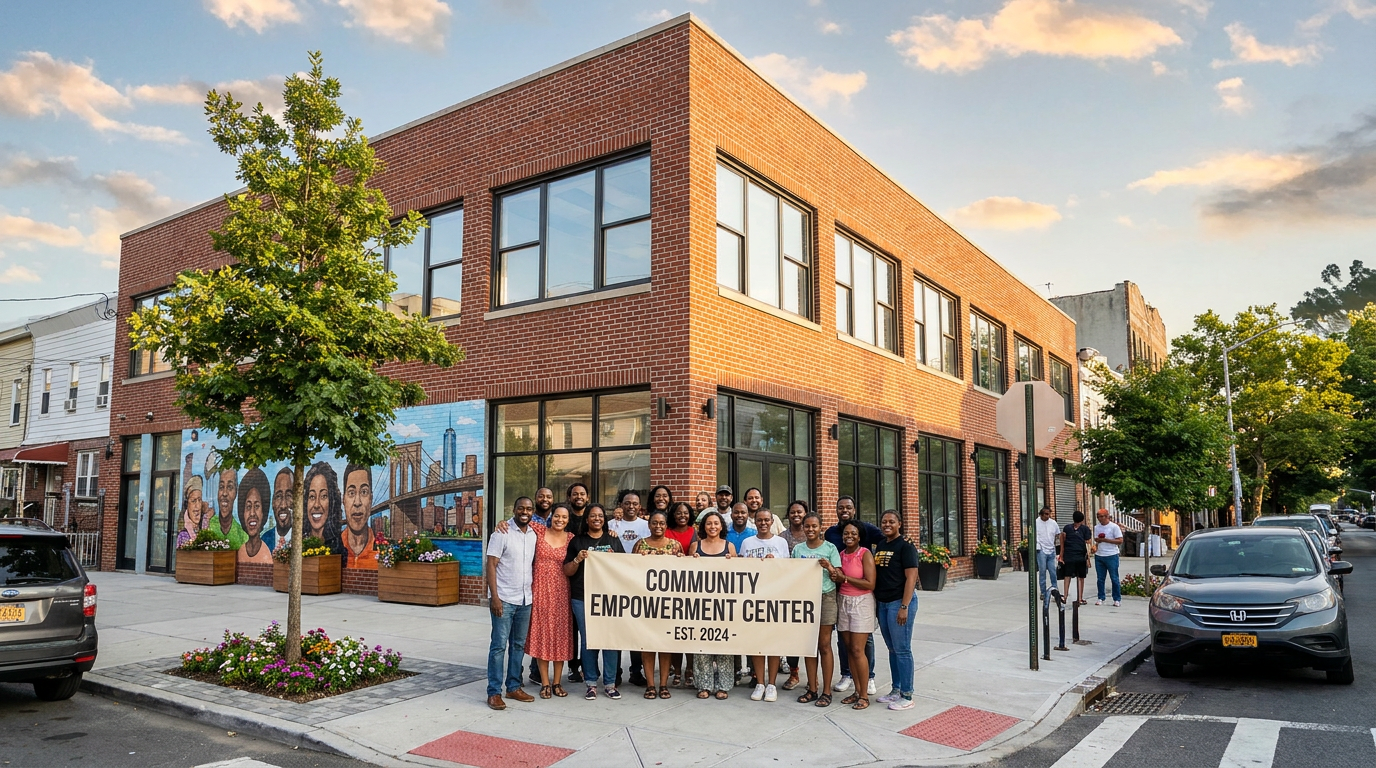
In New York City, the movement is crossing a major threshold this month. The East New York Community Land Trust is set to become the first in city history to purchase a commercial property off the private market. The organization is transforming a vacant, two-story brick building into the "East Brooklyn Liberation Center," a $2.3 million acquisition that will provide affordable office space for local businesses and nonprofits. The milestone represents a critical evolution for CLTs, proving they can protect local economies just as effectively as residential blocks.[1]

"Removing land from the speculative market is building power in the neighborhood," explained Boris Santos, president of the East New York CLT. The acquisition aims to protect East New York and Brownsville—two working-class neighborhoods facing a rising affordability crisis and a wave of gentrification approaching from the west. By anchoring economic opportunities locally, the trust ensures that the wealth generated by the community stays within the community, rather than being extracted by outside developers.[1]
The momentum extends far beyond the coasts, bringing the dream of homeownership to families who had been entirely priced out of the market. In Texas, the Fort Worth Community Land Trust recently celebrated its very first homeowner. Ashley Guinn, a first-generation homebuyer, closed on her property in the Carroll Park development, marking a deeply emotional milestone for her family. Her success illustrates the immediate human impact of the CLT model, transforming abstract housing policy into tangible stability.[2]
The momentum extends far beyond the coasts, bringing the dream of homeownership to families who had been entirely priced out of the market.
"The Fort Worth Community Land Trust program opens doors and helps break the generational curse of not owning a home or having anything to leave your kids," Guinn said after receiving her keys. To accelerate this progress across the city, JPMorgan Chase recently awarded the Fort Worth CLT a $1.1 million philanthropic grant. The funding will support community-based builders and expand the supply of attainable homes in established neighborhoods, proving that major financial institutions are increasingly viewing CLTs as viable partners.[2]

What was once a grassroots strategy is now attracting massive institutional capital from municipal governments. In California, the newly formed Los Angeles County Affordable Housing Solutions Agency (LACAHSA) launched a $15 million funding program in 2026 specifically designed to support CLTs and preserve naturally occurring affordable housing. The agency spent the first half of the year conducting listening sessions to design a framework that empowers local trusts to compete with corporate buyers in one of the nation's most expensive real estate markets.[5]
Similar public investments are unlocking doors across the country. Baltimore's Department of Housing & Community Development has earmarked up to $8 million from its Affordable Housing Trust Fund to support CLT-sponsored homeownership projects, while New York State Homes and Community Renewal rolled out a $1.5 million support program to fund the general operations of emerging land trusts. The appeal for these municipalities is the permanence of the investment. Traditional affordable housing subsidies often expire after 15 or 30 years, returning the properties to market rates. In a CLT, the public subsidy is locked into the land forever.[4][6]
The model is also proving highly adaptable to rural and suburban challenges, where housing shortages are often driven by second-home buyers and limited new construction. In New Hampshire, the Affordable Housing, Education and Development (AHEAD) organization launched a Rural Community Land Trust in the spring of 2026. The initiative aims to create permanent single-family homes in Coos, Grafton, and Carroll counties, specifically targeting the "missing middle" housing that allows local workforces to remain in their hometowns.[9]

Similarly, the Bolinas Community Land Trust in California recently finalized the purchase of the historic Tacherra ranch. The landmark acquisition will replace temporary housing with permanent homes for roughly 60 longtime residents who had been displaced, while simultaneously preserving local farmland and open space. By blending affordable housing with environmental conservation, rural CLTs are demonstrating how community ownership can solve multiple intersecting crises at once.[8]
As the movement scales rapidly, organizations are focusing heavily on capacity building to ensure these trusts can manage their growing portfolios. Enterprise Community Partners has been running extensive training series across New York State, helping grassroots organizers develop the deep real estate finance and operational expertise required to steward millions of dollars in property. Equipping local leaders with these technical skills ensures that the community-led boards can successfully navigate complex zoning laws, secure financing, and maintain the properties for decades to come.[6]
For decades, the American real estate market has been defined by rampant speculation and skyrocketing costs that displace the most vulnerable. But as the successes of 2026 demonstrate, communities are successfully rewriting the rules of ownership from the ground up. By legally decoupling the value of a home from the speculative value of the land beneath it, Community Land Trusts are proving that permanent affordability is not just a theoretical concept, but a highly scalable reality that is finally receiving the backing it deserves.[3][7]
How we got here
1969
The first Community Land Trust, New Communities Inc., is founded in Georgia by civil rights leaders to secure land for Black farmers.
1984
The Burlington Community Land Trust is founded in Vermont, demonstrating the viability of the model in urban contexts.
2019
New York City Council and State Attorney General begin injecting millions into CLT capacity-building initiatives.
2024
The East New York CLT becomes the first in NYC to buy a multifamily apartment building off the private market.
June 2026
The East New York CLT makes history again by purchasing a commercial property, while major public funds in LA and Baltimore are unlocked for land trusts.
Viewpoints in depth
Community Organizers
Focus on the decommodification of housing to build local power.
For community organizers, the speculative real estate market inherently displaces working-class people by treating homes purely as financial assets. By holding land in a trust, the community retains democratic control over its own neighborhood. This ensures that public investments and neighborhood improvements benefit the actual residents rather than enriching absentee landlords or corporate developers.
First-Generation Homebuyers
Emphasize the stability and equity-building potential of the model.
Homebuyers in a CLT acknowledge the trade-off inherent in the model. While they do not receive the massive financial windfall of a market-rate home sale, they gain the immediate stability of a fixed mortgage and the pride of ownership. For many, this is the only viable path to break the cycle of renting, allowing them to build modest equity that can eventually serve as a down payment for a future market-rate home.
Municipal & Financial Backers
Highlight the long-term efficiency of the public subsidy.
City governments and philanthropic institutions are increasingly drawn to the financial efficiency of the CLT model. A traditional affordable housing grant might keep a unit affordable for 15 to 30 years before it reverts to market rate. A grant to a Community Land Trust keeps that unit affordable for 99 years, serving multiple families over decades for the exact same initial cost.
What we don't know
- Whether the rapid influx of municipal funding will be sustained in future budget cycles if economic conditions tighten.
- How quickly newly formed rural land trusts can navigate local zoning laws to break ground on new construction.
- Whether the shared-equity model will face legal challenges from homeowners seeking to bypass resale caps in hyper-inflated markets.
Key terms
- Community Land Trust (CLT)
- A nonprofit organization that acquires and holds land for the benefit of a community, ensuring permanent affordability.
- Ground Lease
- A long-term agreement (typically 99 years) where the homeowner leases the land beneath their house from the CLT.
- Shared Equity
- A homeownership model where the buyer purchases the home at a below-market price and agrees to limit their profit upon resale to keep it affordable for the next buyer.
- Naturally Occurring Affordable Housing (NOAH)
- Residential properties that are affordable to low- and moderate-income households without government subsidies, often targeted by CLTs for preservation.
Frequently asked
Do you actually own the home in a Community Land Trust?
Yes. You own the physical structure of the home and hold a mortgage just like a traditional buyer, but you lease the land underneath it from the trust.
Can you sell a CLT home and make a profit?
Yes, but the profit is capped. The resale formula allows homeowners to build modest equity while ensuring the home remains affordable for the next low-to-moderate-income buyer.
Who runs a Community Land Trust?
CLTs are typically run by a nonprofit board of directors that includes a mix of CLT residents, broader community members, and local housing or financial experts.
Are CLTs only for residential housing?
No. While most focus on housing, CLTs are increasingly purchasing commercial properties, urban farms, and community centers to preserve local businesses and green spaces.
Sources
Source coverage
9 outlets
3 viewpoints surfaced









[1]New Economy ProjectCommunity Organizers
Next City: A Community Land Trust Is Purchasing Commercial Property in NYC for the First Time
Read on New Economy Project →[2]JPMorgan ChaseFirst-Generation Homebuyers
Fort Worth Community Land Trust celebrates first homeowner, expands access to affordable homeownership
Read on JPMorgan Chase →[3]North Carolina Housing Finance AgencyMunicipal & Financial Backers
Finding Affordable Housing through the Community Land Trust Model
Read on North Carolina Housing Finance Agency →[4]Baltimore City DHCDMunicipal & Financial Backers
Recent Notices of Funding Availability from the Affordable Housing Trust Fund
Read on Baltimore City DHCD →[5]Los Angeles County Affordable Housing Solutions AgencyMunicipal & Financial Backers
Community Land Trust / NOAH
Read on Los Angeles County Affordable Housing Solutions Agency →[6]Enterprise Community PartnersCommunity Organizers
Equipping New York's Community Land Trusts for Long-Term Success
Read on Enterprise Community Partners →[7]The Rissover FoundationMunicipal & Financial Backers
Community Land Trusts: Affordable Housing Solutions
Read on The Rissover Foundation →[8]Bolinas Community Land TrustCommunity Organizers
Bolinas land trust buys former Tacherra Ranch
Read on Bolinas Community Land Trust →[9]Caledonian RecordFirst-Generation Homebuyers
To Increase Affordable Housing, AHEAD Launches Rural Community Land Trust
Read on Caledonian Record →
Every angle. Every day.
Get community stories with full source coverage and perspective breakdowns delivered to your inbox.