
Evidence Pack: Neolithic Humans, Not Glaciers, Transported Stonehenge's 6-Ton Altar Stone
New geological modeling proves that glaciers could not have carried Stonehenge's central megalith from Scotland to southern England, confirming the 435-mile journey was a deliberate, multi-stage human logistical feat.
By Factlen Editorial Team
- Archaeological Consensus
- Focuses on the human ingenuity and complex logistics required to transport the stone.
- Geological Modelers
- Focuses on the empirical data and ice-sheet simulations that rule out natural transport.
- Doggerland Theorists
- Focuses on the intermediate step at the submerged Dogger Bank and its cultural implications.
What's not represented
- · Indigenous/Pagan Cultural Historians
- · Maritime Archaeologists
Why this matters
This discovery fundamentally rewrites our understanding of prehistoric human capabilities, proving that ancient societies possessed the engineering prowess and complex organization to execute logistical miracles long before the invention of the wheel.
Key points
- Stonehenge's six-ton Altar Stone was transported 435 miles from northeast Scotland, a journey previously debated as either natural or human-led.
- New computer simulations of Ice Age ice sheets prove that glaciers did not flow far enough south to deliver the stone to the Salisbury Plain.
- Glaciers may have moved the stone partway to Dogger Bank, leaving Neolithic humans to transport it the remaining hundreds of kilometers.
- The findings highlight a highly sophisticated level of organization, planning, and cooperation among prehistoric communities.
For centuries, the monolithic silhouettes of Stonehenge have stood as silent sentinels on the Salisbury Plain, guarding the secrets of their construction. While the origins of the monument's local sarsen stones and Welsh bluestones have been mapped, the provenance of its central megalith—the six-ton Altar Stone—remained an enigma. In 2024, scientists stunned the archaeological world by tracing the grayish-green sandstone to the Orcadian Basin in the far northeast of Scotland, some 435 miles (700 kilometers) away. The discovery immediately sparked a fierce debate: did Neolithic humans haul this 13,000-pound behemoth across the length of Britain, or did nature do the heavy lifting via ancient glaciers?[1][5]
A comprehensive new study published in the Journal of Quaternary Science in June 2026 provides a definitive answer, fundamentally reshaping our understanding of prehistoric capabilities. Led by researchers from Curtin University and Sheffield Hallam University, the research team assembled an evidence pack combining advanced mineral dating, geological provenance analysis, and high-resolution computer simulations of Ice Age ice-sheet movements. Their central claim is unambiguous: while natural forces may have played a supporting role, the final, grueling legs of the Altar Stone's journey were a deliberate, meticulously planned human enterprise.[2][6][8]
To test the competing "glacial transport" hypothesis, the research team first needed to reconstruct the behavior of the British-Irish Ice Sheet during the Last Glacial Maximum, approximately 27,000 years ago. If glaciers were solely responsible for depositing the Altar Stone on the Salisbury Plain, the ice flow models would need to show a direct, uninterrupted pathway from the northern tip of Scotland down into southern England.[5][8]
The simulation data yielded a starkly different picture. According to Dr. Anthony Clarke of Curtin University, the models demonstrated that the vast majority of ice flows from northeast Scotland pushed northward or southeastward. Crucially, the southern reaches of England, including the Salisbury Plain, were never covered by these massive ice sheets. The geological evidence firmly rules out the possibility that glaciers could have delivered the Altar Stone directly to its final resting place.[1][5][6]

However, the data did reveal a plausible intermediate scenario where nature and human effort intersected. The ice-sheet models suggest that glaciers could have sheared the stone from its Scottish bedrock and carried it southeastward, eventually depositing it at Dogger Bank. Today, Dogger Bank is a submerged sandbank in the North Sea, but during the last Ice Age, it was the highest point of Doggerland—a vast, fertile landmass that connected Britain to mainland Europe before rising sea levels swallowed it.[2][3]
If the Altar Stone was indeed dumped at Dogger Bank by retreating ice, the implications for human history are staggering. It means that Neolithic people living in Doggerland must have encountered the massive sandstone block, recognized it as significant, and made the conscious decision to transport it hundreds of kilometers to the southwest. This entirely removes the possibility of a purely natural phenomenon and inserts human agency at the core of the stone's epic journey.[3][4]
If the Altar Stone was indeed dumped at Dogger Bank by retreating ice, the implications for human history are staggering.
The evidence supporting this human-led rescue mission points to a level of societal organization previously thought impossible for the era. Moving a six-ton megalith across hundreds of miles of varied, challenging terrain is not a task that can be accomplished by a loosely affiliated band of hunter-gatherers. It requires complex logistics, sustained agricultural surplus to feed the labor force, and a unified cultural or religious motivation powerful enough to span generations.[2][8]
Dr. Remy Veness of Sheffield Hallam University notes that the findings imply the people of Doggerland attached profound cultural significance to the Altar Stone long before it was ever incorporated into the Stonehenge monument. The stone was not merely a convenient building material; it was a venerated object, perhaps representing an ancestral homeland or a specific deity, whose presence was deemed essential for the ceremonial site on the Salisbury Plain.[3][4]

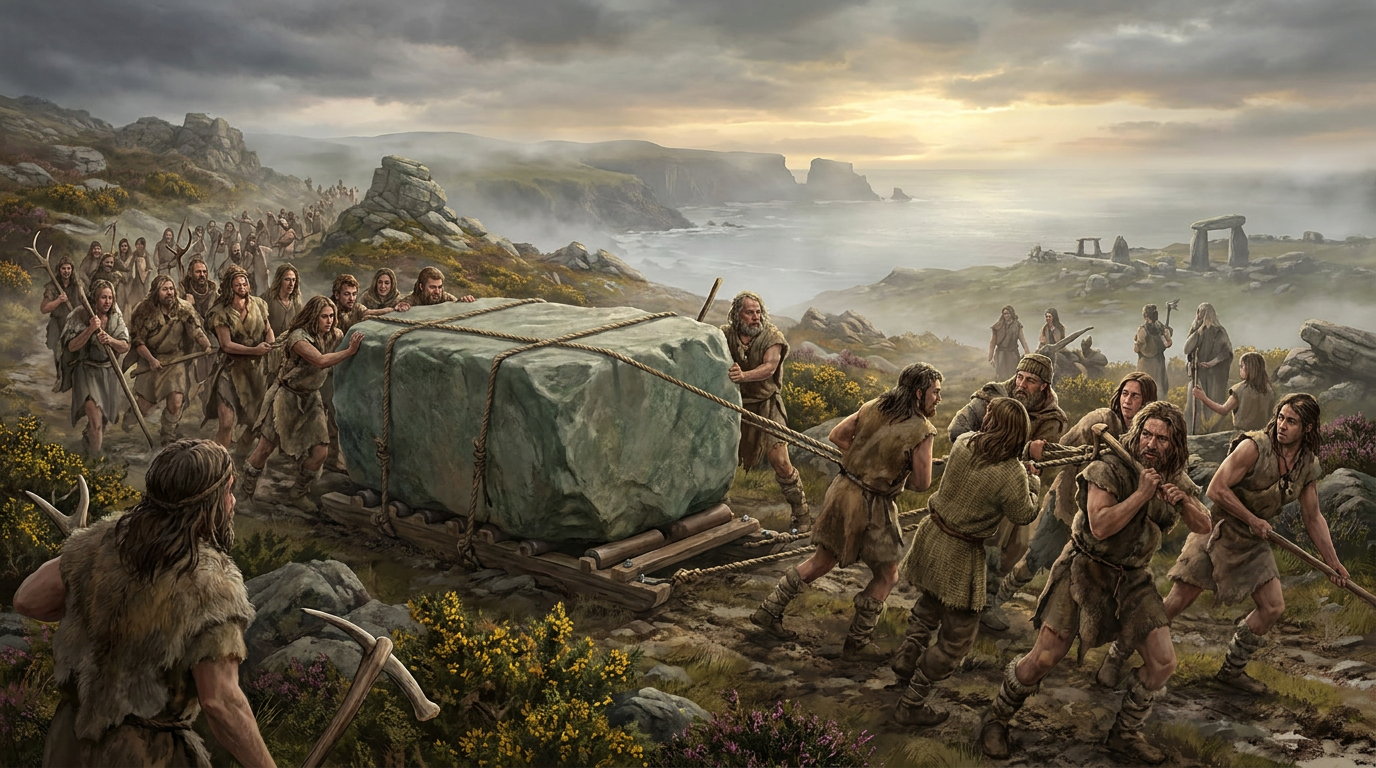
While the geological models strongly support human transport, transparent uncertainty remains regarding the exact mechanics of the journey. The researchers propose a multi-stage route combining overland hauling with maritime navigation. The stone may have been dragged on wooden sledges over frozen ground or rolled on log corduroy roads during the overland segments.[1][2]
For the coastal and riverine legs of the journey, Neolithic engineers likely utilized large, flat-bottomed boats or reinforced timber rafts. Navigating a 13,000-pound shifting load through the treacherous currents of the North Sea and up the river systems of southern England would have required an intimate understanding of tides, buoyancy, and weather patterns.[4][7]
The researchers also identified potential overland corridors that would have facilitated the final approach to Stonehenge. The paper suggests that from the eastern coast, the Altar Stone could have been moved along the Berkshire Ridgeway. Often described as Europe's oldest road, the Ridgeway was an active, elevated thoroughfare during the Neolithic period, providing a relatively dry and navigable route that avoided the dense, swampy forests of the lowlands.[3]

A significant chronological gap presents another layer of uncertainty in the evidence pack. Doggerland was completely submerged by rising sea levels around 6000 BCE, thousands of years before the main construction phases of Stonehenge began. This timeline suggests that the Altar Stone may have been moved and kept at an intermediate sanctuary for millennia before being transported to its final position at the center of the Wiltshire monument.[5]
Ultimately, the findings effectively close the book on the debate over natural versus human transport, shifting the scientific focus toward the cultural networks of Neolithic Britain. The epic journey of the Altar Stone stands as a testament to human determination, proving that ancient Britons were capable of executing logistical miracles that rival the engineering feats of the modern world.[2][8]
How we got here
27,000 years ago
The Last Glacial Maximum peaks, with ice sheets potentially moving the Altar Stone from Scotland to Dogger Bank.
Circa 6000 BCE
Rising sea levels completely submerge Doggerland beneath the North Sea.
Circa 2500 BCE
The main construction phases of Stonehenge take place on the Salisbury Plain.
August 2024
Scientists trace the mineral composition of the Altar Stone to the Orcadian Basin in northeast Scotland.
June 2026
New geological modeling confirms glaciers could not have carried the stone to southern England, proving human transport.
Viewpoints in depth
Archaeological Consensus
Focuses on the human ingenuity and complex logistics required to transport the stone.
Archaeologists emphasize that moving a 13,000-pound megalith across hundreds of miles shatters previous assumptions about Neolithic capabilities. This perspective argues that the feat required sustained agricultural surplus, complex social hierarchies, and a unified cultural motivation spanning generations. They view the transport not just as a physical achievement, but as evidence of a highly organized, interconnected prehistoric society.
Geological Modelers
Focuses on the empirical data and ice-sheet simulations that rule out natural transport.
Geologists and earth scientists anchor their view in the hard data of mineral dating and glacial modeling. By reconstructing the British-Irish Ice Sheet during the Last Glacial Maximum, they demonstrate that ice flows simply did not move in the necessary direction to deposit the stone in southern England. For this camp, the definitive ruling out of a purely natural mechanism is the critical breakthrough that forces a reevaluation of human history.
Doggerland Theorists
Focuses on the intermediate step at the submerged Dogger Bank and its cultural implications.
Researchers focusing on the submerged landmass of Doggerland argue that the stone's journey was likely broken into distinct phases separated by millennia. They suggest that retreating glaciers deposited the stone at Dogger Bank, where it was discovered by Neolithic people before rising sea levels swallowed the region. This camp posits that the stone was a venerated relic of a lost homeland, explaining why ancient Britons went to such extreme lengths to rescue and relocate it to Salisbury Plain.
What we don't know
- The exact route Neolithic humans took to transport the stone from the North Sea coast to the Salisbury Plain.
- Whether the stone was moved continuously or kept at an intermediate sanctuary for millennia before reaching Stonehenge.
- The specific cultural or religious significance the Altar Stone held that justified such a monumental logistical effort.
Key terms
- Altar Stone
- The central, six-ton megalith at Stonehenge, officially designated as Stone 80, known for its unique grayish-green sandstone composition.
- Orcadian Basin
- A geological region in northeast Scotland identified as the original source of the Altar Stone.
- Doggerland
- A vast, now-submerged prehistoric landmass that once connected Great Britain to mainland Europe across the North Sea.
- Last Glacial Maximum
- The most recent period in Earth's climate history when ice sheets were at their greatest extension, roughly 27,000 years ago.
- Sarsen Stones
- The large, locally sourced sandstone blocks that make up the iconic outer circle and trilithons of Stonehenge.
Frequently asked
What is the Altar Stone?
It is a 6-ton grayish-green sandstone block located at the center of Stonehenge, distinct from the monument's local sarsens and Welsh bluestones.
Where did the Altar Stone originally come from?
In 2024, scientists traced its mineral composition to the Orcadian Basin in the far northeast of Scotland, roughly 435 miles away from Stonehenge.
Did glaciers move the stone to Stonehenge?
No. New ice-sheet modeling shows that while glaciers may have moved it partway to the North Sea, they could not have carried it to southern England.
How did humans transport the massive stone?
Researchers believe Neolithic people moved it in stages, combining overland hauling on wooden sledges with coastal or river transport on reinforced rafts.
Sources
Source coverage
8 outlets
3 viewpoints surfaced








[1]Archaeology MagazineArchaeological Consensus
How Did Stonehenge's Altar Stone Arrive at Salisbury Plain?
Read on Archaeology Magazine →[2]Sci.NewsArchaeological Consensus
Neolithic People May Have Hauled Stonehenge's Giant Altar Stone across Britain
Read on Sci.News →[3]ITV NewsDoggerland Theorists
Stonehenge mystery: Famous 'altar stone' may have been moved by glaciers and a rescue mission
Read on ITV News →[4]BBC Science FocusDoggerland Theorists
We may have just cracked one of Stonehenge's greatest mysteries
Read on BBC Science Focus →[5]ScienceAlertGeological Modelers
Stonehenge's Altar Stone Mystery Points to an Epic Human Journey
Read on ScienceAlert →[6]Journal of Quaternary ScienceGeological Modelers
From Highlands To Henge: Refining The Provenance And Transport Pathways Of Stonehenge's Altar Stone
Read on Journal of Quaternary Science →[7]Discover MagazineArchaeological Consensus
Neolithic Humans, Not Glaciers, Likely Transported Stonehenge's Altar Stone Over 400 Miles
Read on Discover Magazine →[8]ScienceDailyGeological Modelers
Stonehenge's most mysterious stone traveled 700 kilometers across Britain
Read on ScienceDaily →

Every angle. Every day.
Get science stories with full source coverage and perspective breakdowns delivered to your inbox.