
Do At-Home LED Face Masks Actually Work? The Clinical Evidence, Explained
At-home LED face masks promise clinic-level skin rejuvenation and acne reduction, but dermatologists warn that a device's efficacy depends entirely on its specific wavelengths, irradiance, and fit.
By Factlen Editorial Team
- Clinical Dermatologists
- Focus on peer-reviewed evidence, precise wavelengths, and the necessity of adequate irradiance for biological changes.
- Skincare Consumers
- Prioritize device comfort, treatment speed, ease of use, and visible results relative to the high retail cost.
- Device Manufacturers
- Emphasize proprietary designs, FDA clearance status, and internal clinical testing to differentiate their products in a crowded market.
What's not represented
- · Estheticians whose in-office business models are impacted by at-home devices
- · Regulatory bodies monitoring unverified claims in the beauty tech space
Why this matters
Consumers are spending upwards of $400 on at-home LED masks, but the unregulated beauty tech market is flooded with underpowered devices. Understanding the clinical metrics—wavelength and irradiance—ensures you don't waste money on a glowing piece of plastic that delivers no biological benefit.
Key points
- Clinical evidence supports LED light therapy for reducing acne, inflammation, and fine lines.
- Red (633nm) and near-infrared (830nm) light are the gold standards for anti-aging and collagen production.
- Blue light (415nm) effectively kills the bacteria responsible for inflammatory acne breakouts.
- At-home masks are less powerful than in-office devices and require months of consistent use to achieve results.
- Flexible silicone masks generally deliver better results than rigid masks by keeping the light source closer to the skin.
- Consumers should verify a device's specific wavelengths and irradiance before purchasing.
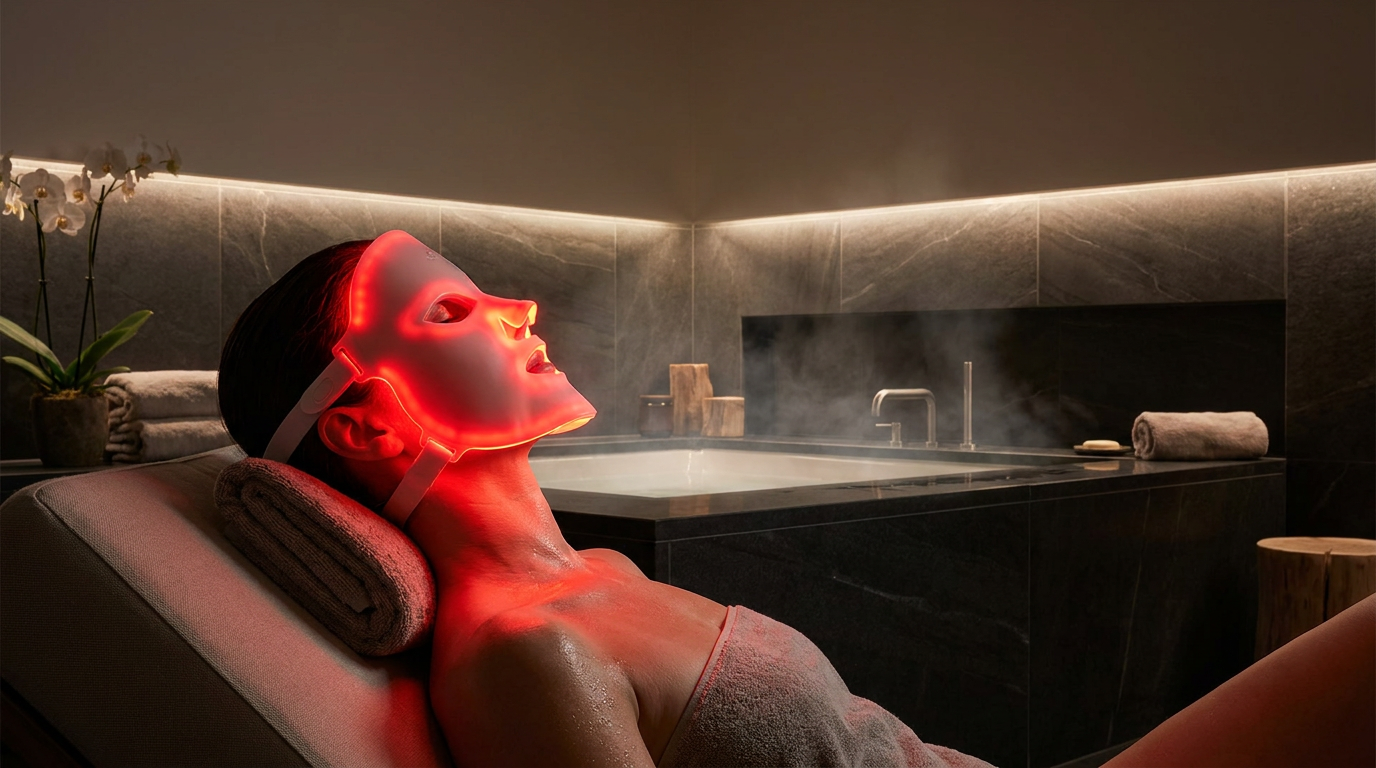
Over the past three years, the at-home skincare market has been illuminated by a wave of glowing, futuristic visors. LED face masks, once confined to the offices of elite dermatologists and estheticians, are now ubiquitous fixtures in nighttime routines, promising to smooth wrinkles, banish acne, and reduce inflammation. But with price tags routinely exceeding $400, consumers are increasingly asking a fundamental question: do these devices actually alter the biology of the skin, or are they simply an expensive placebo?[3][7]
The short answer from the dermatological community is yes—LED light therapy is a scientifically valid mechanism. The long answer, however, is that the efficacy of an at-home mask depends entirely on a strict set of optical physics. Not all light is created equal, and the unregulated nature of the beauty tech industry means that many popular devices lack the power to deliver on their marketing claims.[3][4]
The underlying science is known as photobiomodulation (PBM). When specific wavelengths of light enter the skin, they are absorbed by chromophores within the cells—most notably by the mitochondria, the cell's powerhouse. This absorption triggers a cascade of biological reactions, increasing the production of adenosine triphosphate (ATP) and stimulating cellular repair and regeneration. It is a non-invasive process that does not rely on thermal damage to provoke a healing response, unlike lasers or chemical peels.[2][4]
For anti-aging and skin rejuvenation, the clinical gold standard relies on two specific wavelengths: red light at 633 nanometers (nm) and near-infrared (NIR) light at 830nm. Red light penetrates the epidermis to stimulate fibroblasts, the cells responsible for producing collagen and elastin. Near-infrared light penetrates deeper into the dermis, reducing inflammation and accelerating tissue repair. A review in the Journal of Clinical and Aesthetic Dermatology confirmed that this specific combination yields measurable improvements in fine lines, skin texture, and overall firmness.[2][7]

For acne management, the target shifts to the blue spectrum. Blue light at 415nm has a proven bactericidal effect on Propionibacterium acnes, the bacteria responsible for inflammatory breakouts. A 2025 systematic review published by researchers at Mass General Brigham analyzed data from multiple randomized controlled trials and concluded that at-home red and blue LED devices are a safe, effective, non-pharmaceutical option for treating mild-to-moderate acne, significantly reducing both inflammatory and non-inflammatory lesions.[1]
For acne management, the target shifts to the blue spectrum.
However, wavelength is only half the equation. The critical metric that separates a clinical tool from a useless toy is "irradiance"—the measure of light energy delivered to the skin per square centimeter, expressed as mW/cm². If a mask emits the correct 633nm red light but has an irradiance of only 5 mW/cm², it will not stimulate a meaningful cellular response, regardless of how long it is worn.[4][7]
In-office clinical devices, such as the Dermalux Flex MD, deliver optimal therapeutic wavelengths at high irradiance levels, ensuring fast, measurable results. At-home devices are inherently less powerful to comply with consumer safety regulations. To compensate for this lower power, at-home masks rely on cumulative dosing. Dermatologists emphasize that while an at-home mask can eventually approach clinically meaningful levels of light exposure, it requires months of consistent, near-daily use.[3][4]

This reliance on cumulative dosing brings up the "fit factor," a crucial element often overlooked by consumers. Light energy obeys the inverse-square law: its intensity drops exponentially as the distance from the light source increases. A mask that sits even one inch away from the skin will deliver significantly less energy than one resting directly against it.[4][7]
Because of this optical reality, flexible silicone masks have largely overtaken rigid plastic masks in clinical preference. Devices like the Omnilux Contour Face and the CurrentBody Skin LED Mask are designed to strap tightly and conform to the contours of the face, ensuring the LED diodes are millimeters away from the epidermis. Rigid masks, such as the popular Dr. Dennis Gross DRx SpectraLite, often sit further away from the nose and cheeks, though they attempt to compensate by utilizing higher-powered bulbs and shorter three-minute treatment times.[5][7]

Safety profiles for non-laser LED masks are generally excellent. Unlike ultraviolet (UV) light, which damages cellular DNA and accelerates aging, visible and near-infrared LED light is non-ionizing. However, dermatologists caution users about photosensitizing medications. Individuals taking specific antibiotics, oral retinoids (like Accutane), or using high-strength topical retinoids should consult a physician, as these medications can make the skin abnormally reactive to intense light.[3][5]
There is also an ongoing debate regarding eye protection. While most FDA-cleared red and near-infrared masks are deemed safe for use without goggles, the brightness can be uncomfortable. Blue light, however, carries a slightly higher theoretical risk for retinal strain over long periods, prompting many manufacturers to include blackout goggles with their acne-focused devices.[5][7]
Ultimately, the evidence supports the use of at-home LED masks, provided consumers temper their expectations. These devices are not magic erasers for deep wrinkles or severe cystic acne. They are supportive, long-term tools that excel at reducing baseline inflammation, accelerating post-blemish healing, and slowly building collagen density over a period of 12 to 16 weeks. For those willing to commit to the daily ritual, the science of light offers a genuine, non-invasive path to better skin health.[3][4][7]
Viewpoints in depth
Clinical Dermatologists
Medical professionals who value peer-reviewed data and precise optical physics over marketing claims.
For dermatologists, the conversation around LED masks begins and ends with two metrics: wavelength and irradiance. They view photobiomodulation as a legitimate, evidence-backed science, but express frustration with a consumer market flooded with underpowered devices. Clinical experts emphasize that while at-home masks can be highly effective for maintenance and mild conditions, they cannot replace the high-powered, targeted treatments available in a medical setting. Their primary advice to patients is to temper expectations, commit to a months-long routine, and avoid devices that do not transparently publish their technical specifications.
Skincare Consumers
Users balancing the high upfront cost of devices against the convenience of at-home treatments.
Consumers approach LED masks as an investment in long-term skin health, often comparing the $400 to $500 price tag against the recurring costs of professional facials or Botox. For this group, usability is almost as important as clinical efficacy. A highly powerful mask that is heavy, uncomfortable, or requires being tethered to a wall outlet is likely to gather dust in a drawer. Consequently, consumers heavily favor flexible, battery-operated silicone masks that allow them to walk around or watch television during their 10-minute daily treatments.
Device Manufacturers
Companies navigating the line between consumer safety regulations and clinical efficacy.
Manufacturers of premium LED masks face a difficult engineering challenge: they must design a device powerful enough to trigger biological changes, yet safe enough to pass FDA clearance for unsupervised home use without causing thermal damage or eye strain. To stand out, leading brands invest heavily in proprietary diode layouts, flexible battery technologies, and independent clinical trials to prove their specific device works. They argue that their premium pricing reflects the cost of medical-grade LEDs, which emit precise, narrow-band light, unlike the generic, scattered light bulbs found in cheap knockoffs.
What we don't know
- The exact minimum irradiance threshold required to trigger a biological response in human skin.
- Long-term comparative data showing whether 3-minute high-power sessions equal 10-minute moderate-power sessions.
- How variations in skin thickness and melanin density precisely alter light absorption rates across different demographics.
Key terms
- Photobiomodulation (PBM)
- The process by which specific wavelengths of light are absorbed by cells to stimulate biological processes, such as tissue repair and reduced inflammation.
- Irradiance
- The measure of light energy delivered to a specific area of skin, usually expressed in milliwatts per square centimeter (mW/cm²). It determines how powerful the device is.
- Wavelength
- The distance between successive crests of a light wave, measured in nanometers (nm), which determines the color of the light and how deeply it penetrates the skin.
- Fibroblasts
- Cells within the dermal layer of the skin that are responsible for producing collagen and elastin, the proteins that keep skin firm and youthful.
Frequently asked
Do LED face masks cause sun damage?
No. LED masks use visible and near-infrared light, which is non-ionizing. They do not emit ultraviolet (UV) light, which is the spectrum responsible for sunburns, DNA damage, and skin cancer.
Can I use retinol with an LED mask?
Dermatologists generally recommend using LED masks on clean, bare skin. Because retinoids can make the skin photosensitive, it is best to use the LED mask first, and apply retinol or other active serums afterward.
How long does it take to see results from an LED mask?
Redness and inflammation can improve within 2 to 4 weeks. However, because new collagen takes roughly 90 days to mature, visible improvements in fine lines and skin firmness typically require 12 weeks of consistent use.
Are cheap LED masks from online marketplaces effective?
Usually not. Inexpensive masks often use generic bulbs that do not emit precise wavelengths (like exactly 633nm) and lack the irradiance (power) required to penetrate the skin and trigger cellular changes.
Sources
Source coverage
7 outlets
3 viewpoints surfaced







[1]Mass General BrighamClinical Dermatologists
Systematic Review Finds At-Home LED Devices Effective for Acne
Read on Mass General Brigham →[2]Journal of Clinical and Aesthetic DermatologyClinical Dermatologists
Clinical Efficacy of Combination LED Light Therapy in Facial Skin Rejuvenation
Read on Journal of Clinical and Aesthetic Dermatology →[3]ForbesSkincare Consumers
Here's What Dermatologists Say About LED Face Masks
Read on Forbes →[4]Dr. Caroline Warden ClinicClinical Dermatologists
The Truth About At-Home LED Therapy and Why Irradiance Matters
Read on Dr. Caroline Warden Clinic →[5]Women's HealthSkincare Consumers
6 Best LED Face Masks in 2026, Tested by Dermatologists
Read on Women's Health →[6]ClinicalTrials.govDevice Manufacturers
A Clinical Study to Evaluate the Efficacy of an At-Home Cosmetic LED Device
Read on ClinicalTrials.gov →[7]Factlen Editorial Team
Synthesis by Factlen editorial team
Read on Factlen Editorial Team →


Every angle. Every day.
Get shopping stories with full source coverage and perspective breakdowns delivered to your inbox.