
2026 Rivian R2 vs. Tesla Model Y: The Ultimate Midsize EV Showdown
With Rivian's rugged R2 officially hitting the streets, the Tesla Model Y finally faces a formidable, similarly priced rival. Here is how the two electric SUVs stack up in range, cargo, and off-road capability.
By Factlen Editorial Team
- Pragmatic Commuters
- Value aerodynamic efficiency, proven charging infrastructure, and the lowest possible entry price for daily driving.
- Outdoor Adventurers
- Prioritize ground clearance, rugged utility, maximum cargo space, and genuine off-road capability.
- Tech & Autonomy Enthusiasts
- Focused on the philosophical divide between camera-only self-driving systems and multi-sensor redundancy.
What's not represented
- · Traditional auto manufacturers losing market share to pure EV brands
- · Budget-conscious buyers waiting for sub-$35k EVs
Why this matters
For years, buyers seeking a midsize electric SUV defaulted to the Tesla Model Y due to a lack of viable alternatives. With the arrival of the Rivian R2, consumers finally have a true side-by-side choice between two distinct design philosophies: aerodynamic street performance versus rugged, off-road utility.
Key points
- Rivian has officially begun customer deliveries of the R2 SUV, starting with the $57,990 Performance Launch Edition.
- The R2 offers 9.6 inches of ground clearance and 90.1 cubic feet of cargo space, beating the Model Y in utility.
- The Tesla Model Y Performance remains slightly faster, hitting 60 mph in 3.3 seconds compared to the R2's 3.6 seconds.
- Despite its boxy shape, the Rivian R2 Performance is slightly more efficient than the Model Y Performance, achieving 109 MPGe.
- Tesla's base Model Y remains much more accessible today at $41,630, as Rivian's $45,000 base R2 won't arrive until 2027.
The midsize electric SUV market has officially entered a new era of heavyweight competition. For years, the Tesla Model Y has utterly dominated the segment, recently cementing its massive sales lead with the sleek 2026 "Juniper" refresh that brought refined styling and upgraded suspension. But as of June 2026, Rivian has officially entered the chat, beginning public customer deliveries of its highly anticipated R2 SUV. This launch marks a pivotal moment for electric vehicle buyers, who finally have a compelling, similarly sized, and technologically advanced alternative from a pure-play electric automaker rather than a legacy brand.[1][2]
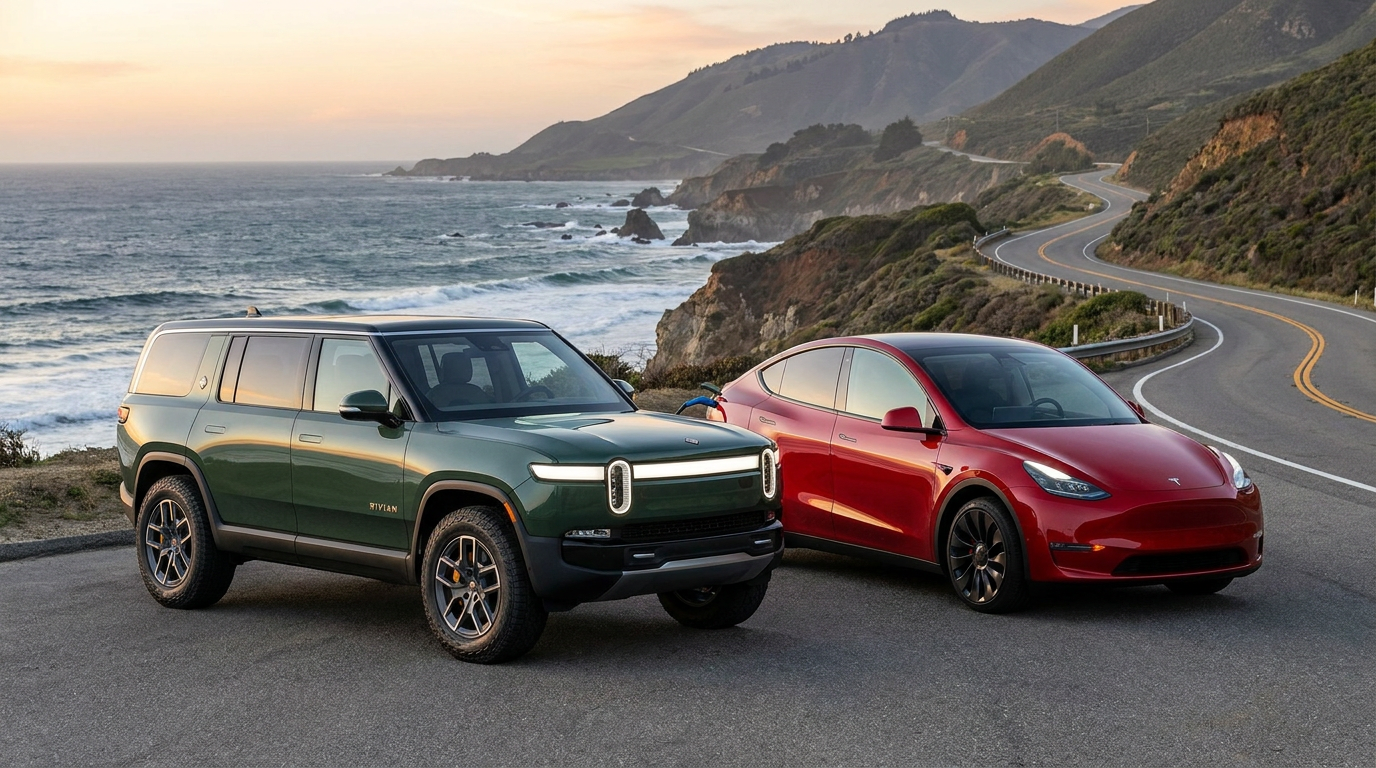
The matchup presents a fascinating philosophical divide in automotive design and engineering. Tesla’s Model Y is a masterclass in aerodynamic teardrop styling, prioritizing low drag coefficients to maximize highway range and deliver sports-car-like street performance. Rivian’s R2, by contrast, leans heavily into traditional, boxy SUV aesthetics. It promises rugged off-road capability and a commanding seating position without sacrificing daily drivability. These divergent approaches mean that while the two vehicles compete for the same demographic on paper, they offer fundamentally different experiences behind the wheel and in the driveway.[4]
At the moment, the financial comparison centers strictly on the premium end of the spectrum. While Tesla offers a highly accessible base Model Y for just $41,630, Rivian is currently only shipping the top-tier $57,990 R2 Performance Launch Edition to early reservation holders. To make a fair, apples-to-apples comparison today, buyers must look at the similarly equipped Model Y Performance, which starts at $59,630. Rivian plans to roll out its more affordable trims gradually, but budget-conscious shoppers looking for a $45,000 R2 will have to wait until the summer of 2027.[1][2]
In a straight line, both of these family haulers deliver supercar-shaming acceleration that will leave traditional gas-powered SUVs in the dust. The Tesla Model Y Performance sprints to 60 mph in a blistering 3.3 seconds, edging out the Rivian R2 Performance’s highly respectable 3.6-second time. However, the Rivian packs a massive 656 horsepower and 609 pound-feet of torque from its dual-motor setup, giving it a raw power advantage over the Tesla's roughly 460-horsepower output. Both vehicles offer more than enough merging power for any highway scenario.[1][2]

Range and efficiency metrics reveal a surprising twist in the engineering battle. Despite its upright, brick-like aerodynamics, the R2 Performance achieves an impressive EPA-estimated 330 miles of range on its 21-inch wheels. The sleeker Model Y Performance tops out at roughly 303 miles on a full charge. Even more remarkably, the heavier, taller Rivian manages 109 MPGe combined, edging past the Tesla’s 104 MPGe. This unexpected efficiency victory is a massive testament to Rivian’s new midsize platform engineering and advanced battery management software.[1][2][4][7]
When the pavement ends, the two vehicles diverge sharply in their capabilities. The Rivian R2 boasts a towering 9.6 inches of ground clearance, a 25-degree approach angle, and a 26-degree departure angle, making it genuinely trail-capable for weekend adventures. The Model Y, sitting at just 6.0 inches of ground clearance, is strictly an on-road machine. While Tesla's all-wheel-drive system handles snow and rain with ease, the vehicle is designed for carving paved canyons rather than crawling over rocks or navigating deeply rutted forest service roads.[4]
Interior packaging also highlights their entirely different missions. The R2 is nearly three inches shorter in overall length than the Model Y, making it slightly easier to parallel park in tight urban spaces. Yet, its boxy greenhouse yields significantly more utility. Rivian claims a cavernous 90.1 cubic feet of total storage with the seats folded—including a versatile 5.2 cubic-foot front trunk. The Tesla Model Y, constrained by its sloping roofline, offers roughly 76 cubic feet of total cargo space and a slightly smaller 4.1 cubic-foot frunk.[4][6]

Interior packaging also highlights their entirely different missions.
Inside the cabin, both automakers embrace modern minimalism, but with distinct executions that cater to different tastes. Tesla’s interior feels like a futuristic bachelor pad, relying entirely on a single central 15.4-inch touchscreen for all instrumentation, climate controls, and media. Rivian’s "nature-inspired" cabin feels more like a high-end designer loft. Crucially, the R2 retains a dedicated digital driver’s display behind the steering wheel—a feature many traditional drivers strongly prefer—alongside its own massive central infotainment screen and tactile steering wheel scroll wheels.[3]
The approach to autonomous driving technology marks another deep divide between the two Silicon Valley-born companies. Tesla continues to double down on its camera-only Full Self-Driving architecture, removing radar and ultrasonic sensors in favor of pure vision processing. Rivian, meanwhile, equips the R2 with a highly redundant sensor suite that includes 11 high-resolution cameras and five radars. Rivian believes this multi-layered hardware approach is essential to eventually supporting safe, hands-free point-to-point driving across millions of miles of North American roads.[5]
For buyers looking to spend under $50,000 today, the Tesla Model Y remains the undisputed default choice, as Rivian’s entry-level models are still over a year away from production. But for those shopping in the $60,000 performance bracket right now, the decision requires carefully weighing distinct trade-offs in capability, design, and daily utility. Neither vehicle is objectively superior in every single category; rather, they are precision-engineered tools built for slightly different lifestyles, and choosing the right one depends entirely on how you actually plan to use it.[2]

The case for the Tesla Model Y is firmly anchored in its proven ecosystem, immediate availability across all price tiers, and superior on-road handling dynamics. It is the lighter, more agile vehicle of the two, offering a sports-car-like driving experience wrapped in a highly practical crossover body. Furthermore, Tesla's seamless software integration, robust entertainment features, and deeply established service network remain the gold standard in the industry, making the Model Y an incredibly easy and reliable vehicle to live with on a daily basis.[3]
The case against the Model Y centers heavily on its ubiquitous, egg-like styling, which prioritizes wind-cheating aerodynamics over rugged visual appeal. Its aggressively sloping roofline severely limits rear cargo height for bulky items like furniture, bicycles, or large dog crates, and its low ground clearance results in a complete lack of off-road capability. Additionally, its stubborn reliance on a single central screen continues to alienate some drivers who strongly prefer having critical speed, range, and navigation information directly in their forward line of sight.[3][4]
The case for the Rivian R2 is built on its truly exceptional packaging, successfully blending a smaller, more urban-friendly exterior footprint with massive interior cargo volume. Its superior ground clearance, slightly longer EPA-estimated range in the top-tier Performance trim, and rugged, distinctive aesthetic offer a highly compelling alternative to the aerodynamic crossover status quo. For buyers who want an electric vehicle that actually looks, feels, and functions like a traditional utility vehicle, the R2 delivers on almost every conceivable front.[4][7]
The case against the Rivian R2 primarily involves its current high cost of entry, as only the most expensive Launch Edition trims are rolling off the assembly line today, leaving budget buyers waiting. Furthermore, its upright, boxy shape inherently creates slightly more wind noise at high highway speeds compared to the whisper-quiet, teardrop-shaped Tesla. Finally, its softer, off-road-tuned suspension, while incredibly comfortable over city potholes and dirt washboards, simply cannot match the Model Y’s razor-sharp cornering precision and planted feel on smooth tarmac.[2][3]

Ultimately, the Tesla Model Y fits perfectly when a buyer prioritizes sports-sedan handling, immediate access to lower-priced base trims, and the sleekest possible aerodynamic profile for long-distance highway commuting. It remains the highly rational, proven choice for the vast majority of drivers who spend 100 percent of their time on paved roads and want the peace of mind that comes with owning the world's best-selling electric vehicle, backed by years of iterative hardware refinements and over-the-air software updates.[1][3]
Conversely, the Rivian R2 fits perfectly when a buyer genuinely needs off-road capability, wants to maximize interior cargo volume for outdoor gear, and strongly prefers the commanding seating position and physical driver displays of a traditional SUV. It stands as the definitive choice for those whose weekend hobbies require leaving the asphalt behind, or for anyone who simply wants a fresh, rugged, and highly capable alternative to the sea of teardrop-shaped crossovers currently dominating the modern electric vehicle market.[2][4]
How we got here
March 2024
Rivian officially unveils the R2 midsize SUV to the public.
Early 2025
Tesla releases the highly anticipated 'Juniper' refresh for the Model Y.
April 2026
Rivian begins private deliveries of the R2 to employees and insiders.
June 2026
Public customer deliveries of the Rivian R2 Performance Launch Edition begin.
Summer 2027
Rivian's target date for releasing the $44,990 base model R2.
Viewpoints in depth
Pragmatic Commuters
Drivers prioritizing efficiency, proven technology, and lower entry prices.
For buyers who view a vehicle primarily as a tool for getting from point A to point B on paved roads, the Tesla Model Y remains the gold standard. This camp values Tesla's unparalleled aerodynamic efficiency, which translates to lower charging costs and reliable highway range. They also point to the immediate availability of the $41,630 base model, arguing that Rivian's current $57,990 entry point makes the R2 inaccessible to the average consumer. For these drivers, the Model Y's sports-car-like handling and deeply integrated software ecosystem outweigh any need for off-road ground clearance.
Outdoor Adventurers
Drivers who need genuine off-road capability and maximum utility for gear.
This camp views the crossover segment as having drifted too far from its utility roots. They celebrate the Rivian R2 for returning to a traditional, boxy SUV shape that maximizes interior volume for camping gear, dogs, and sports equipment. With 9.6 inches of ground clearance and dedicated off-road driving modes, they argue the R2 is the only vehicle in this comparison that can actually handle a rutted forest service road. To these buyers, the slight aerodynamic penalty of a boxy design is a small price to pay for a vehicle that enables their weekend hobbies.
Tech & Autonomy Enthusiasts
Industry watchers focused on the philosophical divide in self-driving hardware.
Beyond the sheet metal, tech enthusiasts view this comparison as a proxy war between two fundamentally different approaches to autonomous driving. Tesla advocates defend the company's camera-only 'vision' approach, arguing that if humans can drive with just two eyes, cars should be able to do the same using advanced neural networks. Conversely, Rivian supporters praise the R2's redundant sensor suite, which includes 11 cameras and five radars. They argue that true, hands-free autonomy requires the cross-verification of multiple sensor types to safely handle edge cases and poor weather conditions.
What we don't know
- Whether Rivian will be able to scale production fast enough to meet demand for the cheaper R2 trims in 2027.
- How the Rivian R2's long-term reliability and service network will compare to Tesla's established infrastructure.
- If Tesla plans to introduce an off-road-focused trim of the Model Y to directly counter the R2.
Key terms
- MPGe
- Miles Per Gallon Equivalent, a metric used by the EPA to compare the energy efficiency of electric vehicles to traditional gas-powered cars.
- Approach Angle
- The maximum angle of a ramp or obstacle a vehicle can climb from a horizontal plane without the front bumper hitting the ground.
- Frunk
- A portmanteau of 'front trunk,' referring to the enclosed storage space located under the hood of an electric vehicle where an engine would traditionally sit.
- NACS
- North American Charging Standard, the charging connector originally developed by Tesla that is now being adopted by most major EV manufacturers.
Frequently asked
When can I buy the $45,000 Rivian R2?
Rivian plans to release the base $44,990 Standard trim in the summer of 2027. Currently, only the $57,990 Performance Launch Edition is available.
Does the Rivian R2 have access to Tesla Superchargers?
Yes, the Rivian R2 features a native NACS (North American Charging Standard) port, allowing it to plug directly into Tesla Superchargers without an adapter.
Which vehicle is faster from 0 to 60 mph?
The Tesla Model Y Performance is slightly quicker, hitting 60 mph in 3.3 seconds, compared to the Rivian R2 Performance's 3.6 seconds.
Which SUV has more cargo space?
The Rivian R2 offers significantly more room, with 90.1 cubic feet of total storage with the seats folded, compared to the Model Y's roughly 76 cubic feet.
Sources
Source coverage
7 outlets
3 viewpoints surfaced







[1]Car and DriverPragmatic Commuters
2026 Tesla Model Y Long Range AWD Juniper
Read on Car and Driver →[2]CleanTechnicaOutdoor Adventurers
Rivian R2 Delivery Timeline
Read on CleanTechnica →[3]CarwowPragmatic Commuters
Rivian R2 vs Tesla Model Y: prices and standard equipment
Read on Carwow →[4]ElectrekOutdoor Adventurers
Rivian R2 vs Tesla Model Y spotted side-by-side: Detailed size comparison
Read on Electrek →[5]ForbesTech & Autonomy Enthusiasts
Rivian R2 Is Imminent: How It Stacks Up Against The Tesla Model Y
Read on Forbes →[6]AutoblogOutdoor Adventurers
2026 Rivian R2 Performance vs. 2026 Tesla Model Y: Which Crossover EV Should You Choose?
Read on Autoblog →[7]CarBuzzTech & Autonomy Enthusiasts
The Rivian R2 Performance Has Up To 24 Miles Of Range On The Model Y Performance
Read on CarBuzz →
Every angle. Every day.
Get automotive stories with full source coverage and perspective breakdowns delivered to your inbox.