
Why Older Adults Are Turning to Brazilian Jiu-Jitsu for Brain Health and Longevity
Emerging neuroscientific research reveals that the complex problem-solving and physical demands of Brazilian Jiu-Jitsu can significantly boost neuroplasticity, preserve cognitive function, and build functional strength in aging adults.
By Factlen Editorial Team
- Neuroscientists & Longevity Researchers
- Focuses on the cellular and structural brain changes induced by complex motor learning.
- Sports Medicine Practitioners
- Focuses on functional mobility, injury prevention, and physical independence.
- BJJ Instructors & Practitioners
- Focuses on the psychological, social, and practical benefits of the art.
What's not represented
- · Physical Therapists treating martial arts injuries
- · Older adults who tried BJJ but found it too physically demanding
Why this matters
As the global population ages, finding sustainable ways to prevent cognitive decline and physical frailty is paramount. Brazilian Jiu-Jitsu offers a unique, evidence-backed intervention that simultaneously rewires the brain, builds functional strength, and combats social isolation, providing a comprehensive blueprint for healthy aging.
Key points
- Brazilian Jiu-Jitsu is increasingly recognized as a powerful intervention for healthy aging, combining physical exercise with intense cognitive demands.
- The real-time problem-solving required in BJJ acts as 'human chess,' preserving executive function and memory.
- Martial arts training elevates Brain-Derived Neurotrophic Factor (BDNF), a crucial protein for neuroplasticity and brain health.
- BJJ builds functional strength, core stability, and balance, directly combating age-related muscle loss and fall risks.
- The strong community aspect of BJJ academies helps combat social isolation and builds emotional resilience in older adults.
- Older practitioners can train safely by prioritizing technique, communicating limits, and engaging in light 'flow rolling.'
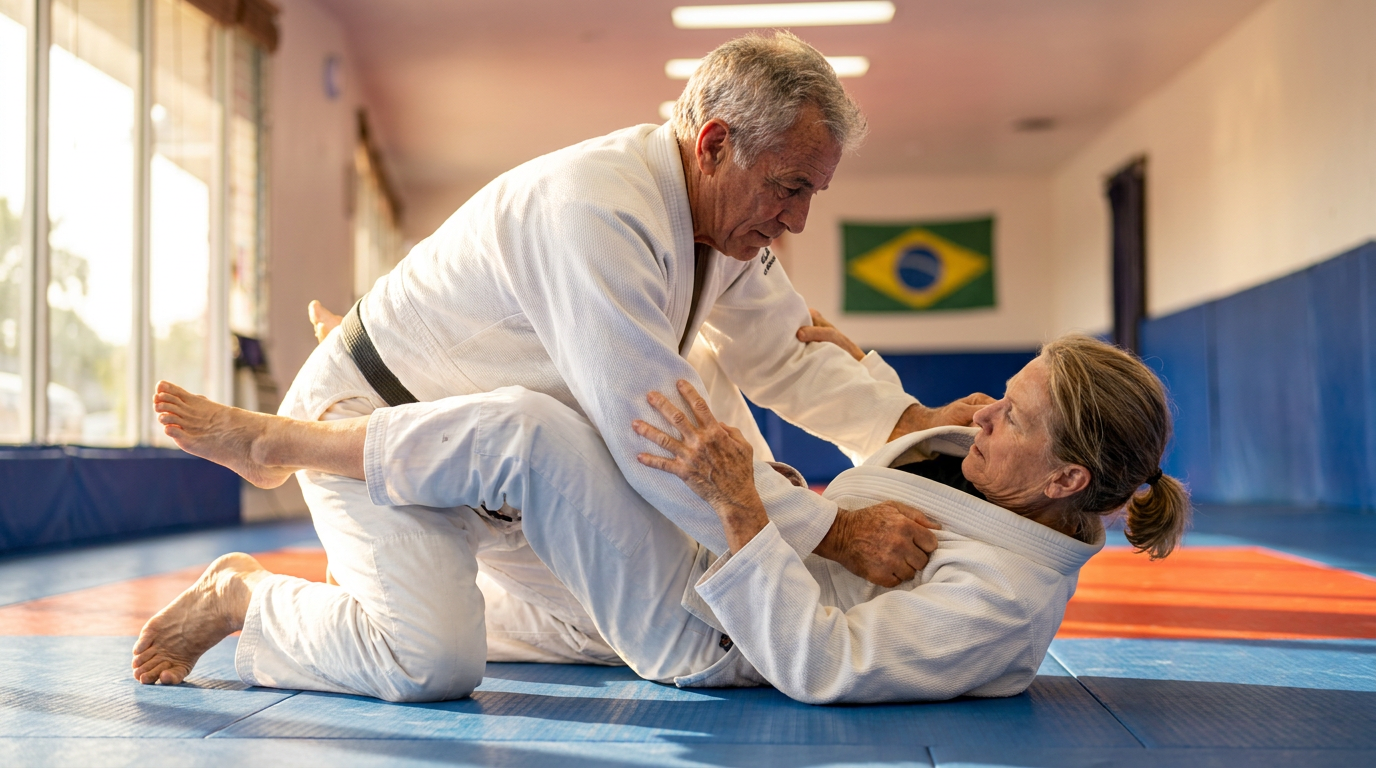
For decades, the standard prescription for healthy aging has been remarkably uniform: walk briskly, lift light weights, and perhaps solve a daily crossword puzzle. Yet, a growing body of research suggests that preserving cognitive and physical vitality requires a far more demanding stimulus. Enter Brazilian Jiu-Jitsu (BJJ)—a grappling-based martial art that is rapidly shedding its reputation as an exclusive domain for young, hyper-competitive athletes.[1]
Across the globe, older adults are stepping onto the mats in record numbers, drawn by the promise of a holistic longevity protocol. Unlike traditional gym routines that isolate muscles or rely on repetitive aerobic motions, BJJ demands the simultaneous engagement of the entire body and the full capacity of the mind. It is a dynamic, unpredictable environment where every movement requires a calculated response.[1][6]
At the heart of BJJ's cognitive benefits is its reputation as "human chess." Practitioners are locked in a continuous cycle of problem-solving under physical pressure. When an opponent attacks, a defender must instantly recognize the threat, recall the appropriate counter-technique, and execute it with precise timing and leverage. This real-time strategic adaptation heavily taxes the brain's executive function.[6]
Executive function encompasses the mental skills needed to plan, focus attention, remember instructions, and juggle multiple tasks successfully. As we age, these cognitive domains typically experience a gradual decline. However, studies indicate that the complex motor learning and rapid decision-making required in martial arts can preserve and even enhance these crucial neural pathways.[2][3]

The neuroscience underlying this phenomenon is increasingly well-documented. A primary driver of cognitive preservation is Brain-Derived Neurotrophic Factor (BDNF), a protein often described as "Miracle-Gro for the brain." BDNF is essential for neuronal survival, synaptic plasticity, and the formation of new memories. Natural BDNF levels drop significantly as humans age, correlating with memory loss and cognitive decline.[2]
Recent reviews in neurocognitive science have highlighted that martial arts training is uniquely effective at elevating BDNF expression. The combination of cardiovascular exertion and intense cognitive demand triggers a robust release of this protein. Older adults who regularly engage in complex, mindful movement practices demonstrate higher resting BDNF levels and increased gray matter volume in the hippocampus and prefrontal cortex.[2][4]
Beyond neurochemistry, BJJ may also induce structural and vascular adaptations in the brain. A fascinating study published in the Scandinavian Journal of Medicine & Science in Sports examined the cerebral blood flow (CBF) of elite BJJ athletes compared to age-matched controls. The researchers discovered that the BJJ practitioners exhibited significantly elevated resting CBF, which is vital for delivering oxygen and nutrients to brain regions responsible for memory and attention.[5]

The researchers proposed an intriguing hypothesis: "cerebral preconditioning." BJJ frequently involves defending against controlled neck chokes, which temporarily alter blood flow. The study suggests that this repeated, controlled exposure may actually precondition the brain's vascular system, strengthening its resilience and potentially offering a neuroprotective effect against age-related cognitive decline.[5]
While the cognitive benefits are profound, the physical transformations experienced by older BJJ practitioners are equally compelling. Sarcopenia—the age-related loss of muscle mass and strength—is a primary cause of frailty and loss of independence. BJJ counters this by providing a comprehensive, full-body resistance workout that builds functional strength without the need for heavy, isolated weightlifting.[1][7]
While the cognitive benefits are profound, the physical transformations experienced by older BJJ practitioners are equally compelling.
Grappling requires practitioners to constantly manipulate their own body weight and that of their opponent. This builds exceptional core stability, grip strength, and joint mobility. Because BJJ emphasizes leverage and technique over brute force, older adults can effectively control larger, younger opponents by understanding body mechanics and skeletal alignment.[6]
Balance and proprioception—the body's ability to sense its location, movements, and actions—are also critical focus areas. Falls are a leading cause of fatal and non-fatal injuries among older adults. The constant positional transitions in BJJ, from standing to the ground and back up again, train the vestibular system and improve spatial awareness, drastically reducing the risk of accidental falls in daily life.[1][7]

Furthermore, BJJ offers a potent cardiovascular workout. A typical training session seamlessly blends aerobic endurance with intense bursts of anaerobic exertion. This varied heart-rate profile improves cardiovascular health, helps manage blood pressure, and meets or exceeds the physical activity guidelines recommended for older adults, all while avoiding the repetitive joint impact associated with running on pavement.[7]
Yet, focusing solely on the physical and neurological mechanisms overlooks one of the most powerful longevity interventions BJJ provides: community. Social isolation and loneliness are epidemic among older populations, carrying health risks comparable to smoking 15 cigarettes a day. The BJJ academy functions as a vibrant, intergenerational social hub.[1][3]
Training in BJJ requires a high degree of mutual trust. Practitioners literally place their physical safety in the hands of their training partners. This shared vulnerability, combined with the mutual struggle of learning a difficult skill, fosters deep bonds and emotional resilience. The psychological support system found on the mats is a powerful buffer against depression and anxiety.[2][3]

Naturally, the prospect of combat sports raises valid concerns about injury, particularly for aging bodies. The key to sustainable practice lies in how older adults approach training. Longevity-focused practitioners prioritize "flow rolling"—a lighter, more fluid form of sparring that emphasizes continuous movement and technical exchange over winning or applying maximum pressure.[1][6]
Leaving the ego at the door is not just a philosophical platitude in BJJ; it is a physical necessity for older athletes. Tapping out early and often, communicating physical limitations to partners, and prioritizing recovery are essential habits. Many academies now offer fundamentals classes or age-specific cohorts that provide a safer, more controlled environment for mastering the basics.[1]
The scientific community is just beginning to unpack the full spectrum of benefits that complex martial arts offer the aging brain and body. While more longitudinal studies are needed to isolate the specific effects of BJJ compared to other interventions, the existing evidence points to a powerful synergy of physical exertion, cognitive challenge, and social connection.[2][4]
Ultimately, Brazilian Jiu-Jitsu offers a compelling counter-narrative to the traditional view of aging as a period of inevitable decline. By consistently stepping onto the mats, older adults are not merely preserving their health; they are actively rewiring their brains, forging new physical capabilities, and proving that the capacity for profound growth extends well into the later chapters of life.[1][6]
How we got here
1920s
Brazilian Jiu-Jitsu is developed from Kodokan Judo, emphasizing ground fighting and leverage over size and strength.
1993
The first Ultimate Fighting Championship (UFC) brings BJJ to global prominence, initially framing it as a brutal combat sport for young athletes.
2010s
A cultural shift occurs within the sport as academies begin offering fundamentals and age-specific classes, attracting a broader demographic.
2024–2026
Emerging neuroscientific research highlights the specific cognitive and neuroprotective benefits of grappling for older adults, shifting BJJ's image toward a longevity practice.
Viewpoints in depth
Neuroscientists & Longevity Researchers
Focuses on the cellular and structural brain changes induced by complex motor learning.
This camp emphasizes that traditional aerobic exercise is insufficient for optimal brain aging. They point to the elevation of Brain-Derived Neurotrophic Factor (BDNF) and increased cerebral blood flow as the primary mechanisms by which martial arts protect against cognitive decline. For these researchers, BJJ is essentially a neuroplasticity engine, forcing the brain to constantly rewire itself to solve novel spatial and physical puzzles under stress.
Sports Medicine Practitioners
Focuses on functional mobility, injury prevention, and physical independence.
Sports medicine professionals view BJJ through the lens of functional aging. They highlight how grappling combats sarcopenia by building core strength and improves proprioception, which directly translates to a lower risk of fatal falls. However, this camp also cautions that older adults must adopt a modified approach to training—prioritizing flow rolling and adequate recovery—to mitigate the inherent joint and ligament risks associated with combat sports.
BJJ Instructors & Practitioners
Focuses on the psychological, social, and practical benefits of the art.
For those on the mats, the scientific data merely validates what they already experience. This camp argues that the true longevity benefit of BJJ lies in its ability to build emotional resilience and combat social isolation. The academy provides a multi-generational community where older adults find purpose, mutual respect, and a continuous path of mastery that keeps them psychologically engaged and motivated long after traditional gym routines become monotonous.
What we don't know
- How the cognitive benefits of Brazilian Jiu-Jitsu specifically compare to other complex martial arts like Judo or Tai Chi in long-term longitudinal studies.
- The exact minimum 'dosage' of training (hours per week) required to trigger significant neuroprotective effects in older adults.
- Whether the 'cerebral preconditioning' hypothesis regarding controlled neck chokes holds true across larger, non-elite populations.
Key terms
- Brain-Derived Neurotrophic Factor (BDNF)
- A protein that promotes the survival of nerve cells and is essential for learning, memory, and the brain's ability to rewire itself.
- Neuroplasticity
- The brain's ability to reorganize itself by forming new neural connections in response to learning, experience, or injury.
- Cerebral Blood Flow (CBF)
- The blood supply to the brain in a given period of time, crucial for delivering oxygen and nutrients that maintain cognitive function.
- Executive Function
- A set of mental skills that include working memory, flexible thinking, and self-control, necessary for planning and executing complex tasks.
- Sarcopenia
- The age-related loss of skeletal muscle mass and strength, which can lead to frailty and decreased mobility in older adults.
- Proprioception
- The body's subconscious ability to sense its movement, action, and location, which is vital for maintaining balance and preventing falls.
Frequently asked
Is Brazilian Jiu-Jitsu safe for people over 50?
Yes, but it requires a modified approach. Older adults should prioritize academies that emphasize technique over aggression, communicate their physical limits, and engage in 'flow rolling' rather than high-intensity competitive sparring.
Do I need to be in shape before starting BJJ?
No. BJJ is designed to build fitness progressively. Beginners start with fundamental movements that gradually improve cardiovascular endurance, flexibility, and core strength over time.
How does BJJ improve brain health compared to running?
While running provides excellent cardiovascular benefits, BJJ adds a layer of intense cognitive demand. The constant need to solve physical puzzles and anticipate an opponent's moves triggers neuroplasticity and elevates brain-derived neurotrophic factor (BDNF) more effectively than repetitive aerobic exercise.
What is 'flow rolling'?
Flow rolling is a form of light, continuous sparring where practitioners focus on fluid movement, technique transitions, and mutual learning, rather than using strength or pressure to force a submission.
Sources
Source coverage
7 outlets
3 viewpoints surfaced





[1]Factlen Editorial TeamBJJ Instructors & Practitioners
Synthesis by Factlen editorial team
Read on Factlen Editorial Team →[2]Frontiers in PsychologyNeuroscientists & Longevity Researchers
Neurocognitive benefits of martial arts in aging: enhanced BDNF, improved executive functions, and strengthened brain connectivity
Read on Frontiers in Psychology →[3]Psychology TodaySports Medicine Practitioners
Martial Arts for Mind, Body, and Beyond
Read on Psychology Today →[4]National Institutes of HealthNeuroscientists & Longevity Researchers
A major topic of current research in aging has been to investigate ways to promote healthy aging and neuroplasticity
Read on National Institutes of Health →[5]Scandinavian Journal of Medicine & Science in SportsNeuroscientists & Longevity Researchers
Cerebral blood flow and neuroprotective effects in elite Brazilian Jiu-Jitsu athletes
Read on Scandinavian Journal of Medicine & Science in Sports →[6]The Jiu-Jitsu FoundryBJJ Instructors & Practitioners
The Neuroscience of Grappling: More Than Just a Workout
Read on The Jiu-Jitsu Foundry →[7]Journal of Aging and Physical ActivitySports Medicine Practitioners
Physical activity and cognitive performance in older adults
Read on Journal of Aging and Physical Activity →

Every angle. Every day.
Get fitness stories with full source coverage and perspective breakdowns delivered to your inbox.