
Trackless Trams: The Hybrid Technology Reshaping Mid-Tier Public Transit
Autonomous Rapid Transit systems are combining the low cost of buses with the ride quality of light rail, prompting cities from Dubai to Perth to rethink their infrastructure.
By Factlen Editorial Team
- Transit Innovators
- View trackless trams as a revolutionary, cost-effective tool to bring high-quality transit to mid-tier cities and suburbs.
- Transit Skeptics
- Argue that trackless trams are just glorified buses with proprietary tech, warning of hidden road maintenance costs and vendor lock-in.
- Municipal Planners
- Focus on the practical benefits of fast deployment and lower upfront capital costs to meet immediate congestion and climate goals.
What's not represented
- · Local business owners along proposed transit corridors
- · Disability advocates assessing boarding accessibility
Why this matters
For mid-sized cities and sprawling suburbs, traditional light rail is often prohibitively expensive, leaving residents reliant on cars or slow buses. Trackless trams offer a viable, zero-emission alternative that could drastically cut commute times and spur neighborhood revitalization at a fraction of the cost.
Key points
- Trackless trams combine the multi-carriage design of light rail with the rubber-tire flexibility of a bus.
- The vehicles follow painted 'virtual tracks' using optical sensors, LiDAR, and GPS.
- Deployment costs are estimated at $7M–$15M per kilometer, a fraction of traditional light rail.
- Dubai is expanding its transit network with trackless trams across eight locations in 2026.
- Skeptics argue the technology is simply a rebranded bus and warn of hidden road maintenance costs.
For decades, mid-sized cities and sprawling suburbs have faced a paralyzing transit dilemma. Heavy subways and traditional light rail systems offer high capacity and spur economic development, but they cost billions of dollars and require years of disruptive construction. Conversely, standard buses are cheap to deploy but often suffer from poor ride quality, social stigma, and getting stuck in traffic.[1][5]
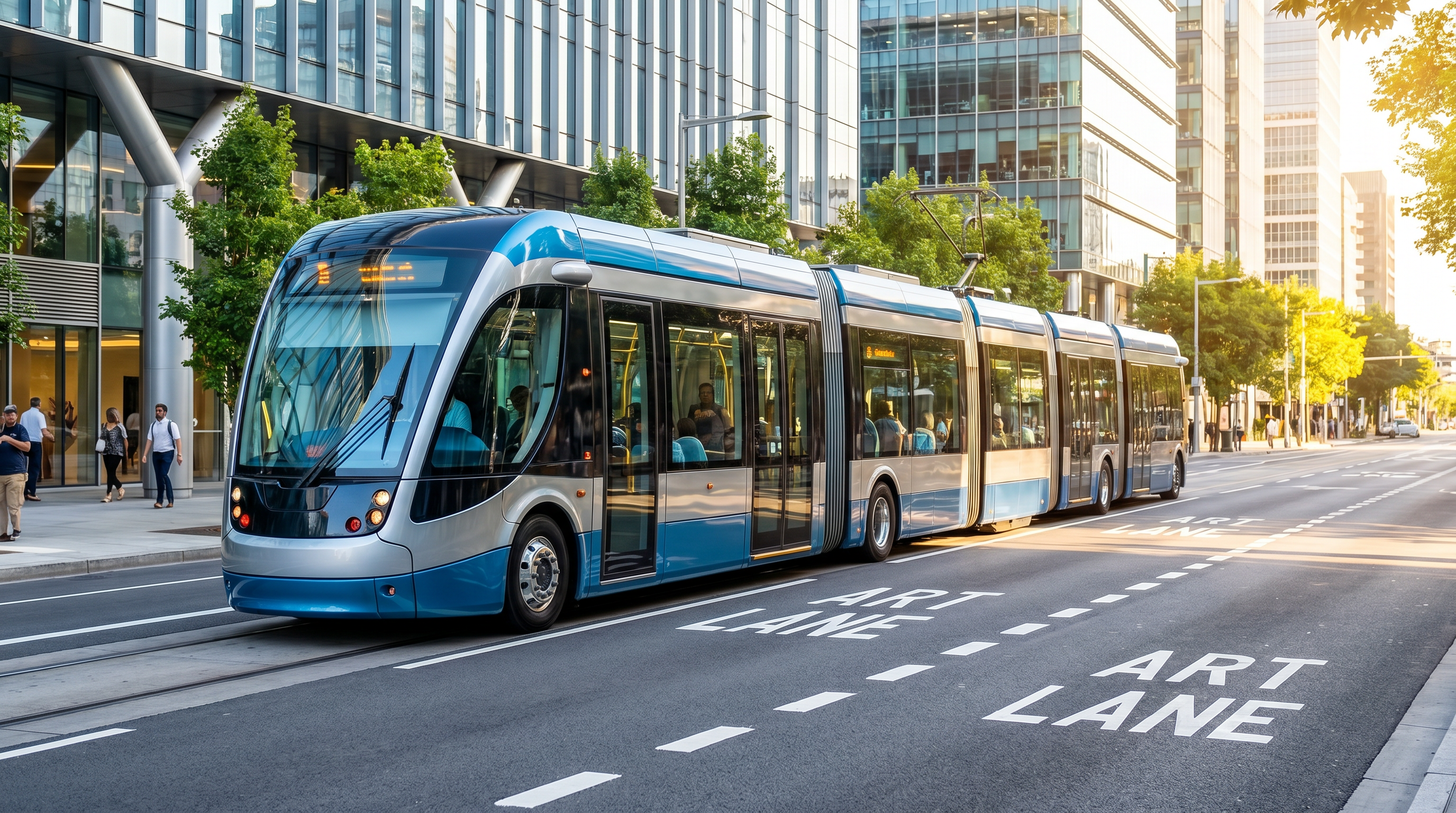
Enter Autonomous Rapid Transit (ART), colloquially known as the "trackless tram." Originally developed by the Chinese rail manufacturer CRRC, this emerging technology is designed to bridge the gap between the affordability of a bus and the premium experience of a train. From the outside, an ART vehicle looks exactly like a sleek, multi-carriage light rail train, complete with aerodynamic styling and low-floor boarding.[1][3]
The technology is rapidly moving from a conceptual novelty to global deployment. In early 2026, Dubai's Roads and Transport Authority announced a major public transport expansion featuring trackless trams across eight locations, aiming to cut journey times by 41 percent. Similar systems are already operating in several Chinese cities, with advanced trials underway in Perth, Australia, and Kuching, Malaysia.[2][5]

The defining feature of the trackless tram is its guidance system. Instead of relying on physical steel rails embedded in the asphalt, ART vehicles follow "virtual tracks." These are simply painted dashed lines on the roadway that the vehicle tracks using a sophisticated array of optical sensors, radar, GPS, and LiDAR.[1][5]
While the term "autonomous" is in the name, the system operates in a semi-autonomous mode. The vehicle automatically steers itself along the painted lines with centimeter-level precision, ensuring perfect alignment at station platforms. However, a human driver remains in the cabin to control acceleration and braking, and can grab the steering wheel to manually navigate around accidents or debris.[1][6]
Power delivery has also been modernized to eliminate the visual clutter of traditional trams. ART vehicles are fully electric and do not require continuous overhead catenary wires. Instead, they rely on roof-mounted lithium-titanate batteries that can absorb a massive amount of energy very quickly.[3][5]
During normal operation, the tram receives a 10-minute fast charge via an overhead pantograph while passengers board at designated stations. This brief top-up provides enough range to reach the next charging hub, while a deep charge is conducted overnight at the depot.[3]
During normal operation, the tram receives a 10-minute fast charge via an overhead pantograph while passengers board at designated stations.
But why call it a tram if it runs on rubber tires? Proponents argue the distinction lies in the ride quality. Standard buses use traditional axles and suspension, which amplify bumps and cause a jerky, swaying ride. Trackless trams, by contrast, utilize active suspension and rail-type bogies adapted from high-speed train technology.[3][6]

This stabilization technology actively counters lateral sway and controls acceleration, resulting in a smooth, gliding sensation that mimics the feel of steel wheels on steel rails. Passengers can read or stand comfortably without the constant lurching associated with bus travel.[3][5]
The vehicles are also massive compared to standard transit. A typical three-carriage ART vehicle stretches over 30 meters long and can carry up to 300 passengers. Five-carriage variants can accommodate up to 500 people, moving at operational speeds of up to 70 kilometers per hour.[1][3]
The primary driver of global interest, however, is the dramatic reduction in capital costs. Building a traditional light rail line requires excavating the roadbed, laying steel tracks, and—most expensively—relocating underground utilities like water mains and fiber optic cables. This process routinely costs between $50 million and $130 million per kilometer.[3][5]
Because trackless trams run on the surface, they bypass the need for deep excavation. Estimates suggest that an ART system can be deployed for $7 million to $15 million per kilometer. The infrastructure requirements are largely limited to road resurfacing, painting the virtual tracks, and building the passenger platforms.[3][5]

This surface-level deployment also means a system can be installed in a matter of months rather than years. For local businesses along the transit corridor, this avoids the prolonged construction disruption that has historically plagued light rail projects and driven shops into bankruptcy.[1][3]
Despite the enthusiasm, the technology faces fierce skepticism from transit purists. Academics at institutions like the University of Sydney argue that the "trackless tram" label is a clever marketing illusion. Legally and mechanically, they assert, the vehicle is simply a highly advanced, optically-guided articulated bus.[4][6]
Skeptics also warn of hidden long-term costs. A 50-ton vehicle traveling over the exact same wheel path every single day will inevitably cause severe rutting in standard asphalt. To prevent the road from deteriorating, cities may need to pour heavily reinforced concrete pathways, which eats into the initial cost savings. Furthermore, the proprietary nature of the optical guidance tech raises concerns about vendor lock-in.[4][6]
Ultimately, the success of the trackless tram may hinge on urban psychology. Light rail is famous for spurring real estate development because steel tracks signal permanence to developers. Whether a painted line can inspire the same billions in private investment remains to be seen. But as cities race to decarbonize and densify, the trackless tram offers a compelling, fast-to-deploy tool for the transit-starved corridors of the world.[3][5]
How we got here
June 2017
Chinese rail manufacturer CRRC unveils the first Autonomous Rapid Transit (ART) vehicle.
2018
The world's first commercial trackless tram line begins operation in Zhuzhou, China.
November 2023
The City of Stirling in Perth, Australia, conducts the nation's first trackless tram trial.
February 2026
Dubai's Roads and Transport Authority announces a major expansion featuring trackless trams across eight city locations.
Viewpoints in depth
Transit Innovators
Proponents argue that the trackless tram solves the 'mid-tier' transit dilemma by offering rail-like quality at bus-like prices.
Urban planners and researchers point out that traditional light rail is simply too expensive for the sprawling middle suburbs of most global cities. By adapting high-speed rail stabilization technology to a rubber-tired vehicle, innovators argue that ART can deliver the smooth ride necessary to attract choice riders out of their cars. Furthermore, they believe the permanence of dedicated stations and high-quality vehicles will spur the same kind of lucrative real estate development historically associated with steel-rail projects.
Transit Skeptics
Academics and transit purists caution against the 'gadgetbahn' hype, arguing the vehicles are merely rebranded buses.
Skeptics emphasize that without physical rails, a trackless tram is legally and mechanically an articulated bus. They warn that the intense weight of a 50-ton vehicle repeatedly driving over the exact same painted line will quickly destroy standard asphalt, forcing cities to pour expensive concrete roadbeds that erase the initial cost savings. Additionally, critics raise alarms about vendor lock-in, noting that municipalities will be permanently tied to the proprietary optical guidance software of a single manufacturer.
Municipal Planners
For city governments, the appeal lies in the speed of deployment and the ability to meet immediate climate goals.
Local governments are under immense pressure to reduce carbon emissions and ease traffic congestion without bankrupting their budgets. For these officials, the trackless tram offers a pragmatic middle ground. Because the system does not require digging up streets to relocate underground utilities, it can be deployed in months rather than years. This rapid turnaround minimizes disruption to local businesses and allows politicians to deliver tangible transit improvements within a single election cycle.
What we don't know
- Whether the 'virtual track' will inspire the same level of real estate investment and urban regeneration as permanent steel rails.
- The true long-term maintenance costs of reinforcing asphalt roadbeds to handle the repeated weight of 50-ton vehicles.
- How the proprietary nature of the optical guidance technology will affect future procurement and vendor lock-in for municipalities.
Key terms
- Autonomous Rapid Transit (ART)
- A high-capacity public transport system that uses rubber tires and optical guidance to simulate the experience of a light rail train.
- LiDAR
- A remote sensing method that uses light in the form of a pulsed laser to measure variable distances, used by ART to detect obstacles.
- Bogie
- A chassis or framework carrying wheels attached to a vehicle; ART uses rail-style bogies adapted for rubber tires to improve stability.
- Bus Rapid Transit (BRT)
- A high-quality bus-based transit system that delivers fast, comfortable, and cost-effective services at metro-level capacities.
- Virtual Track
- Painted dashed lines on the roadway that optical sensors follow to steer an autonomous vehicle.
Frequently asked
Does a trackless tram have a driver?
Yes. While the system steers autonomously along the virtual track, a driver remains in the cabin to monitor systems, control speed, and manually steer around unexpected obstacles.
How is it powered?
Trackless trams are fully electric. They use roof-mounted batteries that fast-charge in about 10 minutes at passenger stations, eliminating the need for continuous overhead wires.
Can it operate in snow or heavy rain?
Extreme weather can obscure the painted virtual tracks. In such cases, the driver can take manual control of the steering wheel to navigate the route safely.
Why is it cheaper than light rail?
It avoids the massive costs of digging up roads to lay steel tracks and relocate underground utilities like water pipes and fiber optic cables.
Sources
Source coverage
6 outlets
3 viewpoints surfaced






[1]World Economic ForumTransit Innovators
What are trackless trams and how could they revolutionize public transport?
Read on World Economic Forum →[2]Construction Week OnlineMunicipal Planners
RTA announces major public transport expansion in Dubai
Read on Construction Week Online →[3]Journal of Transportation TechnologiesTransit Innovators
The Trackless Tram: Is It the Transit and City Shaping Catalyst We Have Been Waiting for?
Read on Journal of Transportation Technologies →[4]University of Sydney ITLSTransit Skeptics
Debunking the myths around optically-guided bus (trackless trams)
Read on University of Sydney ITLS →[5]WSPTransit Innovators
Examining the Emerging Potential of Trackless Rapid Transit
Read on WSP →[6]Factlen Editorial TeamMunicipal Planners
Synthesis by Factlen editorial team
Read on Factlen Editorial Team →

More in automotive
See all 21 stories →Battery Tech
Solid-State EV Batteries Move From Lab to Assembly Line in 2026
7 sources
EV Battery Health
The Science of EV Battery Health: Why Your Car Will Likely Outlast Its Power Pack
9 sources

Rail Tech
The Rise of Hydrogen Trains: How Water-Vapor Transit is Replacing Diesel
7 sources
Grid Tech
How Millions of Parked EVs Are Becoming the Grid's Ultimate Backup Battery
8 sources
Every angle. Every day.
Get automotive stories with full source coverage and perspective breakdowns delivered to your inbox.