
The Rise of Hydrogen Trains: How Water-Vapor Transit is Replacing Diesel
Hydrogen-powered passenger trains are moving from prototypes to daily service across North America and Europe, offering a zero-emission alternative for rail lines too expensive to electrify.
By Factlen Editorial Team
- Hydrogen Proponents
- Believe hydrogen fuel cells are the only viable way to decarbonize long-distance, heavy-duty rail without massive infrastructure costs.
- Battery-First Advocates
- Argue that battery-electric trains are more efficient and cheaper to maintain for the vast majority of regional routes.
- Pragmatic Planners
- View both technologies as necessary tools, deploying hydrogen only where batteries fall short.
What's not represented
- · Freight rail operators
- · Green hydrogen producers
Why this matters
With only 1% of the North American rail network electrified, hydrogen fuel cells present a viable way to cut transit emissions without building billions of dollars in overhead wires, directly improving air quality for communities along rail corridors.
Key points
- Hydrogen trains use fuel cells to generate electricity on board, emitting only water vapor.
- They offer a zero-emission alternative for regional rail lines where overhead electrification is too expensive.
- A Stadler hydrogen train set a world record in 2024 by traveling 1,741 miles without refueling.
- San Bernardino launched the first hydrogen commuter train in the U.S. in September 2025.
- While battery-electric trains are cheaper for short routes, hydrogen excels on long-distance corridors.
The global push to decarbonize public transit has hit a stubborn roadblock: regional rail. While urban subways and high-speed networks easily draw power from electrified third rails or overhead catenary wires, electrifying thousands of miles of rural and regional track is prohibitively expensive. In North America, a staggering 99 percent of the rail network remains un-electrified, leaving transit agencies heavily reliant on diesel locomotives.[2][7]
For decades, diesel was the only practical solution for these sprawling, low-density routes. But a new technology is rapidly moving from European test tracks to North American commuter lines, offering a zero-emission alternative that doesn't require billions of dollars in new infrastructure: the hydrogen passenger train.[7]
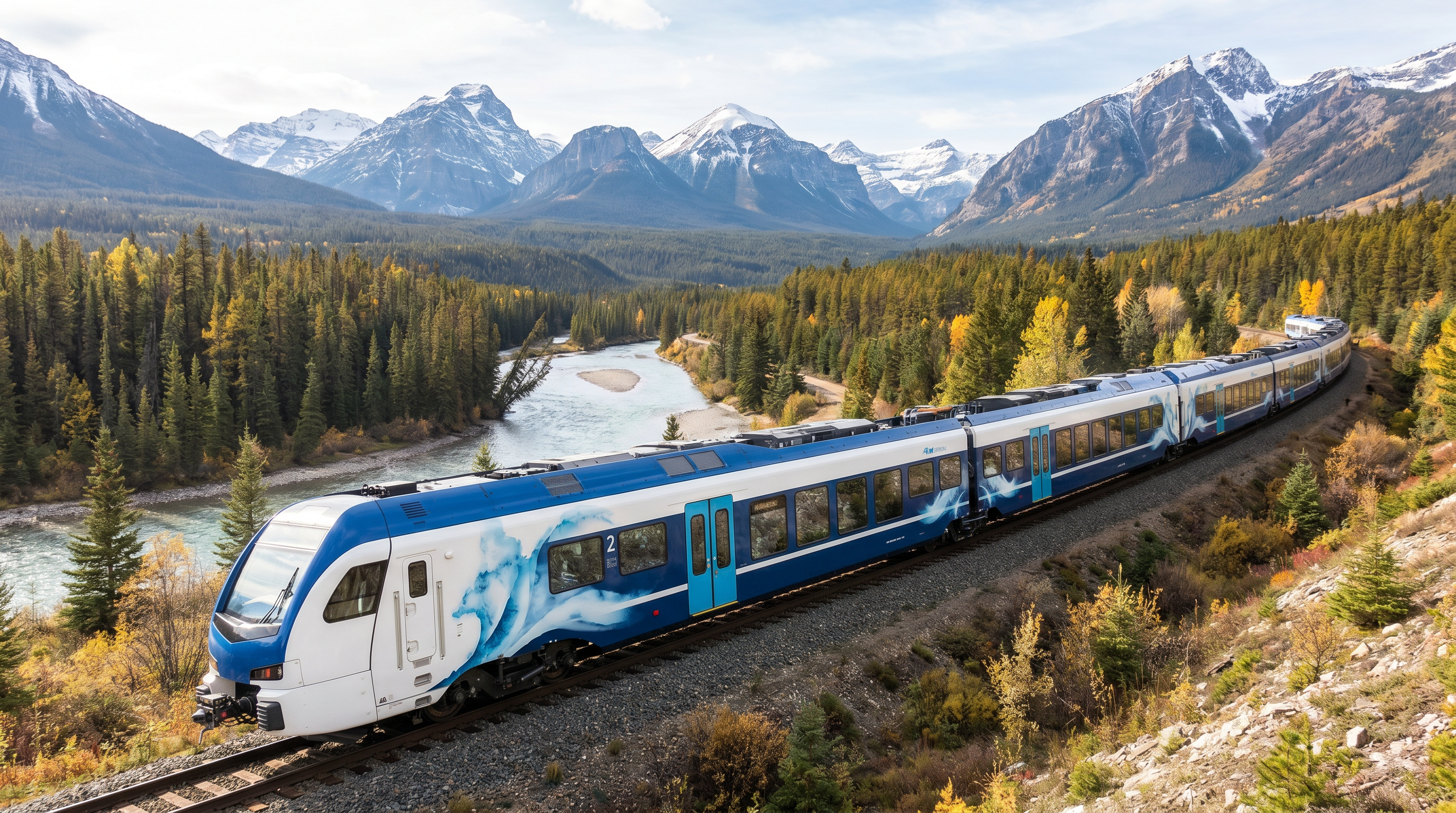
In September 2025, San Bernardino County, California, made history by launching the Zero-Emission Multiple Unit (ZEMU) into regular commuter service. Built by Swiss manufacturer Stadler, the ZEMU became the first hydrogen-powered passenger train to operate under U.S. Federal Railroad Administration safety standards. Wrapped in a distinctive blue and white water-vapor design, the train now shuttles passengers along the nine-mile Arrow line, emitting nothing but water into the California air.[3]
The ZEMU's debut is part of a much larger technological wave sweeping the transit industry. In March 2024, a Stadler FLIRT H2 model shattered the Guinness World Record for hydrogen rail endurance. Operating at a test track in Pueblo, Colorado, the train traveled 1,741 miles (2,803 kilometers) over 46 continuous hours on a single tank of fuel, proving that hydrogen can match or exceed the range of traditional diesel engines.[1]

So how does a hydrogen train actually work? Unlike diesel locomotives that burn fuel in a noisy combustion engine, hydrogen trains are essentially electric trains that generate their own power on board. The core mechanism relies on a central "power pack" containing high-pressure hydrogen tanks and advanced fuel cells.[1][7]
Inside the fuel cell, hydrogen gas is combined with oxygen drawn from the outside air. This electrochemical reaction produces a steady stream of electricity, which is then fed into the train's drive system. Because there is no combustion, the only byproducts of this entire process are pure water vapor and a small amount of heat.[1][2]
Crucially, modern hydrogen trains are hybrid systems. A fuel cell operates most efficiently when it provides a steady, continuous output of power. However, commuter trains require massive, sudden surges of energy to accelerate away from a station or climb a steep grade.[1][7]

A fuel cell operates most efficiently when it provides a steady, continuous output of power.
To handle these peaks, the fuel cell continuously charges an onboard lithium-ion traction battery. The battery delivers the immediate burst of torque needed for acceleration and captures kinetic energy during regenerative braking, making the entire propulsion system highly efficient.[1]
The undisputed pioneer of this technology is French manufacturer Alstom, whose Coradia iLint became the world's first commercial hydrogen passenger train when it entered service in Germany in 2018. Since then, Alstom's fleets have covered hundreds of thousands of miles across Europe, proving the technology's daily reliability.[2]
In the summer of 2023, Alstom brought the iLint to North America for a high-profile demonstration in Quebec. Over four months, the train carried more than 10,000 passengers along the St. Lawrence River, saving an estimated 8,400 liters of diesel and averting 22 tons of carbon dioxide emissions compared to the route's standard trains.[2]
Despite the impressive range and zero-emission profile, hydrogen isn't a universal silver bullet for transit planners. It faces fierce competition from Battery Electric Multiple Units (BEMUs)—trains that run purely on massive batteries and recharge via overhead wires at stations.[4]
Battery trains are often cheaper to maintain and operate. Stadler's own head of German sales recently noted that in technology-neutral tenders for routes under 50 miles (80 kilometers), battery trains almost always win. They avoid the complex logistics of hydrogen refueling and the need to replace expensive fuel cells every few years.[4]

However, hydrogen maintains a distinct and crucial advantage on long, demanding routes where battery weight becomes prohibitive or charging infrastructure is impossible to build. A hydrogen train can refuel in just 15 minutes and travel over 300 to 600 miles, mimicking the operational flexibility and turnaround times of diesel.[4]
Recognizing this specific niche, transit agencies are placing major bets on hydrogen for intercity travel. California's Department of Transportation (Caltrans) has signed an $80 million contract for a fleet of hydrogen intercity trains, aiming to connect Merced and Sacramento by 2027. Globally, the technology is expanding rapidly, with Italy ordering new fleets and China recently rolling out a 100 mph urban hydrogen train.[5][6]

Ultimately, the future of rail decarbonization won't be a winner-take-all battle between batteries and hydrogen. Instead, transit planners are adopting a targeted, multi-tool approach: batteries for the short branch lines, overhead wires for the dense urban cores, and hydrogen fuel cells to conquer the long, quiet stretches in between.[7]
How we got here
2018
Alstom's Coradia iLint becomes the world's first commercial hydrogen passenger train, entering service in Germany.
Summer 2023
The Coradia iLint completes a successful North American demonstration in Quebec, carrying 10,000 passengers.
March 2024
Stadler's FLIRT H2 sets a Guinness World Record by traveling 1,741 miles without refueling in Colorado.
September 2025
San Bernardino launches the ZEMU, the first hydrogen-powered commuter train in regular U.S. service.
2027
California expects to deploy its first fleet of intercity hydrogen trains between Merced and Sacramento.
Viewpoints in depth
Hydrogen Optimists
Advocates who see hydrogen as the ultimate diesel replacement for long-haul routes.
Proponents of hydrogen rail emphasize its operational parity with diesel. Because a hydrogen train can refuel in 15 minutes and travel up to 1,000 kilometers, transit agencies can swap out their diesel fleets without changing their timetables or building new mid-route charging infrastructure. For sprawling networks in North America and rural Europe, they argue that fuel cells are the only financially viable way to achieve zero emissions.
Battery-Electric Advocates
Industry experts who argue batteries are a more efficient and cost-effective solution for most routes.
Critics of hydrogen point to the high costs of fuel cell maintenance and the complexities of hydrogen logistics. They note that battery-electric trains (BEMUs) are far more energy-efficient, as they use electricity directly rather than losing energy during the electrolysis process required to make hydrogen. For the vast majority of regional routes—which are typically under 80 kilometers—they argue that partial overhead electrification combined with battery trains is a cheaper, simpler solution.
Transit Planners
Officials focused on deploying the right technology for the right route.
Rather than picking a single winner, transit authorities are increasingly adopting a mixed-fleet strategy. Planners view battery trains as the default choice for short branch lines connected to electrified mainlines. However, they reserve hydrogen trains as a specialized tool for the longest, most isolated corridors where stringing overhead wires or stopping to recharge batteries would disrupt service.
What we don't know
- How quickly the production of 'green hydrogen' will scale to meet the demands of growing transit fleets.
- Whether the lifespan and maintenance costs of hydrogen fuel cells will decrease enough to compete with battery-electric trains on medium-length routes.
Key terms
- Fuel Cell
- A device that generates electricity through an electrochemical reaction between hydrogen and oxygen, producing only water as a byproduct.
- Green Hydrogen
- Hydrogen fuel produced using renewable energy sources, such as wind or solar, to power the electrolysis of water.
- BEMU
- Battery Electric Multiple Unit; a passenger train powered entirely by large onboard batteries, which are typically recharged via overhead wires at stations.
- Catenary System
- The system of overhead electrical wires used to supply power to trains and trams.
- ZEMU
- Zero-Emission Multiple Unit, the specific name given to the first hydrogen-powered commuter train operating in San Bernardino, California.
Frequently asked
Is hydrogen safe to use on passenger trains?
Yes. Hydrogen tanks are built with carbon-fiber composites designed to withstand extreme impacts. Because hydrogen is lighter than air, any leak rapidly dissipates upward, unlike diesel which pools on the ground.
How fast can a hydrogen train go?
Most regional hydrogen trains, like the Stadler FLIRT H2, operate at commuter speeds of around 80 to 100 mph (130 to 160 km/h), matching the diesel trains they replace.
Why not just use overhead electric wires everywhere?
Electrifying rail lines costs millions of dollars per mile. For low-traffic rural or regional routes, the massive upfront cost of building and maintaining overhead wires cannot be justified by the passenger volume.
Is the hydrogen fuel actually green?
It depends on how it is produced. To be truly zero-emission, trains must use 'green hydrogen' created by splitting water with renewable electricity, rather than 'grey hydrogen' extracted from natural gas.
Sources
Source coverage
7 outlets
3 viewpoints surfaced







[1]Railway TechnologyPragmatic Planners
Stadler steams into record books with hydrogen-powered trainset
Read on Railway Technology →[2]AlstomHydrogen Proponents
Alstom's Coradia iLint wins the Hydrogen Mobility Award
Read on Alstom →[3]San Bernardino County Transportation AuthorityPragmatic Planners
Zero-Emission Multiple Unit (ZEMU)
Read on San Bernardino County Transportation Authority →[4]Hydrogen InsightBattery-First Advocates
Hydrogen will 'almost always' lose out to battery-electric in German rail transport
Read on Hydrogen Insight →[5]California Department of TransportationHydrogen Proponents
Arriving Soon in California: First Intercity Zero-Emission, Hydrogen Passenger Trains in North America
Read on California Department of Transportation →[6]Travel TomorrowPragmatic Planners
China builds world's first urban hydrogen-powered train
Read on Travel Tomorrow →[7]Factlen Editorial TeamPragmatic Planners
Synthesis by Factlen editorial team
Read on Factlen Editorial Team →

More in automotive
See all 21 stories →Battery Tech
Solid-State EV Batteries Move From Lab to Assembly Line in 2026
7 sources
EV Battery Health
The Science of EV Battery Health: Why Your Car Will Likely Outlast Its Power Pack
9 sources

Grid Tech
How Millions of Parked EVs Are Becoming the Grid's Ultimate Backup Battery
8 sources
Transit Tech
Trackless Trams: The Hybrid Technology Reshaping Mid-Tier Public Transit
6 sources
Every angle. Every day.
Get automotive stories with full source coverage and perspective breakdowns delivered to your inbox.