
The Science of Tea: How L-Theanine and Caffeine Synergize to Optimize the Brain
The unique combination of L-theanine and caffeine found in tea creates a state of "calm alertness" by modulating brain waves and neurotransmitters, offering sustained focus without the jittery crash of coffee.
By Factlen Editorial Team
- Clinical Researchers
- Focuses on the empirical EEG data and neurotransmitter binding affinities that explain tea's cognitive effects.
- Integrative Health Practitioners
- Views the L-theanine and caffeine stack as a vital, low-side-effect intervention for attention deficits and anxiety.
- Tea Cultivators & Educators
- Emphasizes the agricultural artistry of shade-growing and the holistic benefits of consuming the whole tea leaf.
- Editorial Synthesis
- Provides the overarching narrative connecting ancient agricultural practices with modern neuroscience.
What's not represented
- · Long-term daily users of high-dose isolated L-theanine supplements
- · Pediatricians treating severe ADHD exclusively with traditional pharmaceuticals
Why this matters
Understanding the neurochemistry of tea allows you to strategically manage your daily energy, focus, and stress levels. By leveraging the natural synergy between L-theanine and caffeine, you can achieve sustained cognitive performance without the anxiety and crashes associated with coffee or energy drinks.
Key points
- L-theanine is an amino acid in tea that crosses the blood-brain barrier to modulate the central nervous system.
- It increases alpha brain waves within 40 minutes, creating a state of "awake relaxation" similar to meditation.
- L-theanine boosts calming neurotransmitters like GABA while slightly inhibiting excitatory glutamate.
- When combined with caffeine, L-theanine neutralizes jitters and anxiety while enhancing cognitive focus.
- Shade-grown teas like matcha contain up to five times more L-theanine than standard green tea.
For millions of people, the morning routine is defined by a familiar, jagged arc: the sharp, sudden jolt of coffee-induced alertness, followed hours later by a jittery, unfocused crash. But a growing body of cognitive science is illuminating why tea drinkers often experience a vastly different trajectory. The secret lies in a unique neurochemical synergy that has been cultivated for centuries but only recently mapped by modern electroencephalogram (EEG) technology.[7]
At the center of this phenomenon is L-theanine, a non-protein amino acid found almost exclusively in the leaves of the Camellia sinensis tea plant and a single species of mushroom. Unlike many dietary compounds that are broken down in the digestive tract, L-theanine easily crosses the blood-brain barrier. Once inside the brain, it acts as a powerful modulator of the central nervous system, fundamentally altering how we process stress, fatigue, and incoming stimuli.[2]
The most immediate and measurable impact of L-theanine is its effect on the brain's electrical output. When researchers hook participants up to EEG monitors, they observe a distinct shift in brain wave patterns within 30 to 40 minutes of L-theanine ingestion. Specifically, the amino acid triggers a significant increase in alpha frequency bands across the cerebral cortex.[4][6]
Alpha waves are the electrical signature of "awake relaxation." They are the exact same brain waves that surge during deep meditation or in the quiet moments just before falling asleep. However, unlike pharmaceutical sedatives, L-theanine does not induce theta waves, which are associated with drowsiness. The result is a state of calm, centered alertness—the mind is quieted, but the cognitive faculties remain sharply engaged.[2][4]

Beyond electrical changes, L-theanine actively rewires the brain's chemical environment. It stimulates the production of gamma-aminobutyric acid (GABA), a crucial inhibitory neurotransmitter that acts like a brake pedal for the nervous system. By elevating GABA levels, L-theanine effectively blunts the body's physiological stress responses, lowering heart rates and reducing the physical sensations of anxiety.[5][6]
Simultaneously, L-theanine influences the brain's reward and learning centers by modulating dopamine and serotonin. It also acts as a competitive antagonist at certain glutamate receptors. Glutamate is the brain's primary excitatory neurotransmitter; by slightly inhibiting its reuptake, L-theanine prevents the hyper-excitability that often leads to scattered thoughts and mental exhaustion.[1][5]
Simultaneously, L-theanine influences the brain's reward and learning centers by modulating dopamine and serotonin.
But the true magic of tea emerges from the interaction between L-theanine and caffeine. Caffeine is a well-documented stimulant that works by blocking adenosine receptors. Adenosine is a chemical that naturally builds up in the brain throughout the day, signaling fatigue. By blocking these receptors, caffeine artificially halts the sensation of tiredness, while simultaneously increasing cholinergic and dopaminergic transmission to boost arousal.[1]
When consumed alone, caffeine's blunt-force mechanism often leads to overstimulation, resulting in anxiety, narrowed peripheral awareness, and the infamous "jitters." This is where L-theanine acts as a neurochemical buffer. By increasing GABA and alpha waves, L-theanine smooths out the jagged edges of caffeine. It neutralizes the physiological anxiety while preserving—and even enhancing—the cognitive alertness.[1][5]
Clinical trials have repeatedly demonstrated the superiority of this combination over caffeine alone. In studies measuring cognitive performance, participants given a combination of L-theanine and caffeine showed significantly faster reaction times, improved sentence verification accuracy, and better numeric working memory than those given a placebo or isolated caffeine.[1][6]
The benefits are particularly pronounced in high-stress scenarios. One study focusing on individuals with high baseline anxiety found that a 200-milligram dose of L-theanine reduced reaction times by 15% during cognitively demanding tasks, while simultaneously lowering their heart rates by 6%. The compound essentially allowed their brains to operate efficiently without triggering a panic response.[6]

Integrative psychiatrists are increasingly looking at this synergy as a therapeutic tool. Recent systematic reviews have highlighted the combination's potential for managing Attention-Deficit/Hyperactivity Disorder (ADHD). In trials involving boys with ADHD, the L-theanine and caffeine stack improved inhibitory control and significantly reduced task-related mind-wandering, offering a natural, low-side-effect adjunct to traditional treatments.[1][5]
However, not all teas deliver this cognitive payload equally. The concentration of L-theanine in a tea leaf is heavily dependent on how it is grown. During the natural growth cycle, sunlight stimulates photosynthesis, which converts L-theanine into catechins (the antioxidants that give green tea its astringent flavor). Therefore, standard green and black teas grown in full sunlight contain relatively low doses of the amino acid—usually around 4 to 20 milligrams per cup.[3]

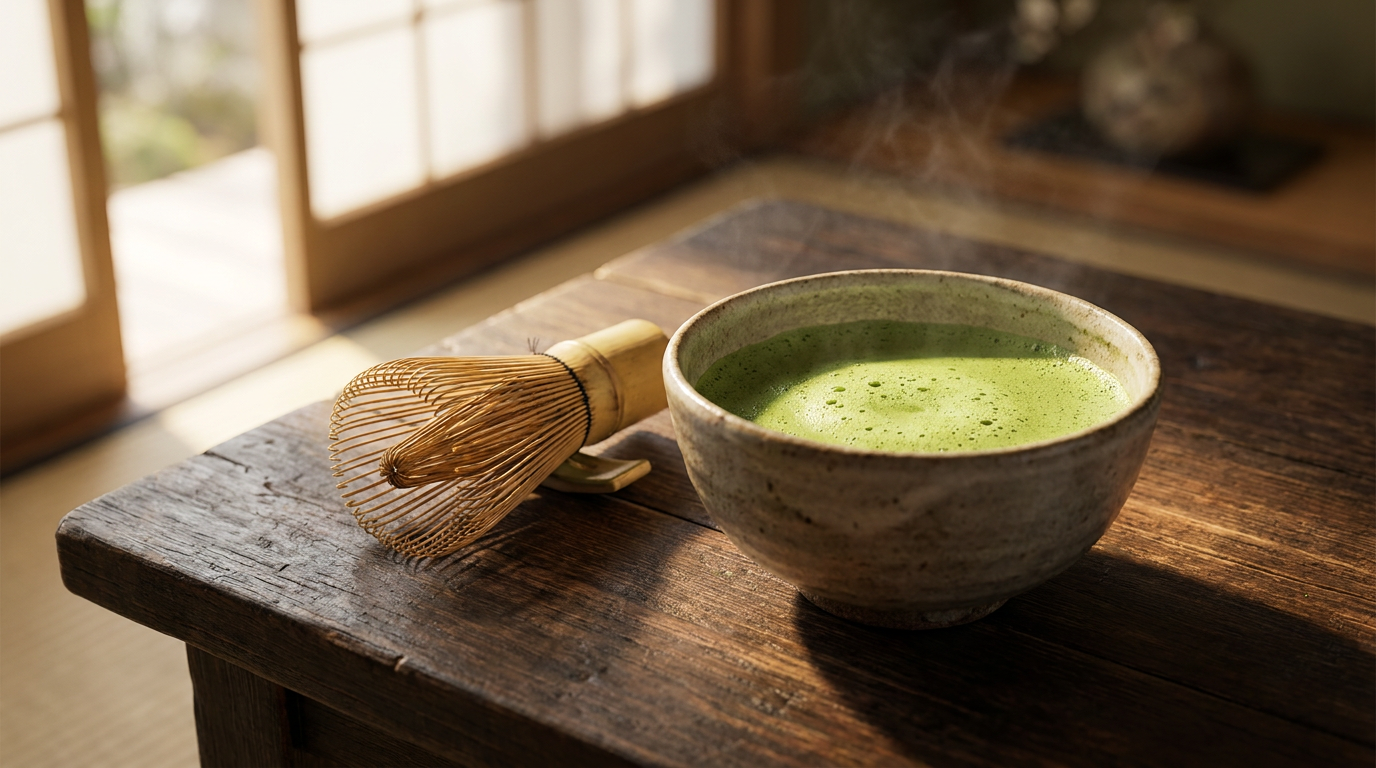
To maximize L-theanine, Japanese farmers developed specialized shade-growing techniques centuries ago. Approximately one month before harvest, tea plants destined to become matcha or gyokuro are covered with heavy tarps, blocking out up to 90% of direct sunlight. This forced shade halts the photosynthetic conversion, trapping massive amounts of L-theanine in the leaves. As a result, ceremonial-grade matcha can contain up to five times the L-theanine of standard green tea.[3]
Ultimately, the science of tea reveals a sophisticated, naturally occurring nootropic stack. By pairing a potent stimulant with a powerful neurological relaxant, tea provides a sustained, focused energy that modern pharmaceuticals and energy drinks struggle to replicate. It is a testament to the fact that sometimes, the most advanced cognitive enhancement technologies are grown in the dirt.[7]

Viewpoints in depth
Clinical Researchers
Focuses on the empirical EEG data and neurotransmitter binding affinities.
For neuroscientists, the value of L-theanine lies in its measurable biological mechanisms. While the subjective feeling of "calm" is notoriously difficult to quantify, the significant increase in alpha wave amplitude on an EEG provides hard data. Researchers emphasize that L-theanine's ability to act as a competitive antagonist at glutamate receptors offers a clear, pharmacological explanation for why tea prevents the hyper-excitability associated with isolated caffeine consumption.
Integrative Health Practitioners
Focuses on the practical application for patients managing stress and attention deficits.
Integrative psychiatrists view the L-theanine and caffeine stack as a vital first-line intervention for mild attention deficits and generalized anxiety. They praise the combination for its high safety profile and lack of dependency compared to synthetic stimulants. For these practitioners, the synergy offers a way to help patients achieve sustained focus and reduce task-related mind-wandering without the severe crashes or cardiovascular stress of traditional ADHD medications.
Tea Cultivators & Educators
Focuses on the agricultural artistry and the holistic benefits of the whole plant.
Tea experts argue that isolating L-theanine into pill form misses the broader benefits of the Camellia sinensis plant. They emphasize that the centuries-old shade-growing processes used for matcha and gyokuro not only preserve L-theanine but also maintain a complex matrix of polyphenols and catechins. From this perspective, the neurochemical benefits of tea are inextricably linked to the traditional, holistic methods of its cultivation and preparation.
What we don't know
- The exact long-term neuro-adaptive effects of taking high doses of isolated L-theanine supplements daily.
- Whether the L-theanine/caffeine synergy can fully replace pharmaceutical stimulants for severe cases of ADHD.
- The precise genetic factors that make some individuals hyper-responders to L-theanine while others feel minimal effects.
Key terms
- L-theanine
- A non-protein amino acid found almost exclusively in tea leaves that promotes relaxation without causing drowsiness.
- Alpha brain waves
- Electrical patterns in the brain associated with a state of relaxed, wakeful rest, such as during meditation.
- GABA
- An inhibitory neurotransmitter that acts like a brake pedal for the nervous system, reducing anxiety and physiological stress.
- Adenosine
- A chemical that builds up in the brain throughout the day to signal fatigue; caffeine works by blocking its receptors.
- Glutamate
- The brain's primary excitatory neurotransmitter, which L-theanine partially inhibits to prevent mental overstimulation.
Frequently asked
Will taking L-theanine make me feel sleepy or drowsy?
No. L-theanine increases alpha brain waves, which are associated with a state of "awake relaxation" or calm alertness. It does not induce the theta waves associated with sleepiness.
How much L-theanine is naturally found in a cup of tea?
A standard cup of brewed black or green tea contains roughly 4 to 20 milligrams. However, shade-grown teas like matcha can contain up to five times that amount.
How long does it take for L-theanine to affect the brain?
Clinical EEG studies show that alpha brain wave activity begins to significantly increase within 30 to 40 minutes of ingestion, with effects lasting for several hours.
Sources
Source coverage
7 outlets
4 viewpoints surfaced







[1]National Institutes of HealthClinical Researchers
The Cognitive-Enhancing Outcomes of Caffeine and L-Theanine: A Systematic Review
Read on National Institutes of Health →[2]The Better Sleep ClinicIntegrative Health Practitioners
L-Theanine And Sleep: Separating Fact From Fiction
Read on The Better Sleep Clinic →[3]Breakaway MatchaTea Cultivators & Educators
L-theanine in Matcha
Read on Breakaway Matcha →[4]IEEE XploreClinical Researchers
Classification of human brain attention focused on meditation, effected by L-theanine acid in Oolong tea
Read on IEEE Xplore →[5]Philadelphia Integrative PsychiatryIntegrative Health Practitioners
Enhancing Cognition and Attention: The Synergistic Effects of L-Theanine and Caffeine
Read on Philadelphia Integrative Psychiatry →[6]Natural Health Research InstituteClinical Researchers
L-Theanine Improves Reaction Time in High Anxiety Subjects
Read on Natural Health Research Institute →[7]Factlen Editorial TeamEditorial Synthesis
Synthesis by Factlen editorial team
Read on Factlen Editorial Team →
Every angle. Every day.
Get food drink stories with full source coverage and perspective breakdowns delivered to your inbox.