
The Science of Deep Sleep: How Pink Noise and Temperature Drops Unlock the Brain's Cleaning Cycle
Recent discoveries reveal that deep sleep physically alters the brain to flush out toxic proteins, and scientists are finding new ways to trigger this restorative state using acoustic stimulation and thermal regulation.
By Factlen Editorial Team
- Neurologists & Sleep Researchers
- Focus on the glymphatic system's role in clearing neurotoxic proteins and preventing long-term cognitive decline.
- Behavioral Sleep Specialists
- Emphasize foundational, free lifestyle interventions like temperature control and exercise timing over technological fixes.
- Neurotechnology Innovators
- Focus on emerging acoustic stimulation techniques, like pink noise, to actively enhance slow-wave brain activity.
What's not represented
- · Shift workers who cannot maintain consistent circadian rhythms
- · Individuals with chronic insomnia who experience anxiety around sleep optimization
Why this matters
Understanding how to actively trigger deep sleep empowers you to protect your long-term cognitive health, improve daily memory recall, and actively stave off neurodegenerative diseases using free, evidence-backed lifestyle adjustments.
Key points
- Deep sleep activates the glymphatic system, which washes toxic proteins out of the brain.
- Brain cells physically shrink during slow-wave sleep to allow cerebrospinal fluid to flow.
- Timed pulses of pink noise have been shown to enhance deep sleep and triple memory recall in older adults.
- A cool bedroom (60-67°F) is required to trigger the core temperature drop needed for deep sleep.
- Consuming 400mg of caffeine even 12 hours before bed can reduce deep sleep by over 20 minutes.
For decades, sleep was viewed primarily as a state of passive rest—a period when the body powered down to conserve energy. But recent advances in neuroscience have completely inverted this paradigm. Sleep is not a shutdown sequence; it is an active, highly orchestrated biological maintenance cycle that is critical for long-term survival.[1]
At the center of this paradigm shift is the discovery of the brain's built-in waste disposal network, known as the glymphatic system. Unlike the rest of the body, which relies on the lymphatic system to clear out cellular trash, the brain is a closed, highly protected environment. For years, scientists didn't fully understand how the brain cleared the metabolic byproducts generated by a day of intense cognitive activity.[2]
The answer, it turns out, lies in the deepest stages of slumber. Researchers have found that the glymphatic system kicks into high gear specifically during slow-wave sleep, also known as deep sleep or Stage N3. During this phase, the brain undergoes a literal physical transformation to wash itself clean of the day's debris.[2][4]
The mechanics of this nightly "brain cleanse" are remarkable. During deep sleep, brain cells actually shrink in size, expanding the interstitial space between them. This structural shift allows cerebrospinal fluid to rush in, flowing along microscopic channels created by star-shaped cells called astrocytes.[2][4]

As this clear fluid washes through the brain tissue, it flushes away toxic proteins and metabolic waste, including beta-amyloid and tau—two proteins notoriously linked to the development of Alzheimer's disease and other forms of dementia. Studies indicate that up to 60 percent more waste is cleared from the brain during sleep compared to waking hours.[4][7]
But the fluid doesn't just flow on its own; it requires a pump. A groundbreaking study revealed that the synchronized, high-energy electrical activity generated during deep sleep—known as delta waves—produces a flow of ions that physically carries the cerebrospinal fluid along with it. As the researchers noted, neurons that fire together literally "shower" together.[3]
The problem is that modern lifestyles and the natural aging process are actively eroding our deep sleep. While healthy adults typically spend 10 to 20 percent of their night in this restorative stage, the ability to generate slow-wave sleep diminishes significantly as we get older. This age-related decline in deep sleep is now viewed by neurologists as a potential early risk factor for cognitive decline.[2][7]
Beyond aging, environmental factors play a massive role in disrupting sleep architecture. Intermittent environmental noise, irregular sleep schedules, and chronic stress all fragment sleep, pulling the brain out of its deepest stages before the cleaning cycle can finish. Fortunately, sleep science has identified several highly effective, evidence-based interventions to protect and enhance slow-wave sleep.[6][9]

Beyond aging, environmental factors play a massive role in disrupting sleep architecture.
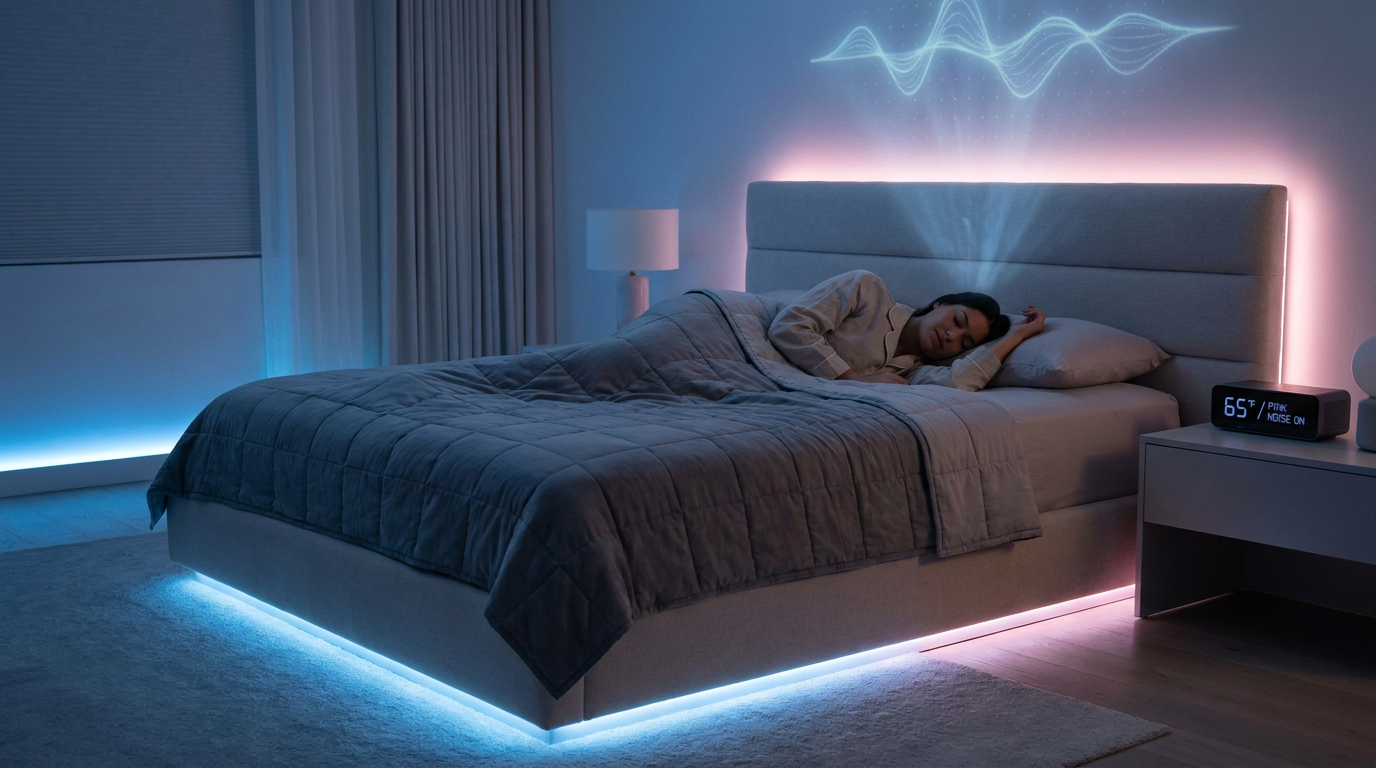
One of the most promising frontiers in sleep optimization is acoustic stimulation, specifically the use of "pink noise." Unlike white noise, which has equal volume across all frequencies and can sound harsh or static-like, pink noise turns down the volume on higher frequencies. The result is a deeper, more balanced sound that mimics natural environments like rushing water, steady rain, or wind through trees.[5][7]
Scientists at Northwestern University have found that the frequency profile of pink noise closely matches the slow brain waves seen in deep sleep. In controlled studies, playing short, timed pulses of pink noise to older adults during slow-wave sleep significantly enhanced their delta wave oscillations.[5]
The results of these acoustic interventions were striking: participants who received the targeted pink noise stimulation performed three times better on memory recall tests the following morning compared to nights without the sound. The acoustic pulses were just loud enough for the sleeping brain to register, but not loud enough to wake the individual, effectively coaching the brain into a deeper state of rest.[5]

However, nuance is required when using sound therapy. A recent study found that while continuous pink noise can mask disruptive environmental sounds, playing it constantly throughout the entire night might slightly alter overall sleep architecture, potentially reducing REM sleep by an average of 19 minutes. Researchers suggest that the most effective acoustic interventions in the future will likely use smart devices that play pink noise only during specific sleep stages.[6]
Beyond sound, temperature is one of the most powerful levers for inducing deep sleep. The body's core temperature must drop by about two to three degrees Fahrenheit to initiate and maintain slow-wave sleep. If the sleep environment is too warm, the brain struggles to cross the threshold into Stage N3, leaving the individual stranded in lighter, less restorative sleep phases.[7]
Sleep specialists universally recommend keeping the bedroom cool, ideally between 60 and 67 degrees Fahrenheit. A counterintuitive method to accelerate this process is the "hot bath trick." Taking a warm bath or shower 90 minutes before bed draws blood to the surface of the skin, which then rapidly dissipates heat when you step into a cool bedroom, accelerating the core temperature drop needed for deep sleep.[7]
Daytime behaviors also dictate nighttime sleep architecture. A comprehensive review of over 50 peer-reviewed studies identified consistent, moderate aerobic exercise as one of the most reliable ways to increase deep sleep duration. However, timing is critical: intense workouts within three hours of bedtime elevate core temperature and cortisol, delaying the onset of slow-wave sleep.[9]

Finally, the chemical environment of the brain must be clear of stimulants. Caffeine is notorious for its long half-life. Data shows that consuming 400 milligrams of caffeine—roughly two large cups of coffee—even 12 hours before bedtime can reduce deep sleep by over 20 minutes. The stimulant blocks adenosine receptors, preventing the brain from building the necessary "sleep pressure" required to dive into slow-wave sleep.[8][9]
While the science of sleep optimization is advancing rapidly, there are still unknowns. Commercial sleep trackers and wearables are excellent at measuring total sleep time and heart rate variability, but they remain imprecise at accurately distinguishing between light sleep, REM, and deep sleep compared to clinical EEG monitors. Obsessing over a wearable's nightly "sleep score" can sometimes induce anxiety, which ironically degrades sleep quality.[1][9]
Furthermore, while the link between poor deep sleep and the buildup of Alzheimer's-related proteins is clear, researchers are still investigating whether artificially enhancing deep sleep over decades can definitively prevent neurodegenerative diseases. Long-term longitudinal studies are currently underway to answer this critical question and map the exact relationship between lifetime sleep habits and cognitive longevity.[2][4]
What is undeniable, however, is that sleep can no longer be viewed as an optional luxury or a biological inconvenience. It is a foundational health behavior. By managing light, temperature, sound, and daily habits, we can actively support the brain's nightly cleaning crew, protecting our cognitive health for the decades to come.[1][4]
How we got here
2012
Researchers at the University of Rochester first discover and name the 'glymphatic system' in the brain.
2017
Northwestern University publishes early studies showing timed pink noise can enhance deep sleep and memory in older adults.
2024
Studies reveal that synchronized delta brain waves physically drive the flow of cerebrospinal fluid through the brain.
2025
Major reviews solidify the link between disrupted glymphatic clearance and the onset of Alzheimer's disease.
2026
New data highlights the nuanced effects of continuous pink noise on REM sleep, emphasizing the need for timed acoustic stimulation.
Viewpoints in depth
Neurologists & Sleep Researchers
Focus on the long-term stakes of sleep architecture and the prevention of cognitive decline.
For neurologists, the discovery of the glymphatic system elevated sleep from a wellness topic to a critical pillar of preventative medicine. They view chronic sleep deprivation not just as a cause of daily fatigue, but as a mechanism that allows toxic proteins like beta-amyloid to accumulate over decades. Their primary focus is on how protecting slow-wave sleep could serve as a population-level defense against the rising tide of Alzheimer's disease and other dementias.
Behavioral Sleep Specialists
Emphasize foundational, behavioral interventions over technological fixes and gadgets.
Behavioral specialists argue that before patients invest in acoustic stimulation devices or expensive wearables, they must master the basics of sleep hygiene. They emphasize that strict sleep schedules, aggressive temperature control, and eliminating late-day caffeine and alcohol are the most powerful levers available. They often warn that obsessing over sleep tracker data can induce anxiety, which ironically degrades the very deep sleep patients are trying to achieve.
Neurotechnology Innovators
Focus on the potential to actively manipulate and enhance sleep architecture using external stimuli.
Innovators in the neurotechnology space point out that because deep sleep naturally declines with age, behavioral changes alone may not be enough for older adults. They champion the development of non-invasive technologies—like smart headbands that deliver timed pulses of pink noise or responsive mattresses that actively cool the body—to artificially boost slow-wave activity and compensate for the brain's aging architecture.
What we don't know
- Whether artificially enhancing deep sleep over decades can definitively prevent Alzheimer's disease.
- How accurately consumer wearables can measure specific sleep stages compared to clinical EEG monitors.
- The long-term effects of using continuous acoustic stimulation every night for years.
Key terms
- Glymphatic System
- The brain's waste clearance pathway that flushes out metabolic byproducts using cerebrospinal fluid.
- Slow-Wave Sleep (Stage N3)
- The deepest phase of non-REM sleep, characterized by slow delta brain waves and vital for physical restoration.
- Astrocytes
- Star-shaped cells in the brain that help form the microscopic channels through which cerebrospinal fluid flows during sleep.
- Pink Noise
- A type of background sound that includes all audible frequencies but reduces the volume of higher pitches, mimicking natural sounds.
- Delta Waves
- High-amplitude, low-frequency electrical brain waves that dominate during deep sleep and help drive fluid clearance.
Frequently asked
What is the glymphatic system?
The glymphatic system is the brain's unique waste-clearance network. During deep sleep, it uses cerebrospinal fluid to flush out toxic proteins and metabolic byproducts that accumulate during waking hours.
What is the difference between white noise and pink noise?
White noise has equal volume across all frequencies, which can sound harsh or static-like. Pink noise reduces the volume of higher frequencies, creating a deeper, more natural sound similar to rushing water or steady rain.
Can I catch up on lost deep sleep?
While the body will naturally prioritize deep sleep after a period of deprivation, chronic sleep loss causes cumulative damage that cannot be fully reversed by sleeping in on a single weekend.
Does alcohol help with deep sleep?
No. While alcohol may help you fall asleep faster, it severely fragments sleep architecture and drastically reduces the amount of time spent in restorative deep sleep.
Sources
Source coverage
9 outlets
3 viewpoints surfaced









[1]Factlen Editorial Team
Synthesis by Factlen editorial team
Read on Factlen Editorial Team →[2]Science InsightsNeurologists & Sleep Researchers
Sleep and the Glymphatic System: A Review of Brain Cleansing Mechanisms
Read on Science Insights →[3]PsychiatryOnlineNeurologists & Sleep Researchers
The Discovery of the Brain's Cleaning System
Read on PsychiatryOnline →[4]National Neuroscience InstituteNeurologists & Sleep Researchers
Clean your brain as you sleep
Read on National Neuroscience Institute →[5]TIMENeurotechnology Innovators
How 'Pink Noise' Can Improve Sleep and Memory
Read on TIME →[6]MindBodyGreenNeurotechnology Innovators
Pink Noise Reduced REM Sleep By 19 Minutes, Study Finds
Read on MindBodyGreen →[7]Cleveland ClinicBehavioral Sleep Specialists
How To Get More Deep Sleep
Read on Cleveland Clinic →[8]The Washington PostBehavioral Sleep Specialists
How diet and caffeine affect your sleep
Read on The Washington Post →[9]KygoBehavioral Sleep Specialists
How to Increase Deep Sleep: Evidence from 50+ Studies
Read on Kygo →

Every angle. Every day.
Get health stories with full source coverage and perspective breakdowns delivered to your inbox.