
The Science of Sourdough: How Wild Yeast and Bacteria Transform Flour and Water
A sourdough starter is a complex, symbiotic ecosystem of wild yeast and lactic acid bacteria that not only leavens bread but fundamentally alters its nutritional profile.
By Factlen Editorial Team
- Microbial Ecologists
- Focus on the ecological diversity and symbiotic relationships within the starter culture.
- Nutritional Researchers
- Focus on the biochemical breakdown of antinutrients and the improvement of digestibility.
- Artisan Bakers
- Focus on manipulating environmental variables to control the dough's physical and flavor properties.
What's not represented
- · Commercial yeast manufacturers
- · Gluten-free bakers
Why this matters
Understanding the microbial ecosystem inside a sourdough starter allows home bakers to troubleshoot their dough, manipulate flavor profiles, and unlock the profound nutritional benefits—like increased mineral absorption and lower blood sugar spikes—that long fermentation provides.
Key points
- A sourdough starter is a symbiotic ecosystem where wild yeast and lactic acid bacteria coexist without competing for the same food.
- The yeast consumes simple sugars to produce carbon dioxide for leavening, while the bacteria consume complex sugars to produce flavor-enhancing acids.
- Recent sequencing shows that the vast majority of a starter's microbiome comes directly from the flour, not the surrounding air.
- Lactic acid bacteria activate enzymes that break down phytic acid, increasing the body's ability to absorb essential minerals.
- The fermentation process pre-digests gluten proteins and lowers the bread's glycemic index, making it easier to digest.
- Bakers can manipulate the flavor profile of their bread by adjusting the temperature and hydration of the starter.
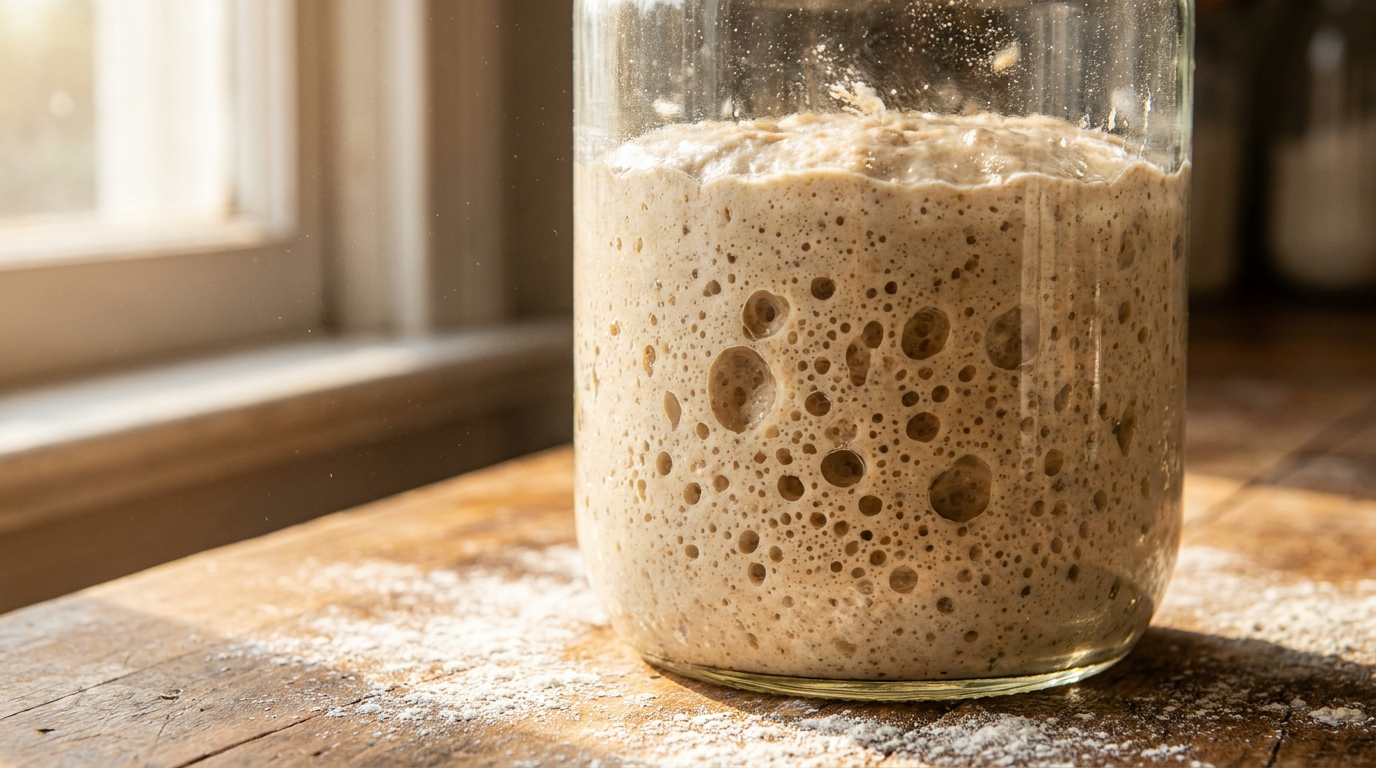
To the naked eye, a sourdough starter is just a jar of beige paste sitting on a kitchen counter. But under a microscope, that simple mixture of flour and water reveals itself as a bustling, microscopic metropolis. While millions of home cooks learned to maintain these bubbling cultures during the recent baking booms, few understand the complex biological machinery operating beneath the surface. Baking a loaf of sourdough bread is not just a culinary exercise; it is an act of applied microbiology.[5]
The transformation begins the moment water hydrates the flour. Wheat and rye flours are naturally coated in dormant microorganisms that have survived the milling process. When mixed with water, naturally occurring enzymes in the flour, such as amylase, immediately begin breaking down complex starches into simple sugars. This sudden abundance of food awakens the dormant microbes, kicking off a fierce microscopic competition for resources.[4][5]
Within a few days of regular feeding, the chaotic microbial battleground stabilizes into a highly organized ecosystem known as a SCOBY—a symbiotic culture of bacteria and yeast. In this cooperative environment, the dominant organisms crowd out spoilage bacteria and mold. The two primary residents of this newly formed city are wild yeasts and lactic acid bacteria (LAB), which work in tandem to transform dense dough into an airy, flavorful loaf.[1][4]
The wild yeasts, which often include species like Saccharomyces cerevisiae and Candida milleri, act as the biological engine of the bread. As they consume simple sugars, they undergo alcoholic fermentation, releasing ethanol and carbon dioxide. The carbon dioxide gas becomes trapped within the dough's elastic gluten network, creating the expanding bubbles that cause the bread to rise.[1][5]

While the yeast provides the lift, the lactic acid bacteria provide the character. LAB, which outnumber yeast cells by as much as 100 to 1 in a mature starter, metabolize sugars to produce organic acids. Homofermentative LAB produce primarily lactic acid, which imparts a mild, yogurt-like tang. Heterofermentative LAB produce both lactic acid and acetic acid, the latter providing a sharper, vinegar-like sourness. Together, these acids drop the pH of the dough, creating an environment too hostile for harmful pathogens to survive.[3][5]
The secret to this enduring partnership is resource partitioning. In a thriving starter, the yeast and bacteria do not compete for the same food supply. The wild yeasts generally prefer to consume simple sugars like glucose and fructose. Meanwhile, the lactic acid bacteria—particularly specialized strains like Fructilactobacillus sanfranciscensis—preferentially metabolize maltose, a more complex sugar that the yeast cannot easily digest.[4]
Because their dietary preferences do not overlap, the yeast and bacteria can coexist peacefully in the same jar for decades, or even centuries. When the yeast cells eventually die, they break down into compounds that the bacteria can consume, further cementing their symbiotic relationship. This perfect biological balance is why a well-maintained sourdough starter can be passed down through generations without spoiling.[4][5]
Because their dietary preferences do not overlap, the yeast and bacteria can coexist peacefully in the same jar for decades, or even centuries.
For years, bakers romanticized the idea that a starter's unique flavor came from wild yeast floating in the air of their specific kitchen or city. However, recent large-scale sequencing of sourdough microbiomes has largely debunked this myth. Studies analyzing starters from professional bakers around the world have revealed that the vast majority of the microbial community arrives directly on the flour itself.[1][2]
While the flour provides the baseline population, the environment does play a secondary role. Microbes from the baker's hands and the ambient kitchen environment can eventually integrate into the culture. However, researchers have found little evidence of strict geographic patterns; a starter cultivated in San Francisco might share a nearly identical microbial makeup with one grown in Paris, provided they are fed the same flour and kept at similar temperatures.[1][2]
Beyond leavening and flavor, this microbial ecosystem performs a profound nutritional alchemy. The fermentation process fundamentally alters the chemical structure of the grain, unlocking nutrients that would otherwise pass through the human digestive system unabsorbed. One of the most significant transformations involves the breakdown of phytic acid, an antinutrient naturally present in the bran of wheat and rye.[3]
Phytic acid binds to essential minerals like iron, zinc, and magnesium, preventing the body from absorbing them. However, the acidic environment created by the lactic acid bacteria activates an enzyme called phytase, which hydrolyzes the phytic acid. Research indicates that a long sourdough fermentation can reduce phytate levels by up to 90 percent, dramatically increasing the bioavailability of these crucial minerals.[3]

The bacterial activity also initiates extensive proteolysis—the breakdown of proteins. The acidic conditions activate cereal proteases, which, along with enzymes produced by the LAB, begin to dismantle the complex gluten network. They cleave these large, difficult-to-digest proteins into smaller peptides and free amino acids. This pre-digestion process is why many individuals with mild non-celiac gluten sensitivities find long-fermented sourdough bread much easier to tolerate than commercial yeast bread.[3]
Furthermore, the organic acids produced during fermentation alter how the human body metabolizes the bread's carbohydrates. Lactic and acetic acids slow down the rate of gastric emptying and inhibit certain starch-digesting enzymes in the body. As a result, sourdough bread typically boasts a significantly lower glycemic index compared to conventional white bread, providing a slower, more stable release of blood sugar.[3]
Some strains of lactic acid bacteria also produce exopolysaccharides—complex carbohydrate polymers that act as a natural hydrocolloid. These compounds not only improve the volume and shelf-life of the bread by retaining moisture, but they also function as prebiotic dietary fiber, feeding the beneficial bacteria in the consumer's own gut microbiome.[3]
Artisan bakers learn to manipulate this microscopic ecosystem by adjusting environmental variables. Temperature is the most powerful lever: warmer temperatures generally favor the rapid growth of yeast and lactic acid production, resulting in a faster rise and a milder flavor. Cooler temperatures, such as a slow fermentation in the refrigerator, favor the production of acetic acid, yielding a more pronounced, pungent sourness.[5]

Hydration levels also dictate the microbial balance. A liquid starter with a high ratio of water to flour encourages enzymatic activity and lactic acid production. Conversely, a stiff starter with less water restricts microbial mobility and favors the production of acetic acid. By tweaking these parameters, a baker acts as a microbial conductor, steering the flavor profile of the final loaf.[4][5]
Ultimately, a sourdough starter is a vivid reminder that our food is intimately connected to the invisible natural world. By simply mixing flour and water, home bakers are cultivating a vibrant, domesticated ecosystem on their countertops. It is a daily practice of tending to a microbial garden—one that rewards patience and observation with a loaf of bread that is more nutritious, more flavorful, and deeply alive.[1][6]
How we got here
3700 BC
Earliest evidence of sourdough bread is baked, as excavated in modern-day Switzerland.
Middle Ages
Sourdough remains the standard method of breadmaking across Europe before the advent of commercial skimming.
Late 19th Century
Industrially produced baker's yeast begins replacing traditional sourdough cultures for speed and consistency.
1971
Scientists officially identify Lactobacillus sanfranciscensis as a key, specialized bacteria in sourdough cultures.
2020
The COVID-19 pandemic sparks a massive global resurgence in home sourdough baking and starter cultivation.
Viewpoints in depth
Microbial Ecologists
Focus on the ecological diversity and symbiotic relationships within the starter.
For microbiologists, a sourdough starter is a model ecosystem for studying microbial population dynamics. They emphasize that the starter is not merely a collection of isolated organisms, but a highly structured community where resource partitioning prevents competitive exclusion. By studying how Saccharomyces yeasts and Lactobacillus bacteria share the carbohydrate resources of flour without starving each other, researchers gain insights into how complex microbiomes assemble and stabilize in the natural world.
Nutritional Researchers
Focus on the biochemical breakdown of antinutrients and the improvement of digestibility.
Nutritional scientists view sourdough fermentation as a vital pre-digestion process that fundamentally alters the grain's chemical matrix. They point to the enzymatic hydrolysis of phytic acid, which unlocks essential minerals, and the extensive proteolysis that degrades gluten proteins. From this perspective, the primary value of sourdough is not its artisanal flavor, but its ability to transform a high-glycemic, mineral-locking staple crop into a bioavailable, gut-friendly functional food.
Artisan Bakers
Focus on manipulating environmental variables to control the dough's physical and flavor properties.
For professional and home bakers, the science of sourdough is a practical tool for sensory manipulation. They view the starter as an instrument that can be tuned via temperature, hydration, and feeding schedules. By understanding that cooler temperatures favor acetic acid production and higher hydration favors lactic acid, bakers can intentionally steer the microbial metabolism to produce anything from a mildly tangy sandwich loaf to a sharply sour San Francisco-style boule.
What we don't know
- While researchers have identified the dominant species in sourdough, the exact function of the hundreds of minor microbial strains present in various starters remains unmapped.
- The precise mechanisms by which specific lactic acid bacteria strains interact with the human gut microbiome post-consumption are still being actively studied.
- It is not fully understood why certain starters spontaneously develop highly unique flavor profiles even when fed identical flour in identical environments.
Key terms
- SCOBY
- A Symbiotic Culture of Bacteria and Yeast; a cooperative microbial community where different organisms support each other's survival.
- Lactic Acid Bacteria (LAB)
- A group of bacteria that ferment carbohydrates to produce lactic acid, responsible for the sour flavor and preservation of the dough.
- Phytic Acid
- An antinutrient naturally found in grain bran that binds to minerals and prevents the human body from absorbing them.
- Proteolysis
- The biochemical process of breaking down complex proteins, such as gluten, into smaller, more digestible peptides and amino acids.
- Exopolysaccharides
- Complex carbohydrate chains produced by bacteria that improve the texture of the bread and act as prebiotic fiber.
Frequently asked
Can I start a sourdough culture with just any flour?
Yes, though whole grain flours like rye or whole wheat contain more nutrients and a higher population of wild microbes, making them faster and more reliable for establishing a new starter.
Does sourdough bread contain alcohol?
While wild yeast produces ethanol during the fermentation process, the vast majority of this alcohol evaporates during the high-heat baking process, leaving only trace amounts in the final loaf.
Why does my starter smell like nail polish remover?
A strong acetone or vinegar smell indicates that the starter is hungry and the lactic acid bacteria have produced an excess of acetic acid. Feeding it fresh flour and water will restore the balance.
Is sourdough bread safe for people with celiac disease?
No. While the fermentation process breaks down some gluten, making it easier to digest for those with mild sensitivities, it does not eliminate gluten entirely and is not safe for individuals with celiac disease.
Sources
Source coverage
6 outlets
3 viewpoints surfaced






[1]American Society for MicrobiologyMicrobial Ecologists
The Sourdough Microbiome
Read on American Society for Microbiology →[2]eLifeMicrobial Ecologists
The diversity and function of sourdough starter microbiomes
Read on eLife →[3]MDPINutritional Researchers
A Critical Review on the Role of Lactic Acid Bacteria in Sourdough Nutritional Quality: Mechanisms, Potential, and Challenges
Read on MDPI →[4]The Pantry MamaArtisan Bakers
How Does Sourdough Starter Work? [Science of Sourdough]
Read on The Pantry Mama →[5]Purdue College of AgricultureArtisan Bakers
The science behind sourdough
Read on Purdue College of Agriculture →[6]Factlen Editorial Team
Synthesis by Factlen editorial team
Read on Factlen Editorial Team →
Every angle. Every day.
Get food drink stories with full source coverage and perspective breakdowns delivered to your inbox.