
The Science of Sleep Tourism: How Hotels Are Re-Engineering Rooms for Perfect Rest
As chronic sleep deprivation reaches crisis levels, the hospitality industry is transforming hotel rooms into high-tech recovery labs using circadian lighting, acoustic cocooning, and AI-powered thermal regulation.
By Factlen Editorial Team
- Hospitality Executives
- Viewing sleep as a monetizable infrastructure rather than a passive amenity.
- Sleep Scientists
- Focusing on evidence-based interventions to cure chronic sleep debt.
- Wellness Travelers
- Seeking environments that force disconnection and physical recovery.
What's not represented
- · Budget Travelers
- · Housekeeping Staff
Why this matters
With over a third of adults suffering from chronic sleep debt, the travel industry is shifting from exhausting itineraries to restorative health. The technologies being pioneered in luxury hotels—from AI mattresses to circadian lighting—are setting new standards for how we design our own bedrooms for longevity and mental clarity.
Key points
- The global sleep tourism market is valued at over $640 billion and growing rapidly.
- Hotels are shifting from passive amenities to active 'sleep infrastructure' like circadian lighting.
- Acoustic cocooning treats walls and ventilation as a single system to block low-frequency noise.
- AI-enhanced mattresses actively regulate temperature to mirror the body's natural thermal cycle.
- Major brands are partnering with neuroscientists to build clinical sleep labs and retreats.
- The ultimate goal is to provide guests with biometric data and habits to cure chronic insomnia.
For decades, the ultimate hotel flex was a bustling lobby, a rooftop bar, and a concierge who could score impossible dinner reservations. Today, the most coveted amenity in luxury hospitality is absolute, uninterrupted silence. Welcome to the era of "sleep tourism," a rapidly expanding sector where the primary objective of a vacation is simply to achieve a perfect night's rest.[1][2]
The demand is staggering. The global sleep economy, fueled by a population exhausted by digital overload and "hustle culture," is now valued at over $640 billion and is projected to surpass $1 trillion by the end of the decade. According to the Centers for Disease Control and Prevention, roughly 36% of Americans get insufficient sleep, a chronic deficit linked to cognitive decline, weakened immune function, and metabolic disruption. In response, travelers are increasingly willing to pay premium rates not for stimulation, but for scientifically engineered recovery.[1][2][3][4][6]
"We're seeing a fundamental shift from sleep as a passive amenity to sleep as active infrastructure," notes the Global Wellness Institute's 2025 monitor. In the past, a hotel's sleep program might have consisted of a lavender pillow spray and a plush duvet. Today, it involves neuroscientists, biometric tracking, and the architectural re-engineering of the guest room itself.[4][5][6]
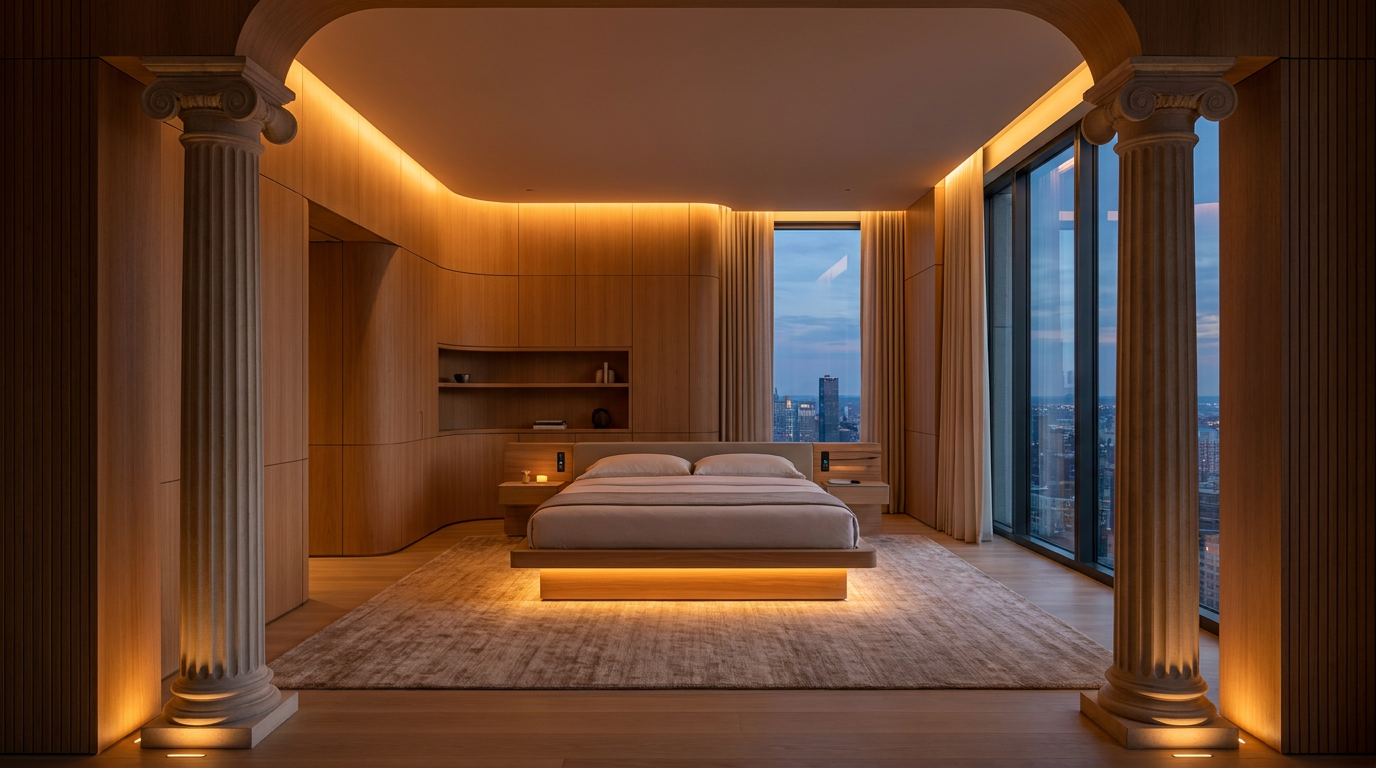
The foundation of this new architecture is circadian optimization. Human biology relies on light cues to regulate melatonin production, but standard hotel lighting—often harsh and static—disrupts this natural rhythm. To counter this, properties are installing dynamic LED systems that mimic the color temperature of the sun. These systems bathe the room in bright, blue-enriched light (around 6500K) in the morning to stimulate cortisol and alertness, then automatically transition to warm, amber hues (2700K) as evening approaches, signaling the brain to prepare for rest.[2][5][6]

Acoustic engineering has also moved far beyond double-paned windows. Sleep scientists refer to the new standard as "acoustic cocooning." Low-frequency noises, such as the hum of an elevator shaft or a standard HVAC unit, can pull a sleeper out of deep, restorative delta-wave sleep without fully waking them. To prevent this micro-fragmentation, developers are treating walls, doors, and ventilation ducts as a single, integrated acoustic system. In London, the Zedwell hotel brand has taken this to the extreme, offering windowless, sound-insulated "cocoons" equipped with purified air systems to entirely eliminate urban sensory pollution.[2][4][6]
Acoustic engineering has also moved far beyond double-paned windows.
Thermal regulation is perhaps the most critical, and technologically advanced, frontier. To initiate and maintain sleep, the human core body temperature must drop by roughly two to three degrees Fahrenheit. Traditional hotel thermostats, which often blast dry, recycled air, fight this biological imperative. Now, luxury properties are deploying AI-enhanced mattresses from companies like Bryte and Eight Sleep to actively manage the microclimate under the covers.[1][5][6][7]
At the Park Hyatt New York, guests can book specialized Sleep Suites featuring Bryte's AI beds for a $300 nightly surcharge. These mattresses use a network of sensors and active liquid cooling to mirror the body's natural thermal cycle—cooling down to induce sleep, maintaining a low temperature during deep sleep phases, and gently warming up to wake the user in the morning. The bed also makes micro-adjustments to relieve pressure points throughout the night, minimizing tossing and turning.[1][3]
To ensure these interventions are grounded in actual biology, major hospitality brands are bringing clinical expertise in-house. Equinox Hotels recently partnered with Dr. Matthew Walker, a prominent neuroscientist and author of *Why We Sleep*, to develop an immersive "Sleep Lab" at its Hudson Yards property in New York. Hilton has similarly appointed Dr. Rebecca Robbins, a sleep scientist at Brigham and Women's Hospital, to design evidence-based "Sleep Retreats" across its luxury portfolio.[7][8]

The Equinox program exemplifies the clinical rigor of modern sleep tourism. Rooms are designed as "sleep chambers," engineered for total darkness and locked at an optimal 66 degrees Fahrenheit. The experience extends to the dining menu, which features items rich in tryptophan and magnesium—such as bone broth and charcoal lattes—to support natural melatonin production. Guests can even utilize IV drips and spa treatments designed to lower cortisol levels before bed.[1][2][7]
Other brands are leaning heavily into biohacking and biometric feedback. At Six Senses resorts, guests can undergo comprehensive wellness screenings that assess stress resilience and rest quality. They are provided with wearable EEG headbands or smart rings that track their sleep architecture—measuring the exact duration of REM and deep sleep stages. A dedicated sleep coach then reviews this data each morning, adjusting the guest's daily itinerary, light exposure, and thermal settings to optimize the following night's rest.[1][3][5]

While these highly personalized, tech-heavy experiences currently command luxury price tags—often exceeding $1,000 a night—the underlying principles are beginning to trickle down to mid-tier hospitality. Hilton's newer lifestyle brand, Tempo, incorporates automated sunset-dimming lights, screen-free zones, and advanced cooling mattresses as standard features, proving that sleep science can scale.[1][4][8]
Ultimately, the goal of a sleepcation is not just to provide one perfect night of rest, but to break the cycle of chronic insomnia. By exposing guests to optimal circadian lighting, strict thermal control, and biometric feedback, these hotels are teaching travelers what their bodies actually require to recover. The true luxury of sleep tourism isn't the AI mattress or the acoustic cocoon—it's returning home with the blueprint to finally get some rest.[2][3][5][6]
How we got here
1999
Westin Hotels launches the 'Heavenly Bed,' kicking off the hospitality industry's initial focus on premium mattresses.
2020
Zedwell opens London's first dedicated 'sleep hotel,' featuring windowless, sound-insulated cocoons.
2022
Park Hyatt New York debuts its Restorative Sleep Suites equipped with Bryte AI mattresses.
2024
The global sleep tourism market reaches an estimated $640 billion as travelers prioritize rest over sightseeing.
2025
Major brands like Equinox and Hilton formalize partnerships with neuroscientists to build clinical 'Sleep Labs' and retreats.
Viewpoints in depth
Hospitality Executives
Viewing sleep as a monetizable infrastructure rather than a passive amenity.
For hotel operators, the sleep crisis represents a massive commercial opportunity. By investing heavily in room infrastructure—such as $4,000 AI mattresses and acoustic engineering—brands can differentiate themselves in a crowded luxury market. Executives argue that guests will increasingly judge the value of a stay not by the lobby's marble, but by the biometric sleep score they wake up with, justifying premium nightly rates.
Sleep Scientists
Focusing on evidence-based interventions to cure chronic sleep debt.
Neuroscientists and clinical researchers view hotel partnerships as a way to scale sleep hygiene education. They emphasize that true sleep tourism must go beyond marketing buzzwords. By controlling variables like light spectrum, ambient temperature, and noise pollution, scientists can use these controlled environments to run real-world sleep labs, helping guests reset their circadian rhythms and take healthy habits back home.
Wellness Travelers
Seeking environments that force disconnection and physical recovery.
For the modern traveler, the goal of a vacation has shifted from exploration to restoration. Burned out by the attention economy and chronic stress, these guests actively seek out 'restoration architectures'—spaces that remove the friction of daily life. They value biometric tracking and biohacking tools not as gimmicks, but as necessary interventions to reclaim their physical and mental health.
What we don't know
- Whether the short-term biometric improvements achieved in high-tech hotel rooms translate to long-term behavioral changes once guests return to their normal environments.
- How quickly advanced sleep infrastructure, such as acoustic cocooning and AI thermal regulation, will become standard in mid-tier and budget hotel chains.
- The exact degree to which these improvements are driven by the technology itself versus the psychological placebo effect of being on a dedicated wellness vacation.
Key terms
- Circadian Lighting
- Lighting systems that adjust color temperature and brightness throughout the day to mimic the sun, supporting the body's natural sleep-wake cycle.
- Acoustic Cocooning
- Advanced soundproofing techniques that treat a room's walls, doors, and ventilation as a single system to block disruptive low-frequency noises.
- Delta Waves
- High-amplitude brain waves associated with the deepest, most restorative stage of sleep.
- Biohacking
- The practice of using science, technology, and data tracking to optimize human biology and health performance.
- Sleep Architecture
- The structural organization of normal sleep, divided into cycles of light, deep, and REM (rapid eye movement) stages.
Frequently asked
What makes a hotel room a sleep suite?
A sleep suite is specifically engineered for rest, featuring circadian lighting, advanced soundproofing, AI-powered thermal mattresses, and strict climate control, rather than just luxury decor.
Does AI actually help you sleep better?
AI mattresses track biometric data and make micro-adjustments to firmness and temperature throughout the night, which clinical studies show can reduce tossing and turning and prolong deep sleep.
Is sleep tourism only for luxury budgets?
While AI beds and sleep labs command premium prices, mid-tier hotels are beginning to adopt the foundational science, such as automated dimming lights and better acoustic insulation.
Sources
Source coverage
8 outlets
3 viewpoints surfaced








[1]Business InsiderHospitality Executives
AI beds and sleep labs: Some luxury hotels are charging more than $1,000 a night for good sleep
Read on Business Insider →[2]ForbesHospitality Executives
Why Sleep Tourism Is The Trend We've Been Dreaming About
Read on Forbes →[3]US MagazineWellness Travelers
Sleep Tourism Is One of 2026's Biggest Travel Trends — Why Travelers Are Booking Trips to Sleep Better
Read on US Magazine →[4]Hospitality InvestorWellness Travelers
The science of sleep tourism
Read on Hospitality Investor →[5]Robb ReportWellness Travelers
New Science of the In-Room Experiences That Transform a Hotel Stay
Read on Robb Report →[6]Global Wellness InstituteSleep Scientists
2025 Global Wellness Economy Monitor: Sleep Tourism and the Growing Sleep Divide
Read on Global Wellness Institute →[7]Equinox HotelsSleep Scientists
The Art + Science of Sleep by Equinox Hotels
Read on Equinox Hotels →[8]HiltonHospitality Executives
Hilton 2025 Travel Trends Report
Read on Hilton →

Every angle. Every day.
Get travel stories with full source coverage and perspective breakdowns delivered to your inbox.