
The Science of Bioluminescent Beaches: How They Work and Where to Find Them
Microscopic marine organisms called dinoflagellates use a delicate chemical reaction to make the ocean glow. Understanding this phenomenon is key to protecting the world's rarest glowing bays.
By Factlen Editorial Team
- Conservationists
- Prioritize the protection and restoration of the fragile ecosystems that support permanent bioluminescence.
- Marine Biologists
- Focus on the evolutionary arms race and the precise chemical triggers of bioluminescence.
- Ecotourism Advocates
- Focus on sustainable travel and the economic benefits of bioluminescent phenomena.
What's not represented
- · Local Vieques residents affected by tourism
- · Climate scientists modeling future hurricane impacts
Why this matters
Bioluminescent bays are among the rarest and most fragile ecosystems on Earth. Understanding the delicate chemistry and environmental balance that makes the ocean glow is crucial for protecting these natural wonders from climate change, pollution, and over-tourism.
Key points
- Bioluminescent beaches glow due to dinoflagellates, microscopic marine plankton that emit light when physically disturbed.
- The glow is caused by a chemical reaction between the molecule luciferin and the enzyme luciferase, lasting just 0.5 microseconds per flash.
- Scientists believe the light acts as a "burglar alarm" defense mechanism to startle predators and expose them to larger threats.
- Puerto Rico's Mosquito Bay is the world's brightest permanent bioluminescent bay, relying on a delicate mangrove ecosystem to trap and nourish the plankton.
- After going dark following Hurricane Maria in 2017, Mosquito Bay's dinoflagellate population rebounded to record highs of 2.4 million per gallon.
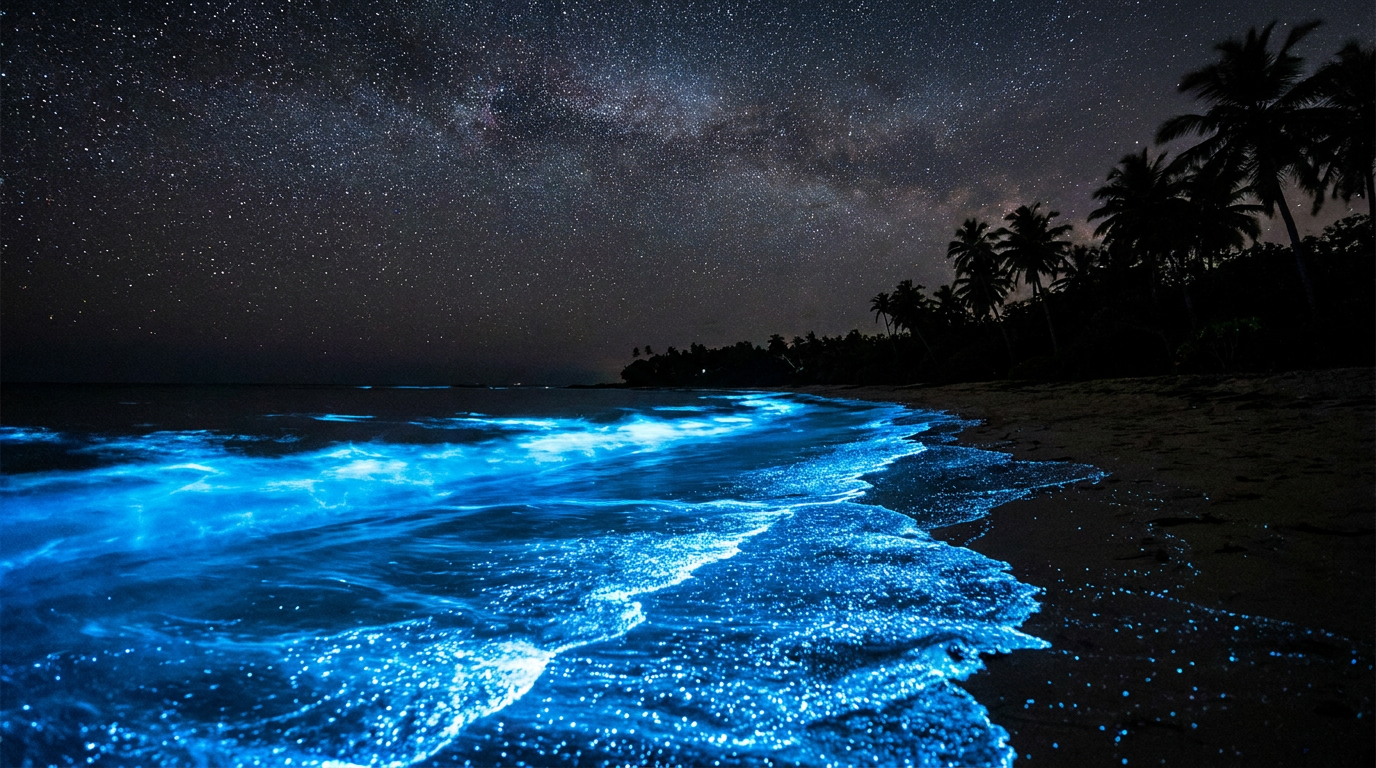
Imagine wading into the ocean on a pitch-black night, only to watch the water erupt into electric-blue sparks with every step. From the "Sea of Stars" in the Maldives to the glowing shores of California, bioluminescent beaches offer one of nature's most surreal spectacles.[7]
While it might look like magic or science fiction, the phenomenon is driven by microscopic marine life. The most common culprits behind glowing coastal waters are dinoflagellates, a type of single-celled phytoplankton that float near the ocean's surface.[1]
The glow is the result of a highly efficient chemical reaction that takes place inside the organism's specialized organelles, known as scintillons. When the dinoflagellate is physically disturbed by a crashing wave, a boat hull, or a swimmer, a rapid change in cellular pH is triggered.[2]
This sudden drop in pH allows a light-emitting molecule called luciferin to bind with an enzyme called luciferase. In the presence of oxygen, the enzyme catalyzes the oxidation of luciferin, converting chemical energy directly into visible blue-green light.[1][2]

Each individual dinoflagellate produces a flash of light that lasts a mere 0.5 microseconds—a fraction of a second so brief it is imperceptible on its own. However, when millions of these microscopic organisms are agitated simultaneously, their collective flashes create a sustained, brilliant glow across the water.[1]
Scientists believe this bioluminescence evolved as a sophisticated defense mechanism, often referred to as the "burglar alarm" hypothesis. When a predator approaches and disturbs the water, the sudden flash of light startles the attacker and simultaneously illuminates it, making the predator vulnerable to even larger secondary predators.[1]
To conserve energy, dinoflagellates operate on a strict circadian rhythm. They synthesize their light-producing chemicals during the day while photosynthesizing, and only deploy their bioluminescent defenses at night when the glow will be visible against the darkness.[1]
To conserve energy, dinoflagellates operate on a strict circadian rhythm.
While dinoflagellates are found in oceans worldwide, spectacular bioluminescent blooms require specific conditions. In places like La Jolla, California, or Chennai, India, the glowing waves are transient, often triggered by seasonal "red tides" where warm water and nutrient runoff cause massive, temporary population explosions.[6][7]
However, a few rare locations on Earth boast permanent, year-round bioluminescence. The crown jewel of these ecosystems is Mosquito Bay on the Puerto Rican island of Vieques, which holds the Guinness World Record for the brightest bioluminescent bay in the world.[7]
Mosquito Bay's unparalleled brightness is the result of a perfect ecological storm. The bay features a very narrow opening to the Caribbean Sea, which traps the dinoflagellates inside. Furthermore, the bay is ringed by dense mangrove forests; as the mangrove leaves fall into the water and decompose, they release a rich soup of nutrients that allows the plankton to thrive.[3]
Because these permanent bio-bays rely on such a delicate balance, they are highly vulnerable to extreme weather. In September 2017, Hurricane Maria devastated Puerto Rico as a Category 4 storm, decimating the mangrove forests around Mosquito Bay and flushing the bay with massive amounts of freshwater.[3][4]
In the immediate aftermath of the hurricane, Mosquito Bay went completely dark. The sudden drop in salinity and the loss of the protective mangrove canopy left researchers and locals fearing that the world's brightest bio-bay had been permanently extinguished.[3][4]
Yet, the ecosystem demonstrated remarkable resilience. As the water chemistry stabilized over the following months, the dinoflagellates returned with unprecedented vigor. By late 2018, researchers recorded concentrations of up to 2.4 million dinoflagellates per gallon in Mosquito Bay—more than double the highest concentrations measured before the storm.[3]

To ensure the long-term survival of the bay, local conservationists launched aggressive restoration efforts. The Vieques Conservation and Historical Trust initiated a "Mangrove Project," cultivating nurseries to plant thousands of red, white, and black mangrove trees along the shoreline to replace those lost to the hurricane and stabilize the nutrient cycle.[5]
The recovery of Mosquito Bay underscores the need for responsible ecotourism. To protect the fragile dinoflagellates, authorities strictly regulate access: swimming is banned to prevent chemical contamination from sunscreen and bug spray, and visitors must explore the bay in unmotorized, clear-bottom kayaks.[7]

Whether witnessed as a fleeting summer bloom in California or a permanent neon lagoon in the Caribbean, bioluminescent waters are a testament to the intricate, interconnected chemistry of the ocean. Protecting these glowing shores requires preserving the delicate balance of nutrients, temperature, and darkness that allows the sea to mirror the stars.[8]
How we got here
540 Million Years Ago
Bioluminescence first evolves in marine organisms as a survival mechanism.
2008
Mosquito Bay in Puerto Rico is officially named the brightest bioluminescent bay in the world by the Guinness Book of World Records.
September 2017
Hurricane Maria devastates Puerto Rico, destroying mangrove forests and causing Mosquito Bay to go dark.
Late 2018
Mosquito Bay's dinoflagellate population recovers to record-breaking levels of 2.4 million per gallon.
2022
Conservationists launch the Mangrove Project to plant thousands of trees and permanently stabilize the bay's ecosystem.
Viewpoints in depth
Marine Biologists
Focuses on the evolutionary arms race and the precise chemical triggers of bioluminescence.
For marine biologists, the glowing ocean is less a magical spectacle and more a microscopic battlefield. They study the 'burglar alarm' hypothesis, which posits that dinoflagellates use their 0.5-microsecond flashes to startle immediate predators while simultaneously exposing those attackers to larger secondary predators. Researchers are also deeply invested in understanding the exact protein structures of luciferase and how cellular pH shifts trigger the reaction, hoping it could inspire new biotechnologies.
Conservationists
Prioritizes the protection and restoration of the fragile ecosystems that support permanent bioluminescence.
Conservation groups emphasize that permanent bioluminescent bays are incredibly rare and fragile anomalies. They point to the devastation of Hurricane Maria as proof of how quickly these ecosystems can collapse when their surrounding mangrove forests are damaged or water salinity drops. For this camp, the priority is aggressive habitat restoration—such as planting thousands of mangrove trees—and strictly limiting human interference to ensure the dinoflagellates have the nutrient-rich, unpolluted environment they need to survive.
Ecotourism Advocates
Focuses on sustainable travel and the economic benefits of bioluminescent phenomena.
The ecotourism sector views bioluminescent bays as vital economic engines for local coastal communities. However, they advocate for a strict 'look but don't touch' approach to preserve the attraction. By promoting unmotorized, clear-bottom kayak tours and banning swimming—which introduces toxic sunscreens and insect repellents into the water—they argue that communities can monetize the natural wonder without loving it to death.
What we don't know
- The exact evolutionary origin of the luciferin-luciferase reaction in dinoflagellates remains debated among marine biologists.
- It is unclear how long-term rising ocean temperatures and increased storm frequency will permanently alter the delicate balance of permanent bioluminescent bays.
Key terms
- Dinoflagellates
- Microscopic, single-celled marine plankton responsible for the majority of coastal bioluminescence.
- Luciferin
- A light-emitting molecule that produces a glow when oxidized.
- Luciferase
- An enzyme that catalyzes the chemical reaction between luciferin and oxygen to produce light.
- Scintillons
- Specialized organelles inside a dinoflagellate where the bioluminescent chemical reaction takes place.
- Circadian Rhythm
- An internal biological clock that regulates an organism's behavior over a 24-hour cycle, such as glowing only at night.
Frequently asked
Why do bioluminescent beaches only glow at night?
Dinoflagellates operate on a circadian rhythm, synthesizing their light-producing chemicals during the day and only deploying their glowing defense mechanism at night when it is visible.
Can you swim in bioluminescent water?
While it is physically safe for humans, swimming is banned in highly protected areas like Mosquito Bay because chemicals from sunscreen, lotions, and bug spray can kill the fragile organisms.
What is the brightest bioluminescent bay in the world?
Mosquito Bay on the island of Vieques in Puerto Rico holds the Guinness World Record for the brightest bioluminescent bay, thanks to its high concentration of dinoflagellates.
What triggers the water to glow?
The glow is triggered by physical agitation. When a wave crashes, a fish swims, or a kayak paddle breaks the surface, the movement causes a chemical reaction inside the plankton.
Sources
Source coverage
8 outlets
3 viewpoints surfaced








[1]American Chemical SocietyMarine Biologists
Bioluminescence: The Light of the Sea
Read on American Chemical Society →[2]Chemistry WorldMarine Biologists
The chemistry of the sea sparkle
Read on Chemistry World →[3]Smithsonian MagazineConservationists
How Puerto Rico's Bioluminescent Bays Recovered From Hurricane Maria
Read on Smithsonian Magazine →[4]PBS NOVAConservationists
Bioluminescent Bays Shine Light on Puerto Rico's Resilience
Read on PBS NOVA →[5]Vieques Conservation and Historical TrustConservationists
The Mangrove Reforestation Project
Read on Vieques Conservation and Historical Trust →[6]Travel and Leisure AsiaEcotourism Advocates
Decoding Chennai's Bioluminescent Waves: What Makes Them Glow?
Read on Travel and Leisure Asia →[7]Beach.comEcotourism Advocates
The Best Bioluminescent Beaches Around the World
Read on Beach.com →[8]Factlen Editorial TeamConservationists
Synthesis by Factlen editorial team
Read on Factlen Editorial Team →

Every angle. Every day.
Get travel stories with full source coverage and perspective breakdowns delivered to your inbox.