
The Science of Ashwagandha: How the Popular Adaptogen Rewires the Body's Stress Response
Clinical data confirms ashwagandha can significantly lower cortisol and reduce anxiety, but genetic variability and rare liver risks mean it isn't a universal cure-all.
By Factlen Editorial Team
- Clinical Researchers
- Focuses on the statistically significant reductions in cortisol and anxiety scores demonstrated in randomized trials.
- Hepatologists & Safety Monitors
- Highlights the rare but documented risk of idiosyncratic liver injury associated with the supplement.
- Precision Medicine Advocates
- Argues that genetic variability explains why ashwagandha works miracles for some but fails for others.
- Integrative Health Analysts
- Synthesizes traditional Ayurvedic use with modern clinical data to provide holistic guidance.
What's not represented
- · Traditional Ayurvedic Practitioners
- · Supplement Industry Regulators
Why this matters
Millions of people take ashwagandha daily to manage modern anxiety. Understanding exactly how it alters brain chemistry—and why it only works for specific biological profiles—empowers you to use it safely and effectively.
Key points
- Ashwagandha is an adaptogenic herb that helps the body manage stress by modulating the HPA axis and lowering cortisol levels.
- The herb also exhibits GABAergic activity, promoting a sense of calm by interacting with the brain's primary inhibitory neurotransmitter.
- Clinical meta-analyses show that 300 to 600 mg of standardized root extract daily can reduce stress and anxiety scores by 20 to 30 percent.
- Genetic differences in neurotransmitter processing explain why the supplement is highly effective for some individuals but ineffective for others.
- While generally safe, ashwagandha carries a rare risk of idiosyncratic liver injury and should be avoided by those with chronic liver disease.
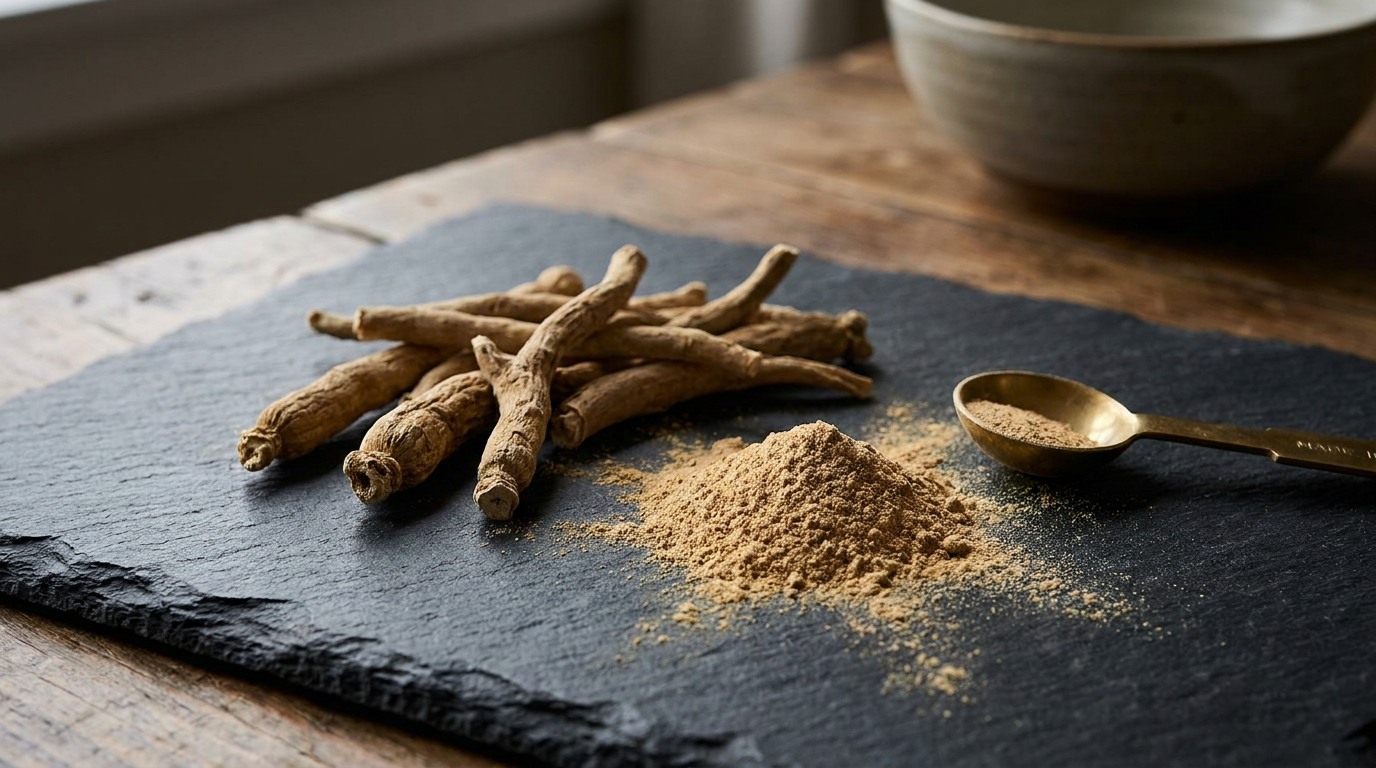
Ashwagandha has transitioned from an ancient Ayurvedic staple to a modern wellness phenomenon. Walk into any pharmacy, and you will find the root extract packaged into gummies, tinctures, and capsules, all promising to neutralize the anxieties of modern life.[7]
But behind the marketing hype lies a complex, highly active botanical compound. Known scientifically as Withania somnifera, ashwagandha is classified as an adaptogen—a substance that helps the body maintain homeostasis in the face of physical or psychological stressors.[6]
To understand how ashwagandha works, one must first look at the body’s primary stress response system: the hypothalamic-pituitary-adrenal (HPA) axis. When the brain perceives a threat, the hypothalamus signals the pituitary gland, which in turn commands the adrenal glands to flood the bloodstream with cortisol.[6]
In acute situations, this cortisol spike is life-saving. But chronic modern stress leaves the HPA axis permanently engaged, leading to elevated baseline cortisol, disrupted sleep, and persistent anxiety. Clinical data suggests ashwagandha directly intervenes in this loop, dampening HPA overactivity and normalizing cortisol production.[4][6]

The herb’s second major mechanism of action occurs in the central nervous system. Ashwagandha exhibits GABAergic activity, meaning its active compounds—known as withanolides—interact with the brain's gamma-aminobutyric acid (GABA) receptors.[6]
GABA is the brain’s primary inhibitory neurotransmitter. It acts as a neurological brake pedal, counterbalancing the excitatory signals that drive racing thoughts and panic. By enhancing GABA receptor efficacy, ashwagandha promotes a sense of calm without the heavy sedative effects typical of pharmaceutical tranquilizers.[6]
The clinical evidence supporting these mechanisms has grown remarkably robust. A comprehensive 2026 systematic review and meta-analysis published in Complementary Therapies in Medicine evaluated dozens of randomized controlled trials involving adults with stress and anxiety.[3]
The clinical evidence supporting these mechanisms has grown remarkably robust.
The analysis revealed that daily supplementation with ashwagandha significantly reduced both self-reported stress scores and objective serum cortisol levels. The most pronounced benefits were observed in participants taking between 300 and 600 milligrams of standardized root extract per day.[3]
In recent multi-center trials, participants taking these clinical doses experienced a 20 to 30 percent reduction in validated anxiety metrics over an eight-week period, a statistically significant improvement compared to placebo groups.[4][6]

Yet, despite the compelling aggregate data, ashwagandha is not a universal cure-all. A substantial minority of users report feeling no benefit whatsoever, while a smaller fraction report feeling paradoxically worse or emotionally blunted.[5]
Precision medicine researchers point to genetic variability as the likely culprit. Ashwagandha specifically targets cortisol and GABA. If an individual's anxiety is primarily driven by a different neurochemical imbalance—such as rapid dopamine breakdown via the COMT gene, or depleted serotonin linked to the SLC6A4 gene—ashwagandha will not resolve the underlying issue.[5]
Furthermore, the surge in ashwagandha's popularity has brought renewed scrutiny to its safety profile. While clinical trials consistently report that the herb is well-tolerated with side effects comparable to a placebo, real-world data paints a slightly more nuanced picture.[3][4]
The National Institutes of Health’s LiverTox database currently classifies ashwagandha as a Grade B hepatotoxin, indicating it is a "likely cause of clinically apparent liver injury."[1]

Hepatologists note that these cases are rare and idiosyncratic, meaning they do not predictably scale with dosage. When liver injury does occur, it typically presents as jaundice and elevated liver enzymes two to twelve weeks after starting the supplement.[1][2]
Fortunately, the prognosis for ashwagandha-induced liver injury is generally excellent. The condition is almost always self-limiting, with liver function returning to normal within one to three months after the patient stops taking the supplement.[1][2]
Medical professionals advise that individuals with pre-existing chronic liver disease should avoid the herb entirely. For the general population, the risk remains low, but it underscores a vital reality about potent botanical medicines: they are biologically active interventions, not inert candies.[2][7]
How we got here
Ancient History
Ashwagandha is utilized as a foundational 'Rasayana' (rejuvenating tonic) in traditional Ayurvedic medicine.
2017
The first well-documented case reports of clinically apparent liver injury linked to ashwagandha supplementation are published.
2019
The NIH LiverTox database officially classifies ashwagandha as a Grade B hepatotoxin based on accumulating case reports.
2026
Comprehensive meta-analyses confirm the herb's efficacy in reducing cortisol and anxiety scores across diverse adult populations.
Viewpoints in depth
Clinical Researchers' View
Focuses on the statistically significant reductions in cortisol and anxiety scores demonstrated in randomized trials.
This camp emphasizes the robust aggregate data supporting ashwagandha's efficacy. Pointing to recent meta-analyses, researchers highlight that standardized root extracts consistently outperform placebos in lowering serum cortisol and improving scores on validated anxiety scales. They view the herb as a viable, low-side-effect alternative or complement to traditional pharmaceutical interventions for mild to moderate stress.
Hepatologists' View
Highlights the rare but documented risk of idiosyncratic liver injury associated with the supplement.
Medical safety monitors and hepatologists caution against treating ashwagandha as a harmless wellness product. While acknowledging that severe adverse events are statistically rare, they point to the NIH's Grade B liver toxicity classification. This camp advocates for greater regulatory oversight, standardized dosing, and clear warning labels for individuals with pre-existing liver conditions.
Precision Medicine View
Argues that genetic variability explains why ashwagandha works miracles for some but fails for others.
Precision medicine advocates look beyond broad clinical averages to individual genetic profiles. They argue that because ashwagandha specifically modulates the HPA axis and GABA receptors, it is highly effective for cortisol-driven stress but useless for anxiety rooted in serotonin depletion or rapid dopamine breakdown. This camp pushes for targeted supplementation based on genetic testing rather than trial-and-error.
What we don't know
- The exact biological mechanism that triggers rare liver toxicity in a small subset of users remains unidentified.
- Long-term safety data for continuous, uninterrupted daily use beyond 12 months is still limited.
- It is unclear exactly how different genetic variants alter the dose-response curve for individual patients.
Key terms
- Adaptogen
- A natural substance considered to help the body adapt to stress and exert a normalizing effect upon bodily processes.
- HPA Axis
- The hypothalamic-pituitary-adrenal axis, a complex set of interactions that controls the body's reaction to stress and regulates cortisol.
- GABA
- Gamma-aminobutyric acid, the primary inhibitory neurotransmitter in the brain that promotes relaxation and reduces neuronal excitability.
- Hepatotoxicity
- Chemical-driven liver damage or injury.
- Withanolides
- The primary active chemical compounds found in the ashwagandha plant, believed to be responsible for its therapeutic effects.
Frequently asked
How long does it take for ashwagandha to work?
Clinical trials typically measure significant reductions in stress and cortisol after 4 to 8 weeks of consistent daily use.
Can ashwagandha cause liver damage?
Yes, though it is rare. The NIH classifies it as a likely cause of clinically apparent liver injury, which usually resolves once the supplement is stopped.
Should I take ashwagandha in the morning or at night?
Because it lowers cortisol and promotes GABA activity, many people take it in the evening to support sleep, though clinical trials often divide the dose between morning and night.
Why doesn't ashwagandha work for my anxiety?
Genetic differences play a role. If your anxiety is driven by low serotonin rather than high cortisol or low GABA, ashwagandha's specific mechanisms may not address the root cause.
Sources
Source coverage
7 outlets
4 viewpoints surfaced






[1]National Institutes of HealthHepatologists & Safety Monitors
Ashwagandha - LiverTox®
Read on National Institutes of Health →[2]University of Colorado Department of MedicineHepatologists & Safety Monitors
Ashwagandha is Popular for Boosting Health — But Could it Hurt Your Liver?
Read on University of Colorado Department of Medicine →[3]Complementary Therapies in MedicineClinical Researchers
Effects of ashwagandha on mental health in adults: a systematic review and dose-response meta-analysis
Read on Complementary Therapies in Medicine →[4]Journal of Medicine and LifeClinical Researchers
A proprietary herbal extract of ashwagandha root for stress and anxiety in healthy adults
Read on Journal of Medicine and Life →[5]SelfDecodePrecision Medicine Advocates
Ashwagandha Response & Your Genes
Read on SelfDecode →[6]SuperpowerClinical Researchers
Ashwagandha for Stress and Anxiety
Read on Superpower →[7]Factlen Editorial TeamIntegrative Health Analysts
Synthesis by Factlen editorial team
Read on Factlen Editorial Team →


Every angle. Every day.
Get health stories with full source coverage and perspective breakdowns delivered to your inbox.