
The Science of Aquatic Longevity: Why Swimming is the Ultimate Anti-Aging Exercise
New research highlights swimming as a potent longevity intervention, offering unique cardiovascular, cognitive, and joint-preserving benefits that outpace many land-based exercises.
By Factlen Editorial Team
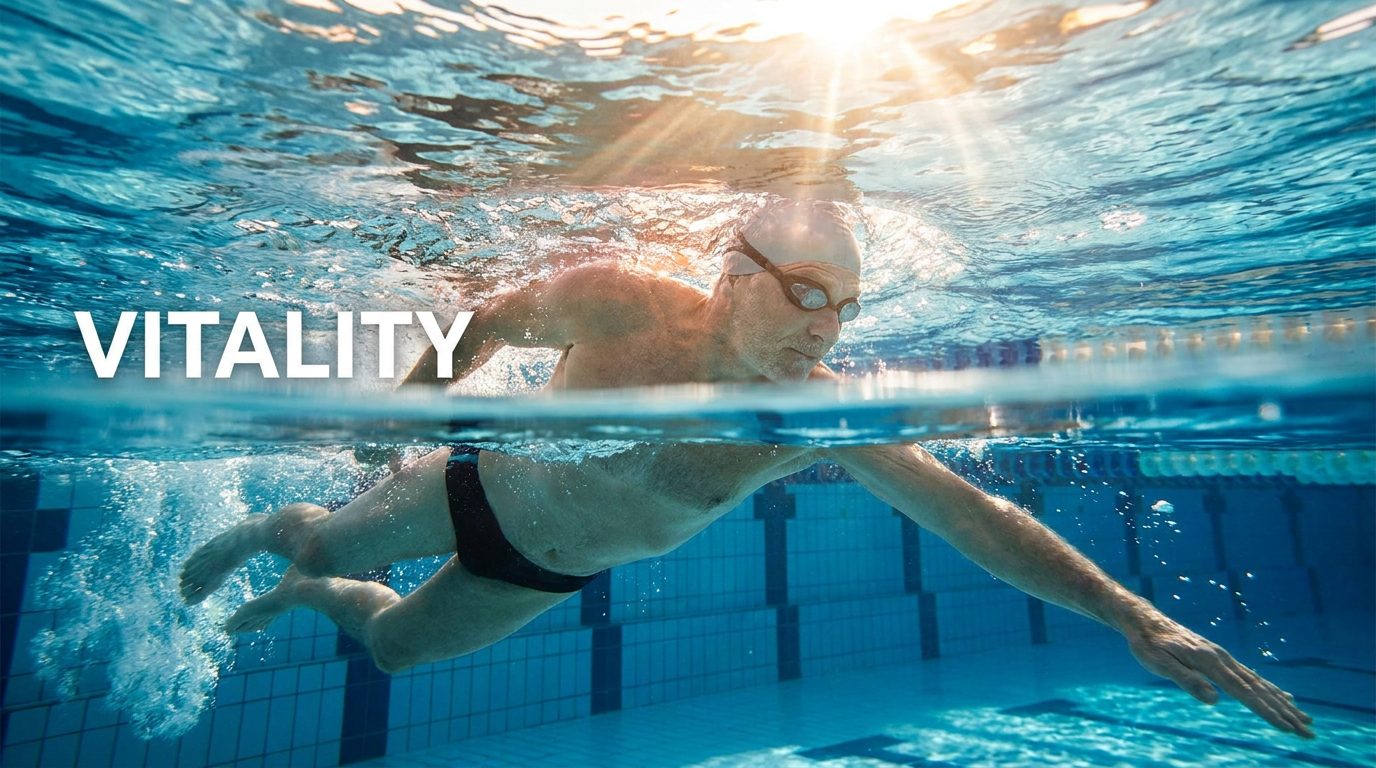
- Exercise & Longevity Researchers
- Focus on the cardiovascular efficiency and mortality reduction driven by aquatic exercise.
- Cognitive Neurologists
- Emphasize the brain-protecting neuroplasticity and increased cerebral blood flow caused by water immersion.
- Rheumatologists
- Highlight the joint-preserving nature of buoyancy combined with the muscle-building resistance of water.
Why this matters
As the global population ages, finding sustainable, low-impact ways to maintain cardiovascular and cognitive health is critical. Swimming offers a rare combination of high-intensity physiological benefits without the joint degradation associated with traditional weight-bearing exercises.
The search for the ultimate longevity exercise often leads to high-impact activities like running, plyometrics, or heavy resistance training. While these modalities are undeniably effective for building bone density and cardiovascular endurance, they come with a biological toll: cumulative wear and tear on the joints. As the global population ages and life expectancies extend, researchers are increasingly looking for interventions that deliver maximum physiological benefits with minimal structural damage, allowing individuals to stay active well into their later decades. The ideal exercise would challenge the heart, stimulate the brain, and build muscle, all without accelerating the degradation of cartilage.
Emerging evidence suggests that the proverbial fountain of youth might literally be a body of water. Swimming is rapidly transitioning from being viewed merely as a gentle rehabilitation tool for the injured or elderly to being recognized as a potent, multi-system anti-aging intervention. By combining cardiovascular conditioning, muscular resistance, and unique environmental pressures, aquatic exercise offers a biological return on investment that few land-based activities can match. It forces the human body to adapt to an entirely different physical medium, triggering physiological responses that protect the heart, preserve the brain, and lubricate the joints.
The mortality data surrounding swimming is striking, consistently showing survival advantages that outpace other popular forms of exercise. In a massive longitudinal study analyzing the habits of over 80,000 British adults, researchers found that regular swimmers experienced a 28 percent lower risk of all-cause mortality compared to those who did not swim. Even more remarkably, the swimmers demonstrated a 41 percent reduction in cardiovascular-related mortality, placing aquatic exercise among the most protective activities for long-term heart health and disease prevention.[1]
These findings are corroborated by decades of data from the United States. The Aerobics Center Longitudinal Study, which tracked more than 40,000 men over a 32-year period, revealed that regular swimmers were 53 percent less likely to die from any cause compared to their sedentary peers. Crucially, the data showed that swimmers also outlived both regular walkers and runners, suggesting that the pool offers unique survival advantages beyond simple caloric expenditure or basic aerobic conditioning. The researchers hypothesized that the combination of full-body engagement and low injury rates allows swimmers to maintain their fitness routines more consistently over a lifespan.[2]

To understand why swimming is so uniquely protective, exercise physiologists point to the physical properties of water itself. The primary mechanism driving these cardiovascular benefits is hydrostatic pressure. When a human body is submerged, the surrounding water exerts a constant, uniform pressure on the skin, acting much like a full-body compression garment. This pressure increases with depth, meaning the lower body experiences slightly more compression than the chest, creating a natural gradient that influences how blood moves through the circulatory system.[5]
This hydrostatic pressure fundamentally alters human hemodynamics. The compression forces blood out of the extremities and pushes it back toward the thoracic cavity and the heart. As a result, the heart's stroke volume—the amount of blood pumped with each beat—increases significantly. This allows the cardiovascular system to achieve high levels of cardiac output and oxygen delivery without the extreme spikes in heart rate required by land-based sprinting. The heart works more efficiently, pumping larger volumes of blood with less mechanical strain.[5]
The vascular benefits of this fluid shift are profound and long-lasting. Research from cardiovascular aging laboratories demonstrates that regular swimming training effectively lowers systolic blood pressure, particularly in older adults dealing with prehypertension. The natural compression of the water improves endothelial function, helping arteries remain flexible and efficient at clearing metabolic waste products from the bloodstream. Over time, this enhanced vascular elasticity reduces the workload on the heart and lowers the risk of arterial stiffness, a primary driver of cardiovascular disease.[5]
The vascular benefits of this fluid shift are profound and long-lasting.
But the physiological benefits of hydrostatic pressure do not stop at the neck; the brain is also a major beneficiary of aquatic immersion. As blood is shunted upward from the legs and core, cerebral blood flow increases noticeably. Studies show that even passive resting in chest-deep water enhances blood flow through the middle and posterior cerebral arteries, bathing brain tissue in oxygen and vital nutrients. This increased perfusion helps clear metabolic byproducts from the brain, supporting overall cognitive health.[3]

When active movement is added to this immersion, the neurological effects multiply rapidly. Aquatic exercise has been shown to stimulate the release of brain-derived neurotrophic factor (BDNF) and insulin-like growth factor 1 (IGF-1). These biomolecules are critical for neuroplasticity—the brain's ability to form new neural connections and repair damaged ones. Elevated levels of BDNF are known to suppress the cellular apoptosis and inflammation associated with aging, effectively acting as a molecular shield against dementia and age-related cognitive decline.[3]
Furthermore, the act of swimming demands intense, continuous cognitive engagement. Unlike running on a treadmill, which can quickly become an automated motor pattern requiring little conscious thought, swimming requires the brain to constantly coordinate breath timing, cross-body mechanics, and spatial awareness in a sensory-deprived environment. This complex multitasking stimulates the prefrontal cortex and amygdala, improving executive function, attention, and memory recall. The brain is forced to stay highly active to navigate the water, building cognitive reserves in the process.[3]
Beyond the heart and the brain, swimming solves one of the greatest paradoxes of aging: how to maintain muscle mass without destroying cartilage. On land, gravity is a relentless force. Every footstrike while running sends a shockwave through the ankles, knees, hips, and spine. While this impact is necessary for building bone density in younger years, it can accelerate the degradation of joint tissue over decades, leading to chronic pain and mobility issues in older adults. Finding a way to train the muscular system without taxing the skeletal system is a primary goal of longevity science.
Water effectively removes gravity's penalty. The natural buoyancy of the human body in water unloads the skeletal system, reducing joint compression to near zero. A person submerged to their neck bears only about ten percent of their actual body weight. This allows individuals to move their limbs through a full, uninhibited range of motion without the grinding bone-on-bone friction that often accompanies land-based exercise for those dealing with arthritis or joint degeneration. This weightlessness provides a safe environment for rehabilitating injuries and maintaining flexibility.[4]

Yet, this weightlessness does not mean the muscles are resting; in fact, they are working harder than they might on land. Water is roughly 800 times denser than air, providing constant, omnidirectional resistance. This creates an isokinetic environment: the harder a swimmer pulls against the water, the more resistance the water provides in return. This dynamic allows for intense muscle strengthening and toning across the entire body without the risk of sudden, jerky movements that cause connective tissue injuries or muscle tears.[4]
The long-term protective effects on joint architecture are significant and well-documented. Data from the Osteoarthritis Initiative, which evaluated the lifetime exercise habits of thousands of adults, found that a history of swimming is strongly associated with a decreased prevalence of symptomatic knee osteoarthritis. Rather than wearing the joints down, the smooth, repetitive motion of swimming helps circulate synovial fluid, keeping the cartilage lubricated, nourished, and healthy over the course of a lifetime. This makes it an ideal preventative measure against age-related mobility loss.[4]

Ultimately, the true longevity power of swimming may lie in its unparalleled sustainability. The best exercise for extending human lifespan is not necessarily the most intense one, but the one an individual can continue doing safely into their seventies, eighties, and nineties. Because it simultaneously protects the joints, strengthens the heart, and bathes the brain in oxygen, swimming offers a rare, lifelong pathway to preserving human vitality and extending healthspan. It is a holistic intervention that respects the body's limits while continuously pushing its capabilities.[6]
Viewpoints in depth
Exercise & Longevity Researchers
Focus on the cardiovascular efficiency and mortality reduction driven by aquatic exercise.
Exercise physiologists view swimming as a unique cardiovascular tool because of hydrostatic pressure. By compressing the body, water naturally increases venous return to the heart, allowing for higher stroke volumes and cardiac output without the extreme heart rate spikes seen in land sprinting. This makes it an exceptionally efficient way to lower blood pressure and improve endothelial function over a lifespan.
Cognitive Neurologists
Emphasize the brain-protecting neuroplasticity and increased cerebral blood flow caused by water immersion.
Neurological researchers highlight that the benefits of the pool extend far above the neck. The upward shift of blood volume during immersion significantly increases perfusion in the middle and posterior cerebral arteries. Combined with the complex motor coordination required to swim, this environment triggers the release of BDNF and IGF-1, proteins that are critical for forming new neural pathways and staving off age-related cognitive decline.
Rheumatologists
Highlight the joint-preserving nature of buoyancy combined with the muscle-building resistance of water.
For joint specialists, the primary value of swimming is the removal of gravity's penalty. Land-based exercises often force a trade-off between cardiovascular fitness and cartilage wear. Swimming bypasses this by using buoyancy to unload the hips, knees, and spine, while the 800-fold density of water compared to air provides isokinetic resistance. This builds the stabilizing muscles around the joints without the compressive, bone-on-bone friction that exacerbates osteoarthritis.
What we don't know
- How the cardiovascular benefits of warm-water lap swimming compare precisely to the metabolic shocks of cold-water immersion.
- Whether the long-term respiratory benefits of swimming outweigh the potential risks of chronic exposure to chloramines in poorly ventilated indoor pools.
- The exact minimum weekly dosage of aquatic exercise required to trigger significant neuroplasticity and BDNF release.
Sources
Source coverage
6 outlets
3 viewpoints surfaced






[1]British Journal of Sports MedicineExercise & Longevity Researchers
Associations of specific types of sports and exercise with all-cause and cardiovascular-disease mortality
Read on British Journal of Sports Medicine →[2]University of South Carolina Aerobics CenterExercise & Longevity Researchers
Swimming and All-Cause Mortality Risk Compared With Running, Walking, and Sedentary Habits
Read on University of South Carolina Aerobics Center →[3]Translational Journal of the American College of Sports MedicineCognitive Neurologists
Aquatic Cognitive–Motor Exercise for Cognition, Balance, and Functional Mobility in Older Adults
Read on Translational Journal of the American College of Sports Medicine →[4]Osteoarthritis InitiativeRheumatologists
Evidence that Swimming May be Protective of Knee Osteoarthritis
Read on Osteoarthritis Initiative →[5]Cardiovascular Aging Research LaboratoryExercise & Longevity Researchers
Effects of swimming training on blood pressure and vascular function
Read on Cardiovascular Aging Research Laboratory →[6]Factlen Editorial TeamExercise & Longevity Researchers
Synthesis by Factlen editorial team
Read on Factlen Editorial Team →

More in fitness
See all 43 stories →Recovery Science
The Science of Thermal Recovery: When to Use Ice Baths, Saunas, and Contrast Therapy
6 sources

Fitness Biomechanics
The Science of Reformer Pilates: How Spring Resistance Actually Changes Your Muscles
7 sources

Muscle Science
The Science of Hypertrophy: How Muscles Actually Grow
6 sources

Sports Nutrition
The New Science of Creatine: Why the Classic Muscle Supplement is Going to the Brain
6 sources

Every angle. Every day.
Get fitness stories with full source coverage and perspective breakdowns delivered to your inbox.