
Inside SpaceX’s $1.77 Trillion IPO: How the Largest Public Offering in History Actually Works
SpaceX is set to debut on the Nasdaq after raising $75 billion in an unprecedented offering that merges space infrastructure with artificial intelligence. Here is how the numbers, the risks, and the massive retail allocation break down.
By Factlen Editorial Team
- Bullish Tech Investors
- Argues the unprecedented valuation is justified by the company's absolute monopoly in launch infrastructure and its strategic merger with xAI.
- Skeptical Value Analysts
- Warns that trading at 97 times revenue while posting multi-billion dollar losses leaves no room for execution errors or market downturns.
- Wall Street Underwriters
- Views the mega-IPO primarily as a historic fee-generation event and a crucial tool to cement relationships with ultra-wealthy clients.
What's not represented
- · Competitors in the commercial space launch sector
- · Retail traders who were denied IPO allocation
Why this matters
The SpaceX IPO is the largest wealth-creation event in public market history, instantly reshaping the Nasdaq and forcing billions of dollars in passive index buying. For everyday investors, its unprecedented 30% retail allocation offers rare ground-floor access to a mega-cap tech monopoly, while its success or failure will dictate whether other AI giants like OpenAI go public this year.
Key points
- SpaceX has executed the largest IPO in history, raising $75 billion at a $1.77 trillion valuation.
- The offering shatters the previous $25.6 billion record set by Saudi Aramco in 2019.
- A recent merger with Musk's AI startup, xAI, transformed the company into a dual space-and-AI conglomerate.
- Unusually, the company set a strict $135 share price and reserved 30% of the offering for retail investors.
- The company is currently operating at a massive loss due to AI compute costs, though banks project $160 billion in revenue by 2028.
- Nasdaq altered its rules to allow SpaceX to join the Nasdaq 100 in just 15 days, which will trigger billions in forced passive buying.
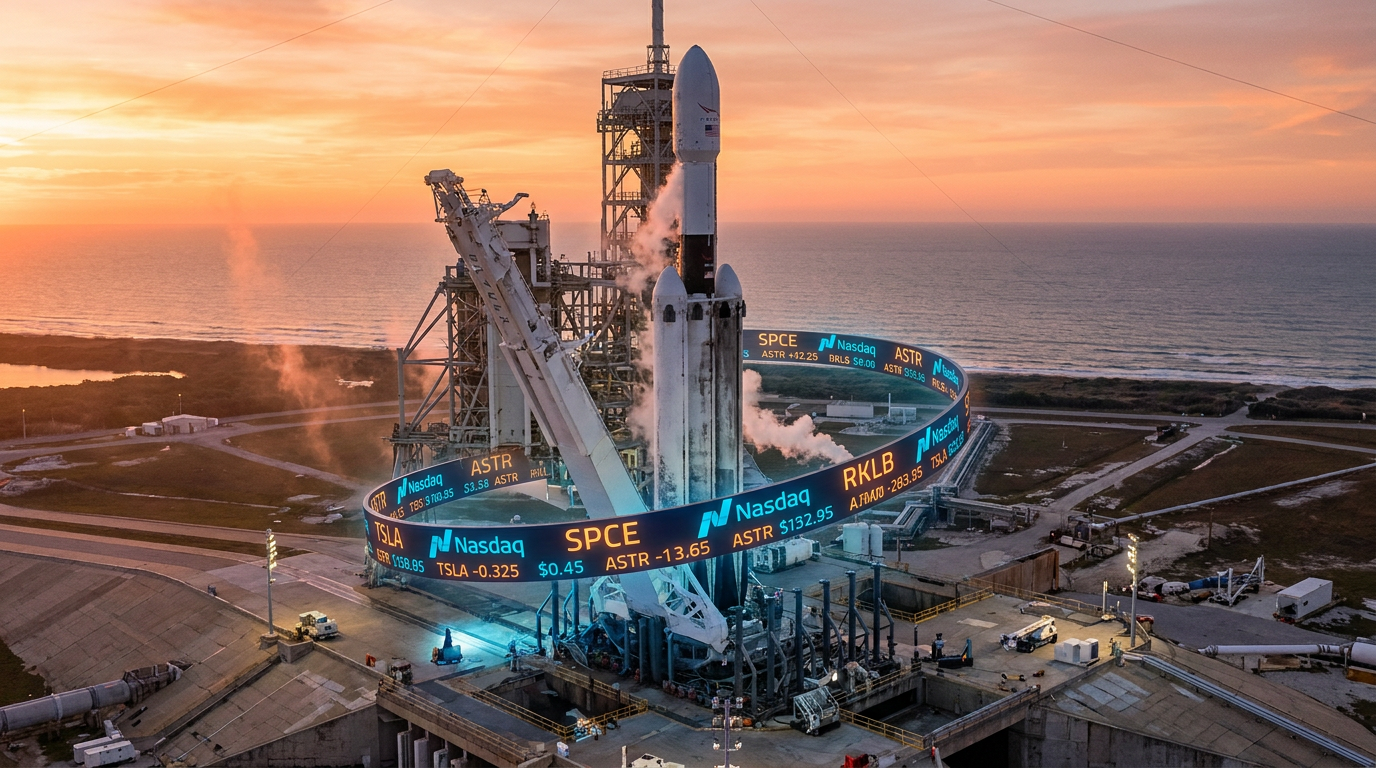
After nearly two and a half decades as a private enterprise, SpaceX is set to debut on the Nasdaq on Friday under the ticker symbol SPCX, marking the culmination of the most anticipated public offering in modern financial history. The aerospace and technology conglomerate finalized its initial public offering price at $135 per share late Thursday, successfully raising $75 billion. At that pricing, SpaceX commands a staggering valuation of approximately $1.77 trillion, catapulting it immediately into the ranks of the world's seven most valuable public companies, situated just behind semiconductor foundry TSMC and ahead of Broadcom.[1][6]
The sheer scale of the transaction rewrites the record books for global capital markets. To put the $75 billion raise into perspective, it nearly triples the previous all-time record set by Saudi oil giant Aramco, which raised $25.6 billion during its December 2019 debut. The offering was met with voracious appetite from global capital, with total investor demand reportedly exceeding $250 billion—leaving the massive deal roughly four times oversubscribed before the final pricing was locked in.[1][6]

SpaceX executed the offering with an unusual set of structural terms that upended traditional Wall Street conventions. Rather than providing institutional investors with a customary price range to gauge market demand and discover a clearing price, Chief Executive Officer Elon Musk dictated a strict, take-it-or-leave-it price of $135 per share. The company reportedly informed its underwriting banks early in the process that it would not budge from this figure, forcing asset managers to base their buy-in entirely on enthusiasm for the fixed valuation rather than negotiating for a discount.[2][6]
Another structural anomaly is the unprecedented allocation reserved for everyday traders. SpaceX reportedly carved out up to 30% of the $75 billion offering specifically for retail investors, a stark departure from typical mega-IPOs that heavily favor institutional hedge funds and sovereign wealth vehicles. Retail demand shattered expectations, with individual investors placing orders for more than $100 billion in shares prior to the debut. This massive retail tranche is protected by day-one provisions designed to prevent immediate insider dumping, though the sheer volume of mom-and-pop capital involved raises the stakes for the stock's post-debut performance.[1][4]

For the Wall Street institutions managing the debut, the transaction represents a historic windfall. A syndicate of top-tier investment banks—led by JPMorgan, Goldman Sachs, Morgan Stanley, and Bank of America—is set to reap more than $500 million in underwriting fees. Beyond the immediate revenue, the banks are leveraging the intense scarcity and hype surrounding the SpaceX allocation as a strategic tool. Access to the IPO has become the ultimate bargaining chip in the fiercely competitive wealth management sector.[5][8]
At exclusive gatherings, such as a recent event hosted at JPMorgan's New York headquarters, bank executives pitched the offering directly to ultra-high-net-worth clients. By granting billionaires and family offices early access to the most hyped stock of the decade, banks are cementing lucrative, long-term advisory relationships. JPMorgan CEO Jamie Dimon framed the broad distribution of shares as a "democratization of finance," though critics note that the primary beneficiaries of the pre-IPO allocations remain the world's wealthiest individuals and elite venture capital funds.[5]
The $1.77 trillion valuation cannot be justified by rocket launches alone; it is heavily anchored by a strategic pivot executed earlier this year. In February 2026, SpaceX formally merged with xAI, Musk's artificial intelligence startup. This consolidation transformed SpaceX from a pure-play space infrastructure and satellite broadband provider into a sprawling AI compute powerhouse. Investors are no longer just buying into the Falcon 9 launch monopoly or the Starlink internet constellation; they are purchasing exposure to frontier AI models trained on massive, proprietary data centers, a combination with no precedent in public markets.[2][4]

The $1.77 trillion valuation cannot be justified by rocket launches alone; it is heavily anchored by a strategic pivot executed earlier this year.
Financially, this dual mandate of conquering space and artificial intelligence requires staggering amounts of capital, pushing the company deeply into the red. Without the xAI merger, SpaceX posted a respectable $791 million net profit in 2024. However, the immense capital expenditures required for AI compute, combined with the $3 billion invested annually in the next-generation Starship rocket program, resulted in a $4.94 billion net loss in 2025. In the first quarter of 2026 alone, the combined entity reported a $4.28 billion loss against $4.69 billion in revenue.[4][7]
Despite the current cash burn, institutional underwriters are selling a vision of exponential growth. Research analysts at Goldman Sachs and Morgan Stanley have circulated projections suggesting SpaceX's revenue could surge from roughly $19 billion today to nearly $160 billion by 2028. Looking further ahead, internal models shared with top investors reportedly model revenues reaching an astonishing $3.4 trillion by 2040, driven by the monetization of the Starlink user base, deep-space logistics, and enterprise applications built atop xAI's foundational models.[7]

Value-oriented analysts remain deeply skeptical of these assumptions. At $1.77 trillion, SpaceX is trading at approximately 97 times its trailing annual revenue—by far the highest multiple among the world's ten most valuable companies. Portfolio managers at defense and technology funds have cautioned that this valuation leaves absolutely no room for execution errors. To justify the price tag, SpaceX must achieve total, uninterrupted dominance across the commercial launch sector, global satellite internet, and the hyper-competitive generative AI landscape for the next decade.[6][7]
The unprecedented scale and structure of the company have also drawn sharp regulatory scrutiny. Earlier this week, Senator Elizabeth Warren sent a 12-page letter to the Securities and Exchange Commission requesting a delay in the IPO. Warren cited profound concerns regarding the company's governance structure and investor protections. Despite taking the company public, Musk will retain an overwhelming 82% of the shareholder voting power, granting him an unprecedented level of unilateral control over a nearly $2 trillion public entity.[1][6]
For early venture capital backers, the IPO represents a long-awaited, mandatory liquidity event. Firms like Founders Fund and DFJ invested in SpaceX more than 15 years ago when its valuation was under $1 billion. Because traditional venture funds are legally obligated to return capital to their limited partners at the end of their fund lifespans, these early backers will be forced to distribute or sell shares once the staggered lockup periods begin expiring in late July. This impending wave of insider selling will test the market's ability to absorb billions of dollars in new supply.[4]
To help absorb that supply, SpaceX will benefit from a highly unusual regulatory accommodation by the Nasdaq exchange. Nasdaq recently altered its listing rules specifically to allow mega-cap companies like SpaceX to join the prestigious Nasdaq 100 index after just 15 trading days, a sharp reduction from the previous three-month minimum requirement. This accelerated timeline ensures that the stock will quickly become a core holding for millions of passive investors.[4]
The inclusion in major indices will trigger an automatic, price-agnostic wave of buying. Analysts estimate that joining the Nasdaq 100 alone will force passive index funds to purchase approximately $8 billion worth of SpaceX shares within the first month of trading. If the company is subsequently fast-tracked into the S&P 500, total forced purchasing by passive funds could reach $30 billion, providing a massive structural floor for the stock price regardless of the company's near-term earnings reports.[4]
Ultimately, the SpaceX debut serves as the critical stress test for a new era of capital markets. It is the first of several highly anticipated 2026 mega-IPOs, with artificial intelligence titans OpenAI and Anthropic expected to follow suit later this year. If public markets can successfully digest a $1.77 trillion company that spent two decades incubating in the private sector, it will validate the modern venture capital model. If the stock falters under the weight of its own valuation, it could chill the pipeline for the next generation of technological disruptors.[2][3]
How we got here
2002
SpaceX is founded by Elon Musk as a private aerospace manufacturer.
Dec 2019
Saudi Aramco sets the previous global IPO record by raising $25.6 billion.
Feb 2026
SpaceX formally merges with Musk's artificial intelligence startup, xAI.
May 2026
SpaceX files its S-1 prospectus with the SEC, revealing plans for a mega-IPO.
June 11, 2026
SpaceX finalizes its IPO price at a fixed $135 per share, raising $75 billion.
June 12, 2026
SpaceX officially begins trading on the Nasdaq under the ticker SPCX.
Viewpoints in depth
Bullish Tech Investors
Argues the unprecedented valuation is justified by the company's absolute monopoly in launch infrastructure and its strategic merger with xAI.
Optimists view the $1.77 trillion valuation not as a ceiling, but as a floor for a company that has effectively monopolized the future of human infrastructure. By merging with xAI, SpaceX is no longer just a rocket company; it is the sole entity controlling both the physical hardware to reach orbit and the digital intelligence required to process the data generated there. Proponents point to Wall Street projections of $160 billion in revenue by 2028 as evidence that the company will rapidly grow into its massive valuation multiple. Furthermore, this camp believes the massive 30% retail allocation is a brilliant strategic move. By democratizing access to the stock, SpaceX is building a fiercely loyal shareholder base that will support the share price through near-term volatility. They argue that traditional valuation metrics are useless for a company that operates without true peers in both the space and artificial intelligence sectors.
Skeptical Value Analysts
Warns that trading at 97 times revenue while posting multi-billion dollar losses leaves no room for execution errors or market downturns.
Value-oriented analysts look at the SpaceX prospectus and see a massive financial risk. At 97 times trailing revenue, the company is priced for absolute perfection over the next decade. Skeptics point out that the core space launch business, while dominant, is highly capital intensive, and the recent pivot into artificial intelligence has completely wiped out the company's profitability, resulting in a staggering $4.94 billion net loss in 2025. Beyond the balance sheet, this camp is deeply concerned about corporate governance. Despite taking $75 billion from public investors, Elon Musk retains 82% of the voting power, meaning shareholders have virtually no recourse if the company's strategic direction falters. Skeptics warn that once the initial retail hype fades and early venture capital lockups expire in late July, the market may struggle to absorb the massive influx of shares, potentially leading to a sharp correction.
Wall Street Underwriters
Views the mega-IPO primarily as a historic fee-generation event and a crucial tool to cement relationships with ultra-wealthy clients.
For the syndicate of banks managing the offering, the underlying valuation of SpaceX is secondary to the structural mechanics of the deal itself. The $75 billion raise is generating more than $500 million in underwriting fees, providing a massive boost to second-quarter earnings for institutions like JPMorgan and Goldman Sachs. The fixed $135 share price eliminated the traditional roadshow haggling, allowing banks to simply allocate shares to their most favored clients. More importantly, access to the SpaceX IPO has become the ultimate weapon in the wealth management wars. By offering guaranteed allocations to billionaires, family offices, and elite hedge funds, these banks are securing lucrative, multi-generational advisory relationships. The underwriters are also heavily focused on the impending index inclusion, knowing that the Nasdaq's rule change will force passive funds to blindly purchase up to $30 billion in shares, creating a structural safety net for the stock's early trading days.
What we don't know
- How the stock will perform once the initial retail hype subsides and early venture capital lockup periods expire in late July.
- Whether the SEC will take any delayed action regarding the governance concerns raised by lawmakers.
- If the company can successfully scale its xAI division to justify the massive AI-driven premium on its valuation.
Key terms
- Initial Public Offering (IPO)
- The process by which a private company offers shares to the public for the first time to raise capital.
- Oversubscribed
- A situation in which investor demand for shares in a new stock issue heavily exceeds the total number of shares available.
- Valuation Multiple
- A financial metric that compares a company's overall market value to its annual revenue or earnings, used to determine if a stock is expensive.
- Lockup Period
- A predetermined window of time after an IPO during which early investors and company insiders are legally restricted from selling their shares.
- Passive Index Fund
- An investment fund designed to automatically track the components of a financial market index, such as the Nasdaq 100, rather than actively picking stocks.
Frequently asked
How much is SpaceX worth after the IPO?
At the final IPO price of $135 per share, SpaceX is valued at approximately $1.77 trillion, making it one of the seven most valuable public companies in the world.
Can regular people buy SpaceX stock?
Yes. In an unusual move, SpaceX reserved up to 30% of its $75 billion offering specifically for retail investors, though shares will also be available on the open market via the Nasdaq under the ticker SPCX.
Is SpaceX a profitable company?
Currently, no. While it posted a profit in 2024, its recent merger with the AI startup xAI and heavy investments in the Starship rocket program resulted in a $4.94 billion net loss in 2025.
Does Elon Musk still control SpaceX?
Yes. Despite selling shares to the public, Musk retains an overwhelming 82% of the shareholder voting power, giving him near-total control over the company's direction.
Sources
Source coverage
8 outlets
3 viewpoints surfaced








[1]ForbesBullish Tech Investors
SpaceX Files For What Could Be Largest IPO In History
Read on Forbes →[2]The GuardianSkeptical Value Analysts
IPO for Elon Musk's company comes in what is predicted to be a banner year for public offerings of AI companies
Read on The Guardian →[3]Business InsiderBullish Tech Investors
SpaceX is the blueprint for mega IPOs to come
Read on Business Insider →[4]Investing.comSkeptical Value Analysts
SpaceX's IPO is a landmark event by every structural measure
Read on Investing.com →[5]Business Times SingaporeWall Street Underwriters
How banks are using SpaceX to woo the super rich
Read on Business Times Singapore →[6]Trending TopicsBullish Tech Investors
SpaceX Pulls In $75 Billion in Mega IPO – $20 Billion to Repay Debt
Read on Trending Topics →[7]WealthBriefingSkeptical Value Analysts
As Countdown Nears For SpaceX IPO, Valuations Debated
Read on WealthBriefing →[8]MarketWatchWall Street Underwriters
JPMorgan says investors are overlooking the upside to Wall Street banks that comes from SpaceX and other mega IPOs
Read on MarketWatch →
More in finance
See all 74 stories →Mega-IPO
SpaceX's Impending IPO Triggers Market Reshuffle and Revives Wall Street Dealmaking
10 sources
Mega-IPOs
How Mega-IPOs Like SpaceX Fuel Wall Street Bank Revenues
7 sources
Fixed Annuities
Do Fixed-Index Annuities Actually Outperform the Stock Market?
7 sources

Retirement Income
The 'Steak-Dinner' Annuity Pitch: Decoding Fixed-Rate Annuities for Retirement
7 sources

Every angle. Every day.
Get finance stories with full source coverage and perspective breakdowns delivered to your inbox.