
The Race to Replace Diesel: How Hydrogen and Battery Trains are Decarbonizing Rail
As railways phase out diesel on non-electrified routes, a technological rivalry between hydrogen fuel cells and battery-electric systems is reshaping the future of clean transit.
By Factlen Editorial Team
- Battery-Electric Proponents
- Emphasize that rapid advancements in battery technology and partial electrification make BEMUs the cheaper, simpler choice for most regional lines.
- Systems Analysts
- Maintain that there is no universal solution; the choice between battery and hydrogen must be tailored to the specific topography, distance, and infrastructure of each route.
- Hydrogen Advocates
- Argue that hydrogen is the only viable zero-emission replacement for long-distance, heavy-duty routes where batteries fall short.
What's not represented
- · Fossil fuel suppliers facing demand destruction
- · Local communities living near proposed hydrogen production plants
Why this matters
Nearly half of Europe's railway network remains un-electrified, relying on polluting diesel engines. The successful deployment of hydrogen and battery technologies will determine how quickly the transportation sector can achieve its zero-emission targets without incurring the massive costs of building overhead power lines.
Key points
- Nearly half of Europe's railway network remains un-electrified, relying heavily on polluting diesel locomotives.
- Hydrogen trains use fuel cells to generate electricity onboard, emitting only water vapor and heat.
- Early hydrogen deployments faced infrastructure and reliability hurdles, prompting a surge in battery-electric alternatives.
- Battery trains excel on shorter routes using 'partial electrification' to charge at stations.
- Hydrogen remains the preferred zero-emission solution for long, remote, or heavy-duty routes.
- Future rail networks will likely use a tailored mix of both technologies to fully phase out diesel.
For decades, rail has been celebrated as the poster child for clean transportation. Yet, behind the sleek high-speed electric networks lies a dirty secret: a surprisingly large share of regional rail services still runs on fossil fuels. Across the European Union, only about 57 percent of the railway network is electrified, with countries like Italy falling below one-third. For many rural and regional routes, stringing continuous overhead power lines is simply too expensive and technically challenging, leaving diesel locomotives as the stubborn fallback.[6]
That paradigm is now changing rapidly. As climate mandates tighten and the cost of carbon rises, the rail industry is in the midst of a massive propulsion shift. The goal is to achieve zero-emission traction without the staggering infrastructure burden of full electrification. To bridge this gap, engineers and transport authorities are turning to alternative green technologies that carry their power with them.[1][8]
Two primary contenders have emerged to dethrone diesel on these non-electrified routes: hydrogen fuel cells (often referred to as "hydrail") and battery-electric multiple units (BEMUs). While they compete for the same contracts, both are fundamentally electric trains. They feature the same smooth acceleration, regenerative braking, and quiet electric traction motors. The difference lies entirely in how they store and generate their electricity onboard.[4][7]
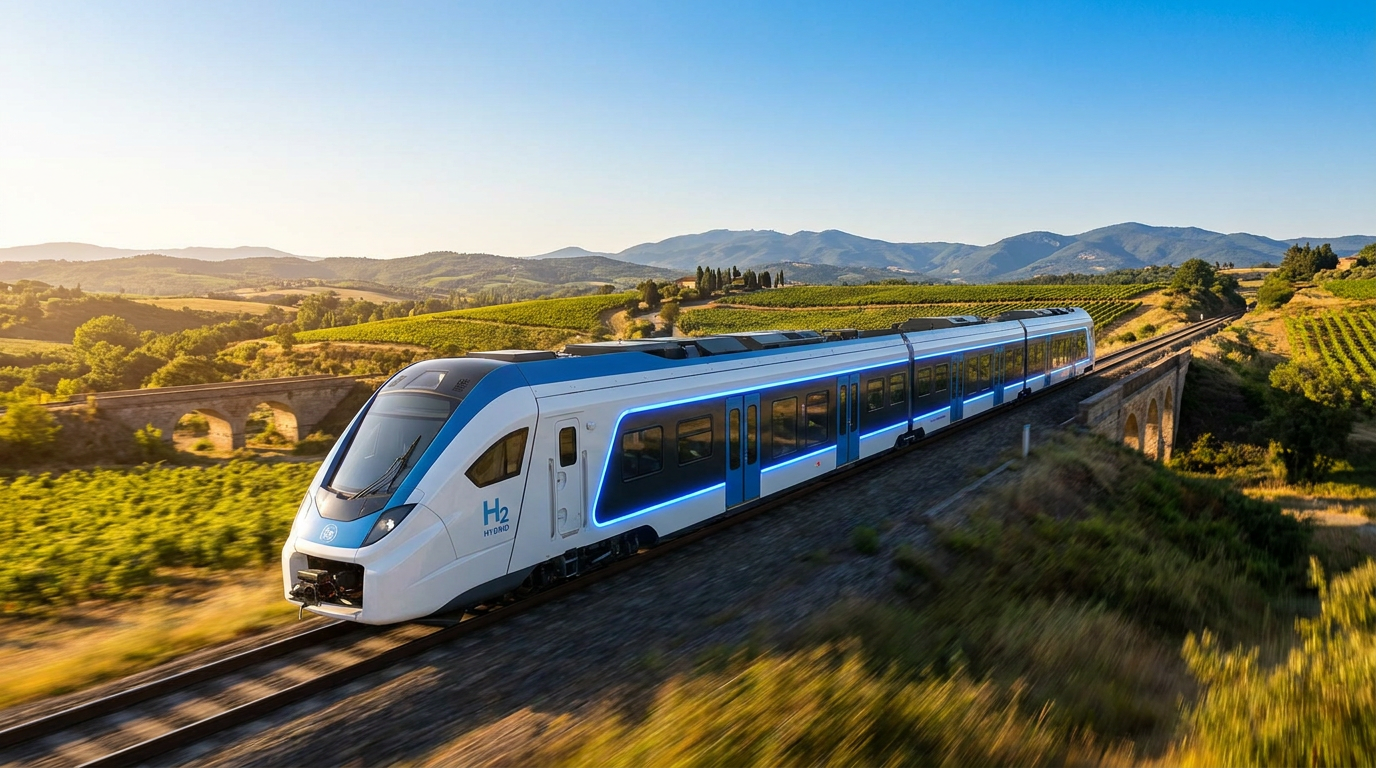
The mechanics of a hydrogen train are a marvel of modern electrochemistry. Instead of burning fuel in a combustion engine, a hydrogen train carries roof-mounted tanks of pressurized hydrogen gas alongside a fuel cell stack. Inside the fuel cell, the stored hydrogen is combined with oxygen drawn from the ambient air. This electrochemical reaction generates a steady flow of electricity, with the only direct byproducts being heat and pure water vapor.[7]

Because fuel cells operate most efficiently at a steady, continuous output, they are almost always paired with a lithium-ion battery pack. This hybrid approach is crucial because rail traction is highly dynamic. The battery handles the sudden peaks in power demand—such as accelerating out of a station or climbing a steep gradient—while the fuel cell provides the cruising power and recharges the battery. The battery also captures and stores energy during regenerative braking, maximizing the train's overall efficiency.[4][7]
The pioneer of this technology was French manufacturer Alstom, whose Coradia iLint became the world's first commercial hydrogen-powered passenger train. It proved that hydrogen could match diesel's operational range, with one unit famously covering 1,175 kilometers on a single tank. By 2022, fleets of these trains were entering regular passenger service in the German regions of Lower Saxony and Hesse, logging hundreds of thousands of kilometers and generating immense optimism for a hydrail revolution.[1][5]
But scaling the technology from demonstration to daily regional service revealed significant growing pains. In 2024 and 2025, those early German fleets faced a cascade of operational hurdles. Operators reported fuel cell degradation that ran ahead of the designed service intervals, software faults affecting energy management, and severe reliability problems with contracted hydrogen suppliers. The logistical reality of keeping high-pressure gas flowing to regional depots proved far more complex than anticipated.[5]
But scaling the technology from demonstration to daily regional service revealed significant growing pains.
These setbacks forced some German transport authorities to temporarily pull their hydrogen units and rely on leased diesel backups to maintain timetables. The experience highlighted a hard truth: hydrogen rail is not a plug-and-play replacement for a diesel locomotive. It is a complex, region-wide systems project. Success requires not just a working train, but a flawless ecosystem of green hydrogen production, specialized storage, rigorous safety protocols, and robust refueling infrastructure.[4][5]
While hydrogen stumbled over infrastructure hurdles, battery-electric technology advanced at a blistering pace. Benefiting from billions of dollars of research in the automotive sector, battery packs have become lighter, cheaper, and more energy-dense. BEMUs offer a compellingly simple value proposition: they have fewer moving parts than fuel cells, require no high-pressure gas logistics, and can plug directly into the existing electrical grid.[4]
Battery trains excel under a deployment model known as "partial electrification." Instead of wiring an entire 100-kilometer route, a transport authority can electrify just the busiest segments or install fast-charging overhead rails at terminal stations. The battery train charges while running under the wires or waiting at the platform, then operates seamlessly on battery power through the non-electrified gaps. For many regional networks, this hybrid infrastructure is the most cost-effective path to zero emissions.[1][4]

Consequently, the competitive boundary between the two technologies is shifting. As battery ranges improve, the number of corridors where hydrogen is clearly superior is shrinking. Several transport authorities that initially explored hydrogen have pivoted, announcing that future orders for short-to-medium regional routes will focus on battery-electric multiple units instead.[4][5]
However, hydrogen is far from obsolete; rather, it is being repositioned as a highly targeted tool. Hydrogen still wins decisively on long, remote, or heavy-duty routes where charging opportunities are non-existent, or where the sheer weight of the batteries required would make the train too heavy to operate efficiently. Where timetable intensity makes battery charging impractical, hydrogen's fast refueling time remains a critical advantage.[1][4]
Recognizing this, several European nations are doubling down on hydrail for specific use cases. Italy, for instance, has committed €300 million to replace diesel trains with hydrogen units across six regions by June 2026. Crucially, the vast majority of that funding—€276 million—is dedicated not to the trains themselves, but to building the localized production, storage, and fueling infrastructure required to make renewable hydrogen reliable.[3]
Similarly, Siemens Mobility is moving forward with the rollout of its Mireo Plus H trains in Bavaria, scheduled for 2026. These two-car trains, ordered by the State of Bavaria, feature roof-mounted fuel cells and 1.7 megawatts of drive power, enabling a top speed of 140 km/h. They will replace diesel units on a 32-kilometer non-electrified route, supported by a dedicated electrolysis plant built by Deutsche Bahn to ensure a steady supply of green hydrogen.[2]

Recent digital modeling by researchers at the Sapienza University of Rome confirms that there is no universal winner. By simulating hybrid train performance on real railway lines, they found that flat, short routes favor larger battery configurations to smooth out power fluctuations, while mountainous or long-distance routes require a heavier reliance on hydrogen fuel cells to ensure stable operation without excessive battery wear.[6]
Ultimately, the future of non-electrified rail will not be a winner-take-all battle between hydrogen and batteries. It will be a tailored, route-by-route ecosystem. Transport authorities will deploy battery trains for commuter hops and partially wired regional lines, while reserving hydrogen for the long, heavy hauls into the hinterlands. Working in tandem, these two technologies are poised to finally consign the diesel locomotive to the history books.[1][8]
How we got here
2018
Alstom's Coradia iLint, the world's first hydrogen passenger train, enters commercial service in Germany.
August 2022
A fleet of 14 hydrogen trains begins regular passenger service in Lower Saxony, Germany.
2024 - 2025
Early German hydrogen fleets face operational setbacks, including fuel cell degradation and supply chain issues.
June 2026
Target completion date for Italy's €300 million rollout of hydrogen trains and localized refueling infrastructure.
Viewpoints in depth
Hydrogen Advocates
Argue that hydrogen is the only viable zero-emission replacement for long-distance, heavy-duty routes where batteries fall short.
Proponents of hydrail emphasize that batteries simply cannot scale to meet the demands of long, remote, or freight-heavy routes due to their immense weight and long charging times. They argue that the recent operational hiccups in Germany are typical early-stage deployment issues, not fundamental flaws in the technology. By investing heavily in localized green hydrogen production—as seen in Italy's €300 million initiative—advocates believe hydrogen will provide the necessary range and fast refueling times that mimic the operational flexibility of diesel.
Battery-Electric Proponents
Emphasize that rapid advancements in battery technology and partial electrification make BEMUs the cheaper, simpler choice for most regional lines.
Supporters of battery-electric multiple units (BEMUs) point out that hydrogen rail is overly complex, requiring a massive parallel infrastructure of high-pressure gas storage and specialized maintenance. In contrast, battery trains benefit directly from the billions invested in automotive battery research, resulting in plummeting costs and increasing energy density. By utilizing 'partial electrification'—wiring only stations or steep grades—battery trains can operate seamlessly on existing grids, making them the most pragmatic and cost-effective solution for the vast majority of regional commuter routes.
Systems Analysts
Maintain that there is no universal solution; the choice between battery and hydrogen must be tailored to the specific topography, distance, and infrastructure of each route.
Researchers and transport economists argue that framing the transition as a 'hydrogen vs. battery' war misses the point. Digital modeling, such as recent studies from the Sapienza University of Rome, demonstrates that total cost of ownership depends entirely on the route's characteristics. Flat, short routes with frequent stops heavily favor the regenerative braking and simplicity of batteries. Conversely, mountainous terrain or long distances without grid access require the sustained energy output of hydrogen fuel cells. Analysts conclude that a successful zero-emission network will inevitably require a hybrid ecosystem utilizing both technologies.
What we don't know
- How quickly the cost of green hydrogen production will fall to make hydrail economically competitive with diesel on a per-kilometer basis.
- Whether solid-state battery breakthroughs will eventually give battery trains enough range to render hydrogen obsolete even on long routes.
Key terms
- Hydrail
- A term used to describe any railway vehicle that uses hydrogen fuel cells as its primary power source.
- Fuel Cell
- A device that generates electricity through an electrochemical reaction between hydrogen and oxygen, without any combustion.
- BEMU
- Battery-Electric Multiple Unit; a train powered by onboard battery packs, often capable of charging from overhead wires while in motion or at stations.
- Partial Electrification
- A strategy where only specific segments of a railway line or terminal stations are equipped with overhead wires to charge battery trains.
Frequently asked
Do hydrogen trains emit greenhouse gases?
No, they produce zero direct emissions. The only byproducts of the electrochemical reaction inside the hydrogen fuel cell are water vapor and heat.
Why not just electrify all railway lines?
Stringing continuous overhead electric wires is highly expensive and technically challenging, especially on remote, mountainous, or low-traffic regional routes where the investment cannot be justified.
Are battery trains better than hydrogen trains?
It depends entirely on the route. Battery trains are generally cheaper and simpler for short-to-medium routes, while hydrogen offers greater range and faster refueling for long, remote distances.
Where does the hydrogen fuel come from?
Hydrogen can be produced via electrolysis using renewable energy (known as green hydrogen). However, building the localized infrastructure to produce and distribute this green hydrogen remains a major logistical challenge.
Sources
Source coverage
8 outlets
3 viewpoints surfaced








[1]AlstomSystems Analysts
Green traction solutions: Choosing battery or hydrogen traction technology
Read on Alstom →[2]Hydrogen EuropeHydrogen Advocates
German rail network to introduce Siemens hydrogen-powered trains
Read on Hydrogen Europe →[3]International Energy AgencyHydrogen Advocates
Diesel trains replacement with hydrogen trains – Policies
Read on International Energy Agency →[4]IlluminemBattery-Electric Proponents
Hydrogen vs batteries (and partial electrification) in rail
Read on Illuminem →[5]AutonocionBattery-Electric Proponents
Germany Pulled Most of Its Hydrogen Trains Out of Service in 2024
Read on Autonocion →[6]Global Energy PrizeSystems Analysts
Hydrogen trains to replace diesel locomotives?
Read on Global Energy Prize →[7]TWI GlobalSystems Analysts
How Do Hydrogen Powered Trains Work?
Read on TWI Global →[8]Factlen Editorial TeamSystems Analysts
Synthesis by Factlen editorial team
Read on Factlen Editorial Team →
Every angle. Every day.
Get transportation stories with full source coverage and perspective breakdowns delivered to your inbox.