
The Green Collar Boom: How Vocational Training is Powering the Clean Energy Transition
As wind, solar, and electric vehicle infrastructure expand rapidly, vocational schools and apprenticeship programs are racing to train a new generation of 'green collar' workers. These fast-track, high-growth trades are bypassing traditional four-year degrees to fill critical labor gaps in the clean energy economy.
By Factlen Editorial Team
- Vocational Educators
- Institutions focused on rapidly scaling technical training to meet industry demand.
- Clean Energy Industry
- Companies deploying wind, solar, and EV infrastructure who urgently need skilled labor.
- Policy & Labor Advocates
- Unions and workforce coalitions pushing for long-term, earn-while-you-learn models.
What's not represented
- · Traditional 4-Year Universities
- · Fossil Fuel Industry Workers Transitioning
Why this matters
The transition to renewable energy isn't just an environmental shift; it's a massive economic engine. For students and transitioning workers, green trades offer rapid entry into high-paying, secure careers without the burden of mounting university student debt.
Key points
- Wind turbine technicians and solar installers are the two fastest-growing occupations in the U.S.
- Vocational schools are launching accelerated 7- to 12-week programs to meet urgent industry demand.
- Registered apprenticeships offer an 'earn while you learn' model that bypasses traditional student debt.
- Federal and state policies are tying tax incentives to workforce training and prevailing wage requirements.
- Crossover skills allow technicians to easily transition between wind, solar, and EV infrastructure roles.
For decades, the default advice for high school graduates was to pursue a four-year university degree. But as the global economy undergoes a massive decarbonization effort, a new, highly lucrative path is emerging: the "green collar" trade. Across the United States and globally, vocational schools, community colleges, and union halls are racing to train a workforce capable of physically building the clean energy transition.[1]
This shift is not merely an environmental initiative; it is a profound economic realignment. In 2024, clean energy employment grew three times faster than the rest of the U.S. workforce, according to industry tracking data. Globally, the renewable energy sector employed a staggering 16.6 million people by the end of 2024, with solar photovoltaics alone accounting for over 7 million of those roles.[3][6]
The sheer scale of the demand has created a severe skills gap. Energy companies have the capital and the technology to deploy wind farms, solar arrays, and electric vehicle charging networks, but they frequently lack the specialized labor required to install and maintain them. In response, vocational education is experiencing a renaissance, pivoting sharply to offer fast-tracked, highly technical certifications.[1][8]
Two roles currently dominate the labor statistics, outpacing nearly every other profession in the country. The U.S. Bureau of Labor Statistics projects that employment for wind turbine service technicians will grow by 50 percent between 2024 and 2034. Close behind are solar photovoltaic installers, with a projected growth rate of 42 percent. To put that in perspective, the average growth rate for all U.S. occupations hovers around 8 percent.[2]

The appeal of these roles lies in their accessibility and their compensation. A wind turbine technician, who inspects and services towers that can reach hundreds of feet into the air, earns a median annual wage of over $62,000, with experienced union workers earning significantly more. These positions generally do not require a bachelor's degree; instead, they rely on specialized post-secondary certificates or on-the-job apprenticeship training.[2][4]
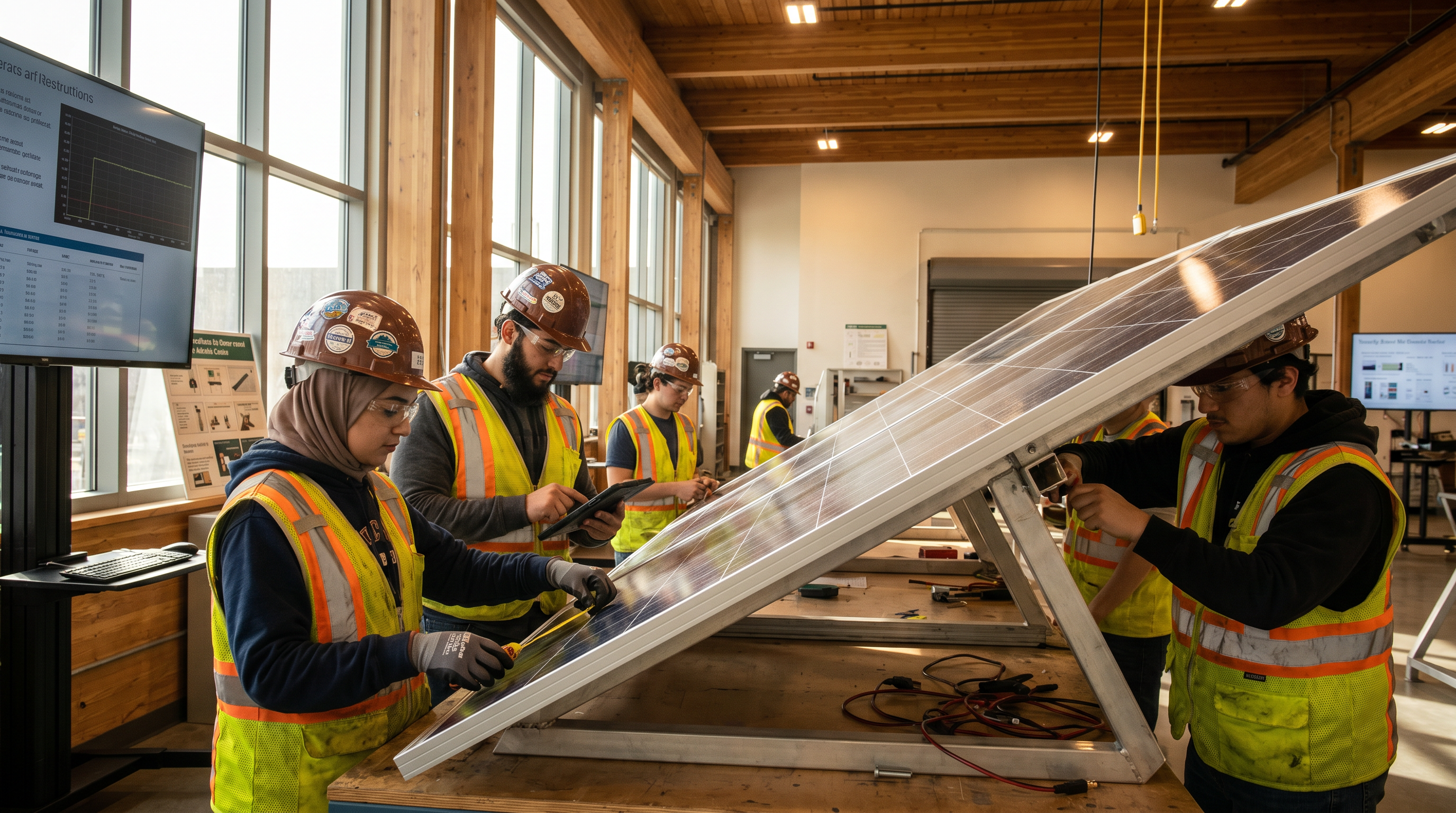
The day-to-day reality of these green trades is physically demanding but highly technical. Solar installers must read complex blueprints, mount racking systems, wire panels to high-voltage inverters, and ensure seamless integration with the local electrical grid. Wind technicians often climb ladders inside turbine towers or are hoisted by helicopters to troubleshoot mechanical and electrical systems in extreme weather conditions.[1][4][9]
Beyond wind and solar generation, the electrification of transportation is spawning entirely new vocational categories. As automakers transition their fleets to electric vehicles, the traditional automotive mechanic is evolving into a high-voltage systems specialist. This requires a fundamental shift in training, moving away from internal combustion engines toward battery chemistry, thermal management, and advanced software diagnostics.[1][5]
Community colleges are at the forefront of this automotive evolution. The City Colleges of Chicago, for example, have launched dedicated clean energy programs that include 10-week certifications for EV charging station installers and 12-week pre-apprenticeship programs designed specifically for EV manufacturers like Rivian. These programs require basic knowledge of electrical systems but offer a rapid on-ramp to a rapidly expanding industry.[5]

Community colleges are at the forefront of this automotive evolution.
The training mechanisms for these green collar jobs generally fall into two categories: accelerated technical programs and registered apprenticeships. Accelerated programs, such as those offered by the Universal Technical Institute, can equip students with the foundational skills for wind turbine maintenance in as little as seven to eight months. These intensive courses focus heavily on electrical troubleshooting, wiring, and safety protocols, getting students into the field as quickly as possible.[4]
Registered apprenticeships, on the other hand, offer an "earn while you learn" model that is becoming increasingly popular. Supported by coalitions like the Apprenticeships in Clean Energy Network, these programs typically last between two and five years. They represent a deeper, longer-term investment in worker competency and safety.[8]
In the apprenticeship model, trainees are hired as paid employees from day one, receiving hands-on mentorship alongside classroom instruction. Upon completion, the apprentice earns a nationally recognized journey-level credential, which functions much like a degree in the skilled trades. This model drastically reduces student debt while guaranteeing employers a pipeline of highly trained talent.[8]
The expansion of these vocational pathways is heavily supported by public policy and government funding. The federal Inflation Reduction Act, for instance, ties significant tax incentives for large-scale energy projects to strict apprenticeship and prevailing wage requirements. This legislative mechanism effectively forces developers to invest directly in local workforce training if they want to maximize their financial returns.[1][8]

State governments are also injecting capital into the vocational ecosystem to ensure the transition is equitable. In April 2026, New York Governor Kathy Hochul announced a $50 million funding package dedicated to clean energy workforce development. The initiative aims to create career pathways, upskill existing workers, and provide wraparound services to ensure that underserved communities can access these family-sustaining jobs.[7]
One of the most promising aspects of the green collar boom is the crossover potential between different renewable sectors. While wind and solar technologies are distinct, the foundational skills required to service them—electrical theory, mechanical troubleshooting, and rigorous safety compliance—are remarkably similar.[9]
This overlap allows for significant career mobility. A technician trained in solar PV installation can often transition into wind turbine maintenance or EV infrastructure with minimal additional education. Training providers are increasingly designing standardized, cross-disciplinary curricula to foster this adaptability, ensuring that workers are not siloed into a single technology as the market evolves.[9]
The geographic distribution of these jobs is also expanding beyond traditional strongholds. While states like Texas, California, and Iowa have long dominated wind and solar employment, the manufacturing and infrastructure boom is spreading to the Midwest and the South. Battery manufacturing plants and utility-scale solar farms are creating regional vocational hubs in areas that previously relied on traditional manufacturing or fossil fuels.[6]

For educators and policymakers, the primary challenge now is scaling these programs quickly enough to meet industry demand. This requires recruiting experienced tradespeople to serve as instructors—a difficult task when those same professionals can command premium salaries working directly in the private sector.[1]
Despite these growing pains, the trajectory of the green collar workforce is clear. The clean energy transition is fundamentally rewriting the rules of the blue-collar economy, elevating traditional trades into high-tech, high-stakes professions that are critical to national infrastructure.[1]
For a generation of students wary of mounting university tuition and uncertain white-collar job markets, the green collar sector offers a compelling alternative. It provides a tangible, hands-on career that not only pays well but directly contributes to solving one of the defining global challenges of the 21st century.[1]
How we got here
August 2022
The Inflation Reduction Act passes, tying significant clean energy tax credits to registered apprenticeship and prevailing wage requirements.
Late 2024
Global renewable energy employment reaches 16.6 million, with solar PV accounting for the largest share of jobs.
Early 2025
The Bureau of Labor Statistics projects wind turbine technicians and solar installers as the two fastest-growing occupations in the U.S. through 2034.
April 2026
New York announces a $50 million funding package specifically dedicated to clean energy workforce development and upskilling.
Viewpoints in depth
Vocational Educators
Institutions focused on rapidly scaling technical training to meet industry demand.
Community colleges and technical institutes argue that the traditional four-year degree is no longer the only—or even the best—path to a stable, high-paying career. By offering accelerated 7- to 12-week certificate programs, these educators aim to quickly bridge the skills gap in the clean energy sector. Their primary challenge is securing enough experienced instructors, as master electricians and seasoned turbine technicians can often earn significantly more working in the private sector than teaching in a classroom.
Clean Energy Employers
Companies deploying wind, solar, and EV infrastructure who urgently need skilled labor.
For the clean energy industry, the workforce shortage is an existential bottleneck. Companies have the capital and government backing to build massive renewable projects, but project timelines are frequently delayed by a lack of qualified installers and high-voltage technicians. Employers are increasingly partnering directly with vocational schools to design custom curricula—such as Rivian's pre-apprenticeship programs—ensuring that graduates possess the exact technical competencies required on day one.
Labor & Apprenticeship Advocates
Unions and workforce coalitions pushing for long-term, earn-while-you-learn models.
Labor advocates emphasize that the clean energy transition must prioritize job quality, not just job quantity. They champion the registered apprenticeship model, which guarantees workers a living wage, rigorous safety training, and a nationally recognized credential over a two- to five-year period. These groups strongly support policies like the Inflation Reduction Act, which ties federal tax incentives to prevailing wage and apprenticeship requirements, ensuring that the green collar boom results in secure, family-sustaining careers rather than temporary gig work.
What we don't know
- Whether vocational schools can recruit enough experienced instructors to scale programs at the speed the industry requires.
- How potential future changes to federal tax incentives might impact the funding for registered apprenticeship programs.
Key terms
- Green Collar Worker
- A professional employed in the environmental sectors of the economy, particularly in roles related to renewable energy, energy efficiency, and sustainability.
- Photovoltaic (PV) System
- A technology that converts sunlight directly into electricity using solar panels, requiring specialized installation and wiring.
- Registered Apprenticeship
- A formal, government-vetted training program that combines paid on-the-job learning with classroom instruction, leading to a recognized industry credential.
- Journey-Level Credential
- A certification indicating that a worker has fully mastered a specific trade and can work independently without supervision.
- High-Voltage Systems
- Electrical systems operating at significantly higher voltages than standard household wiring, common in electric vehicles and utility-scale renewable energy, requiring advanced safety training.
Frequently asked
Do I need a college degree to work in renewable energy?
No. The fastest-growing roles, such as wind turbine technicians and solar installers, typically require a high school diploma followed by a vocational certificate or a registered apprenticeship.
How much do wind turbine technicians make?
According to the Bureau of Labor Statistics, the median annual wage for wind turbine service technicians was over $62,000 in 2024, with experienced or union-affiliated workers earning more.
What is a registered apprenticeship?
It is an 'earn while you learn' program where workers are paid employees from day one. They receive hands-on mentorship and classroom instruction, typically lasting two to five years, culminating in a journey-level credential.
Are clean energy jobs only located in certain states?
While states like California and Texas have historically led in solar and wind, clean energy jobs are rapidly expanding nationwide, particularly in the South and Midwest due to new battery manufacturing and utility-scale projects.
Sources
Source coverage
9 outlets
3 viewpoints surfaced









[1]Factlen Editorial TeamPolicy & Labor Advocates
Synthesis by Factlen editorial team
Read on Factlen Editorial Team →[2]Bureau of Labor StatisticsPolicy & Labor Advocates
Fastest Growing Occupations: 2024–2034
Read on Bureau of Labor Statistics →[3]International Renewable Energy AgencyClean Energy Industry
Renewable Energy and Jobs: Annual Review 2025
Read on International Renewable Energy Agency →[4]Universal Technical InstituteVocational Educators
Wind Turbine Technician Training Program
Read on Universal Technical Institute →[5]City Colleges of ChicagoVocational Educators
Join Illinois' Future in Clean Energy
Read on City Colleges of Chicago →[6]Environmental EntrepreneursClean Energy Industry
Clean Jobs America 2024
Read on Environmental Entrepreneurs →[7]New York State GovernmentPolicy & Labor Advocates
Governor Hochul Expands Clean Energy Workforce Commitment With $50 Million in New Funding
Read on New York State Government →[8]Apprenticeships in Clean Energy NetworkPolicy & Labor Advocates
Apprenticeships in Clean Energy Network
Read on Apprenticeships in Clean Energy Network →[9]STL USAClean Energy Industry
The crossover in training requirements for wind and solar field technicians
Read on STL USA →

More in education
See all 24 stories →College Access
How Direct Admissions is Flipping the College Application Process
7 sources

Cognitive Science
The Science of Effective Learning: What Academic Research Actually Proves Works
8 sources

Literacy Reform
How the 'Science of Reading' is Transforming American Classrooms
8 sources

EdTech Efficacy
The Evidence on AI Tutors: How Universities Are Closing the STEM Achievement Gap
7 sources

Every angle. Every day.
Get education stories with full source coverage and perspective breakdowns delivered to your inbox.