
The Flipped College Application: How Direct Admissions is Reshaping Higher Education
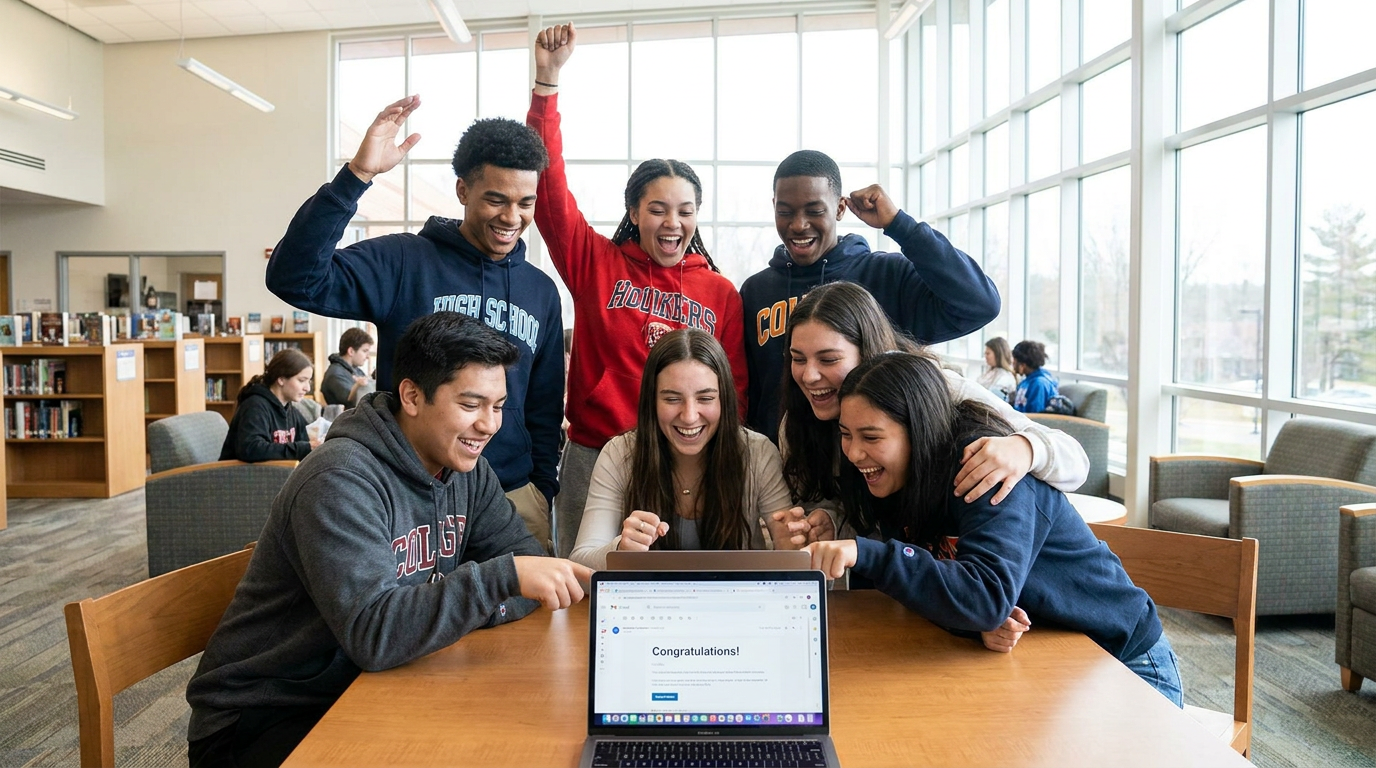
Colleges are bypassing the traditional application process to proactively offer guaranteed acceptance to hundreds of thousands of students. This 'reverse application' model aims to reduce anxiety and increase access for first-generation applicants.
By Factlen Editorial Team
- Access Advocates
- Argue that direct admissions is a critical tool for dismantling systemic barriers and empowering first-generation students.
- University Administrators
- Value the model as a necessary yield management strategy to broaden applicant pools and stabilize enrollment amid demographic shifts.
- Education Researchers
- Emphasize that while proactive offers boost confidence, they must be paired with transparent financial aid to translate into actual enrollment.
What's not represented
- · Highly Selective Universities
- · High School Guidance Counselors
Why this matters
The traditional college application process is expensive, stressful, and often deters qualified students from applying. Direct admissions removes these barriers, returning power to the student and fundamentally changing how families plan for higher education.
Key points
- Direct admissions flips the traditional college application process by proactively offering acceptance to qualified students before they apply.
- During the 2025–2026 cycle, over 200 colleges participated in the Common App's program, extending offers to more than 800,000 students.
- The model specifically targets first-generation and low-to-middle-income students, removing barriers like application fees and essays.
- At least 15 states have implemented their own centralized direct admissions programs to keep local talent at in-state public universities.
- While the program successfully boosts student confidence and application rates, researchers note that clear financial aid is required to ensure students actually enroll.
For generations, the path to higher education has followed a predictable, anxiety-inducing script. High school seniors spend months researching institutions, writing personal essays, requesting letters of recommendation, and paying hefty application fees, all while waiting in suspense for a decision.[2][6]
But during the 2025–2026 admissions cycle, a quiet revolution has reached critical mass. Instead of forcing students to navigate a labyrinthine application process to prove their worth, colleges are flipping the script. They are coming directly to the students.[2]
This paradigm shift is known as "direct admissions," a proactive model where colleges offer enrollment to eligible students before they ever formally apply. By leveraging academic data that already exists—such as GPA and state residency—institutions can identify qualified candidates and extend guaranteed acceptance offers upfront.[5][6]
The scale of this reversal is staggering. For the 2025–2026 cycle, the Common App—the ubiquitous platform used by millions of applicants—expanded its direct admissions initiative to include more than 200 participating colleges and universities across 45 states.[1][4]

Through this single platform alone, more than 800,000 students received proactive offers of admission this year. Meanwhile, third-party platforms like Niche reported extending over one million proactive acceptances, averaging eight offers per student.[1][2]
The mechanism behind direct admissions is remarkably straightforward. Students create a profile on a platform like the Common App, inputting their self-reported grades, coursework, and demographic information. Participating colleges set specific algorithmic criteria, such as a minimum 3.0 GPA or in-state residency.[1][5][6]
If a student's profile matches the college's benchmarks, an official, non-binding offer of admission appears directly in their inbox or dashboard. To accept the offer, the student simply confirms their interest. The traditional hurdles—application fees, supplemental essays, and teacher evaluations—are entirely waived.[1][5][6]
While the convenience is universally appealing, the primary engine driving direct admissions is educational equity. The traditional application process is riddled with a "hidden curriculum" that disproportionately disadvantages first-generation and low-income students.[1][3]
While the convenience is universally appealing, the primary engine driving direct admissions is educational equity.
Students without access to expensive college counselors or generational knowledge often self-select out of applying to four-year universities, assuming they will not be accepted or cannot afford the fees. Direct admissions shatters this psychological barrier by providing an immediate, validating "yes."[1][3][7]
The data indicates that this validation works. According to the Common App, first-generation students are roughly twice as likely to engage with direct admissions offers compared to their peers. Furthermore, 25% of students who received an offer ended up applying to at least one institution they had not previously considered.[1]

States are also taking matters into their own hands. Idaho pioneered the first statewide direct admissions policy in 2015, and today, 15 states—including Connecticut, Illinois, Wisconsin, and Georgia—have implemented their own centralized programs.[4][7]
In Wisconsin, for example, most public university campuses now directly admit qualifying high school seniors based on their state education data, entirely bypassing the traditional application portal. This state-level integration allows public universities to keep local talent in-state while fulfilling their broad-access missions.[4][7]
For colleges, direct admissions is not merely an act of altruism; it is a vital strategy for institutional survival. Higher education is currently facing a "perfect storm" of demographic shifts, declining birth rates, and intense competition for a shrinking pool of high school graduates.[2]
Less selective and regional public universities are utilizing proactive offers as a crucial yield management tool. By reaching out to verified academic fits early in the cycle, these institutions can broaden their applicant pools, secure enrollments faster, and stabilize their tuition revenue.[2][8]

However, education researchers caution that an acceptance letter is only the first step. While direct admissions successfully boosts application numbers and student confidence, translating those offers into actual college enrollment remains a complex challenge.[3][7]
The primary friction point is affordability. A direct admission offer guarantees a seat, but it does not automatically guarantee that the student can afford the tuition. Without clear, upfront financial aid packages paired with the acceptance, many low-income students are still forced to decline the offer.[3][7]
To address this, some forward-thinking programs are beginning to bundle merit-based scholarships and financial aid estimates directly into the initial acceptance notification. When students can see both their acceptance and their net cost simultaneously, the path to enrollment becomes significantly clearer.[5][7]

Ultimately, the rapid expansion of direct admissions represents a structural correction in higher education. By dismantling the artificial scarcity and anxiety of the traditional admissions cycle, colleges are returning agency to the students.[2][8]
For hundreds of thousands of teenagers, the question is no longer "Am I good enough to get in?" but rather, "Which of these guaranteed options is the best fit for my future?" In an era often defined by educational stress, this shift stands as a profound and empowering victory for student access.[6][8]
How we got here
2015
Idaho implements the nation's first statewide direct admissions program.
2021
The Common App launches its first small-scale direct admissions pilot program.
2023
The Common App expands the program to over 70 institutions, targeting low- and middle-income students.
Fall 2024
States like Georgia, Indiana, and Wisconsin roll out large-scale statewide direct admissions initiatives.
2025-2026 Cycle
Direct admissions reaches mainstream scale, with over 200 colleges participating on the Common App and over 1 million total offers extended across all platforms.
Viewpoints in depth
Access Advocates
Focus on how direct admissions dismantles systemic barriers for marginalized students.
Advocates for educational equity view the traditional application process as a gauntlet of 'hidden curriculum'—fees, essays, and insider knowledge that disproportionately filter out low-income and first-generation students. By delivering a proactive 'yes,' direct admissions removes the psychological barrier of rejection. These advocates argue that the model proves students are capable and welcome, fundamentally shifting the power dynamic of college access.
University Administrators
View the model as a necessary strategy to stabilize enrollment and broaden applicant pools.
For regional and broad-access universities, direct admissions is a pragmatic response to a looming demographic cliff. With fewer high school graduates entering the pipeline, colleges can no longer afford to wait passively for applications. Administrators utilize proactive offers as a yield management tool, allowing them to secure a baseline of verified academic fits early in the cycle, stabilize tuition revenue, and fulfill institutional diversity mandates.
Education Researchers
Caution that acceptance offers must be paired with financial aid to ensure actual enrollment.
While researchers acknowledge the surge in application volume generated by direct admissions, they emphasize that an acceptance letter does not pay for tuition. Studies of early state-level programs show mixed results regarding actual enrollment gains among low-income cohorts. Researchers argue that unless direct admission offers are bundled with transparent, upfront financial aid packages, the model risks offering false hope to students who ultimately cannot afford to attend.
What we don't know
- Whether the massive surge in proactive admissions offers will translate into proportional increases in actual college graduation rates over the next four years.
- How highly selective, elite universities will adapt their own recruitment strategies as the broader higher education market shifts toward frictionless admissions.
Key terms
- Direct Admissions
- A flipped process where colleges proactively offer acceptance to students based on their academic data before a formal application is submitted.
- Yield Management
- Strategies used by universities to predict and control the number of accepted students who actually enroll.
- Common App
- A standardized online platform used by millions of students to apply to over 1,000 member colleges and universities.
- First-Generation Student
- A student whose parents did not complete a four-year college or university degree.
- Open-Access Institution
- Colleges or universities that accept the vast majority of applicants, focusing on broad educational availability rather than exclusivity.
Frequently asked
Is a direct admissions offer binding?
No. Direct admissions offers are completely non-binding. Students are free to review the offer, explore the college, and decide later if they actually want to enroll.
Do I still have to pay an application fee?
In most cases, no. Participating colleges typically waive the application fee for students who accept a direct admissions offer.
Does a direct admission mean my tuition is paid for?
No. While the offer guarantees your acceptance, financial aid and scholarships are handled separately. Some schools are beginning to include aid estimates with their offers, but students still need to review their net costs.
Can I still apply to other colleges the traditional way?
Yes. Receiving a direct admissions offer does not restrict you from applying to any other universities through the standard application process.
Sources
Source coverage
8 outlets
3 viewpoints surfaced







[1]Common AppAccess Advocates
Simplifying the path to college: Common App Direct Admissions
Read on Common App →[2]ForbesUniversity Administrators
8 Education Trends That Are Changing College Admissions
Read on Forbes →[3]Higher Ed DiveAccess Advocates
Common App direct admissions pilot boosts applications from underrepresented students
Read on Higher Ed Dive →[4]BestCollegesUniversity Administrators
Common App Offers Direct Admissions to Colleges and Universities Nationwide
Read on BestColleges →[5]MEFAEducation Researchers
What is Common App Direct Admissions?
Read on MEFA →[6]EdVisorlyUniversity Administrators
Direct Admissions: Cutting Out the Application
Read on EdVisorly →[7]Complete College AmericaAccess Advocates
Direct Admissions: Considerations for States
Read on Complete College America →[8]Factlen Editorial TeamEducation Researchers
Synthesis by Factlen editorial team
Read on Factlen Editorial Team →

More in education
See all 5 stories →Toolbelt Generation
The 'Toolbelt Generation': Why Gen Z is Choosing Trade Schools Over Four-Year Degrees
7 sources

AI Tutoring
The Measurable Impact of AI Tutors on College Retention: What the Evidence Shows
7 sources

College Admissions
The 'Reverse Application': How Direct Admissions is Flipping the College Process
6 sources

Every angle. Every day.
Get education stories with full source coverage and perspective breakdowns delivered to your inbox.