
The End of the Unexpected Bump: How AI, Lasers, and Swarm Data Are Eradicating Unseen Turbulence
Aviation engineers and meteorologists are deploying a powerful triad of technologies—machine learning, onboard LIDAR, and global data sharing—to detect and avoid clear-air turbulence before an aircraft ever reaches it.
By Factlen Editorial Team
- Aviation Safety Regulators
- Focuses on standardizing objective metrics like EDR and mandating global data sharing to raise the safety baseline for all carriers.
- AI & Meteorology Innovators
- Argues that replacing static, twice-daily weather balloon data with dynamic, machine-learning-driven 'nowcasting' is the key to predicting chaotic air.
- Aerospace Hardware Engineers
- Believes that while predictive models are excellent, true safety requires outfitting individual aircraft with autonomous, forward-looking sensors like LIDAR.
What's not represented
- · Commercial Airline Pilots
- · Flight Attendant Unions
Why this matters
For millions of passengers, the fear of sudden turbulence is the most stressful part of flying. Understanding that the aviation industry is actively mapping and illuminating the invisible atmosphere means travelers can expect significantly smoother, safer, and more predictable flights in the near future.
Key points
- Clear-air turbulence is invisible to traditional radar, making it a leading cause of unexpected in-flight injuries.
- IATA's Turbulence Aware platform allows thousands of aircraft to automatically share objective turbulence data in real-time.
- AI 'Nowcasting' models ingest massive datasets to predict rough air up to six hours in advance with 90% accuracy.
- Aerospace engineers are testing onboard LIDAR lasers to detect invisible air disturbances up to 11 miles ahead of the plane.
- Beyond passenger comfort, avoiding turbulence allows airlines to fly more direct routes, saving fuel and reducing emissions.
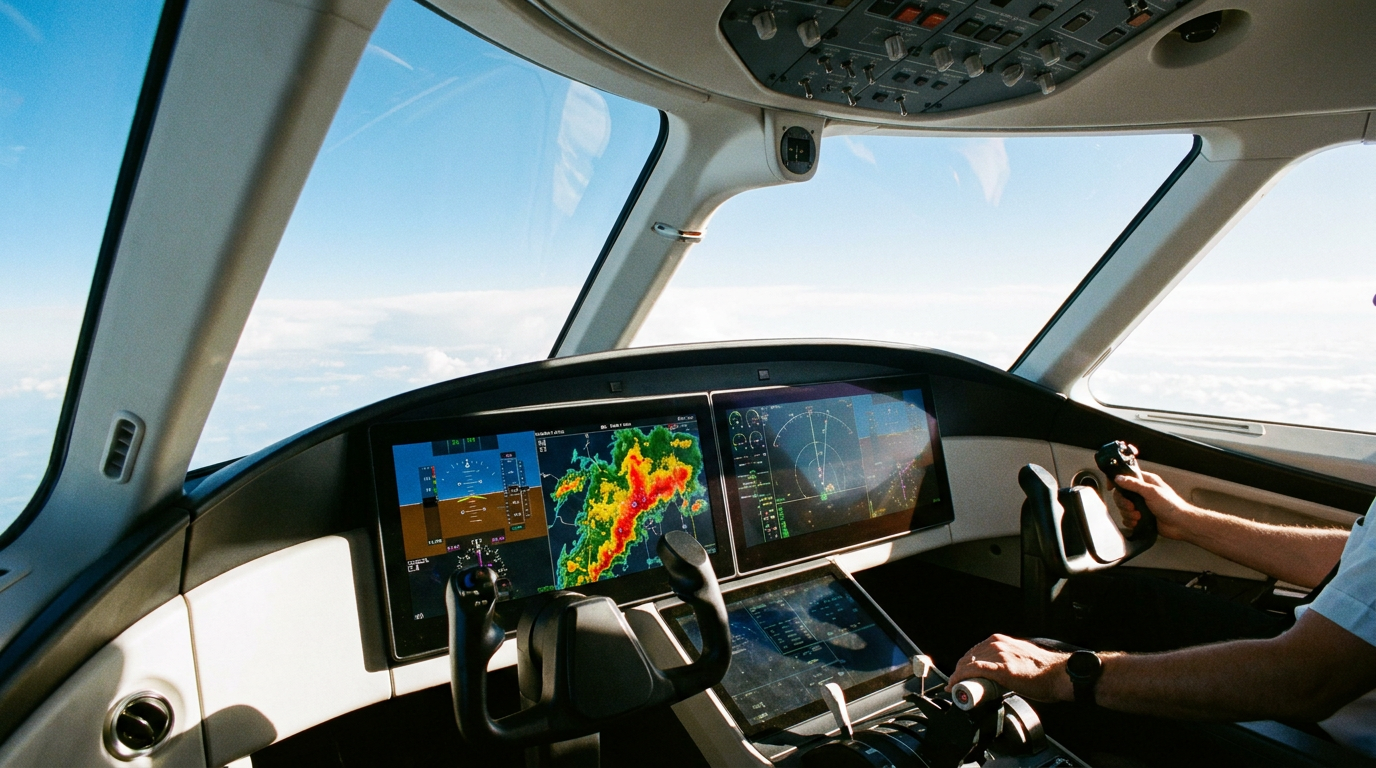
For decades, commercial aviation has battled an invisible adversary. While modern weather radar easily highlights thunderstorms and heavy precipitation, the atmosphere frequently hides "clear-air turbulence" (CAT)—violent, swirling air currents that occur in cloudless skies. Because it lacks moisture, CAT is completely invisible to traditional radar, leaving pilots to rely on outdated weather balloons and subjective radio reports from aircraft flying ahead of them.[1][6]
This reliance on reactive communication has historically meant that the first warning a flight crew receives about severe clear-air turbulence is often the moment they fly into it. But a quiet revolution is currently transforming the cockpit. Aviation engineers, meteorologists, and software developers are deploying a powerful triad of new technologies—swarm intelligence, artificial intelligence, and laser-based sensors—to illuminate the invisible sky and eradicate the unexpected bump.[1][8]
The foundation of this smoother future is "swarm intelligence." In 2018, the International Air Transport Association (IATA) launched Turbulence Aware, a global data-sharing platform designed to replace subjective pilot reports with hard mathematics. Instead of a pilot radioing that the air feels "a bit choppy," modern aircraft software automatically calculates the Eddy Dissipation Rate (EDR)—an objective, universal metric of atmospheric instability.[2][3]
As an aircraft flies, its sensors continuously measure how much the plane is being displaced by the air. This EDR data is instantly anonymized and beamed down to ground servers, which then broadcast it to every other participating aircraft in the sky. By 2023, the system was generating 38 million automated turbulence reports annually. When major carriers like Lufthansa, British Airways, and Singapore Airlines joined the network, the skies effectively became a massive, interconnected sensor grid.[2][3]

Pilots utilizing the IATA platform now view a dynamic, color-coded map on their cockpit tablets. If an aircraft 50 miles ahead encounters a pocket of rough air, trailing flights instantly see a red marker appear on their screens, detailing the exact altitude, time, and intensity of the disturbance. This allows crews to proactively request a minor altitude change or securely seat passengers long before the seatbelt sign would traditionally illuminate.[2][3]
However, swarm intelligence only tells pilots what is happening right now. To know what will happen hours in the future, the industry is turning to Artificial Intelligence. Traditional weather forecasting models struggle with the upper atmosphere because weather balloons are only launched twice a day, leaving massive data gaps at cruising altitudes. AI is stepping in to fill those voids.[4][5]
However, swarm intelligence only tells pilots what is happening right now.
Companies like SkyPath have partnered with AI meteorological firms like Zeus AI to create "Nowcasting" models. These deep-learning systems ingest billions of data points—from satellite microwave sounders to historical flight telemetry—and learn the complex, non-linear relationships that create turbulence. By processing this data in real-time, these AI models can predict short-term turbulence up to six hours in advance with an astonishing 90 percent accuracy.[4][5]
The results of this AI integration are profound. In Japan, a joint venture between All Nippon Airways (ANA) and Keio University resulted in BlueWX, an AI turbulence prediction system trained on a decade of the airline's flight data. During extensive trials, the deep-learning model demonstrated a 2.7-fold increase in accuracy over conventional weather models. Pilots are no longer guessing where the air might be rough; they are navigating through a highly precise, AI-rendered topographical map of the sky.[8]

Yet, even the best AI models are predictive, not observational. For the ultimate safeguard, aerospace engineers are looking to give aircraft the ability to "see" clear-air turbulence directly ahead of their own nose. The solution lies in LIDAR (Light Detection and Ranging), the same technology that allows autonomous cars to navigate city streets.[1][6]
A Doppler LIDAR system mounted on an aircraft fires continuous, invisible laser pulses miles into the flight path. While clear-air turbulence lacks water droplets, the air still contains microscopic dust and aerosol particles. As the laser light bounces off these particles, the system analyzes the "Doppler shift"—the change in the light's wavelength caused by the particles moving toward or away from the plane. If the particles are swirling chaotically, the LIDAR instantly flags it as turbulence.[6][7]
The Japan Aerospace Exploration Agency (JAXA), in collaboration with Boeing, has been rigorously testing these airborne LIDAR systems. Their long-range prototypes have successfully detected once-undetectable clear-air turbulence up to 17.5 kilometers (about 11 miles) ahead of the aircraft. At cruising speeds, this provides the flight crew with roughly a minute of advanced warning—more than enough time to alert the cabin, halt beverage service, and ensure everyone is safely buckled.[6][7]
Miniaturizing LIDAR for commercial fleets presents engineering hurdles, primarily because the thin air at 35,000 feet requires powerful, heavy lasers to detect sparse aerosols. However, rapid advancements in optical engineering are steadily shrinking these units. Researchers are even developing "gust alleviation" software that links the LIDAR directly to the plane's flight control surfaces, allowing the aircraft's wings to automatically adjust and absorb the shock of the turbulence before the passengers ever feel it.[6][7]

The convergence of these three technologies—IATA's swarm data, AI Nowcasting, and onboard LIDAR—promises a paradigm shift in passenger comfort. But the benefits extend far beyond spilling fewer cups of coffee. Unpredictable turbulence forces pilots to fly overly cautious, inefficient routes that burn excess jet fuel. By providing a clear picture of exactly where the smooth air is, these systems allow airlines to optimize flight paths, saving millions of gallons of fuel and significantly reducing carbon emissions.[2][4][8]
While the atmosphere will always be a dynamic, swirling ocean of air, the era of flying blind through it is rapidly coming to a close. Through the seamless integration of global data sharing, machine learning, and laser optics, the aviation industry is stripping turbulence of its most dangerous element: the element of surprise.[1][2][6]
How we got here
2018
IATA launches the Turbulence Aware platform to standardize and share objective EDR data globally.
2021
ANA begins trials of an AI-based turbulence prediction system developed with Keio University.
2023
The IATA Turbulence Aware network scales massively, generating 38 million automated reports in a single year.
2024
Boeing and JAXA announce advanced flight-testing of long-range LIDAR capable of detecting clear-air turbulence 17.5km ahead.
2026
Lufthansa Group and other major carriers formally integrate into the IATA swarm network, cementing data-sharing as an industry standard.
Viewpoints in depth
Aviation Safety Regulators
Focuses on standardizing objective metrics like EDR and mandating global data sharing to raise the safety baseline for all carriers.
For international regulatory bodies and organizations like IATA, the primary hurdle in aviation safety has been the subjective nature of human reporting. A pilot flying a massive Boeing 777 might report a patch of air as 'light chop,' while a pilot in a smaller regional jet hitting the exact same air might experience it as 'severe turbulence.' Regulators argue that true safety requires removing human perception from the equation entirely. By championing the Eddy Dissipation Rate (EDR) as a universal, machine-calculated standard, regulators aim to build a unified, objective database. Their ultimate goal is a fully integrated global airspace where every commercial aircraft acts as a sensor node, automatically protecting the planes flying behind it regardless of the airline's flag.
AI & Meteorology Innovators
Argues that replacing static, twice-daily weather balloon data with dynamic, machine-learning-driven 'nowcasting' is the key to predicting chaotic air.
Meteorologists and software developers view turbulence fundamentally as a data-processing problem. Traditional weather models rely on sparse data points—like weather balloons launched only twice a day—which are insufficient for mapping the highly dynamic upper atmosphere. Innovators in this space argue that the solution lies in deep learning. By feeding neural networks an unprecedented volume of diverse data, including satellite microwave sounders, historical flight telemetry, and real-time EDR reports, AI can identify the complex, non-linear patterns that precede clear-air turbulence. They believe that 'nowcasting'—highly accurate, continuously updating short-term forecasts—will eventually make encountering unexpected rough air a statistical anomaly.
Aerospace Hardware Engineers
Believes that while predictive models are excellent, true safety requires outfitting individual aircraft with autonomous, forward-looking sensors like LIDAR.
Hardware engineers approach the problem from a perspective of aircraft autonomy. While they acknowledge the immense value of swarm data and AI forecasting, they point out that forecasts can still be wrong and data-sharing relies on another plane hitting the turbulence first. Their focus is on giving the aircraft its own 'eyes.' By developing and miniaturizing Doppler LIDAR systems, engineers aim to provide flight crews with deterministic, real-time proof of the air conditions directly in front of their specific flight path. Furthermore, they envision a future where this LIDAR data bypasses the pilot entirely, feeding directly into the aircraft's flight control computers to automatically adjust the wings and absorb the turbulence in milliseconds.
What we don't know
- How quickly LIDAR systems can be miniaturized and made cost-effective enough for fleet-wide commercial deployment.
- Whether climate change will increase the frequency of clear-air turbulence faster than AI models can adapt to the shifting atmospheric patterns.
Key terms
- Clear-Air Turbulence (CAT)
- Severe, sudden turbulence occurring in cloudless regions of the sky, making it invisible to traditional weather radar.
- Eddy Dissipation Rate (EDR)
- A universal, objective mathematical metric used by aviation systems to measure the exact intensity of atmospheric turbulence.
- LIDAR
- Light Detection and Ranging; a technology that uses rapid laser pulses to measure distances and detect the movement of invisible air particles.
- Nowcasting
- Highly detailed, short-term weather forecasting that predicts conditions over the next few hours by processing massive amounts of real-time data.
- Swarm Intelligence
- The collective behavior of decentralized systems, applied in aviation by having thousands of aircraft automatically share real-time hazard data with one another.
Frequently asked
Can turbulence crash a modern commercial airplane?
No. Modern commercial aircraft are engineered to withstand structural forces far exceeding even the most severe turbulence ever recorded.
Why is clear-air turbulence considered so dangerous?
Because it occurs without visual cues like clouds or storms, traditional radar cannot detect it, giving pilots and passengers no warning to buckle their seatbelts before the shaking begins.
Will these new technologies eliminate turbulence entirely?
They cannot stop the atmosphere from being turbulent, but they allow pilots to route around rough patches or provide enough advanced warning to safely secure the cabin.
How does an airplane measure turbulence objectively?
Modern aircraft software calculates the Eddy Dissipation Rate (EDR), a mathematical metric that measures exactly how much the plane is being displaced by the surrounding air.
Sources
Source coverage
8 outlets
3 viewpoints surfaced








[1]Factlen Editorial Team
Synthesis by Factlen editorial team
Read on Factlen Editorial Team →[2]IATAAviation Safety Regulators
Turbulence Aware: Keep passengers and crew safe and fuel costs down
Read on IATA →[3]Lufthansa Group
Lufthansa joins IATA Turbulence Aware for safer and smoother flights
Read on Lufthansa Group →[4]The Weather CompanyAI & Meteorology Innovators
AI-powered turbulence forecasting and real-time weather data
Read on The Weather Company →[5]SkyPathAI & Meteorology Innovators
Better prediction, prevention, and mitigation of turbulence with Zeus AI
Read on SkyPath →[6]Channel News AsiaAerospace Hardware Engineers
Could self-driving car tech help planes detect clear-air turbulence?
Read on Channel News Asia →[7]MDPIAerospace Hardware Engineers
A Clear Air Turbulence Detection Method Using a 532 nm Airborne LiDAR System
Read on MDPI →[8]BlueWXAI & Meteorology Innovators
Developed an AI-based turbulence prediction system with 2.7 times the accuracy
Read on BlueWX →
Every angle. Every day.
Get travel stories with full source coverage and perspective breakdowns delivered to your inbox.