
The 2026 European Night Train Renaissance: How Slow Travel is Replacing Short-Haul Flights
Driven by climate anxiety and a desire for deeper immersion, Europe's sleeper train network is undergoing a massive expansion in 2026, led by citizen cooperatives and next-generation rail technology.
By Factlen Editorial Team
- Slow Travel Advocates
- Travelers prioritizing immersion, mental well-being, and sustainability over speed.
- Climate & Policy Watchdogs
- Environmental groups advocating for systemic shifts to lower-carbon transportation.
- Rail Operators & Cooperatives
- The companies and citizen groups physically building and running the new networks.
What's not represented
- · Aviation Industry Representatives
- · Budget Airline Passengers
Why this matters
For travelers, the expansion of the European sleeper network offers a lower-stress, highly sustainable alternative to budget airlines. It fundamentally changes how itineraries are planned, turning transit time into a core part of the vacation experience while drastically cutting personal carbon footprints.
Key points
- The 'slow travel' movement is driving a massive resurgence in European sleeper trains in 2026.
- European Sleeper is launching a new Paris-Brussels-Berlin route in March, replacing a canceled state service.
- Electric trains emit up to 90% less CO2 than comparable short-haul flights.
- New generation trains feature capsule-style mini-cabins and private showers for enhanced comfort.
- Despite environmental benefits, train tickets often remain more expensive than flights due to aviation subsidies.
The era of the hyper-optimized, two-day weekend sprint across Europe is facing a cultural reckoning. In 2026, "slow travel" has transitioned from a niche aesthetic to a dominant philosophy, driven by a collective backlash against burnout and climate anxiety.[4]
At the heart of this shift is the renaissance of the European sleeper train. After decades of decline at the hands of low-cost airlines, overnight rail is experiencing a massive resurgence, transforming the journey from a tedious transit into the first night of the vacation.[3][4]
The revival has not been without its growing pains. In late 2025, the movement suffered a high-profile setback when the Austrian state operator ÖBB—the pioneer of the modern night train—abruptly canceled its Paris-Berlin and Paris-Vienna Nightjet services, citing the withdrawal of French government subsidies.[1]
Yet, the setback proved temporary, highlighting a new dynamic in European rail: the rise of citizen-backed cooperatives. European Sleeper, a Belgian-Dutch company funded by thousands of private investors, immediately stepped in to rescue the Paris-Berlin connection.[1][7]
Launching on March 26, 2026, the new European Sleeper service will operate three times a week, routing through Brussels to enable seamless Eurostar connections from London. With 12 to 14 coaches, the train boasts a capacity of 600 to 700 passengers, significantly expanding the route's previous volume.[1]
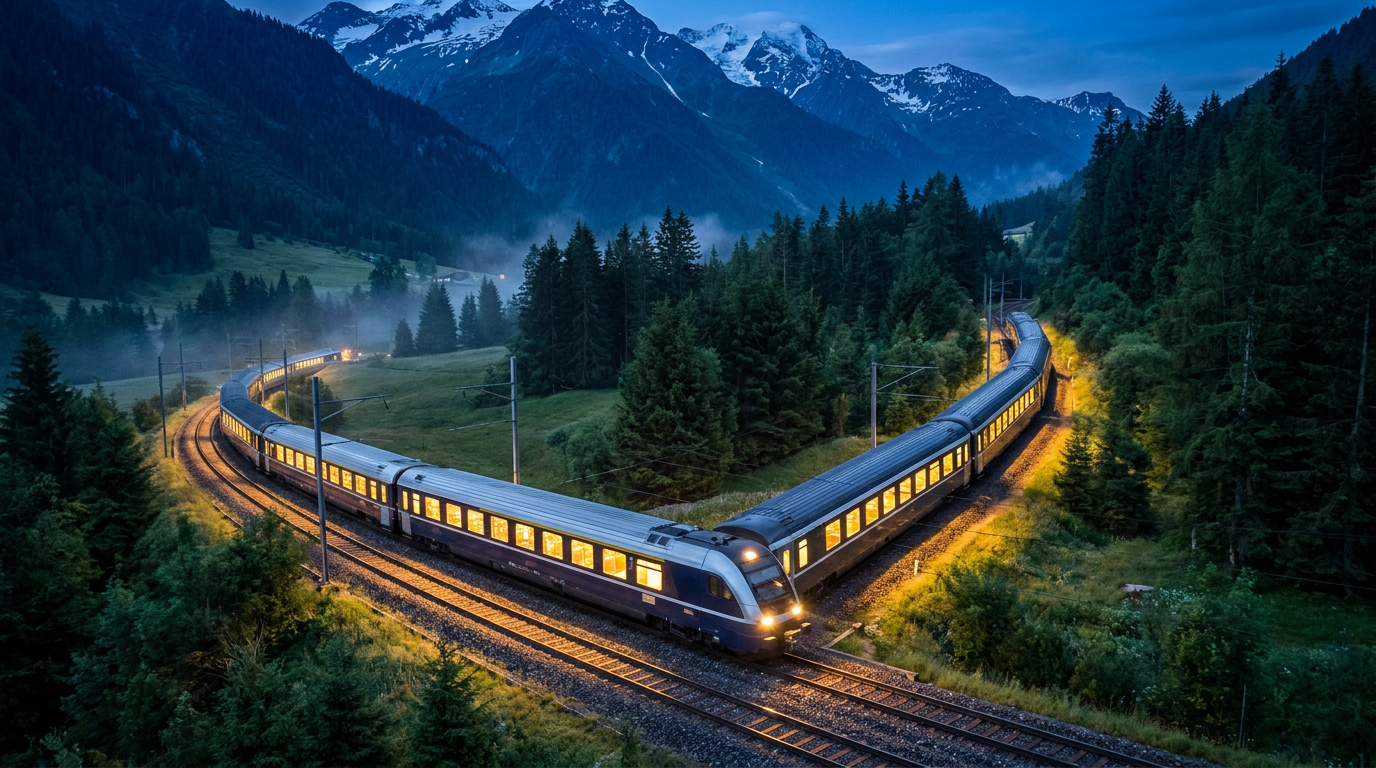
The expansion continues southward in June 2026, when European Sleeper plans to launch an unprecedented route connecting Amsterdam and Brussels to Milan. Following the legendary Simplon Pass, the train will offer passengers spectacular Alpine views at dawn before delivering them to northern Italy.[3]
Other operators are equally aggressive in their 2026 rollouts. May will see the launch of a new Prague-Berlin-Copenhagen connection, linking Central Europe to Scandinavia. Meanwhile, the Adriatic Express is set to return, connecting Warsaw to the Croatian coast across five countries in a single night.[3]
Beyond new routes, the passenger experience is undergoing a radical technological upgrade. ÖBB is aggressively deploying its "new generation" Nightjet trains, which will begin serving the Zurich-Vienna route in June 2026.[2]
Beyond new routes, the passenger experience is undergoing a radical technological upgrade.
These new carriages abandon the cramped, utilitarian designs of the 20th century. They feature Japanese-style capsule mini-cabins for solo travelers, complete with key-card access, wireless charging, and secure luggage lockers, alongside premium sleeper cars equipped with private showers and toilets.[2][4]

The driving force behind this infrastructure boom is a stark environmental reality. According to the European Environment Agency, planes emit an average of 4.84 times more greenhouse gases than trains.[5]
For short-haul routes under 1,500 kilometers, the disparity is even more severe. Because aircraft consume massive amounts of fuel during takeoff and landing, replacing a short flight with an electric train journey can cut a passenger's carbon footprint by up to 90%.[6]

Furthermore, night trains offer a unique "double sustainability" benefit. By combining transportation with accommodation, travelers eliminate the energy consumption and emissions associated with a night in a traditional hotel.[6][7]
Despite the environmental imperative, economics remain a significant hurdle. A comprehensive analysis by Greenpeace revealed that train tickets across Europe were, on average, twice as expensive as flying on the same routes.[5]
This price gap is largely artificial, driven by heavy subsidies for the aviation industry, including tax exemptions on kerosene fuel and zero VAT on international flight tickets. Rail operators, conversely, must pay track access charges and energy taxes.[5][7]
Nevertheless, a growing demographic of travelers is willing to pay the premium. This is fueled by the broader "slow travel" ethos, which prioritizes quality over quantity. Instead of visiting five cities in seven days, the 2026 traveler is increasingly opting to spend a full week immersing themselves in a single region.[4]

This mindset is also intersecting with "cool-cationing"—a climate-driven trend where tourists avoid the extreme summer heat of southern Europe in favor of temperate destinations in Scandinavia, the Alps, and the Baltics, regions naturally suited to scenic rail journeys.[4]
The rail renaissance still faces severe logistical bottlenecks. Cross-border coordination remains notoriously difficult, with differing track gauges, signaling systems, and language requirements for drivers complicating international expansion.[1][7]
A shortage of specialized rolling stock also limits growth. Building new sleeper carriages takes years, and the current manufacturing pipeline is struggling to keep pace with the surging consumer demand for overnight travel.[1]
Despite these friction points, the momentum is undeniable. As 2026 unfolds, the European night train has evolved from a nostalgic novelty into a vital, rapidly expanding pillar of sustainable continental transit.[7]
How we got here
May 2023
European Sleeper launches its inaugural route from Berlin to Brussels, proving the viability of citizen-backed rail.
December 2023
ÖBB introduces its 'new generation' high-tech Nightjet carriages featuring capsule-style mini-cabins.
December 2025
ÖBB discontinues its Paris-Berlin Nightjet service due to subsidy cuts, sparking fears of a stalled renaissance.
March 2026
European Sleeper takes over the Paris-Berlin route, expanding capacity and routing through Brussels.
June 2026
A new overnight route connecting Amsterdam and Brussels to Milan via the Swiss Alps is scheduled to launch.
Viewpoints in depth
Slow Travel Advocates
Travelers and agencies prioritizing immersion, mental well-being, and sustainability over speed.
This camp views the resurgence of rail travel as a necessary cultural correction to the exhaustion of 'checklist tourism.' They argue that the journey should be an integral part of the vacation, allowing travelers to decompress, enjoy the landscape, and arrive at their destination refreshed. For them, the extra time spent on a train is a feature, not a bug, offering a mental reset that airports actively destroy.
Climate & Policy Watchdogs
Environmental groups advocating for systemic shifts to lower-carbon transportation.
Environmental organizations emphasize the stark mathematical reality of transport emissions. They point out that short-haul flights are disproportionately damaging due to the massive fuel burn required for takeoff and landing. This camp strongly advocates for ending aviation subsidies—such as tax-free kerosene—arguing that trains only appear more expensive because the airline industry's environmental costs are heavily subsidized by governments.
Rail Operators & Cooperatives
The companies and citizen groups physically building and running the new networks.
Operators focus on the immense logistical challenges of cross-border rail. They highlight the difficulty of navigating fragmented European rail infrastructure, where different countries use varying track gauges, voltage systems, and signaling technologies. Despite these hurdles, citizen-backed cooperatives like European Sleeper argue that public demand is strong enough to bypass traditional state-run monopolies, proving that the market for overnight rail is highly viable.
What we don't know
- Whether manufacturing pipelines can produce enough new sleeper carriages to meet surging demand.
- If the European Union will implement standardized cross-border ticketing to simplify international rail booking.
- How budget airlines will adjust their pricing strategies as night trains capture more of the short-haul market.
Key terms
- Slow Travel
- A tourism philosophy prioritizing deep connection with local cultures, lower-carbon transport, and longer stays over rapid sightseeing.
- European Sleeper
- A Belgian-Dutch railway cooperative funded by citizen investors that operates cross-border night trains.
- Nightjet
- The sleeper train brand operated by the Austrian Federal Railways (ÖBB), which has spearheaded the modern revival of European night trains.
- Cool-cationing
- A travel trend where tourists seek out cooler climates to escape increasingly extreme summer heatwaves.
Frequently asked
Are sleeper trains more expensive than budget flights?
Often, yes. A Greenpeace study found train tickets can average twice the price of flights due to airline subsidies, though night trains save travelers the cost of a hotel room.
What new sleeper routes are opening in 2026?
Major additions include European Sleeper's Paris-Brussels-Berlin route in March, an Amsterdam-Milan Alpine route in June, and a Prague-Copenhagen connection in May.
How much CO2 does a night train actually save?
Replacing a short-haul flight with an electric train journey can reduce individual carbon emissions by up to 90%, particularly because short flights burn massive amounts of fuel during takeoff and landing.
Sources
Source coverage
7 outlets
3 viewpoints surfaced







[1]The GuardianRail Operators & Cooperatives
European Sleeper steps in to save Paris-Berlin night train route
Read on The Guardian →[2]SBBRail Operators & Cooperatives
New generation of Nightjet trains
Read on SBB →[3]PixidiaSlow Travel Advocates
The 10 night trains you absolutely need to try in 2026
Read on Pixidia →[4]Kiwi.comSlow Travel Advocates
Why Slow Travel Has Become the Defining Trend of 2026
Read on Kiwi.com →[5]Greenpeace UKClimate & Policy Watchdogs
Planes vs Trains: A Europe-wide Analysis
Read on Greenpeace UK →[6]The Man in Seat 61Climate & Policy Watchdogs
Cut your CO2 emissions by up to 90%
Read on The Man in Seat 61 →[7]Factlen Editorial TeamRail Operators & Cooperatives
Synthesis by Factlen editorial team
Read on Factlen Editorial Team →

Every angle. Every day.
Get lifestyle stories with full source coverage and perspective breakdowns delivered to your inbox.