
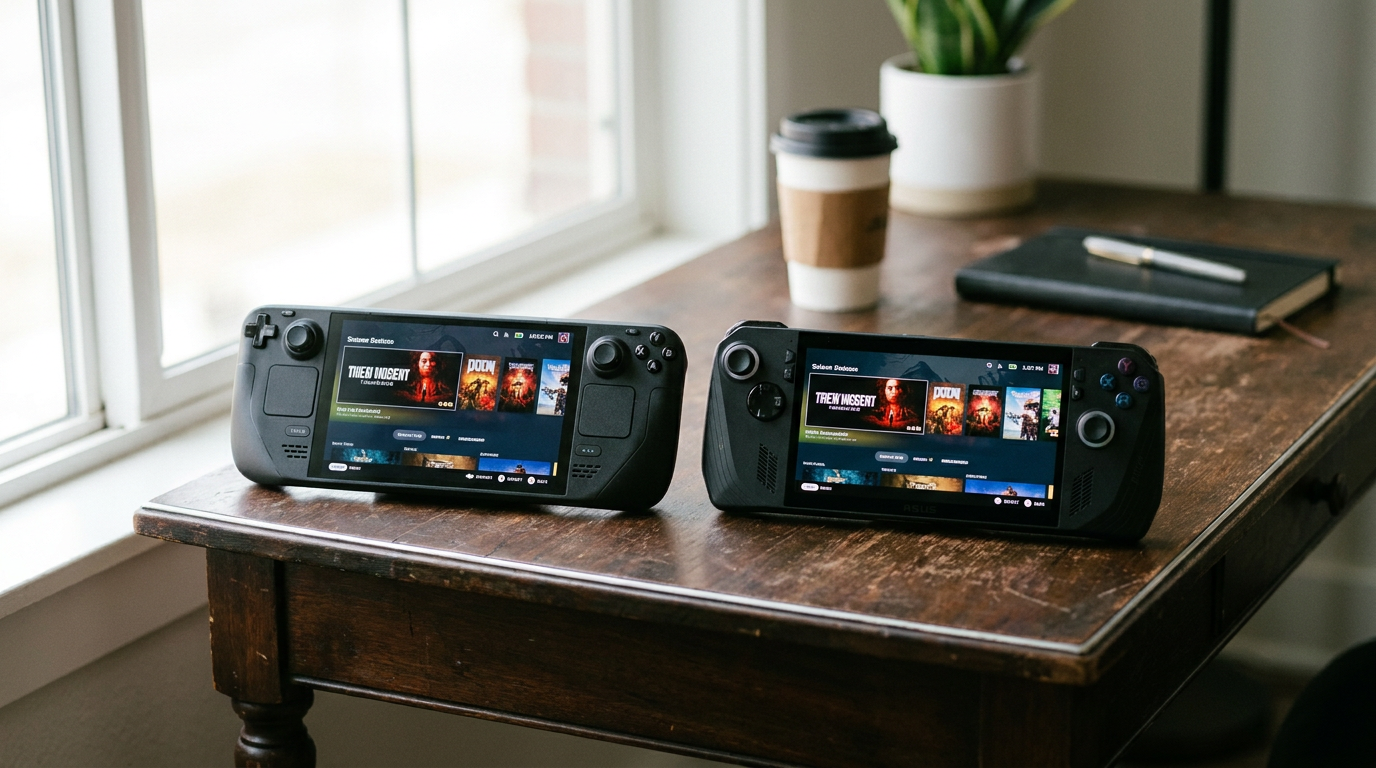
Steam Deck OLED vs. ASUS ROG Ally X: The 2026 Handheld PC Matchup
As the handheld gaming market matures, the choice between Valve's streamlined Steam Deck OLED and the raw Windows-powered performance of the ASUS ROG Ally X defines the modern portable experience. We break down the trade-offs in battery life, display quality, and software to help you decide.
By Factlen Editorial Team
- Steam Ecosystem Loyalists
- Players who value the seamless integration and console-like simplicity of Valve's platform.
- Windows Power Users
- Enthusiasts who demand maximum performance and the freedom to install any software.
- Agnostic Library Gamers
- Gamers who rely heavily on Xbox Game Pass and non-Steam storefronts.
What's not represented
- · Game Developers optimizing for handhelds
- · Cloud Gaming Advocates
Why this matters
Handheld PCs have evolved from niche gadgets into primary gaming consoles. Choosing the right device dictates whether you spend your commute seamlessly playing games or fighting with Windows drivers and battery anxiety.
Key points
- The Steam Deck OLED offers superior battery efficiency for indie games and a seamless, console-like SteamOS interface.
- The ASUS ROG Ally X provides raw Windows 11 performance, natively supporting Xbox Game Pass and demanding AAA titles.
- Valve's handheld features a vibrant 90Hz HDR OLED display, while ASUS opts for a sharper 1080p 120Hz IPS panel.
- The ROG Ally X boasts a massive 80Wh battery, allowing it to outlast the Steam Deck when running heavy games at maximum power.
Handheld gaming in 2026 is no longer a novelty; it is a mature, highly competitive category. At the top of the premium market sit two undisputed champions: the Valve Steam Deck OLED and the ASUS ROG Ally X. While both devices aim to untether PC gaming from the desktop, they represent fundamentally different philosophies about what a portable console should be.[1][6]
The core of this matchup is a trade-off between cohesion and capability. Valve has built a walled garden that prioritizes a seamless, console-like experience, while ASUS offers a miniature Windows 11 laptop packed with the most powerful mobile silicon available. Deciding between them requires looking past the spec sheets and examining how those numbers translate to real-world friction and enjoyment.[3][5]
When analyzing the display technology, the case for the Steam Deck OLED rests entirely on its panel's visual depth. The evidence is immediate: the 7.4-inch screen delivers perfect black levels and vibrant HDR colors that make cinematic games pop. However, the case against it is the 1280 by 800 resolution and 90Hz cap, which can feel slightly soft compared to modern smartphone screens.[2][3]
Conversely, the argument for the ASUS ROG Ally X display centers on sharpness and speed. It features a 7-inch 1080p IPS panel with a 120Hz refresh rate and variable refresh rate support. The evidence shows that for fast-paced competitive shooters or racing games, the Ally X provides a noticeably smoother and crisper image, eliminating screen tearing even when frame rates fluctuate.[3][4]

In the performance arena, the case for the ROG Ally X is built on brute force. ASUS equipped the device with the AMD Ryzen Z1 Extreme processor and a massive 24 gigabytes of fast LPDDR5X RAM. The evidence of this power is clear in benchmark testing, where the Ally X consistently pushes higher frame rates in demanding AAA titles, especially when plugged in and running at its maximum 30-watt thermal design power.[4][5]
The case against the Steam Deck's performance is its aging custom Zen 2 APU and 16 gigabytes of RAM. While Valve's tight optimization allows it to punch above its weight class, the evidence shows it struggles to maintain 30 frames per second in the newest, most demanding releases unless settings are drastically lowered. It simply cannot match the raw computational ceiling of the Ally X.[2][4]
The case against the Steam Deck's performance is its aging custom Zen 2 APU and 16 gigabytes of RAM.
However, the software experience flips the script. The argument for the Steam Deck is its custom SteamOS interface. The evidence of its superiority lies in its reliability: games suspend and resume instantly with the press of a button, shader caches are pre-downloaded for smooth gameplay, and users never have to hunt for driver updates or navigate a desktop interface with a joystick.[1][5]
The case against the ROG Ally X is Windows 11. While ASUS has vastly improved its Armoury Crate software to act as a console-like frontend, the underlying operating system constantly reminds you that it is a PC. The evidence of this friction includes occasional sleep-mode failures, background Windows updates draining the battery, and the general clunkiness of using a touchscreen to navigate desktop menus.[3][5]
Yet, that same Windows environment is also the Ally X's greatest strength. The case for the ASUS handheld is total platform freedom. The evidence is native, offline access to PC Game Pass, the Epic Games Store, and anti-cheat software required by popular multiplayer games like Call of Duty and Fortnite—titles that simply will not boot on the Linux-based SteamOS without extensive hacking.[4][6]

Battery life presents the most nuanced trade-off in this comparison. The argument for the ROG Ally X is its massive 80-watt-hour battery, which is exactly double the capacity of the original model. The evidence shows that when playing heavy AAA games at high wattage, the Ally X outlasts the Steam Deck, providing over two hours of runtime where Valve's machine might die in 90 minutes.[3][4]
But the case for the Steam Deck OLED's battery life is its unmatched efficiency at lower power limits. Thanks to its 50-watt-hour battery and highly optimized APU, the evidence reveals that the Deck can stretch its runtime to an astonishing six to eight hours when playing lightweight indie games or emulating older consoles. The Ally X, burdened by Windows overhead, struggles to match that low-wattage marathon endurance.[2][3]
Ergonomics and inputs also divide the two devices. The Steam Deck is physically larger but distributes its weight perfectly, offering deep grips and dual trackpads that are essential for playing mouse-heavy strategy games. The Ally X is denser and features premium Hall effect joysticks that are immune to stick drift, appealing heavily to players who prefer a traditional Xbox controller layout.[2][3]

Ultimately, the Steam Deck OLED fits well when you want a frictionless, pick-up-and-play experience, value a stunning HDR display, and primarily play games from your existing Steam library. It does not fit when your favorite games rely on aggressive anti-cheat software or when you want to natively download titles from Xbox Game Pass.[1][5]
The ASUS ROG Ally X fits well when you demand maximum portable performance, want the flexibility to install any Windows application, and do not mind occasionally tinkering with settings to optimize your experience. It does not fit when you are looking for console-like simplicity or when budget is your primary concern, as its premium hardware commands a significantly higher price tag.[1][4]
How we got here
February 2022
Valve launches the original Steam Deck, proving the viability of the modern premium handheld PC market.
June 2023
ASUS releases the original ROG Ally, introducing a powerful Windows-based alternative with a 120Hz screen.
November 2023
Valve releases the Steam Deck OLED, featuring a vastly improved HDR display, better battery life, and refined ergonomics.
July 2024
ASUS launches the ROG Ally X, heavily upgrading the battery capacity to 80Wh and increasing the RAM to 24GB.
Early 2026
Both devices remain the dominant top-tier choices as the handheld gaming category reaches full maturity.
Viewpoints in depth
Console Purists
Gamers who prioritize a seamless, frictionless experience over raw graphical power.
For this camp, the handheld is a refuge from the complexities of PC gaming. They argue that a portable device should wake from sleep instantly, manage its own updates quietly, and never require a keyboard or mouse to navigate a launcher. To them, the Steam Deck's SteamOS is the gold standard, proving that tight software optimization matters far more than having the fastest processor on the market.
Windows Power Users
Enthusiasts who want the full flexibility and performance of a desktop PC in their hands.
Power users view walled gardens as a limitation. They argue that if you are paying premium prices for portable hardware, you should be able to run any application, install any mod, and push frame rates as high as the silicon allows. For this group, the ROG Ally X's Z1 Extreme chip and open Windows 11 environment justify the occasional software friction, as it allows them to play demanding AAA titles that the Steam Deck simply cannot handle.
Agnostic Library Gamers
Players whose game collections are spread across multiple storefronts and subscription services.
This perspective prioritizes access above all else. Gamers heavily invested in Xbox Game Pass, the Epic Games Store, or titles with strict anti-cheat software (like Call of Duty or Destiny 2) find the Steam Deck's Linux-based OS too restrictive. They champion devices like the Ally X because it natively supports every PC storefront without requiring third-party workarounds, streaming apps, or complex dual-boot configurations.
What we don't know
- How soon Valve will announce a true next-generation 'Steam Deck 2' with upgraded silicon.
- Whether Microsoft will eventually release a dedicated, lightweight 'Windows Handheld Mode' to solve current OS friction.
Key terms
- APU
- Accelerated Processing Unit, a single chip that combines both the central processor (CPU) and graphics processor (GPU), commonly used in handhelds.
- VRR
- Variable Refresh Rate, a display technology that syncs the screen's refresh rate with the game's frame rate to eliminate visual tearing and stuttering.
- TDP
- Thermal Design Power, a measurement in watts that dictates how much power the processor is allowed to draw, directly impacting both performance and battery life.
- SteamOS
- A custom, Linux-based operating system developed by Valve specifically for the Steam Deck to provide a console-like user interface.
Frequently asked
Can the Steam Deck play Xbox Game Pass games?
Not natively. You can stream Game Pass titles via the cloud on a Steam Deck, but downloading them directly requires installing Windows, whereas the ROG Ally X supports them out of the box.
Does the ROG Ally X have an OLED screen?
No. The ROG Ally X uses a 1080p IPS LCD panel. While it lacks the perfect blacks of an OLED, it offers a sharper resolution and a faster 120Hz refresh rate.
Which handheld has better battery life?
It depends on the game. The Steam Deck OLED is more efficient and lasts longer when playing lightweight indie games, while the ROG Ally X's massive 80Wh battery allows it to outlast the Deck when playing demanding AAA titles.
Sources
Source coverage
6 outlets
3 viewpoints surfaced






[1]Tom's HardwareWindows Power Users
Best gaming handhelds 2026
Read on Tom's Hardware →[2]Rock Paper ShotgunSteam Ecosystem Loyalists
Asus ROG Ally X vs Steam Deck OLED
Read on Rock Paper Shotgun →[3]Tom's GuideAgnostic Library Gamers
Asus ROG Ally X vs Steam Deck OLED: Which is better?
Read on Tom's Guide →[4]Pocket-lintWindows Power Users
ROG Ally X vs Steam Deck OLED
Read on Pocket-lint →[5]Pocket TacticsSteam Ecosystem Loyalists
Steam Deck OLED vs ROG Ally X
Read on Pocket Tactics →[6]ViceAgnostic Library Gamers
Which Gaming Handheld Should You Buy in 2026?
Read on Vice →

Every angle. Every day.
Get shopping stories with full source coverage and perspective breakdowns delivered to your inbox.