
SpaceX Debuts on Nasdaq in Record-Shattering $75 Billion IPO
SpaceX has launched the largest initial public offering in history, targeting a $1.75 trillion valuation as it begins trading on the Nasdaq. The S-1 filings reveal massive revenue growth driven by Starlink, alongside significant operating losses and intense debate over its speculative AI valuation.
By Factlen Editorial Team
- Growth & Retail Investors
- Investors who view SpaceX as a monopolistic tech platform combining space, internet, and AI.
- Fundamental Skeptics
- Financial analysts who argue the $135 IPO price is detached from the company's current financial reality.
- Market Structure Analysts
- Regulators and passive fund managers concerned by the mechanics of the listing and index inclusion.
What's not represented
- · Competitors in the legacy aerospace sector
- · Retail investors who were denied allocation
Why this matters
This IPO fundamentally alters the landscape of public equity markets and space exploration. By raising $75 billion, SpaceX secures an unprecedented capital runway to fund its Mars colonization and AI ambitions, while forcing millions of passive investors to gain exposure to its highly volatile, Musk-controlled governance structure.
Key points
- SpaceX has launched the largest IPO in history, raising $75 billion at a $1.75 trillion valuation.
- The company's S-1 filing reveals $18.7 billion in 2025 revenue, driven largely by its Starlink satellite internet business.
- Despite strong revenue growth, SpaceX posted a $4.9 billion net loss in 2025 due to heavy investments in AI and space infrastructure.
- Analysts warn the valuation is highly speculative, while regulators have raised concerns over Elon Musk retaining 85% of shareholder voting power.
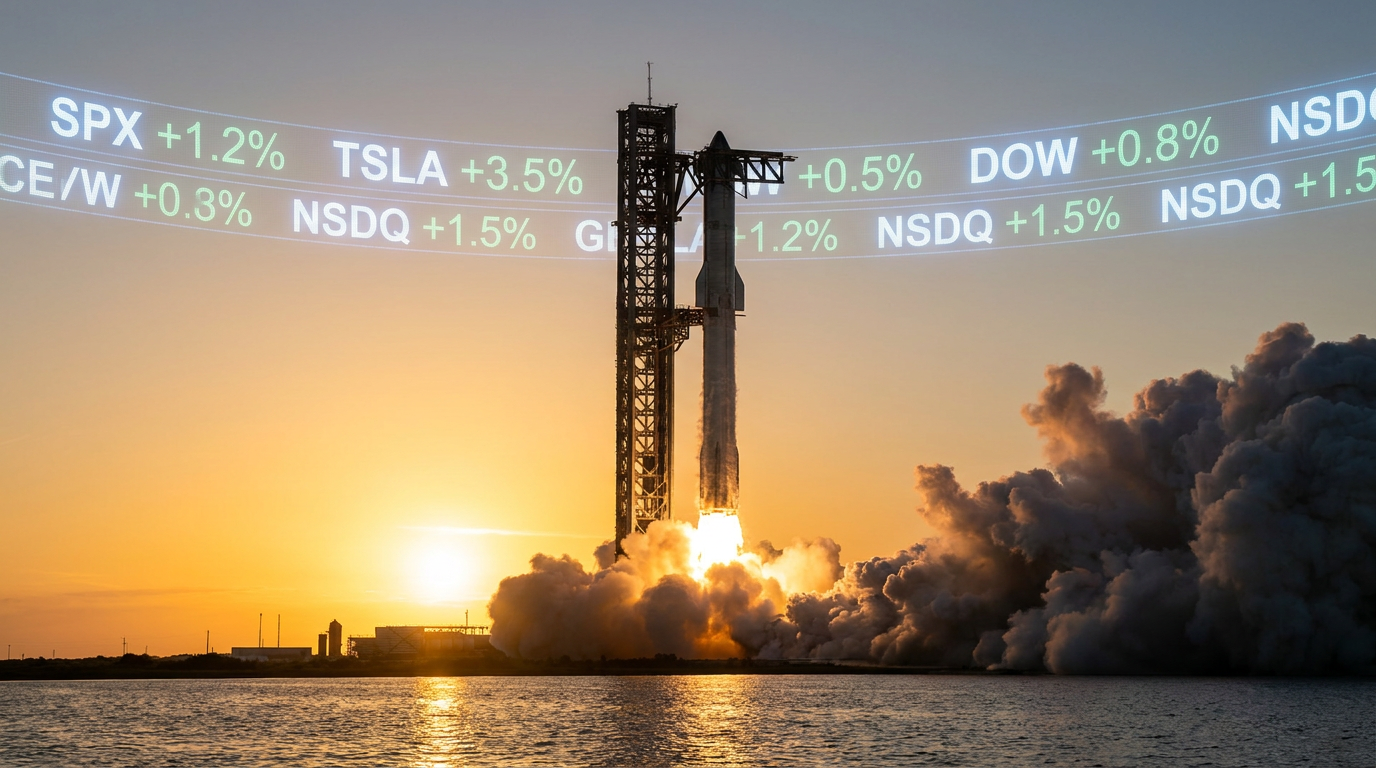
SpaceX has officially debuted on the Nasdaq under the ticker SPCX, executing the largest initial public offering in global financial history. Pricing its shares at a fixed $135, the aerospace and communications conglomerate aims to raise $75 billion. This staggering capital raise dwarfs the previous global record of $29.4 billion, which was set by the Saudi Arabian state oil company Saudi Aramco during its 2019 public debut. By bypassing the traditional bookbuilding process that narrows a price range over several weeks, SpaceX handed the market a definitive number and moved straight to allocation, signaling immense confidence in its underlying demand.[3][4]
At the $135 per share offering price, the listing implies a massive market capitalization of approximately $1.75 trillion to $1.78 trillion. This valuation immediately positions SpaceX as one of the most valuable publicly traded entities on Earth on its very first day of trading. It trails only a handful of established, highly profitable technology giants such as Apple, Microsoft, and Nvidia. The sheer scale of this debut means that SpaceX is not merely entering the public markets; it is instantly becoming a foundational pillar of the major United States equity indices.[2][5]
Evidence of investor appetite suggests that demand for the shares vastly outstripped the available supply. According to data circulated among underwriting banks and reported by financial media, the institutional and retail order book exceeded $250 billion. This means the offering was oversubscribed by more than three times the $75 billion the company actually sought to raise. Major asset managers moved aggressively to secure their positions, with BlackRock alone reportedly placing an order for at least $5 billion in shares—an amount nearly equal to the entirety of the year's previous largest tech IPO.[2][3]

In an unprecedented structural move for an offering of this magnitude, Elon Musk and the underwriting syndicate, led by Goldman Sachs, allocated up to 30 percent of the IPO float directly to retail investors. This represents roughly three times the standard 5 to 10 percent retail allocation typically seen in mega-cap public offerings. As a result, individual investors submitted orders totaling more than $100 billion. This massive retail participation broadens access to a company that has long been shielded in private markets, but it also introduces the potential for heightened volatility in early trading sessions.[3][4]
The core evidence justifying SpaceX's astronomical valuation rests within its S-1 prospectus, which was publicly filed with the Securities and Exchange Commission in late May. The document provided Wall Street with its first transparent look into the conglomerate's internal finances. The filings reveal that SpaceX generated $18.7 billion in total revenue for the full year of 2025, representing a robust 33 percent year-over-year increase. On an adjusted EBITDA basis—which strips out non-cash expenses—the company reported a profit of $6.6 billion, painting a picture of a rapidly scaling industrial powerhouse.[4][7]
However, the evidence regarding the company's true bottom-line profitability is highly contested and presents a starkly different narrative. Under Generally Accepted Accounting Principles (GAAP), the S-1 reveals that SpaceX operated at a massive deficit, posting a net loss of $4.9 billion in 2025. This trend of heavy losses appears to be accelerating into the current year, with the company reporting a $4.28 billion net loss in just the first quarter of 2026. These figures highlight the immense capital burn required to sustain the company's multi-front technological ambitions.[2][4][7]
These massive GAAP losses are primarily driven by aggressive capital expenditures across the company's various divisions. The financial filings detail billions of dollars spent on depreciation for the rapidly expanding Starlink satellite constellation, alongside heavy stock-based compensation required to retain its highly specialized engineering workforce. Furthermore, the company is executing massive infrastructure build-outs for its artificial intelligence subsidiary, xAI. This AI division is reportedly burning through $2.5 billion per quarter as it races to secure advanced compute clusters, develop next-generation foundational models, and lay the groundwork for futuristic orbital data center capabilities.[4][6]
These massive GAAP losses are primarily driven by aggressive capital expenditures across the company's various divisions.
Despite the overall corporate losses, the evidence strongly supports the thesis that Starlink is the current financial engine keeping the conglomerate afloat. The satellite internet network accounted for $11.4 billion—or roughly 61 percent—of the company's total revenue in 2025. More importantly, Starlink's operating income reportedly surged by 120 percent year-over-year as global subscriber growth accelerated and terminal manufacturing costs decreased. For many institutional investors, Starlink's trajectory toward becoming a global telecommunications monopoly is the primary justification for participating in the IPO.[4][6]

Yet, a $1.75 trillion valuation cannot be mathematically justified by aerospace and broadband revenues alone. Pricing the company at roughly 94 times its trailing sales means investors are paying a massive premium for SpaceX's total addressable market claims. In its prospectus, the company estimates this total market at an astonishing $28.5 trillion. This figure relies heavily on a projected $2.4 trillion market for AI infrastructure, alongside the long-term commercialization of deep space, including lunar bases and the eventual colonization of Mars.[2][3][6]
Independent financial analysts argue that the evidence simply does not support the $135 asking price, warning of severe downside risk. Analysts at Morningstar calculated a fair value estimate of just $63 per share, explicitly warning clients of a major disconnect between market expectations and the company's underlying fundamentals. They advise that retail and institutional buyers alike should sit out the initial frenzy and wait for a more attractive entry point once the initial hype subsides and the lock-up periods expire.[2]
The core of this skeptical argument is that the current valuation relies almost entirely on untested technologies and unprecedented execution. While analysts broadly acknowledge Starlink's proven strength and the Falcon rocket family's dominance in orbital launch, they caution that the artificial intelligence business and deep-space colonization goals remain highly speculative. Pricing these futuristic endeavors as if they are already successful businesses makes the current entry price exceptionally risky for public market investors who are accustomed to valuing companies on current cash flows.[2]

Beyond the financial metrics, the S-1 filing also exposed significant structural governance risks that have alarmed regulators. The share structure dictates that Elon Musk retains 85 percent of the shareholder voting power, despite holding only about 42 percent of the underlying equity. This extreme concentration of control prompted Senator Elizabeth Warren to petition the SEC for a delay in the listing. She argued that this structure gives Musk an unprecedented level of power over public capital, leaving traditional shareholders with significantly fewer rights and protections than they would have in a standard public corporation.[3][4]
A secondary, yet highly influential, driver of the IPO's pricing momentum is the mechanical structure of modern passive investing. Major index providers, including Nasdaq, have made the controversial decision to fast-track SpaceX's inclusion into their headline benchmarks. To accommodate the sheer size of the listing, index providers waived standard minimum float requirements and the traditional 'seasoning' periods that usually require a company to trade publicly for several months before being added to major indices. This regulatory flexibility highlights how deeply index providers desire to capture the trading volume of the world's most valuable aerospace firm.[5]
Because of these accelerated inclusion timelines, passive index funds and exchange-traded funds are effectively forced to replicate SpaceX's massive weight in the index almost immediately. Market structure analysts note that this dynamic creates intense, price-agnostic liquidity demand. When passive funds are mandated to buy millions of shares regardless of the underlying valuation, early trading is driven more by mechanical supply-and-demand imbalances than by fundamental price discovery. This forced buying acts as a structural floor for the stock price in the near term, regardless of the company's actual earnings reports.[5]

The ultimate test of SpaceX's public market viability will unfold over its first four quarters of mandatory SEC reporting. It remains entirely uncertain whether the company can successfully transition its massive capital expenditures in artificial intelligence and the Starship program into GAAP profitability. Furthermore, it is unknown how the unusually high 30 percent retail allocation will behave during broader market downturns, or if the extreme concentration of voting power will lead to conflicts between Musk's multi-planetary ambitions and Wall Street's demand for quarterly returns.[2][4]
For now, the successful execution of the $75 billion raise provides SpaceX with an unparalleled capital runway that no private funding round could ever match. Whether the company utilizes that capital to finalize its orbital internet monopoly, scale its artificial intelligence compute, or actually establish a human presence on Mars, the IPO itself is a watershed moment. By bringing the modern space economy to the public markets at this scale, SpaceX has permanently altered the composition and future trajectory of global equities.[1][6]
How we got here
April 2026
SpaceX confidentially files its draft registration statement with the SEC.
May 20, 2026
The company publicly releases its S-1 prospectus, revealing internal finances for the first time.
June 4, 2026
SpaceX launches an accelerated roadshow, bypassing the traditional price-range bookbuilding process.
June 11, 2026
Shares are officially priced at a fixed $135, locking in a record-breaking $75 billion raise.
June 12, 2026
SpaceX begins public trading on the Nasdaq under the ticker SPCX.
Viewpoints in depth
Growth & Retail Investors
Investors who view SpaceX as a monopolistic tech platform combining space, internet, and AI.
This camp argues that traditional valuation metrics like price-to-sales are irrelevant for a company building multi-planetary infrastructure. They point to Starlink's 120% operating income growth and the $28.5 trillion total addressable market outlined in the S-1. For these investors, the $1.75 trillion valuation is justified by the conglomerate's potential to dominate orbital data centers, global broadband, and next-generation AI compute.
Fundamental Valuation Skeptics
Financial analysts who argue the $135 IPO price is detached from the company's current financial reality.
Skeptics, including analysts at Morningstar, emphasize the company's $4.9 billion net loss in 2025 and its staggering 94x trailing sales multiple. They argue that while the rocket and satellite businesses are proven, the artificial intelligence and Mars colonization premiums are entirely speculative. This camp believes the stock is priced for flawless execution over the next decade, leaving no margin of safety for public market buyers.
Market Structure & Governance Critics
Regulators and passive fund managers concerned by the mechanics of the listing.
This perspective focuses on the structural risks of the IPO. Critics point to Elon Musk's retention of 85% voting power as a severe corporate governance risk that strips public shareholders of traditional oversight. Furthermore, market structure analysts warn that the waiver of standard index inclusion rules forces passive ETFs to buy the stock blindly, creating artificial price inflation driven by mechanical demand rather than fundamental value.
What we don't know
- Whether SpaceX can transition its massive capital expenditures in AI and the Starship program into GAAP profitability in the near term.
- How the unusually high 30% retail investor allocation will impact the stock's volatility during its first few months of trading.
- If the SEC will take any future regulatory action regarding the extreme concentration of voting power held by Elon Musk.
Key terms
- Initial Public Offering (IPO)
- The process by which a private company offers shares to the public for the first time, transitioning to a publicly traded entity.
- S-1 Prospectus
- A comprehensive registration document required by the SEC that details a company's business model, financials, and risks before an IPO.
- Free Float
- The portion of a company's shares that are available for trading by the general public, excluding locked-in shares held by insiders.
- Passive Index Fund
- An investment fund designed to mechanically track the performance of a specific market benchmark, requiring it to buy shares of companies added to that index.
- Adjusted EBITDA
- A measure of a company's operating profitability that strips out non-cash expenses like depreciation and stock-based compensation.
Frequently asked
How much is SpaceX worth after the IPO?
At the IPO price of $135 per share, SpaceX is valued at approximately $1.75 trillion, making it one of the most valuable companies in the world.
Is SpaceX currently profitable?
No. While it generated $18.7 billion in revenue in 2025, heavy investments in infrastructure and AI resulted in a net loss of $4.9 billion last year.
Can individual retail investors buy shares?
Yes. In an unusual move, up to 30% of the IPO shares were allocated directly to retail investors, resulting in over $100 billion in retail demand.
Why did Elizabeth Warren want to delay the IPO?
Senator Warren raised concerns over corporate governance, specifically that Elon Musk retains 85% of the voting power, which she argued gives him unprecedented control over public investors.
Sources
Source coverage
7 outlets
3 viewpoints surfaced







[1]BBCMarket Structure Analysts
Watch: Three things to know about SpaceX's stock market debut
Read on BBC →[2]The GuardianFundamental Skeptics
Analysts say IPO that could make Elon Musk the world's first trillionaire has a 'major disconnect' on price
Read on The Guardian →[3]ForbesGrowth & Retail Investors
SpaceX Files For What Could Be Largest IPO In History
Read on Forbes →[4]Capital.comFundamental Skeptics
SpaceX IPO Date, Price, and Trading Strategy
Read on Capital.com →[5]CME GroupMarket Structure Analysts
The SpaceX Mega-IPO: Why Index Choice Matters
Read on CME Group →[6]Investing.comGrowth & Retail Investors
No Ordinary Space Company: SpaceX IPO
Read on Investing.com →[7]U.S. Securities and Exchange Commission
Form S-1 Registration Statement: Space Exploration Technologies Corp.
Read on U.S. Securities and Exchange Commission →

More in science
See all 55 stories →Targeted Protein Degradation
Scientists Develop 'Molecular Glue' to Destroy Undruggable Cancer Protein
6 sources

Neural Circuits
How the Brain Physically Stores Recent History to Shape Immediate Decisions
5 sources

Interoception
The 'Sixth Sense' Transforming Mental Health: How Interoception Rewires the Brain
8 sources

Neutrino Physics
JUNO Underground Observatory Releases First Data, Achieving Record Precision on 'Ghost Particles'
6 sources

Every angle. Every day.
Get science stories with full source coverage and perspective breakdowns delivered to your inbox.