
SpaceX Completes Record $75 Billion IPO, Making Elon Musk the World's First Trillionaire
SpaceX shares surged 19% in their public market debut, cementing the largest initial public offering in history and pushing founder Elon Musk's net worth past the $1 trillion mark.
By Factlen Editorial Team
- Space Industry Bulls
- View the IPO as a watershed moment that validates the commercial space economy and will recycle capital into new aerospace startups.
- Economic Justice Advocates
- Argue that the creation of the world's first trillionaire represents a failure of tax policy and a dangerous concentration of wealth.
- Market Skeptics
- Question the $2.2 trillion valuation, pointing to the company's heavy cash burn and arguing the IPO price was set without traditional market consultation.
What's not represented
- · Retail investors priced out of the IPO
- · Competitors in the legacy aerospace sector
Why this matters
The largest public offering in history validates the commercial space industry as a major pillar of the global economy. It also creates an unprecedented concentration of individual wealth, sparking new debates over taxation and economic inequality.
Key points
- SpaceX raised a record $75 billion in its initial public offering, pricing shares at $135.
- The stock surged 19% on its first day of trading, giving the company a $2.2 trillion market capitalization.
- The massive valuation pushed founder Elon Musk's net worth past $1.14 trillion, making him history's first trillionaire.
- The milestone has drawn sharp criticism from economic justice advocates calling for aggressive wealth taxes.
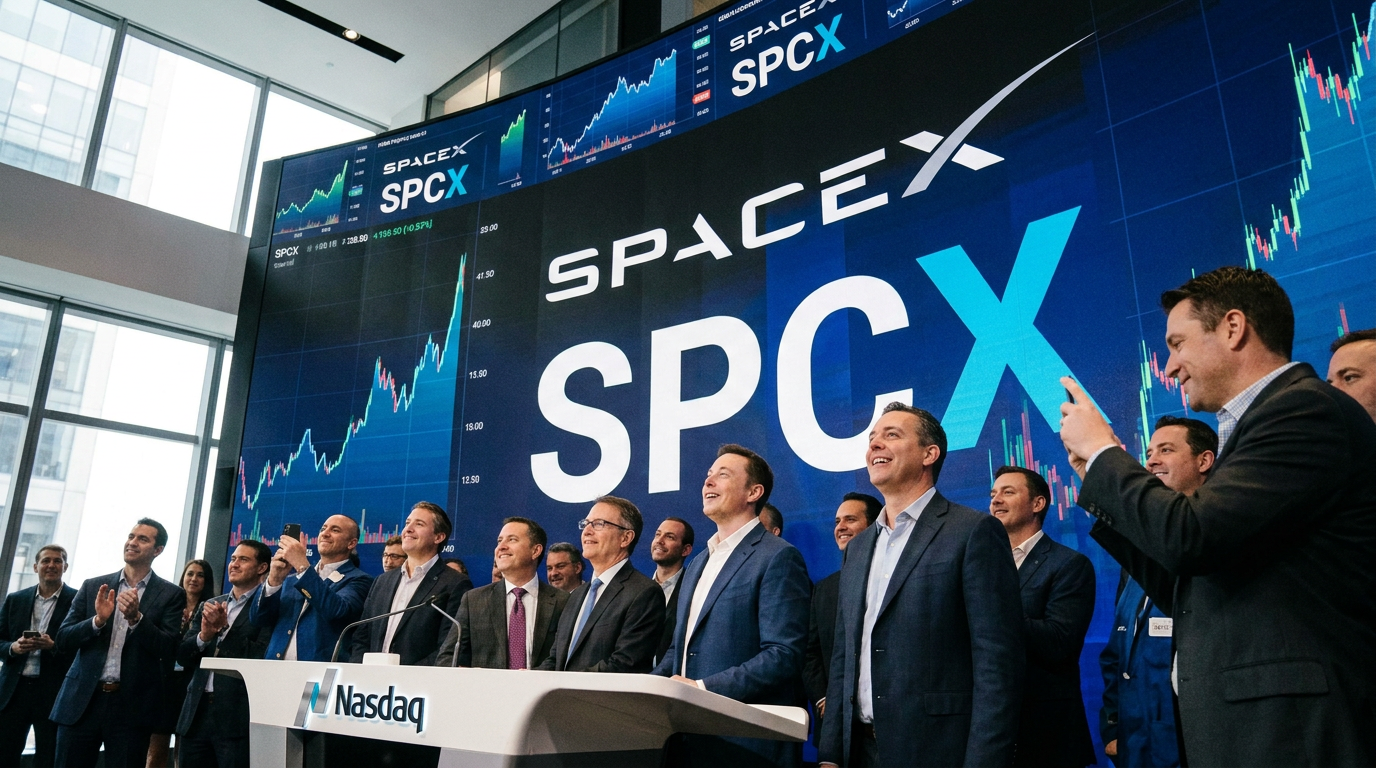
SpaceX has officially entered the public markets, shattering records with a $75 billion initial public offering that instantly transformed the aerospace giant into one of the world's most valuable companies. Trading under the ticker symbol SPCX on the Nasdaq, the company priced its offering at $135 per share, easily surpassing the previous IPO record set by Saudi Aramco in 2019.[2][5][7]
The stock surged immediately upon its Friday debut, climbing 19% to close at $160.95. The first-day pop pushed SpaceX's total market capitalization to approximately $2.2 trillion, reflecting massive institutional and retail demand for a piece of the commercial space economy.[3][5]
The blockbuster listing also triggered a historic milestone in personal wealth: SpaceX founder and CEO Elon Musk became the world's first trillionaire. Musk, who owns roughly 42% of the company, saw his net worth eclipse the $1 trillion mark within minutes of the opening bell.[2][3][7]

By the time markets closed, Musk's combined holdings across SpaceX, Tesla, and his other ventures placed his estimated net worth at $1.14 trillion. To put the figure in perspective, Musk is now worth more than the world's next four richest people combined, and his fortune rivals the gross domestic product of nations like the Netherlands.[1][2]
The sheer scale of the IPO has electrified the broader aerospace sector. Venture capitalists and industry analysts are calling the listing space's "Netscape moment"—a watershed event that validates the commercial space industry to Wall Street and is expected to open the floodgates for investment in orbital infrastructure.[4]

The sheer scale of the IPO has electrified the broader aerospace sector.
Beyond the psychological boost, the IPO is expected to function as a massive wealth-recycling event. Early SpaceX employees and investors who saw their stakes turn into billions are anticipated to reinvest that capital into the next generation of space startups, potentially accelerating the entire industry's growth.[3][4][7]
Yet the astronomical valuation has sparked intense debate among financial analysts. Skeptics point to SpaceX's history of heavy cash burn—including an estimated $8.7 billion over the 15 months ending in March 2026—and argue that the $135 IPO price was set without traditional market consultation, leaving the stock potentially overvalued.[1][7]
Bulls counter that traditional aerospace metrics fail to capture SpaceX's expanding business model. Beyond its dominant rocket launch business, investors are pricing in the rapid growth of the Starlink satellite internet constellation and the company's emerging plans to build orbital data centers to power artificial intelligence.[1][4]
The proceeds from the $75 billion raise are earmarked for SpaceX's most ambitious projects. Musk has stated the capital will fund the continued development of the Starship megarocket, the expansion of the Starlink network, and the company's ultimate goal of establishing a human settlement on Mars.[1][5]

Meanwhile, the trillionaire milestone has reignited fierce debates over global wealth inequality. Progressive lawmakers and economic justice advocates seized on the IPO to call for aggressive wealth taxes, arguing that such extreme concentration of capital is detrimental to democratic systems.[2][6]
Oxfam America released an analysis noting that Musk's fortune now exceeds the combined wealth of the poorest 46% of the global population—roughly 3.8 billion people. Advocates pointed out that a 10% tax on his net worth could theoretically fund global extreme poverty eradication efforts for an entire year.[2][6]
Despite the political friction and valuation debates, the successful listing marks a triumphant chapter for a company that nearly went bankrupt in 2008. From a scrappy startup in an El Segundo warehouse to a $2.2 trillion public juggernaut, SpaceX has definitively proven that the commercialization of space is no longer science fiction.[5]
How we got here
2002
Elon Musk founds SpaceX with the goal of reducing space transportation costs and colonizing Mars.
2008
After three failed attempts, SpaceX successfully launches the Falcon 1 rocket, securing a crucial NASA contract that saves the company from bankruptcy.
2020
SpaceX becomes the first private company to send human astronauts to the International Space Station.
May 2025
SpaceX files confidential paperwork with the SEC signaling its intent to go public.
June 12, 2026
SpaceX debuts on the Nasdaq, raising $75 billion in the largest IPO in history.
Viewpoints in depth
The Aerospace Ecosystem
Industry insiders view the IPO as a catalyst for future space innovation.
Venture capitalists and aerospace executives argue that SpaceX's public debut is the ultimate validation of the commercial space sector. By providing a massive liquidity event for early investors and employees, the IPO is expected to free up billions of dollars that will likely be reinvested into a new wave of space startups, creating a robust ecosystem around orbital infrastructure, satellite manufacturing, and space-based services.
The Valuation Debate
Financial analysts are divided on whether SpaceX's $2.2 trillion market cap is justified.
While bulls point to SpaceX's near-monopoly on commercial rocket launches and the explosive growth potential of its Starlink network, skeptics warn that the company is priced for perfection. Critics highlight SpaceX's significant ongoing cash burn and the immense capital requirements of its Starship and Mars colonization programs, arguing that the $135 IPO price was set aggressively without the traditional price-discovery mechanisms of the open market.
The Inequality Backlash
Economic justice advocates point to Musk's trillionaire status as a symptom of a broken economic system.
Organizations like Oxfam and progressive lawmakers have used the IPO to highlight the widening gap between the ultra-wealthy and the working class. They argue that a system allowing one individual to amass a fortune greater than the combined wealth of the poorest 3.8 billion people on Earth is fundamentally flawed, using the milestone to renew calls for aggressive wealth taxes and stricter regulations on corporate monopolies.
What we don't know
- Whether SpaceX can maintain its $2.2 trillion valuation given its high cash burn and ambitious capital expenditure plans.
- How the massive influx of liquid capital from early SpaceX employees will reshape the broader venture capital landscape.
Key terms
- Initial Public Offering (IPO)
- The process by which a private company offers shares of its stock to the public for the first time.
- Market Capitalization
- The total dollar market value of a company's outstanding shares of stock, calculated by multiplying the stock price by the total number of shares.
- Starlink
- SpaceX's satellite internet constellation, designed to provide high-speed broadband coverage globally.
- Orbital Data Center
- A proposed concept to place computer servers in space, utilizing the cold vacuum for cooling and solar energy for power.
Frequently asked
How much did SpaceX raise in its IPO?
SpaceX raised a record $75 billion by selling 555 million shares at $135 each.
What is SpaceX's stock ticker?
SpaceX trades on the Nasdaq under the ticker symbol SPCX.
How did Elon Musk become a trillionaire?
Musk owns roughly 42% of SpaceX. When the company's valuation surpassed $2 trillion on its first day of trading, the value of his stake combined with his Tesla holdings pushed his net worth over $1 trillion.
What will SpaceX do with the money?
The company plans to use the capital to fund its Starship megarocket, expand the Starlink satellite internet network, and pursue its goal of establishing a human colony on Mars.
Sources
Source coverage
7 outlets
3 viewpoints surfaced







[1]The Washington PostMarket Skeptics
Elon Musk is the world's first trillionaire (on paper) thanks to the SpaceX IPO
Read on The Washington Post →[2]CBS NewsEconomic Justice Advocates
Elon Musk becomes the world's first trillionaire with SpaceX's IPO
Read on CBS News →[3]Business InsiderSpace Industry Bulls
SpaceX IPO: SPCX stock rises 19% in its first day of trading, cementing Musk as the first-ever trillionaire
Read on Business Insider →[4]Payload SpaceSpace Industry Bulls
VCs Predict the SpaceX IPO Will Lift the Entire Industry
Read on Payload Space →[5]Los Angeles TimesSpace Industry Bulls
SpaceX shares rise 19% in stock market debut after historic IPO
Read on Los Angeles Times →[6]Common DreamsEconomic Justice Advocates
'Trillionaires Shouldn't Exist': Obscene Musk Milestone Spurs Calls for Aggressive Wealth Tax
Read on Common Dreams →[7]QuartzMarket Skeptics
Elon Musk becomes first trillionaire as SpaceX IPO debuts
Read on Quartz →

Every angle. Every day.
Get business stories with full source coverage and perspective breakdowns delivered to your inbox.