
Smart Ring vs. Smartwatch: Which Health Tracker Should You Buy?
As smart rings challenge the dominance of smartwatches, choosing the right wearable comes down to whether you want a screen-free health sentinel or a wrist-based mini-computer.
By Factlen Editorial Team
- Active Fitness Enthusiasts
- Prioritize real-time data, built-in GPS, and the ability to leave their smartphone behind during intense workouts.
- Digital Minimalists
- Advocate for screen-free technology that monitors health in the background without introducing notification fatigue.
- Data-Driven Optimizers
- Focus on the highest possible accuracy for sleep staging, heart rate variability, and long-term recovery trends.
What's not represented
- · Traditional Watch Enthusiasts
- · Medical Professionals
Why this matters
Wearables are a $200 to $500 investment that dictate how you interact with your health data. Picking the wrong form factor often leads to device abandonment, while the right one can seamlessly improve your sleep, recovery, and fitness.
Key points
- Smart rings offer superior accuracy for resting metrics like sleep and HRV due to stable finger sensors.
- Smartwatches dominate active fitness tracking with real-time screens, GPS, and workout pacing.
- Rings provide 4 to 7 days of battery life, eliminating the daily charging routine required by watches.
- Many smart rings require a monthly subscription for full data access, though the market is shifting.
- The choice depends on whether you want a screen-free health sentinel or an interactive wrist computer.
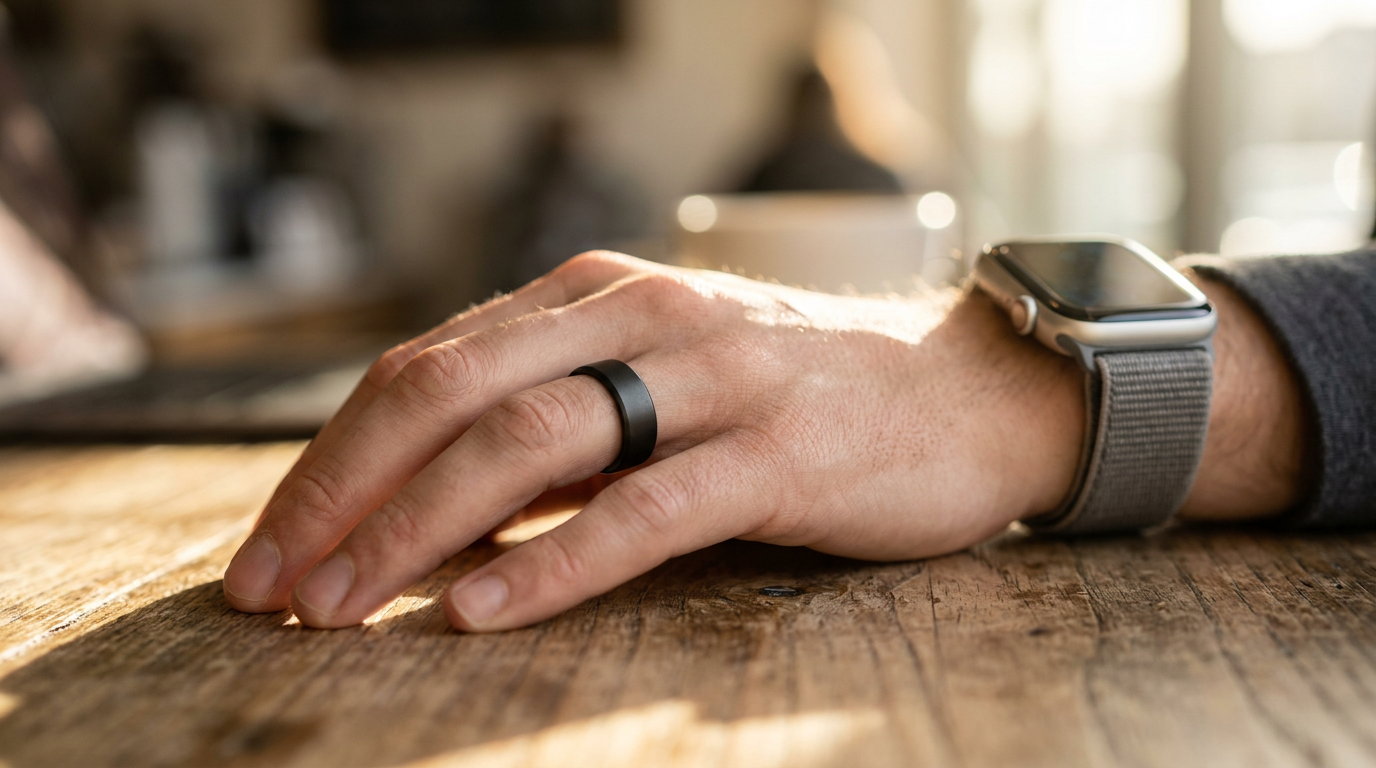
The wearable landscape has fundamentally shifted. The choice facing consumers is no longer just which brand to buy, but which part of the body to digitize. Smartwatches and smart rings now offer overlapping health metrics, forcing buyers into a decision that dictates how they will interact with their own biology on a daily basis.[1]
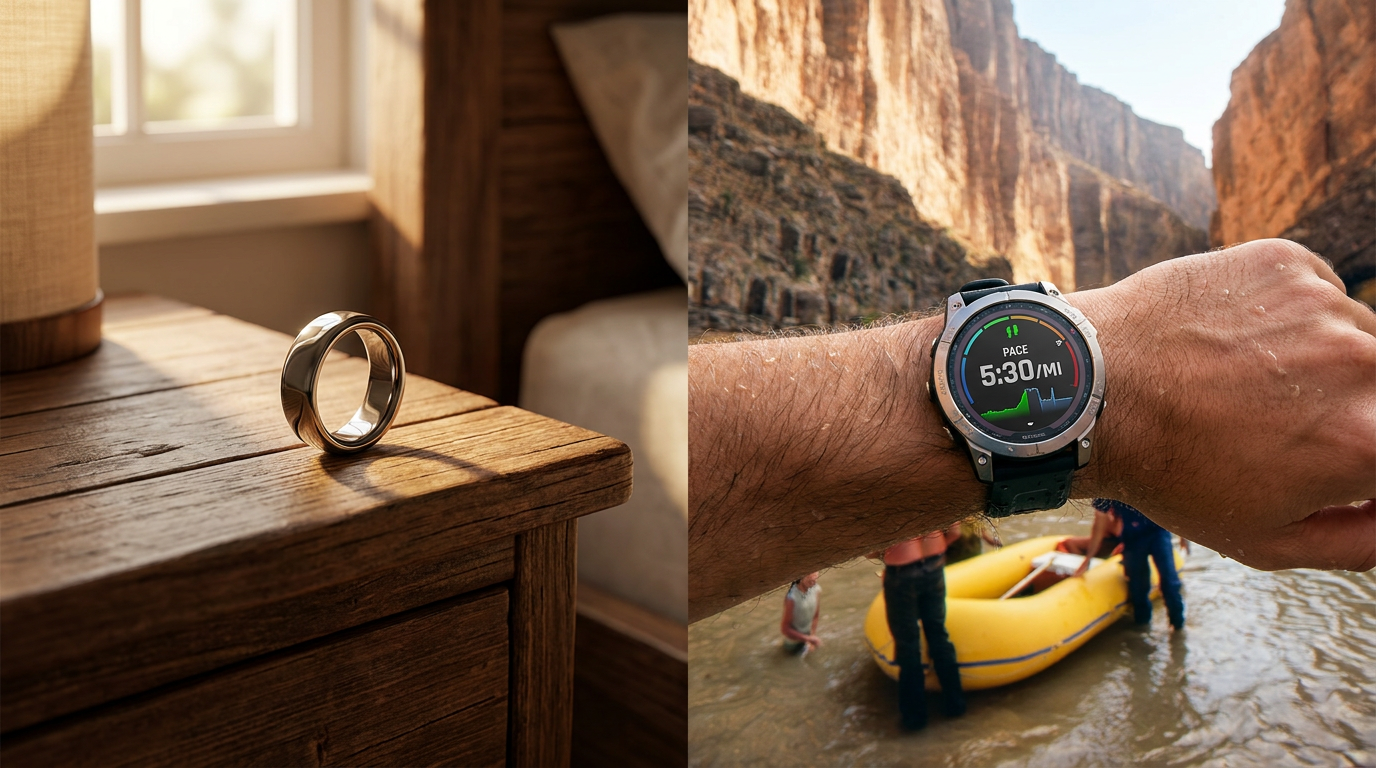
The philosophical divide between the two form factors comes down to screen versus silence. Smartwatches are designed as wrist-bound extensions of the smartphone, built to notify, display, and compute, with health tracking acting as a secondary feature. Smart rings, conversely, are silent sentinels. They lack screens, vibration motors for notifications, and apps, dedicating their entire surface area solely to passive data collection.[2][4]
When evaluating the case for smart rings, the strongest argument lies in sensor accuracy for resting metrics. The finger contains dense capillary networks much closer to the skin's surface than the wrist. This physiological advantage allows the optical sensors in a ring to capture highly stable heart rate and blood oxygen readings without the noise introduced by wrist movement.[5][8]

The evidence for this accuracy is particularly strong in sleep tracking. A recent National Institutes of Health study demonstrated that smart rings closely match clinical polysomnography for detecting sleep stages and wakefulness. Because a ring fits snugly and does not shift during the night, it avoids the movement artifacts that frequently cause smartwatches to misread short awakenings or deep sleep cycles.[8]
Comfort further tips the sleep-tracking scale in favor of the ring. Wearing a bulky, illuminated screen on the wrist overnight is a common friction point that leads to device abandonment. A lightweight titanium ring, weighing just a few grams, fades into the background, allowing for uninterrupted, frictionless data collection over weeks and months.[3][7]
However, the argument against smart rings becomes glaringly obvious the moment a user begins an active workout. Rings are entirely passive; they cannot display real-time heart rate zones, pace, or distance during a run. Furthermore, the rigid metal form factor makes them uncomfortable and prone to scratching during strength training, often forcing users to remove them before gripping a barbell.[2][7]
This is where the smartwatch presents its strongest case: active fitness and connectivity. A modern smartwatch is a standalone fitness computer equipped with built-in GPS, real-time coaching, and the ability to stream music directly to wireless earbuds. For runners, cyclists, and outdoor athletes, the ability to leave the smartphone behind while maintaining full tracking and communication capabilities is an unmatched advantage.[4][6]
This is where the smartwatch presents its strongest case: active fitness and connectivity.
The evidence supporting smartwatches also extends to advanced, on-demand health diagnostics. Devices from major manufacturers now feature FDA-cleared electrocardiogram apps capable of detecting atrial fibrillation, a feature that requires the user to actively touch a sensor on the watch face. Smart rings, lacking the surface area and interface for such active tests, cannot currently replicate this level of diagnostic capability.[2][6]
Battery life represents the most quantifiable trade-off between the two devices. Because they power bright OLED displays and constant wireless communication, smartwatches typically max out at 18 to 48 hours of battery life. This forces users into a daily charging routine, often sacrificing overnight sleep tracking to juice up the device.[4][5]

In stark contrast, the screen-free nature of smart rings allows them to sip power. Most leading rings deliver four to seven days of continuous use on a single charge, with some newer models pushing past a week. This extended battery life is the linchpin of the smart ring's value proposition, enabling true 24/7 health monitoring without the anxiety of a dying battery.[5][9]
The financial equation also requires careful consideration, as the true cost of ownership often extends beyond the initial hardware purchase. While both devices generally retail between $250 and $500, the software models diverge sharply. Smartwatches rarely charge for access to their native health apps, providing a complete experience out of the box.[2][9]
Conversely, the smart ring market has historically relied on recurring revenue. Market leaders often gate their most valuable insights—such as detailed sleep staging and daily readiness scores—behind a monthly subscription fee. Over a three-year lifespan, this adds significantly to the total cost, though competitors are increasingly launching subscription-free alternatives to challenge this paradigm.[7][9]

Ultimately, the smartwatch fits well when the user demands real-time interaction and active fitness tracking. It is the ideal choice for athletes who need live pacing data, professionals who want to triage notifications without touching their phones, and anyone who views their wearable as a productivity tool as much as a health monitor.[2][4]
The smartwatch does not fit when the user suffers from digital fatigue. For those who find constant wrist vibrations distracting, or who simply prefer the aesthetic of traditional mechanical watches, strapping a miniature smartphone to the wrist introduces more stress than it alleviates.[5][7]
The smart ring fits well when the priority is invisible, frictionless health monitoring. It is perfectly suited for data-driven individuals focused on sleep optimization, recovery metrics, and long-term health trends, offering a 'set it and forget it' experience that quietly builds a comprehensive biological baseline.[1][8]

How we got here
2015
The Apple Watch launches, establishing the wrist as the default location for consumer health tracking.
2018
Oura releases its Gen 2 ring, proving that comprehensive sleep and recovery tracking can be miniaturized into a finger-worn device.
2022
Smartwatches begin incorporating advanced health sensors like ECG and temperature tracking, blurring the lines with medical devices.
2024
Clinical studies validate that smart rings match or exceed smartwatch accuracy for overnight sleep staging and resting heart rate.
2026
Major tech players fully enter the smart ring market, introducing subscription-free models and forcing a direct consumer choice between form factors.
Viewpoints in depth
Digital Minimalists' View
Advocating for technology that operates invisibly without demanding attention.
For digital minimalists, the smart ring represents the ideal evolution of wearable technology. They argue that strapping a screen to the wrist introduces unnecessary notification fatigue and anxiety, turning a health tool into a distraction. By removing the display, smart rings allow users to collect vital biological data without feeling tethered to the digital world, promoting a healthier relationship with technology.
Active Fitness Enthusiasts' View
Prioritizing actionable, real-time data to optimize physical performance.
Fitness enthusiasts view the smartwatch as an indispensable training partner. They point out that passive data collection is useless in the middle of a marathon or a heavy lifting session. The ability to glance at a wrist to check heart rate zones, track pacing via built-in GPS, and leave the smartphone at home makes the smartwatch the only viable option for serious athletes who need immediate feedback to adjust their effort.
Data-Driven Optimizers' View
Focusing on the highest fidelity of continuous biological data for long-term health.
This camp prioritizes the quality and continuity of data above all else. They favor smart rings because the finger's capillary density provides a cleaner signal for resting metrics like heart rate variability and temperature trends. Because rings are comfortable enough to wear 24/7 and don't require daily charging, optimizers argue they provide a much more complete and accurate picture of a user's baseline health and recovery capacity.
What we don't know
- Whether the subscription-free model introduced by newer smart ring brands will remain financially viable long-term.
- How quickly smart rings will be able to incorporate active diagnostic features like FDA-cleared ECGs.
- The long-term battery degradation rates of smart rings compared to smartwatches over a multi-year lifespan.
Key terms
- Heart Rate Variability (HRV)
- The variation in time between each heartbeat, used as a key indicator of physical recovery and stress levels.
- Photoplethysmography (PPG)
- The optical sensor technology used in wearables to measure blood flow and heart rate by shining light into the skin.
- Readiness Score
- A daily metric calculated by wearables that combines sleep quality, HRV, and recent activity to estimate how prepared your body is for physical exertion.
- Sleep Staging
- The process of categorizing sleep into different phases, such as light, deep, and REM sleep, based on movement and heart rate data.
Frequently asked
Can I wear a smart ring while lifting weights?
While possible, many users find smart rings uncomfortable or prone to scratching against metal barbells and dumbbells, making smartwatches better for strength training.
Do all smart rings require a monthly subscription?
No. While market leaders like Oura require a monthly fee for full data access, newer alternatives from Samsung and RingConn offer subscription-free models.
Which device is more accurate for heart rate?
Smart rings are generally more accurate for resting heart rate and HRV due to the finger's dense capillaries, while smartwatches are better at tracking active heart rate during intense movement.
Can a smart ring wake me up with an alarm?
Most smart rings lack vibration motors or speakers to save battery and space, so they cannot serve as an alarm clock, unlike smartwatches.
Sources
Source coverage
9 outlets
3 viewpoints surfaced









[1]Factlen Editorial Team
Synthesis by Factlen editorial team
Read on Factlen Editorial Team →[2]ForbesActive Fitness Enthusiasts
Oura Ring Vs. Apple Watch: Which Fitness Tracker Is Right For You?
Read on Forbes →[3]Garage Gym ReviewsData-Driven Optimizers
Oura Ring vs Apple Watch: A Fitness Tracker Comparison
Read on Garage Gym Reviews →[4]MashableActive Fitness Enthusiasts
Oura Ring vs. Apple Watch: Which fitness tracker is better?
Read on Mashable →[5]CircularDigital Minimalists
Smart Ring vs Smartwatch: Which Wearable is Right for You?
Read on Circular →[6]SamsungData-Driven Optimizers
Smart Ring vs Smartwatch: Which is best?
Read on Samsung →[7]TechRadarActive Fitness Enthusiasts
Smart rings vs smartwatches: which is the best choice for you?
Read on TechRadar →[8]National Institutes of HealthData-Driven Optimizers
Accuracy of Consumer Sleep Tracking Devices Compared to Polysomnography
Read on National Institutes of Health →[9]RingConnDigital Minimalists
Smart Ring vs Smartwatch: The Ultimate Wearable Comparison
Read on RingConn →
More in shopping
See all 6 stories →TV Tech
OLED vs. Mini-LED: The 2026 TV Buyer's Guide
0 sources

E-Bike Tech
The Ultimate Guide to Buying an E-Bike in 2026
0 sources

Summer Sales
The 'July' Deal Wars Move to June as Amazon, Walmart, and Target Announce Overlapping Summer Sales
0 sources

TV Tech
OLED vs. Mini-LED in 2026: The Ultimate TV Technology Comparison
0 sources

Every angle. Every day.
Get shopping stories with full source coverage and perspective breakdowns delivered to your inbox.