
Sodium-Ion Batteries Enter Mass Production, Solving EV Winter Range Anxiety
As the industry chases solid-state technology, affordable sodium-ion batteries have quietly reached mass production in 2026, offering extreme cold-weather resilience and up to 30% lower costs.
By Factlen Editorial Team
- Asian Battery Manufacturers
- Prioritizing sodium-ion to dominate the affordable EV market and reduce reliance on imported minerals.
- Western Automakers
- Reserving sodium-ion for grid storage while keeping passenger EVs focused on high-density lithium.
- EV Adoption Advocates
- Highlighting sodium-ion's potential to solve cold-weather anxiety and lower the barrier to entry for EV ownership.
What's not represented
- · Lithium mining industry representatives
- · Environmental groups monitoring deep-sea sodium extraction
Why this matters
By replacing expensive lithium with abundant sodium, this breakthrough paves the way for cheaper electric vehicles that won't lose massive amounts of range in freezing winter temperatures.
Key points
- Sodium-ion batteries have officially entered mass production in 2026, led by industry giant CATL.
- The chemistry replaces expensive lithium and cobalt with abundant sodium, potentially lowering battery costs by 30 percent.
- Sodium-ion cells retain 90 percent of their capacity at -40 degrees Celsius, effectively eliminating winter range anxiety.
- While Chinese automakers are putting sodium batteries into passenger EVs, Western companies like GM are reserving them for stationary grid storage.
For years, the electric vehicle industry has been fixated on the promise of solid-state batteries as the next great leap. But as 2026 unfolds, a different, highly practical chemistry has quietly crossed the finish line first: the sodium-ion battery. While solid-state technology remains largely in pilot phases for premium vehicles, sodium-ion cells are rolling off mass-production lines today, promising to democratize EV ownership by drastically lowering costs and solving one of the technology's most stubborn flaws.[1][4]
The breakthrough was formalized in late May 2026, when CATL—the world's largest battery manufacturer—confirmed that all manufacturing bottlenecks for its sodium-ion cells had been resolved. Speaking at the 2026 Equipment Powerhouse Forum, CATL's Chief Scientist Wu Kai announced that the company is actively integrating these systems across passenger models and commercial fleets.[2][5]
This is not a laboratory roadmap; it is a commercial reality. CATL and automaker Changan have already unveiled the Changan Nevo A06, the world's first mass-produced passenger EV running on a sodium-ion pack, with a market launch slated for mid-2026.[1][4]
To understand why this shift matters, one must look at the periodic table. Sodium sits directly below lithium, meaning it shares similar chemical properties and can store energy through a nearly identical mechanism—moving ions between a cathode and an anode. However, sodium is roughly 1,000 times more abundant on Earth than lithium. It can be extracted from seawater and common minerals, bypassing the complex, geographically concentrated, and often ethically fraught mining supply chains required for lithium, cobalt, and nickel.[4][5]
By eliminating these expensive bottleneck materials, the cost implications are staggering. Industry analysts project that at scale, sodium-ion cells will be up to 30 percent cheaper to produce than today's baseline lithium iron phosphate (LFP) batteries. This structural cost advantage is what will ultimately drive the price of entry-level EVs below their gasoline-powered equivalents.[1][2]

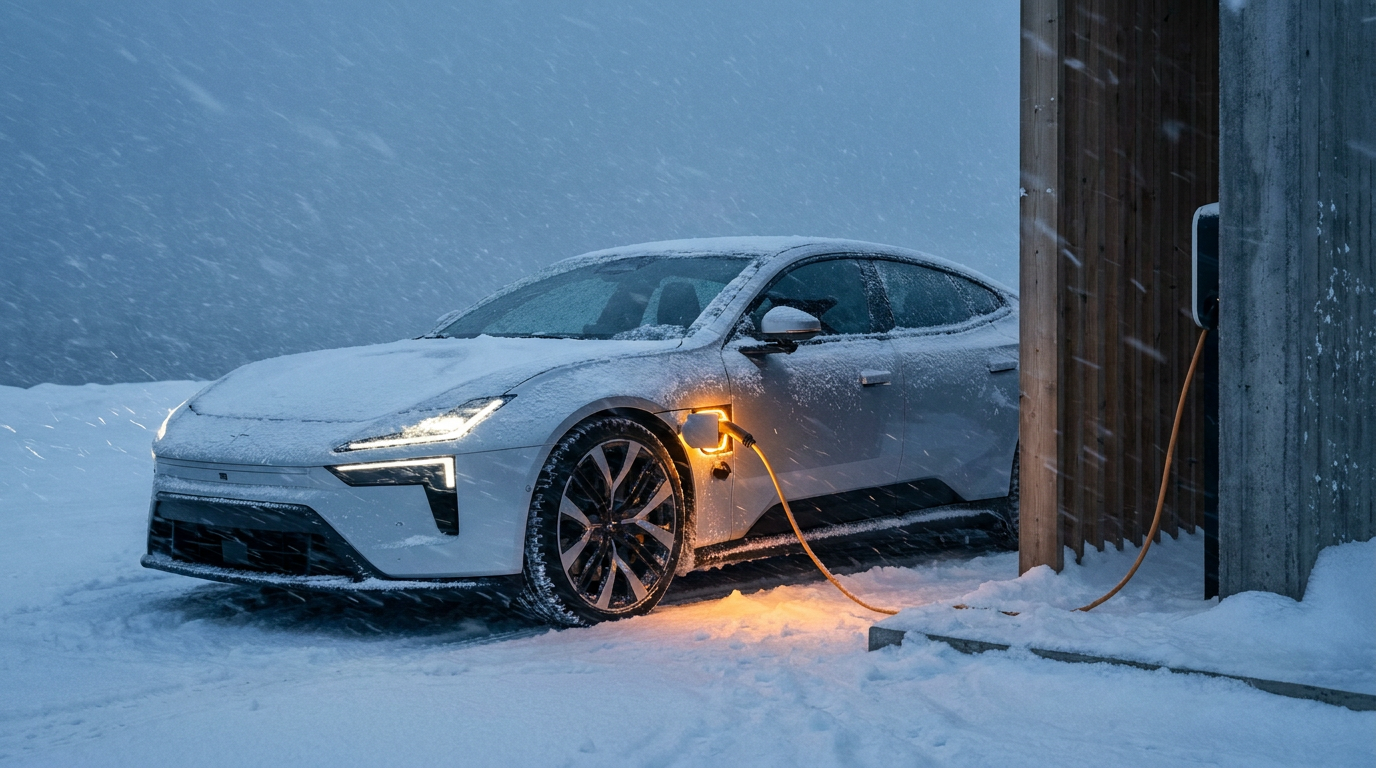
But the true superpower of the sodium-ion battery—and the reason it is generating intense consumer interest—is its extreme resilience in cold weather. Traditional lithium-ion batteries become sluggish in freezing temperatures; the liquid electrolyte thickens, slowing the movement of lithium ions and causing severe range degradation and slow charging speeds.[4]
Sodium ions, despite being physically larger than lithium ions, interact differently with the specialized electrolytes used in these new cells. The electrolyte remains highly conductive even when frozen solid. As a result, CATL's sodium cells can retain roughly 90 percent of their energy capacity at minus 40 degrees Celsius.[4]
Sodium ions, despite being physically larger than lithium ions, interact differently with the specialized electrolytes used in these new cells.
The real-world performance metrics are striking. At minus 30 degrees Celsius, the discharge power of a sodium-ion cell is nearly three times that of an equivalent LFP cell. Furthermore, the battery can still accept a fast charge when completely frozen. For drivers in Canada, Scandinavia, or the northern United States, this effectively ends winter range anxiety—a hurdle that has historically suppressed EV adoption in colder climates.[4]

Despite these advantages, sodium-ion technology does have a fundamental physical limitation: energy density. Because sodium atoms are heavier and larger than lithium atoms, they inherently store less energy per kilogram of battery weight. Energy density, measured in Watt-hours per kilogram (Wh/kg), dictates how far a car can drive on a single charge for a given battery size.[3][4]
CATL's current "Naxtra" sodium cell achieves an energy density of about 175 Wh/kg. This puts it roughly on par with older LFP batteries and is sufficient for a 400-kilometer (248-mile) driving range under testing cycles. While CATL is targeting 600 kilometers for future generations, sodium currently trails the 300+ Wh/kg offered by premium nickel-manganese-cobalt (NMC) lithium batteries used in long-range vehicles.[1][4]
This energy density gap has triggered a fascinating strategic divergence between Chinese and Western automakers. While Chinese manufacturers are aggressively pushing sodium into budget and mid-range passenger cars, United States automakers are taking a distinctly different route.[1][3]
In June 2026, General Motors announced a partnership with battery startup Peak Energy to develop and manufacture sodium-ion cells. However, GM explicitly stated that these batteries will not be placed inside their electric vehicles in the short or medium term, citing the lower energy density as a barrier for American consumers who demand long driving ranges.[3]
Instead, GM is targeting the booming market for stationary battery energy storage systems (BESS). These are massive, container-sized battery bunkers used to store excess energy from solar and wind farms, or to provide backup power for data centers. In a stationary bunker, the physical weight and size of the battery are irrelevant. What matters is cost, safety, and longevity—areas where sodium excels.[3]

Sodium-ion batteries are inherently safer than lithium-ion equivalents, with a much lower risk of thermal runaway and fire. They also boast an exceptional cycle life, capable of enduring thousands of deep discharges with minimal degradation, making them ideal for the 20-to-25-year lifespan expected of grid-scale energy storage.[3][4]
Ultimately, the arrival of mass-market sodium-ion batteries in 2026 marks the end of lithium's absolute monopoly on the clean energy transition. By bifurcating the market—powering winter-proof, affordable city cars in Asia and Europe, while stabilizing massive renewable energy grids in North America—sodium is proving that the future of electrification doesn't rely on a single, scarce resource.[1][3][4]
How we got here
2024
Battery manufacturers begin early pilot testing of sodium-ion cells in small, low-speed vehicles.
February 2026
CATL and Changan unveil the Nevo A06, the first mass-production passenger EV designed for a sodium-ion pack.
May 2026
CATL confirms it has overcome manufacturing bottlenecks, officially moving sodium-ion into mass production.
June 2026
General Motors announces a partnership to develop sodium-ion batteries specifically for stationary grid storage.
Viewpoints in depth
Asian Battery Manufacturers
Prioritizing sodium-ion to dominate the affordable EV market and reduce reliance on imported minerals.
Companies like CATL and BYD view sodium-ion as the key to unlocking the sub-$15,000 EV market. By utilizing abundant sodium, they can insulate themselves from the volatile price swings of the global lithium and cobalt markets. Their strategy is to deploy sodium in entry-level vehicles, urban fleets, and battery-swapping networks, accepting a slightly lower driving range in exchange for massive scale and unbeatable pricing.
Western Automakers
Reserving sodium-ion for grid storage while keeping passenger EVs focused on high-density lithium.
Automakers like General Motors argue that American and European consumers demand longer driving ranges that sodium-ion currently cannot provide. Instead of putting sodium in cars, they are channeling the technology into stationary Battery Energy Storage Systems (BESS). In a grid-scale bunker, the physical weight of the battery doesn't matter, allowing them to leverage sodium's low cost, high safety, and long cycle life without compromising vehicle performance.
EV Adoption Advocates
Highlighting sodium-ion's potential to solve cold-weather anxiety and lower the barrier to entry for EV ownership.
For drivers in regions with harsh winters, the theoretical 300-mile range of a lithium-ion battery is often an illusion, as freezing temperatures can slash efficiency by up to 40 percent. Advocates emphasize that sodium-ion cells retain 90 percent of their capacity at -40 degrees Celsius. For these consumers and industry watchers, a reliable 200-mile range that doesn't degrade in a blizzard is far more valuable than a longer range that disappears when the temperature drops.
What we don't know
- How quickly Western automakers might pivot to using sodium-ion in passenger cars if energy density improves.
- The exact real-world degradation rate of sodium-ion cells over a 10-year vehicle lifespan.
Key terms
- Sodium-ion battery (Na-ion)
- A rechargeable battery that uses sodium ions to store and release energy, offering a cheaper and more abundant alternative to lithium.
- Lithium iron phosphate (LFP)
- Currently the most common and cost-effective lithium-ion battery chemistry used in standard-range electric vehicles.
- Energy density
- The amount of energy a battery can store relative to its weight (measured in Wh/kg), which directly determines an EV's driving range.
- Stationary battery energy storage systems (BESS)
- Large-scale battery installations used to store energy for the electrical grid, data centers, or renewable power plants.
Frequently asked
Will sodium-ion batteries replace lithium-ion in all EVs?
No. Because sodium-ion batteries have lower energy density, they are best suited for budget EVs, city cars, and stationary grid storage. Premium, long-range EVs will continue to rely on lithium-based chemistries.
Why are sodium batteries better in the cold?
Sodium ions interact differently with the battery's liquid electrolyte, allowing the electrolyte to remain highly conductive even when frozen solid at -40 degrees Celsius.
When can I buy a car with a sodium-ion battery?
The first mass-produced passenger EV with a sodium-ion battery, the Changan Nevo A06, launches in China in mid-2026. Global availability will likely follow in the coming years.
Sources
Source coverage
5 outlets
3 viewpoints surfaced





[1]AutoNocionEV Adoption Advocates
CATL just quietly made solid-state battery hype look like a distraction
Read on AutoNocion →[2]CarNewsChinaAsian Battery Manufacturers
CATL will launch a series of mass-produced sodium-ion battery products this year
Read on CarNewsChina →[3]Car and DriverWestern Automakers
GM Is Adding a Fourth Battery Chemistry: Sodium-Ion
Read on Car and Driver →[4]EleportEV Adoption Advocates
Sodium-Ion batteries go mainstream
Read on Eleport →[5]Battery-Tech NetworkAsian Battery Manufacturers
CATL will mass-produce sodium-ion batteries in 2026
Read on Battery-Tech Network →

Every angle. Every day.
Get automotive stories with full source coverage and perspective breakdowns delivered to your inbox.