
How an Ancient Japanese Mold Became the Secret Engine of Global Fine Dining
Aspergillus oryzae, the microscopic fungus known as koji, has broken out of traditional East Asian pantries to revolutionize modern gastronomy. Chefs worldwide are harnessing its powerful enzymes to unlock deep umami, upcycle food waste, and elevate plant-based cuisine.
By Factlen Editorial Team
- Avant-Garde Chefs
- View koji as a versatile tool for flavor innovation and sustainability.
- Traditional Fermenters & Historians
- Focus on the centuries-old heritage and cultural significance of koji in East Asian cuisine.
- Food Scientists & Microbiologists
- Study the genetic domestication and enzymatic mechanisms of the mold.
- Plant-Based Innovators
- Champion koji as the ultimate solution for vegan umami.
What's not represented
- · Home cooks adopting the ingredient
- · Traditional Japanese soy sauce artisans facing industrialization
Why this matters
Understanding koji demystifies the complex, savory flavors found in top-tier restaurants and offers home cooks a natural, sustainable way to elevate their own meals. As the culinary world shifts toward zero-waste and plant-based diets, this ancient microbe provides a blueprint for building deep flavor without relying on highly processed ingredients or heavy meat consumption.
Key points
- Koji is a domesticated mold (Aspergillus oryzae) historically used in Japan to make soy sauce, miso, and sake.
- The mold secretes enzymes that break down starches into sugars and proteins into amino acids, creating intense umami flavors.
- Western fine-dining restaurants, led by Copenhagen's Noma, have adopted koji to ferment non-traditional local ingredients.
- Chefs are increasingly using koji to upcycle kitchen waste into complex sauces, promoting culinary sustainability.
- The ingredient is revolutionizing plant-based cooking by providing natural, deep savory notes without meat or dairy.
The secret ingredient sweeping global fine dining isn't a rare truffle, an exotic spice, or a luxury caviar. It is a fuzzy, microscopic mold called Aspergillus oryzae, known in Japan as koji. Once confined to traditional East Asian pantries, this remarkable organism has broken out of its geographic boundaries. Today, it serves as the quiet engine behind the world's most celebrated kitchens, from Copenhagen to Mexico City. Chefs are harnessing koji not just to brew soy sauce or sake, but to transform local ingredients, reduce food waste, and build profound layers of flavor. [1][2][1][2]
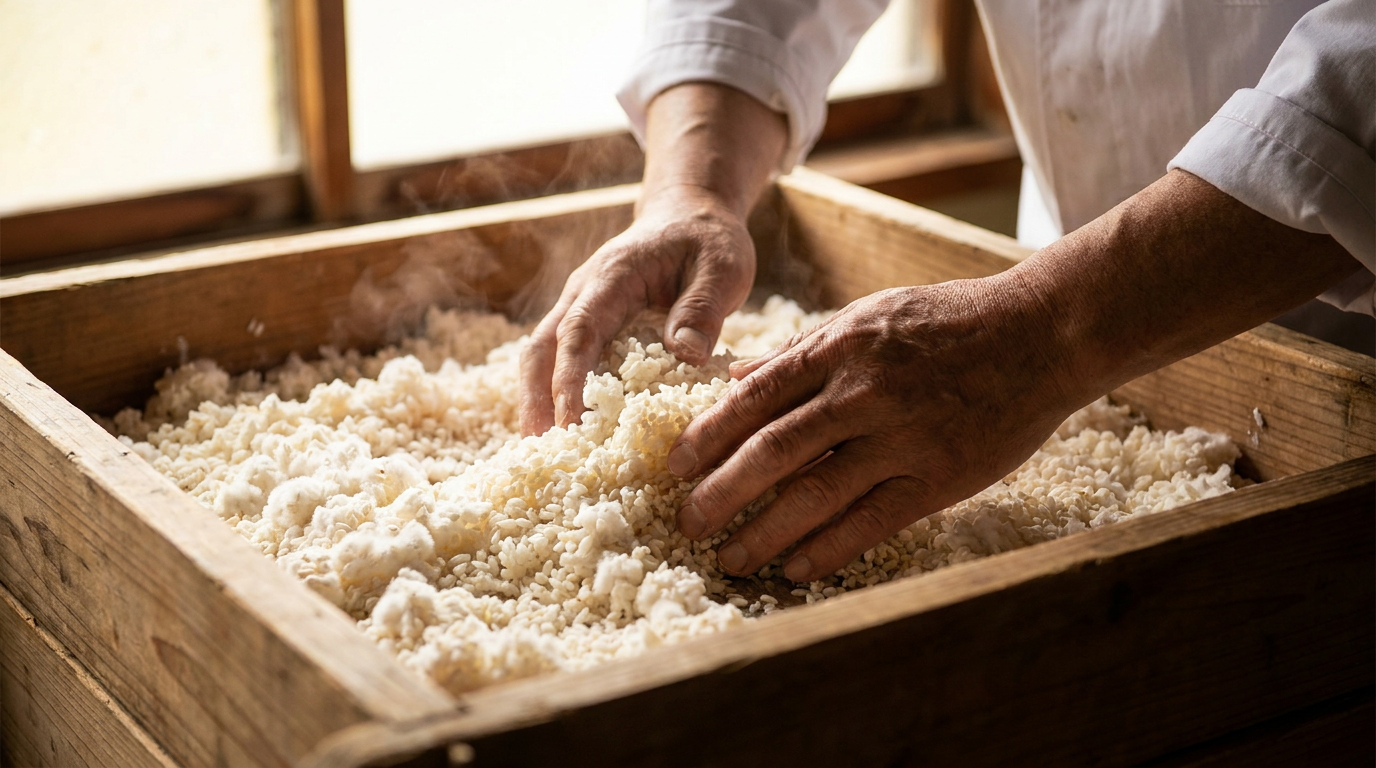
To understand the power of koji, one must look closely at its biology. Aspergillus oryzae is a master digester. When its spores are inoculated onto a warm, humid substrate—typically steamed rice, barley, or soybeans—the mold begins to grow a network of white, fluffy mycelium. This incubation period requires precise control, usually kept around 30 degrees Celsius with high humidity, allowing the mold to thrive without being overtaken by competing bacteria. [4][5][4][5]
As it grows, the mold secretes a powerful arsenal of enzymes into its environment to digest its food. Amylases break down complex starches into simple, sweet sugars. Proteases dismantle tight protein structures into individual amino acids. Lipases break down fats into aromatic compounds. The mold essentially pre-digests the grain, creating a nutrient-dense, highly flavorful base that serves as the foundation for further fermentation. [4][5][4][5]
This enzymatic breakdown is the biological mechanism of deliciousness. When proteases cleave proteins, they release large amounts of glutamate. Glutamate is the molecule responsible for umami, the deeply satisfying, savory "fifth taste" that humans naturally crave. By deploying koji, chefs can unlock intense umami in almost any ingredient, turning bland grains or vegetables into flavor bombs that rival the savoriness of aged meats. [4][7][4][7]

The taming of this microbe is one of humanity's oldest and most significant biotechnological triumphs. Evolutionary biologists believe early fungal domestication in Asia began nearly 9,000 years ago, around the same time humans were domesticating crops and livestock. The wild ancestor of koji, Aspergillus flavus, is an agricultural pest that produces potent toxins capable of causing severe liver damage. [4][4]
Yet, through centuries of careful selection, ancient brewers domesticated the mold. They successfully stripped away its toxicity while amplifying its digestive prowess, creating a safe, food-grade organism. The first written mention of koji's Chinese predecessor, qu, dates back to 300 BCE in the Rites of the Zhou dynasty, highlighting its foundational role in early Asian economies and diets. [4][6][4][6]
It was in Japan, however, that the mold found its ultimate refinement. During the Muromachi period (1336–1573), artisans discovered how to isolate and preserve tane koji—the pure spore starter. This breakthrough allowed for the mass, consistent production of the pillars of Japanese cuisine: sake, miso, soy sauce, and mirin. The organism became so vital to the country's culinary identity that the Brewing Society of Japan officially designated it the "national mold" in 2006. [6][6]

It was in Japan, however, that the mold found its ultimate refinement.
For centuries, koji remained a specialized tool of traditional brewers and Japanese households. But in the 21st century, the mold caught the attention of the Western culinary avant-garde. The catalyst was Noma, the Copenhagen restaurant repeatedly crowned the best in the world by Michelin and global critics. Chef René Redzepi and his dedicated fermentation lab realized that the mold's enzymes were universally applicable. [3][7][3][7]
Noma's team understood that koji didn't care if it was digesting Japanese soybeans or Nordic yellow peas. They began applying the mold to local, non-traditional ingredients, creating entirely new categories of flavor that reflected the Scandinavian landscape. This yielded innovations like "peaso"—a miso made from yellow peas—and smoked mushroom garum, a vegan take on the ancient Roman fermented fish sauce. [3][7][3][7]
By publishing The Noma Guide to Fermentation in 2018, the restaurant effectively open-sourced these techniques, sparking a global movement among chefs. Today, the cross-cultural applications are boundless. In Mexico City, chefs are growing koji on native arroz Morelos and fermenting the corn fungus huitlacoche into savory garums. In North America, kitchens are using the mold to ferment local tepary beans and farro, capturing the unique terroir of their specific regions. [1][3][1][3]
Beyond flavor creation, koji is emerging as a powerful tool for culinary sustainability. High-end kitchens are increasingly using the mold's transformative enzymes to upcycle food scraps. By turning vegetable trimmings, stale bread, and meat offcuts into rich, complex sauces, chefs are effectively closing the loop on kitchen waste. The Michelin Guide has noted that these preserved and fermented flavors are shaping the future of dining. [1][2][1][2]

The mold is also revolutionizing plant-based dining. Historically, vegan cuisine has struggled to replicate the deep, lingering savory notes of aged meats and dairy without relying on highly processed additives. Koji solves this elegantly by breaking down plant proteins into the exact same amino acids found in a seared steak or aged parmesan, providing a natural, whole-food source of umami. [7][7]
Restaurants dedicated entirely to plant-based menus are now using in-house koji fermentation to cure seasonal vegetables. This technique draws out a rounded, savory sweetness that replaces traditional fish-based broths like dashi. It allows vegan kitchens to build flavor from the microbe up, achieving the depth and structure expected in world-class fine dining. [7][7]
The trend is now trickling down from Michelin-starred tasting menus to everyday home cooking and commercial organic products. Shio koji, a simple mixture of koji, salt, and water, has become a popular household marinade globally. It tenderizes meat by breaking down muscle fibers while simultaneously injecting it with umami. Meanwhile, food scientists are exploring precision fermentation, using Aspergillus oryzae to produce sustainable enzymes on an industrial scale. [1][5][1][5]

Yet, even as it enters the realm of modern food tech, koji remains deeply rooted in its heritage. It is a testament to the ingenuity of ancient artisans who learned to collaborate with nature long before the discovery of microbiology. In an era where culinary trends often prioritize fleeting novelty, the rise of koji is a return to substance—proving that profound innovation sometimes just requires a microscopic mold, warmth, and time. [2][6][7][2][6][7]
How we got here
300 BCE
First written mention of qu, koji's predecessor, in the Chinese Rites of the Zhou dynasty.
8th Century
First recorded use of moldy rice to brew sake in Japan.
14th Century
Japanese artisans discover how to isolate tane koji (seed starter), enabling mass production.
2006
The Brewing Society of Japan officially designates Aspergillus oryzae as the 'national mold.'
2018
Noma publishes The Noma Guide to Fermentation, popularizing koji applications in global fine dining.
Viewpoints in depth
Traditional Fermenters & Historians
Focus on the centuries-old heritage and cultural significance of koji in East Asian cuisine.
For traditional artisans, koji is not a new culinary trend but the foundational bedrock of Japanese gastronomy. They emphasize the centuries of careful cultivation required to domesticate the mold and the deep cultural reverence it commands, culminating in its designation as Japan's 'national mold.' While they welcome its global popularity, there is a strong desire to ensure that the traditional methods of producing sake, miso, and soy sauce are preserved and respected amidst the wave of modern experimentation.
Avant-Garde Chefs
View koji as a versatile tool for flavor innovation and sustainability.
Modern chefs see Aspergillus oryzae as a universal biological key that can unlock umami in any ingredient. By divorcing the mold from its traditional substrates like rice and soybeans, they apply it to local grains, legumes, and even food waste. For this camp, koji is a mechanism for culinary freedom, allowing them to create hyper-local misos and garums that reflect their specific regional terroir while simultaneously reducing kitchen waste.
Food Scientists & Microbiologists
Study the genetic domestication and enzymatic mechanisms of the mold.
Scientists marvel at koji as one of humanity's earliest and most successful biotechnological achievements. They focus on how ancient humans managed to domesticate a toxic agricultural pest (Aspergillus flavus) into a safe, highly efficient enzyme factory. Today, researchers are looking beyond the kitchen, exploring how the mold's prestigious secretory system can be utilized in precision fermentation to sustainably produce proteins and enzymes for the broader food and pharmaceutical industries.
Plant-Based Innovators
Champion koji as the ultimate solution for vegan umami.
For plant-based chefs, the historical challenge has been replicating the deep, lingering savory notes of meat and dairy without resorting to ultra-processed additives. Koji provides a natural, whole-food solution. By using the mold's proteases to break down plant proteins into amino acids like glutamate, vegan kitchens can build complex, satisfying flavor profiles from the microbe up, proving that world-class savory depth does not require animal products.
What we don't know
- How the industrial scaling of precision fermentation using Aspergillus oryzae will impact traditional artisanal koji producers in Japan.
- The full extent of undiscovered flavor profiles that could be unlocked as chefs apply koji to previously unfermented indigenous plants globally.
Key terms
- Koji
- Steamed grain or legume inoculated with the mold Aspergillus oryzae, used as a starter for fermentation.
- Aspergillus oryzae
- A domesticated filamentous fungus that secretes enzymes to break down starches and proteins.
- Umami
- The fifth basic taste, characterized by a savory, meaty flavor, primarily driven by the amino acid glutamate.
- Garum
- Historically a Roman fermented fish sauce, now adapted by modern chefs using koji and various proteins or vegetables to create umami-rich liquids.
- Shio Koji
- A versatile Japanese marinade made from koji, salt, and water, used to tenderize meat and enhance flavor.
- Tane Koji
- The 'seed' or spore starter used to inoculate grains and produce koji.
Frequently asked
Is koji safe to eat?
Yes. While its wild ancestor is toxic, Aspergillus oryzae was domesticated thousands of years ago and is completely safe, recognized globally as a food-grade organism.
What does koji taste like on its own?
The mold itself has a sweet, floral aroma often compared to mushrooms, grapefruit, and sweet yeast.
Can I use koji at home?
Absolutely. Products like shio koji are widely available and can be used as a simple marinade to tenderize meats and boost the savory flavor of vegetables.
Why is it popular in vegan cooking?
Koji breaks down plant proteins into amino acids, creating the deep, savory umami flavors typically associated with meat and dairy.
Sources
Source coverage
7 outlets
4 viewpoints surfaced






[1]Fine Dining LoversAvant-Garde Chefs
Chefs across North America are harnessing the power of koji
Read on Fine Dining Lovers →[2]Michelin GuideAvant-Garde Chefs
Preserved and fermented flavors are shaping dining in 2026
Read on Michelin Guide →[3]The GuardianAvant-Garde Chefs
René Redzepi's temple of Nordic gastronomy to become a food lab
Read on The Guardian →[4]Knowable MagazineFood Scientists & Microbiologists
From toxic fungus to soy sauce superstar
Read on Knowable Magazine →[5]National Institutes of HealthTraditional Fermenters & Historians
Aspergillus oryzae as a biotechnological tool in food industry
Read on National Institutes of Health →[6]KikkomanTraditional Fermenters & Historians
The History of Koji and Traditional Japanese Fermentation
Read on Kikkoman →[7]Factlen Editorial TeamPlant-Based Innovators
Synthesis by Factlen editorial team
Read on Factlen Editorial Team →
Every angle. Every day.
Get food drink stories with full source coverage and perspective breakdowns delivered to your inbox.