
The Library Renaissance: How Public Libraries Evolved Into the Ultimate Community Hubs
Public libraries are transforming from quiet book repositories into dynamic community centers, offering everything from 3D printers and power tools to mobile health clinics. This 'Library of Things' movement is redefining the sharing economy and combating the disappearance of free public spaces.
By Factlen Editorial Team
- Civic Advocates
- Viewing libraries as essential social infrastructure that must be protected and expanded.
- Resource Pragmatists
- Focusing on the economic efficiency and sustainability of the sharing economy.
- Library Professionals
- Balancing the excitement of innovation with concerns over mission creep and staff burnout.
What's not represented
- · Municipal budget directors balancing city funds
- · Traditional patrons who prefer quiet study spaces
Why this matters
As the cost of living rises and free indoor spaces disappear, libraries are stepping in to provide essential economic relief and social connection. By offering access to expensive tools, technology, and health services, they are quietly becoming the most important civic infrastructure in modern society.
Key points
- Public libraries are rapidly evolving into dynamic community hubs, offering far more than traditional book lending.
- The 'Library of Things' movement allows patrons to borrow expensive items like power tools, thermal leak detectors, and state park passes.
- Makerspaces equipped with 3D printers and laser cutters are democratizing access to advanced technology and fostering local entrepreneurship.
- Libraries are serving as critical 'third spaces'—free, indoor environments where people can gather without the expectation of spending money.
- Despite the positive impact, expanded services are straining library budgets and placing new demands on staff.
The stereotype of the public library as a silent, dusty repository of books guarded by a shushing librarian has never been more obsolete. Across the globe, a quiet but profound transformation is underway, often referred to by urban planners and civic leaders as the "Library Renaissance."[1]
Driven by shifting community needs, the decline of free public spaces, and the rapid pace of technological change, libraries are aggressively evolving. They are no longer just places to consume information; they are dynamic hubs for creation, connection, and social support.[7]
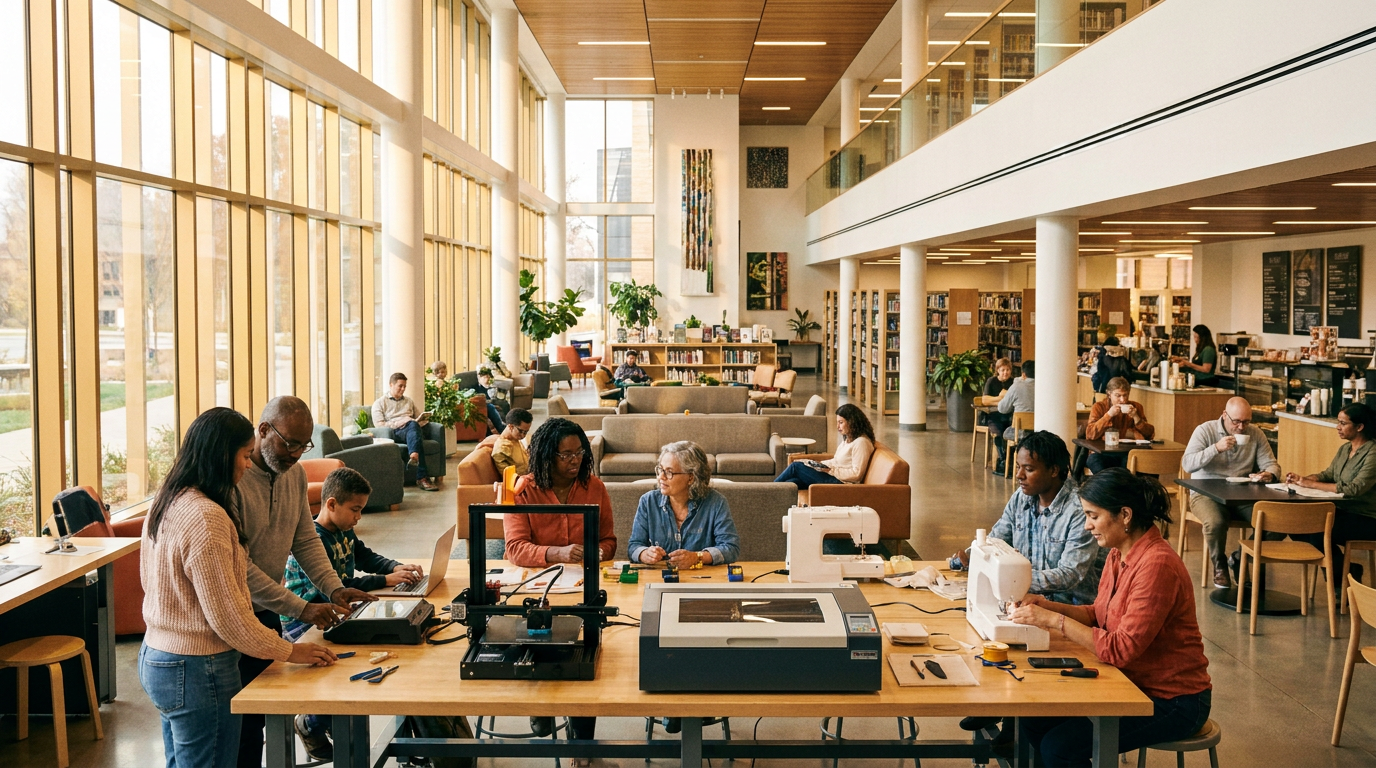
This evolution is visible in the architecture, the programming, and most notably, the catalog. Today's library card unlocks far more than paperbacks and periodicals—it is a passport to power tools, 3D printers, state park passes, and even mobile health clinics.[1][4]
At the forefront of this shift is the "Library of Things" movement, which fundamentally redefines the library's role from an information archive to a champion of the sharing economy. The premise is simple: why should every household purchase an expensive, specialized item they will only use once or twice a year?
The Denver Public Library, for example, offers a catalog that reads more like a hardware store and an electronics retailer combined. Patrons can check out thermal leak detectors to improve their home's energy efficiency, bicycle repair kits, and even passes to the local tool library, which grants access to ladders, lawnmowers, and power drills.[5]

In New Mexico, the Las Cruces Public Libraries have launched the ALICE program, featuring a Library of Things that includes a massive collection of baking supplies, jewelry-making kits, and traditional fiber art tools. By prioritizing access over ownership, libraries are providing immediate economic relief to their communities while promoting sustainable, circular economies.[6]
Beyond lending physical objects, libraries are democratizing access to advanced technology through the integration of "makerspaces." These dedicated zones are equipped with tools that are typically cost-prohibitive for the average citizen, transforming libraries into incubators for creativity and entrepreneurship.
In Watertown, Massachusetts, the public library's "Hatch" makerspace recently celebrated a decade of operation. Located just around the corner from the main branch, the facility is stocked with laser cutters, 3D printers, and sewing machines.[2]
What makes spaces like Hatch truly valuable, however, is not just the hardware, but the human capital. Expert volunteers are on hand to teach patrons how to use the equipment, fostering a collaborative environment where people spend less time staring at screens and more time working with their hands.[2]
What makes spaces like Hatch truly valuable, however, is not just the hardware, but the human capital.
This focus on community connection highlights another critical function of the modern library: serving as the ultimate "third space." Sociologists define the third space as a social environment distinct from the home and the workplace—a place where people can gather, interact, and build community.[7]

In an increasingly commercialized world, genuine third spaces are disappearing. Cafes, restaurants, and recreation centers all require patrons to spend money to justify their presence. The public library stands alone as an indoor, climate-controlled environment where there is no admission fee, no expectation of a purchase, and no built-in class barrier.[3][7]
As highlighted in a recent editorial by The Guardian, libraries offer a lifeline of free engagement. They host craft workshops, coding clubs, and reading challenges, providing desperately needed company to isolated parents and a safe haven for teenagers. You do not even need to buy a cup of tea to spend the entire day there.[3]
Architectural firms are actively redesigning library spaces to reflect this reality. Modern layouts are moving away from endless rows of stacks in favor of flexible zoning—incorporating lecture theaters, cafe spots, teen gaming areas, and collaborative workspaces that encourage interaction between strangers.[7]
But the library's role has expanded even further into the realm of essential social infrastructure, often stepping in where traditional social safety nets have frayed. In many rural and under-supplied regions, libraries have become de facto community health providers.[4]

Recent reports highlight libraries transforming into health hubs, offering patrons access to mobile clinics, mental health support, fitness classes, and food pantries. Because libraries require no insurance, identification, or specific qualifications to enter, they serve as a critical lifeline for vulnerable populations who might otherwise fall through the cracks.[4]
Furthermore, libraries remain on the front lines of bridging the digital divide. While high-speed internet is a prerequisite for modern life—necessary for applying to jobs, accessing government services, and completing homework—millions still lack reliable access. Libraries combat this by checking out WiFi hotspots and Chromebooks for weeks at a time.[5]
Despite these uplifting innovations, the Library Renaissance is not without its challenges. The primary friction point is funding. As libraries take on the responsibilities of community centers, tech hubs, and social service agencies, their budgets rarely increase at a commensurate rate.[1]

This expansion of duties also places an immense burden on library staff. Today's librarians are frequently asked to serve as tech support specialists, event planners, early childhood educators, and frontline social workers—often without specialized training or adequate compensation.[1]
The tension between the traditional mandate of maintaining a quiet space for reading and the noisy, dynamic reality of a modern community hub requires careful management and intentional design. Not every patron is thrilled to hear a 3D printer whirring or a coding class cheering in the next room.[7]
Yet, the trajectory is clear. The public library has survived the digital revolution not by competing with the internet, but by offering what the internet cannot: a physical, inclusive space dedicated to the betterment of the local community. By lending tools, teaching skills, and opening their doors to everyone, libraries are proving that their most valuable asset was never just the books on their shelves—it was the people walking through their doors.[1][3]
How we got here
2014
The American Library Association launches the 'Libraries Transforming Communities' initiative to deepen civic engagement.
2020-2021
The pandemic accelerates the shift, with libraries serving as emergency hubs for food distribution and internet access.
2024
Major architectural shifts are noted as libraries redesign interiors to prioritize collaborative 'third spaces' over traditional book stacks.
2025-2026
The 'Library of Things' and makerspaces become standard offerings in both urban and rural library systems across the country.
Viewpoints in depth
Civic Advocates
Viewing libraries as essential social infrastructure that must be protected and expanded.
For urban planners and community advocates, the library is the last true 'third space'—a public square where existence doesn't require a transaction. They argue that as commercial spaces increasingly dominate city landscapes, the free access provided by libraries is vital for social cohesion. This camp points to the success of library-hosted health clinics and coding clubs as proof that libraries are uniquely positioned to catch vulnerable populations that traditional social safety nets miss.
Resource Pragmatists
Focusing on the economic efficiency and sustainability of the sharing economy.
This perspective champions the 'Library of Things' as a common-sense solution to modern hyper-consumerism. Why should fifty households on the same street each own a power drill they use twice a year? Pragmatists argue that by pooling resources through the library system, communities can lower the cost of living, reduce environmental waste, and democratize access to expensive technology like 3D printers and laser cutters. To them, the library is the ultimate tool for economic empowerment.
Library Professionals
Balancing the excitement of innovation with concerns over mission creep and staff burnout.
While librarians are generally enthusiastic about serving their communities in new ways, many warn that the 'Library Renaissance' is stretching them to the breaking point. Staff are increasingly expected to act as social workers, IT professionals, and event coordinators, often without the necessary training or a corresponding increase in municipal funding. This camp advocates for realistic budgets and specialized support staff to ensure that the evolution of the library doesn't come at the cost of the workers running it.
What we don't know
- Whether municipal governments will increase funding to match the expanded scope of library services.
- How libraries will balance the need for quiet, traditional reading spaces with the noisy reality of active makerspaces.
- The long-term impact of AI on the digital literacy programs currently taught by library staff.
Key terms
- Library of Things
- A collection of non-traditional items available for checkout, such as tools, electronics, and recreational equipment.
- Third Space
- A social environment distinct from the home and workplace where people can gather and build community without spending money.
- Makerspace
- A collaborative workspace inside a library equipped with high-tech tools like 3D printers and laser cutters for public use.
- Digital Divide
- The gap between demographics and regions that have access to modern information and communications technology and those that do not.
- Circular Economy
- An economic system aimed at eliminating waste and the continual use of resources, often supported by borrowing rather than buying.
Frequently asked
Can anyone use a library makerspace?
Yes, most public library makerspaces are free to use for cardholders, though some specialized equipment may require a brief safety orientation or reservation.
What kind of non-book items can you check out?
Depending on the branch, patrons can borrow power tools, baking pans, board games, thermal leak detectors, WiFi hotspots, and even state park passes.
How are libraries funding these new initiatives?
Funding comes from a mix of municipal budgets, state grants, private donations, and partnerships with local economic development departments.
Do I have to pay late fees for tools?
Many modern libraries have eliminated late fees entirely to reduce barriers to access, though replacement costs still apply for lost or damaged items.
Sources
Source coverage
7 outlets
3 viewpoints surfaced







[1]Factlen Editorial TeamLibrary Professionals
Synthesis by Factlen editorial team
Read on Factlen Editorial Team →[2]CBS NewsResource Pragmatists
Watertown library's 'Hatch' maker space provides tools, community for creators
Read on CBS News →[3]The GuardianCivic Advocates
The Guardian view on public libraries: a lifeline that must be protected
Read on The Guardian →[4]NewsweekLibrary Professionals
How Public Libraries Are Becoming Community Health Hubs
Read on Newsweek →[5]Denver Public LibraryResource Pragmatists
Library of Things | Denver Public Library
Read on Denver Public Library →[6]Las Cruces Public LibrariesResource Pragmatists
ALICE - Artists + Libraries Innovative Collaborative Entrepreneurship
Read on Las Cruces Public Libraries →[7]GenslerCivic Advocates
How Public Libraries Are Evolving Into Community Hubs
Read on Gensler →
Every angle. Every day.
Get culture stories with full source coverage and perspective breakdowns delivered to your inbox.