
The Science of Digital Resistance: How Smart Cable Machines Change Muscle Hypertrophy
Electromagnetic motors are replacing iron plates in home gyms, offering dynamic resistance that eliminates momentum and overloads the eccentric phase of lifts. Biomechanists explain how algorithms can build muscle as effectively as gravity.
By Factlen Editorial Team
- Tech-Forward Home Lifters
- Argues that digital resistance offers superior efficiency, safety, and data tracking for building muscle in a small footprint.
- Traditional Strength Purists
- Maintains that the visceral feedback, stabilizer engagement, and raw load capacity of free weights cannot be fully replicated by algorithms.
- Exercise Scientists
- Focuses on the biomechanical advantages of constant tension and eccentric overload, validating digital weight as a highly effective tool for hypertrophy.
What's not represented
- · Commercial gym owners
- · Physical therapists
Why this matters
Understanding the biomechanics of digital resistance helps you make informed decisions about your fitness investments. By leveraging constant tension and eccentric overload, you can potentially unlock new paths to muscle growth and injury prevention without needing a commercial gym.
Key points
- Digital resistance uses electromagnetic motors to provide constant tension, eliminating the momentum found in free weights.
- Smart cable machines can automatically add weight during the lowering phase of a lift, maximizing muscle hypertrophy.
- Built-in sensors act as an automatic spotter, instantly reducing weight if the user reaches muscular failure.
- While ideal for general fitness and muscle growth, digital weights cannot fully replicate the stabilizer engagement required for competitive powerlifting.
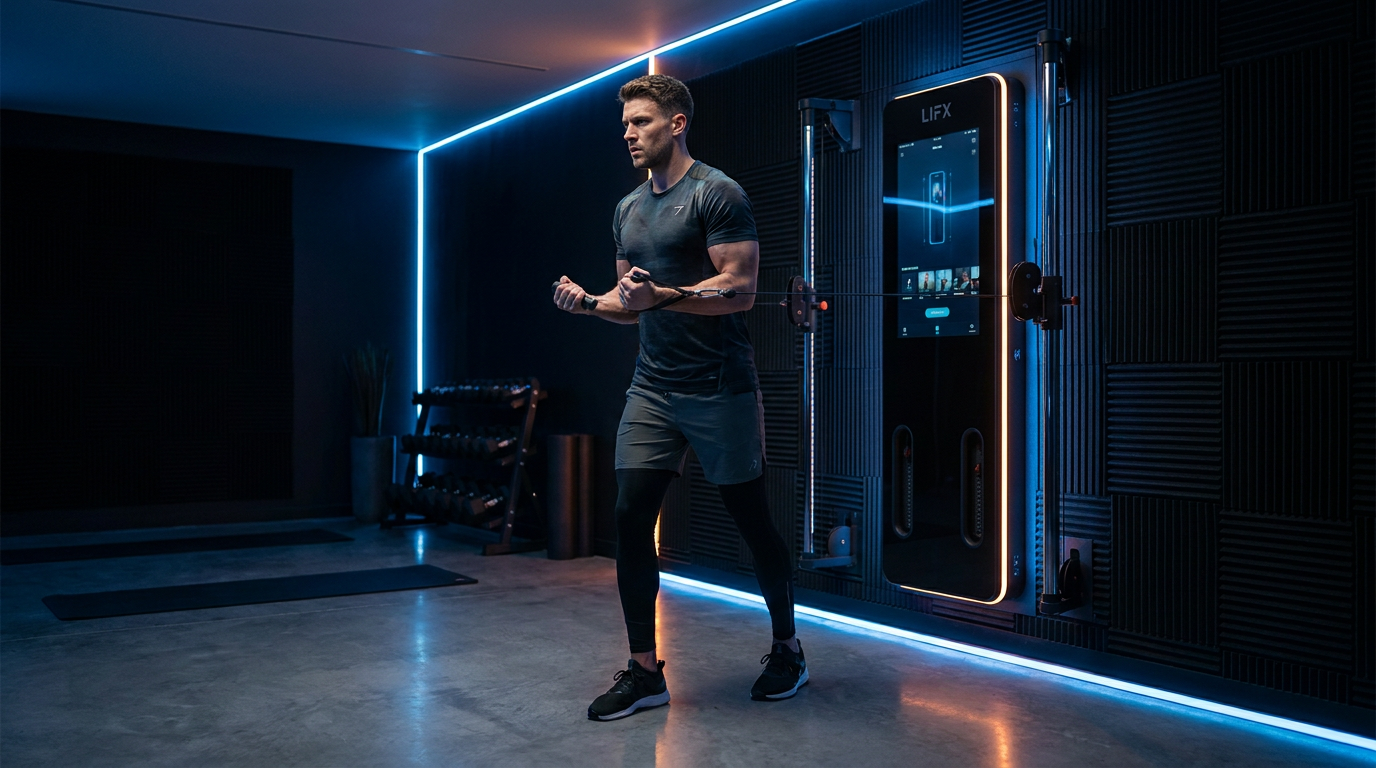
The clanking of iron plates has been the undisputed soundtrack of strength training for over a century, echoing through commercial gyms and garage setups alike. But in recent years, a decidedly different noise has entered the modern home gym: the quiet, high-pitched hum of electromagnetic motors. Devices like Tonal, the Beyond Power Voltra I, and the AEKE system are actively replacing gravity with complex algorithms. They promise to deliver a full commercial gym experience in a fraction of the space, fundamentally changing how everyday athletes approach resistance training.[3][6]
This shift from physical mass to digital resistance is far more than just a space-saving convenience for apartment dwellers. It represents a fundamental evolution in biomechanics and how mechanical tension is applied to human muscle tissue. To truly understand the difference, you have to look at the underlying physics of a traditional barbell. When you lift a standard forty-five-pound iron plate, you are fighting the constant, unchanging force of gravity.[5][6]
However, gravity is heavily subject to the laws of momentum and inertia. If you heave a barbell upward quickly during a bicep curl or a heavy squat, inertia takes over the movement as the weight travels upward. There is a brief, unavoidable moment of weightlessness at the top of the repetition where the muscle experiences almost zero mechanical tension. This dead spot allows the muscle fibers a micro-second of rest, subtly reducing the overall metabolic stress of the exercise and leaving potential muscle growth on the table.[5]
Digital resistance operates on a completely different mechanical principle that eliminates these inefficiencies. Instead of relying on the physical mass of iron plates, these smart machines use high-torque electromagnetic motors to generate targeted force. If a digital cable machine is set to fifty pounds, the motor fights you with exactly fifty pounds of force for every single millimeter of the repetition. There is absolutely no momentum to exploit, and the resistance never wavers, forcing the muscle to work continuously.[2][5]

This unbroken mechanical stress, known as constant tension, is the primary reason why users consistently report that digital weight feels significantly heavier than traditional free weights. Data analysis from millions of recorded lifts suggests that digital resistance feels roughly twenty to twenty-six percent heavier than its iron equivalent. Without the ability to swing or heave the weight, the targeted muscle must exert continuous, grueling force from the bottom of the movement all the way to the top.[2]
Beyond simply eliminating momentum, the true scientific advantage of digital motors lies in their unique ability to dynamically manipulate the eccentric phase of a lift. Every resistance exercise consists of two distinct phases that affect the body differently: the concentric phase, where you actively lift the weight and the muscle shortens, and the eccentric phase, where you slowly lower the weight and the muscle lengthens under tension. Traditional weights treat both phases equally, but human biology does not.[1][4]
Exercise science has long demonstrated that the eccentric phase is responsible for the vast majority of muscle microtrauma. This microscopic tearing of the muscle fibers is the primary biological driver of hypertrophy, the process by which muscles repair themselves and grow larger and stronger. Furthermore, the human body is naturally much stronger during the eccentric phase; you can safely lower significantly more weight than you can lift concentrically, meaning traditional weights often underload the lowering portion of the movement.[1][4]
Exercise science has long demonstrated that the eccentric phase is responsible for the vast majority of muscle microtrauma.
In a traditional commercial gym, taking full advantage of this biological quirk requires a dedicated spotter to physically push down on the barbell as you lower it, or the use of specialized weight releaser hooks that detach at the bottom of a squat. Both methods are cumbersome, require specialized equipment, and are incredibly difficult to perform safely when training alone in a home environment, leaving most everyday lifters entirely unable to properly overload the eccentric phase of their exercises.[4]
Smart cable machines solve this complex biomechanical problem programmatically, without the need for external hardware or a training partner. With a software feature commonly known as eccentric overload, the machine's algorithm automatically adds digital weight the exact moment you begin to lower the handle. Current research indicates that adding roughly twenty-five percent more weight to the eccentric phase is optimal for stimulating muscle growth without overwhelming the central nervous system, a calculation these machines perform instantly and seamlessly on every single repetition.[1][2]

This dynamic, real-time adjustment maximizes mechanical tension throughout the entire range of motion. By overloading the lengthening phase of the muscle, digital resistance heavily stimulates type-II fast-twitch muscle fibers. These are the specific fibers most responsible for explosive power and overall muscle size, accelerating strength adaptations in a way that static iron simply cannot replicate without a team of spotters. The result is a highly efficient workout that triggers maximum hypertrophy in a fraction of the traditional training time.[1][4]
Furthermore, these advanced motor systems offer accommodating resistance, a feature that mimics the effect of wrapping heavy steel chains or thick elastic bands around a barbell. As your mechanical leverage naturally improves near the top of a movement—such as the lockout of a bench press or a heavy squat—the motor algorithmically increases the resistance. This ensures the muscle is maximally challenged at its strongest anatomical point, smoothing out the human strength curve and preventing any portion of the lift from feeling too easy.[2]
Safety is another critical factor driving the rapid adoption of algorithmic weights among home gym enthusiasts who frequently train without supervision. Built-in sensors constantly monitor the cable's position and velocity thousands of times per second. If the system detects that a user's lifting velocity has suddenly dropped—a clear physiological indicator of muscular failure or impending fatigue—the machine acts as an automatic, instantaneous spotter, stepping in exactly when the lifter needs assistance the most to prevent an accident.[2][6]

The motor instantly reduces the digital weight, allowing the fatigued lifter to safely complete the final repetition or exit the movement entirely without the terrifying risk of being pinned under a heavy barbell. This technological safety net empowers users to push much closer to absolute muscular failure, which is a key physiological requirement for maximizing hypertrophy, even when training completely alone in their living room or garage. It effectively removes the psychological barrier of lifting heavy weights solo.[2][6]
Despite these profound biomechanical advantages, digital resistance is not a universal replacement for traditional iron across all strength disciplines. Competitive powerlifters, Olympic weightlifters, and strongman competitors still require the specific neurological adaptations, deep stabilizer muscle engagement, and visceral, tactile feedback of balancing a free-moving, heavily loaded barbell in three-dimensional space. For athletes whose sport explicitly requires moving physical mass under competition rules, training exclusively with algorithms will not fully prepare them for the harsh realities of the platform.[2][5]

Yet, for the vast majority of the population focused on general hypertrophy, functional strength, and long-term joint health, the transition from gravity to algorithms is an absolute revelation. It offers a highly efficient, remarkably safe, and deeply data-driven path to physical adaptation. By perfectly matching the human strength curve and safely overloading the eccentric phase without a spotter, smart cable machines prove that the future of optimal muscle growth might just be written in code rather than cast in heavy iron.[6]
How we got here
2015
Tonal is founded, pioneering the use of electromagnetic resistance for consumer home gyms.
2021
Smart home gyms see a massive surge in adoption as consumers seek commercial-grade workouts in small spaces.
2023
Portable digital resistance devices like the Beyond Power Voltra enter the market, untethering algorithmic weight from wall-mounted screens.
2026
Digital resistance becomes a standard category in strength training, with exercise scientists validating its efficacy for hypertrophy.
Viewpoints in depth
Tech-Forward Home Lifters
Argues that digital resistance offers superior efficiency, safety, and data tracking for building muscle in a small footprint.
This camp, largely composed of busy professionals and home-gym enthusiasts, values the density of the workout. They point to the ability to replace an entire rack of dumbbells and barbells with a single wall-mounted unit. For them, the built-in spotter and automatic data tracking remove the friction of traditional training, allowing them to focus entirely on exertion rather than setup and safety.
Traditional Strength Purists
Maintains that the visceral feedback, stabilizer engagement, and raw load capacity of free weights cannot be fully replicated by algorithms.
Powerlifters and traditional strength coaches argue that lifting is a skill that requires balancing physical mass in three-dimensional space. They emphasize that while digital resistance is excellent for isolation and hypertrophy, it fails to fully engage the deep stabilizer muscles required to control a heavily loaded barbell. Furthermore, they often criticize the reliance on monthly software subscriptions to access basic hardware features.
Exercise Scientists
Focuses on the biomechanical advantages of constant tension and eccentric overload, validating digital weight as a highly effective tool for hypertrophy.
Biomechanists and researchers view digital resistance as a superior tool for manipulating mechanical tension. They highlight the machine's ability to perfectly match the human strength curve through accommodating resistance and eccentric overload. From a purely physiological standpoint, they argue that the muscle cannot distinguish between gravity and an electromagnetic motor—it only responds to tension, making algorithms a highly efficient stimulus for muscle growth.
What we don't know
- Long-term durability of high-torque electromagnetic motors under heavy daily use compared to indestructible iron plates.
- Whether the lack of stabilizer muscle engagement in algorithmic lifting increases injury risk when users transition back to heavy free weights.
Key terms
- Concentric phase
- The portion of a lift where the muscle shortens while contracting, such as lifting the dumbbell during a bicep curl.
- Eccentric phase
- The portion of a lift where the muscle lengthens under tension, such as lowering the dumbbell during a bicep curl.
- Hypertrophy
- The enlargement of an organ or tissue from the increase in size of its cells; in fitness, the process of building muscle mass.
- Constant tension
- A state where the muscle experiences unbroken mechanical resistance throughout the entire range of motion, without resting points.
- Accommodating resistance
- A training method where the resistance increases as the lifter's mechanical advantage improves, often simulating the use of heavy chains or resistance bands.
Frequently asked
Can you build real muscle without heavy iron?
Yes. Muscles respond to mechanical tension, not the source of that tension. Digital resistance provides the necessary stimulus for hypertrophy, often with greater efficiency due to constant tension.
Why does digital weight feel heavier than free weights?
Digital motors eliminate momentum and inertia. Without the ability to swing or heave the weight, your muscles must exert continuous force, making 50 pounds of digital resistance feel roughly 20 to 26 percent heavier than 50 pounds of iron.
Is digital resistance safe for beginners?
Yes, it is generally safer than free weights. Most smart machines feature built-in spotter algorithms that instantly reduce the weight if they detect the user struggling or failing a repetition.
Do I need a subscription to use these machines?
Most wall-mounted smart gyms require a monthly subscription to access data tracking, advanced lifting modes like eccentric overload, and guided classes, though some portable units operate without recurring fees.
Sources
Source coverage
6 outlets
3 viewpoints surfaced






[1]Tonal ResearchTech-Forward Home Lifters
What's the Science Behind Eccentric Training?
Read on Tonal Research →[2]Wits & WeightsExercise Scientists
Dynamic Resistance with Tonal vs. Free Weights for Muscle Gain
Read on Wits & Weights →[3]Garage Gym ReviewsTraditional Strength Purists
8 Best Cable Machines for Home Gyms
Read on Garage Gym Reviews →[4]Verro TrainingExercise Scientists
Overloaded Eccentrics: The Science, Benefits, and Practical Applications
Read on Verro Training →[5]AEKETech-Forward Home Lifters
Do Cables Build Muscle More Efficiently Than Dumbbells?
Read on AEKE →[6]Factlen Editorial TeamExercise Scientists
Synthesis by Factlen editorial team
Read on Factlen Editorial Team →


Every angle. Every day.
Get fitness stories with full source coverage and perspective breakdowns delivered to your inbox.