
SpaceX Shatters Records With $75 Billion IPO, Pushing Valuation Past $2 Trillion on First Day
Elon Musk's aerospace giant executed the largest initial public offering in history, raising $75 billion and opening the commercial space economy to public market investors.
By Factlen Editorial Team
- Growth & Innovation Investors
- Viewing SpaceX as a generational monopoly that justifies its massive premium.
- Value & Risk Analysts
- Warning that the pricing leaves zero margin of safety for operational setbacks.
- Retail Participants
- Focusing on the democratic allocation of shares and the long-term hold strategy.
- Index & Passive Funds
- Grappling with how to integrate a massive, unprofitable mega-cap into traditional indices.
What's not represented
- · Legacy Aerospace Competitors
- · Space Policy Regulators
Why this matters
SpaceX's record-breaking $75 billion IPO fundamentally reshapes the global financial markets, opening the previously guarded commercial space economy to everyday investors. The listing not only mints the world's first trillionaire but also sets a massive new benchmark that will likely trigger a wave of other highly valued technology companies to go public.
Key points
- SpaceX raised $75 billion by selling 555.6 million shares at $135 each, marking the largest IPO in global history.
- The stock surged nearly 20% on its first day of trading, pushing the company's market capitalization above $2 trillion.
- Up to 25% of the offering was reserved for retail investors, with brokerages implementing strict penalties for short-term flipping.
- The company generated $18.7 billion in revenue in 2025 but recorded a $4.9 billion net loss due to heavy infrastructure investments.
- Nasdaq altered its inclusion rules to fast-track SpaceX into the Nasdaq-100 index, while the S&P 500 rejected a similar proposal.
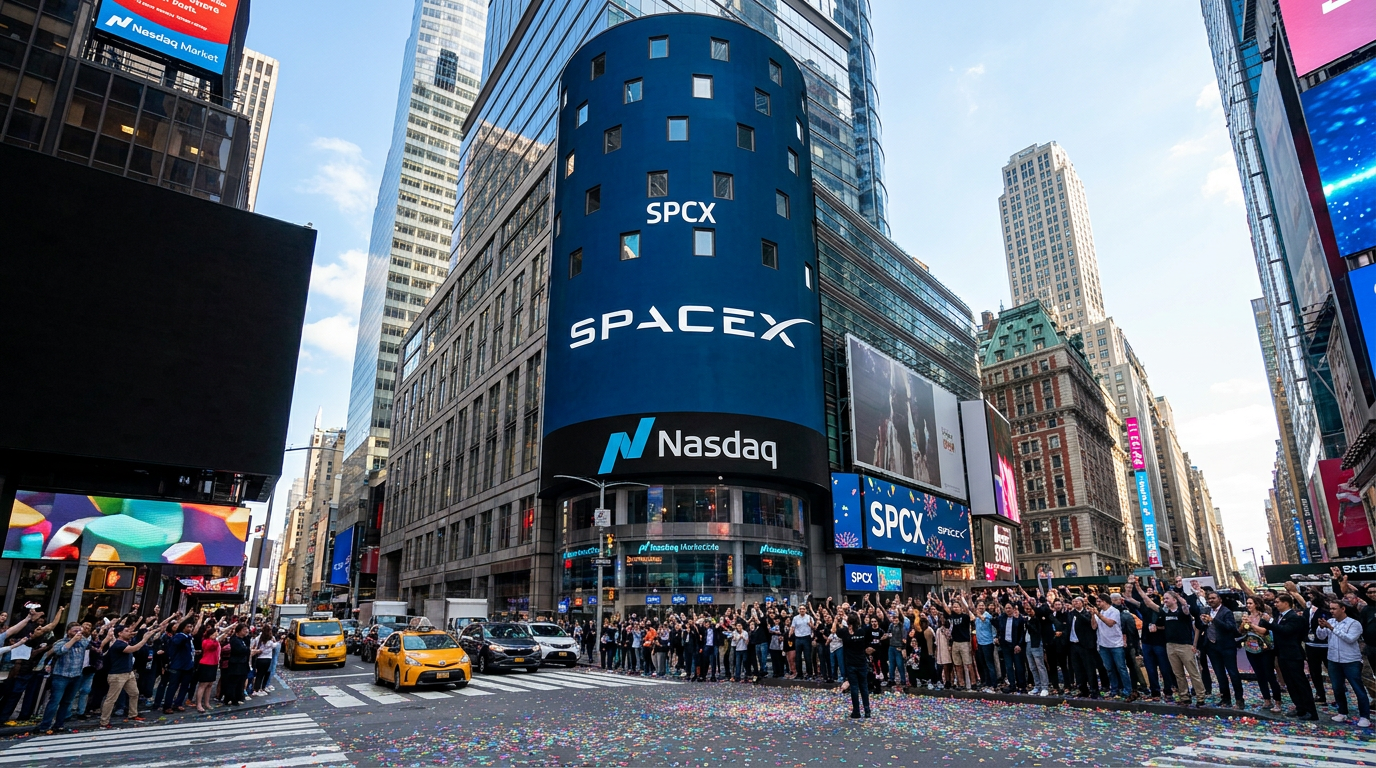
On June 12, 2026, Space Exploration Technologies Corp. fundamentally altered the landscape of global financial markets. In a highly anticipated debut on the Nasdaq under the ticker symbol SPCX, Elon Musk’s aerospace behemoth executed the largest initial public offering in history. The listing represents a watershed moment not just for the commercial space industry, but for the broader technology sector, which has spent years watching the company grow into an undisputed monopoly in the private markets. By transitioning to a public entity, SpaceX has opened its books, subjected itself to quarterly Wall Street scrutiny, and allowed everyday investors to directly participate in the financial upside of orbital logistics and satellite telecommunications.[1][4]
The sheer scale of the capital raise shattered every existing benchmark for public market debuts. By selling 555.6 million shares at an initial offering price of $135, SpaceX successfully raised a staggering $75 billion in fresh capital. To put this figure into perspective, the offering effortlessly eclipsed the previous global record held by the Saudi Arabian state oil company, Saudi Aramco, which raised $25.6 billion during its 2019 listing. The initial pricing bestowed upon SpaceX a staggering valuation of $1.77 trillion, instantly making it one of the most valuable enterprises on the planet before a single share had even traded on the open market.[3][5][6]

The massive size of the offering did little to satiate institutional and retail appetite once the opening bell rang at the Nasdaq MarketSite in Times Square. By the end of its first day of trading, SpaceX shares surged nearly 20% to close just above the $161 mark. This immediate price appreciation pushed the company's total market capitalization well past the $2 trillion threshold, placing it in an elite echelon of technology giants alongside Apple, Microsoft, and Nvidia. For Wall Street underwriters, the flawless execution of such a massive equity sale bucked conventional norms and proved that public markets still possess the deep liquidity required to absorb generational tech monopolies without triggering broader market instability.[1][4]
The historic listing also triggered a monumental shift in global wealth distribution, cementing a new milestone in the history of personal fortunes. By retaining control of roughly half of the company's outstanding shares through a dual-class voting structure, the IPO officially minted founder and CEO Elon Musk as the world’s first trillionaire. The offering also generated unprecedented liquidity for thousands of early SpaceX employees, engineers, and private venture backers who had held illiquid equity for over two decades. Entire communities around SpaceX's primary facilities in Boca Chica, Texas, and Hawthorne, California, are bracing for the localized economic impact of this sudden wealth generation.[1][4]
Unlike many traditional technology IPOs that heavily favor institutional investors, hedge funds, and sovereign wealth portfolios, the SpaceX offering featured a uniquely democratic allocation structure. Up to a quarter of the 555.6 million shares were explicitly reserved for individual retail investors. This decision aligns with Musk's long-stated goal of allowing the general public to invest directly in the mission of making humanity multi-planetary. Retail brokerages experienced record login volumes in the days leading up to the pricing, as millions of individual traders attempted to secure an allocation of the highly coveted Class A common stock.[2]
Fidelity Investments, which managed a significant portion of the retail allocation, was forced to implement a lottery system to distribute the shares equitably among its massive user base. To prevent immediate volatility and discourage short-term speculation, the brokerage instituted a strict 15-calendar-day tracking period for retail participants. Investors who sold their allocated shares within this two-week window were flagged for "flipping," a designation that carries severe penalties for participating in future initial public offerings on the platform. This structure effectively locked in a massive base of retail shareholders who view the stock as a long-term hold rather than a quick momentum trade.[2]
Beneath the historic valuation and the retail enthusiasm lies a complex financial reality that public market investors must now navigate. According to the comprehensive prospectus filed with the Securities and Exchange Commission, SpaceX generated $18.7 billion in revenue during the 2025 fiscal year. This top-line figure represents a robust 33% year-over-year growth rate, driven primarily by an accelerating cadence of commercial satellite launches and the rapid global adoption of its consumer broadband service. The revenue figures confirm that SpaceX is no longer just a research and development project, but a mature logistics and telecommunications provider operating at a massive global scale.[3]
Beneath the historic valuation and the retail enthusiasm lies a complex financial reality that public market investors must now navigate.
However, the company is far from a traditional cash-generating utility. During that same 2025 fiscal period, SpaceX recorded a massive $4.9 billion net loss, completely reversing a modest $791 million profit achieved in 2024. This aggressive cash burn is not a symptom of operational inefficiency, but rather a deliberate strategy of immense capital expenditure. The company is currently pouring billions of dollars into the continuous development and testing of its next-generation Starship launch vehicle, alongside the aggressive manufacturing and deployment of thousands of new Starlink satellites. Investors buying into the IPO are effectively funding the most expensive private infrastructure project in human history.[3]

Wall Street's willingness to overlook a nearly $5 billion annual loss stems directly from SpaceX's unprecedented operational moat. The company currently controls more than 80% of the United States rocket launch market, effectively monopolizing domestic access to orbit. By mastering reusable rocket technology with its Falcon 9 fleet, SpaceX has structurally lowered the cost of spaceflight to a level that legacy aerospace contractors and international space agencies simply cannot match. This dominance ensures a steady stream of high-margin contracts from commercial satellite operators, NASA, and the Department of Defense, providing a reliable financial foundation for its riskier ventures.[3]
Furthermore, the company's Starlink division has transitioned from a speculative beta project into a global telecommunications juggernaut. As of the IPO date, Starlink boasts over 12 million active subscribers spread across 160 countries. By controlling both the launch vehicles and the satellite payloads, SpaceX has achieved a level of vertical integration that traditional aerospace and telecom competitors cannot replicate. This closed-loop ecosystem allows the company to dictate pricing, iterate on hardware designs rapidly, and deploy network upgrades at a pace that has left terrestrial internet providers struggling to compete in rural and developing markets.[3]

To justify its $1.77 trillion initial valuation—which translates to a staggering 94.7 times its annual sales—SpaceX executives pitched institutional investors on a total addressable market (TAM) of $28.5 trillion. This theoretical ceiling encompasses not just current launch services and broadband internet, but the entire future of the commercial space economy. The company's long-term financial models factor in revenue streams from point-to-point Earth transportation, lunar infrastructure development, asteroid mining logistics, and eventual Mars colonization. By framing the company as the foundational infrastructure layer for humanity's expansion into the solar system, underwriters successfully convinced the market to value SpaceX as a category of one.[3]
However, this astronomical multiple has drawn sharp criticism from traditional value analysts who warn of extreme downside risk. Financial research firm Morningstar issued a rare pre-listing warning, explicitly labeling the stock as "significantly overvalued" at the $135 offering price. Critics argue that pricing a company for flawless execution over the next two decades leaves absolutely zero margin of safety for the inevitable setbacks inherent in space exploration. A single catastrophic failure of a Starship vehicle, regulatory hurdles regarding satellite debris, or a shift in government contracting priorities could severely compress the stock's massive premium.[3][6]
The sheer gravity of the SpaceX listing also forced major structural changes within the passive investing ecosystem. Recognizing the unprecedented scale of the company and the demand from index funds, Nasdaq regulators proactively altered their inclusion rules. The exchange allowed SpaceX to join the prestigious Nasdaq-100 index after just 15 days of trading, provided it maintained a top-40 valuation ranking during its first week. This fast-track inclusion guarantees that billions of dollars from passive index funds, such as the Invesco QQQ Trust, will automatically flow into the stock, providing a permanent floor of institutional support.[3]
Conversely, the committee overseeing the S&P 500 rejected a similar rule change, adhering strictly to their requirement for a history of GAAP profitability before inclusion. Because SpaceX posted a $4.9 billion loss in its most recent fiscal year, it remains ineligible for the world's most tracked equity index. This divergence highlights a growing tension in modern financial markets: the struggle between accommodating generational, high-growth mega-caps that investors demand exposure to, and maintaining the traditional financial standards that have governed index inclusion for decades.[3]

The successful execution of the $75 billion raise has immediately thawed a previously tepid market for technology listings, igniting what analysts are already calling the 2026 tech IPO wave. By proving that public markets can easily digest a trillion-dollar debut, SpaceX has cleared the runway for other highly valued private decacorns. Artificial intelligence leaders like Anthropic and OpenAI, which have similarly relied on massive private funding rounds to sustain capital-intensive research, are now widely expected to accelerate their own public market timelines, confident that institutional liquidity remains abundant for transformative technologies.[3][4]
For SpaceX, the transition from a closely guarded private entity to a publicly traded behemoth introduces a fundamentally new operating environment. The company will no longer be able to shield its financial missteps or development delays from the public eye. Every exploded prototype, every delayed launch, and every shift in Starlink subscriber growth will now be scrutinized by algorithmic traders and activist shareholders. The ultimate test for SpaceX is no longer just engineering reusable rockets, but proving that Elon Musk's grand vision for a multi-planetary future can survive the rigid, quarter-by-quarter demands of Wall Street.[1][5]
How we got here
2002
Elon Musk founds Space Exploration Technologies Corp. with the ultimate goal of reducing space transportation costs to enable the colonization of Mars.
2020
SpaceX becomes the first private company to send human astronauts to the International Space Station.
2024
The company posts a modest $791 million profit, signaling the maturing of its Falcon 9 launch business.
April 2026
SpaceX confidentially submits a draft registration statement to the SEC, marking the formal beginning of the IPO process.
June 12, 2026
SpaceX debuts on the Nasdaq, raising $75 billion and achieving a valuation of $1.77 trillion.
Viewpoints in depth
Growth & Innovation Investors
Viewing SpaceX as a generational monopoly that justifies its massive premium.
For growth-focused funds and innovation ETFs, traditional valuation metrics are irrelevant when assessing SpaceX. This camp argues that the company is not merely an aerospace contractor, but the foundational infrastructure layer for a multi-planetary economy. By pointing to the $28.5 trillion total addressable market—which includes point-to-point Earth travel and asteroid mining—they justify the 94x sales multiple. They view the $4.9 billion net loss not as a warning sign, but as necessary capital expenditure to secure an insurmountable lead over legacy competitors and international space agencies.
Value & Risk Analysts
Warning that the pricing leaves zero margin of safety for operational setbacks.
Traditional value analysts, echoed by research firms like Morningstar, view the $1.77 trillion valuation as a dangerous speculative bubble. This perspective emphasizes that space exploration remains an inherently risky, capital-intensive industry with massive regulatory hurdles. They argue that pricing the stock for flawless execution over the next two decades ignores the reality of rocket engineering—where a single catastrophic failure or a shift in government contracting could instantly compress the stock's premium. For this camp, the reversal from a 2024 profit to a massive 2025 loss is a red flag that the core business cannot yet self-fund its ambitions.
Index & Passive Funds
Grappling with how to integrate a massive, unprofitable mega-cap into traditional indices.
The passive investing community is deeply divided on how to handle the SpaceX listing. On one side, Nasdaq regulators bent their own rules to fast-track the company into the Nasdaq-100, ensuring that passive tech funds capture the growth. On the other side, the S&P 500 committee has rigidly adhered to its GAAP profitability requirements, locking SpaceX out of the world's most important benchmark. This camp is primarily concerned with the structural mechanics of the market—how forced buying from index funds will impact SpaceX's volatility, and whether traditional indices risk becoming irrelevant if they exclude the world's most valuable companies due to near-term unprofitability.
What we don't know
- How the intense quarterly scrutiny of public markets will impact SpaceX's long-term, high-risk engineering culture.
- Whether the company can successfully scale its Starship launch vehicle to achieve the massive cost reductions promised to investors.
- How legacy aerospace competitors and international space agencies will adjust their strategies now that SpaceX has access to public market capital.
Key terms
- Initial Public Offering (IPO)
- The process by which a private company offers shares of its stock to the public for the first time, allowing it to raise capital from everyday investors and institutions.
- Total Addressable Market (TAM)
- An estimate of the total revenue opportunity available for a product or service if it achieved 100% market share.
- Flipping
- The practice of buying shares in an IPO and selling them almost immediately for a quick profit, which brokerages often penalize to reduce stock volatility.
- Dual-class voting structure
- A corporate structure where different classes of shares have different voting rights, often used by founders to retain control of a company even after selling equity to the public.
- GAAP profitability
- A measure of a company's profit calculated according to Generally Accepted Accounting Principles, a standard requirement for inclusion in major indices like the S&P 500.
Frequently asked
What is the SpaceX ticker symbol and where does it trade?
SpaceX trades on the Nasdaq exchange under the ticker symbol SPCX.
How much did SpaceX raise in its IPO?
The company raised a record-breaking $75 billion by selling 555.6 million shares at $135 each.
Can everyday investors buy SpaceX stock?
Yes. Up to 25% of the IPO shares were reserved for retail investors through brokerages like Fidelity, and the stock is now freely tradable on the open market.
Is SpaceX a profitable company?
No. While SpaceX generated $18.7 billion in revenue in 2025, it recorded a $4.9 billion net loss due to heavy investments in Starship and Starlink.
Why did the IPO make Elon Musk a trillionaire?
Musk retained control of roughly half of SpaceX's outstanding shares. With the company's valuation surpassing $2 trillion after its first day of trading, his personal stake pushed his net worth past the $1 trillion mark.
Sources
Source coverage
6 outlets
4 viewpoints surfaced






[1]MarketWatchGrowth & Innovation Investors
How Elon Musk nailed the SpaceX IPO: ‘I’m not sure that this could have gone much better’
Read on MarketWatch →[2]Fidelity InvestmentsRetail Participants
How to participate in the SpaceX IPO
Read on Fidelity Investments →[3]GotradeGrowth & Innovation Investors
SpaceX IPO June 12 Targets $1.77 Trillion Valuation
Read on Gotrade →[4]AxiosIndex & Passive Funds
SpaceX raises $75 billion in its IPO
Read on Axios →[5]Kotak SecuritiesIndex & Passive Funds
SpaceX IPO 2026: $75 Billion Mega Listing
Read on Kotak Securities →[6]CNBCValue & Risk Analysts
SpaceX Sets Record with $75 Billion IPO as Nasdaq Listing Approaches
Read on CNBC →



Every angle. Every day.
Get finance stories with full source coverage and perspective breakdowns delivered to your inbox.