
How the US Government Became a $2 Billion Quantum Venture Capitalist
The Commerce Department is taking equity stakes in nine quantum computing companies, shifting federal policy to accelerate the commercialization of subatomic technology.
By Factlen Editorial Team
- Industrial Policy Advocates
- Argue that quantum is critical infrastructure requiring state-backed capital.
- Free Market Skeptics
- Warn against the government acting as a venture capitalist and picking corporate winners.
- Quantum Hardware Developers
- Focus on overcoming the massive capital requirements of scaling qubits.
- Independent Tech Giants
- Prefer to self-fund to maintain agility and avoid restrictive government conditions.
What's not represented
- · Academic researchers relying on traditional grants
- · International quantum competitors in China and the EU
Why this matters
The US government is shifting from simply funding research to acting as a venture capitalist, taking ownership stakes in the companies building the next generation of computing. This accelerates the timeline for breakthroughs in medicine and materials, while ensuring the infrastructure that powers them remains under domestic control.
Key points
- The US government is investing $2 billion into nine quantum computing companies, taking minority equity stakes in return.
- IBM will receive $1 billion to build America's first dedicated quantum chip foundry in New York.
- The funding targets industrial bottlenecks like advanced packaging and cooling, rather than just raw processing power.
- Alphabet rejected the funding, citing restrictive conditions that would slow its independent development.
- The move fills a critical funding gap left by a 50% drop in private venture capital for quantum tech in 2023.
The US government has officially entered the venture capital business, and its first major target is the subatomic world. In a sweeping move that redefines federal technology policy, the Commerce Department announced a $2 billion funding package directed at nine quantum computing companies.[1][7]
But this is not a traditional research grant program. In exchange for the capital, the government is taking minority equity stakes in the recipient firms. The shift signals that Washington no longer views quantum computing merely as a speculative science experiment, but as critical commercial infrastructure on par with advanced semiconductor manufacturing.[3][7]
The lion's share of the funding—$1 billion—is earmarked for IBM. The tech giant plans to use the capital, alongside $1 billion of its own funds, to launch a new subsidiary called Anderon. Headquartered in New Albany, New York, Anderon is designed to be America's first dedicated quantum chip foundry.[1][3]
Semiconductor manufacturer GlobalFoundries is slated to receive $375 million to scale its own quantum hardware manufacturing, yielding the government a roughly 1% ownership stake. The remaining funds will be distributed in approximately $100 million increments to seven other firms, including Rigetti Computing, D-Wave, PsiQuantum, and Infleqtion.[1][7]

The federal intervention arrives at a precarious moment for the quantum industry. While the theoretical promise of the technology has never been higher, private capital has recently retreated. Global private investment in quantum technology plummeted by roughly 50% in 2023, dropping from $2.3 billion to about $1.3 billion as venture capitalists balked at the massive, long-term capital requirements.[4]

To understand why quantum computing is so expensive—and so coveted—requires a brief detour into quantum mechanics. Classical computers process information in "bits," which exist as either a 0 or a 1. Quantum computers use "qubits," which can exist in a state of superposition, representing both 0 and 1 simultaneously.[8]
To understand why quantum computing is so expensive—and so coveted—requires a brief detour into quantum mechanics.
When qubits are linked together through a phenomenon called entanglement, their processing power scales exponentially rather than linearly. A fully realized quantum computer could simulate complex molecular interactions in minutes, unlocking rapid drug discovery, advanced battery materials, and hyper-accurate climate models that would take classical supercomputers millennia to calculate.[2][8]

However, there is a darker side to this computational leap. National security officials are acutely focused on "Q-Day"—the hypothetical moment when a quantum computer becomes powerful enough to shatter the cryptographic algorithms that currently secure the global financial system and classified military communications.[4][8]
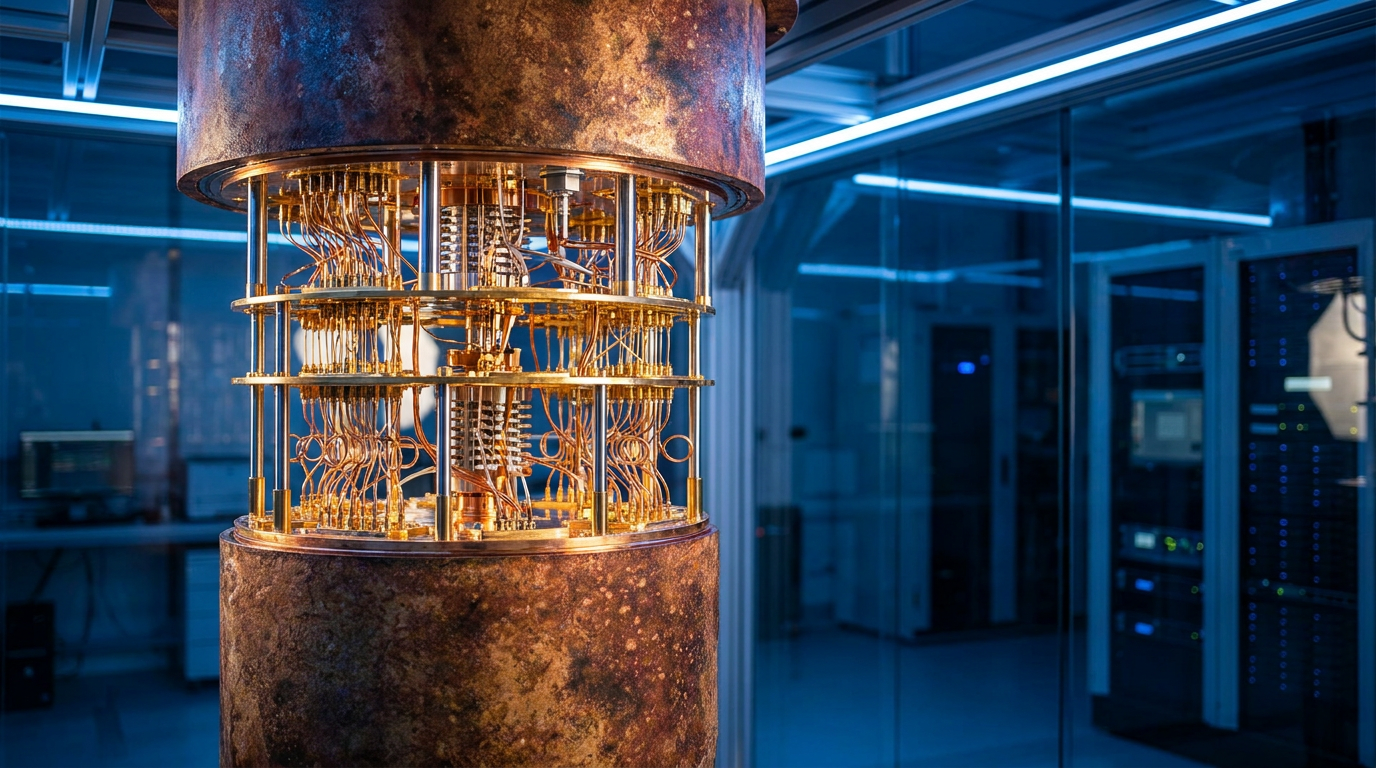
Reaching that milestone, however, requires overcoming immense physical hurdles. Qubits are notoriously fragile; the slightest change in temperature or electromagnetic radiation causes them to lose their quantum state, a problem known as high error rates or "noise." To function, the processors must be housed inside massive dilution refrigerators that cool the chips to temperatures colder than deep space.[1][4][8]
This is why the government's $2 billion package is so targeted. Rather than simply funding the pursuit of higher qubit counts, the capital is aimed squarely at industrial bottlenecks. The investments in IBM and GlobalFoundries are designed to build the domestic supply chain for specialized photonics, advanced packaging, and the unglamorous manufacturing infrastructure required to scale the technology.[3][7]

Not every tech giant is eager to partner with the federal government under these new terms. Alphabet, Google's parent company, notably rejected the funding program. Speaking at the Semafor Tech Summit, Google Quantum AI executives explained that the conditions attached to the federal money would have restricted their agility and slowed their independent quantum roadmap.[6]
The administration's aggressive equity strategy has also drawn sharp criticism from free-market advocates. Critics argue that the government is engaging in "venture capitalist cosplay," putting its thumb on the scale to pick corporate winners rather than funding foundational research. Former IBM CEO Sam Palmisano also voiced concerns about the state directing commercial adoption timelines.[2][5]
How we got here
2022
Global private venture capital for quantum computing peaks at $2.3 billion.
2023
Private funding for quantum technology plummets by 50% as investors balk at long timelines.
May 21, 2026
The Commerce Department announces $2 billion in funding and equity stakes for nine quantum firms.
June 12, 2026
Alphabet reveals it rejected the federal funding to maintain control over its quantum roadmap.
Viewpoints in depth
National Security & Industrial Policy Advocates
Argue that quantum is critical infrastructure and requires state-backed capital to beat international rivals.
This camp views quantum computing not as a software iteration, but as a foundational national security asset akin to the nuclear supply chain. They argue that relying solely on private venture capital—which demands short-term returns—is insufficient for a technology that requires massive, decade-long infrastructure investments. By taking equity, they believe the government ensures domestic control over the foundries and supply chains that will dictate the 21st-century balance of power.
Free Market Skeptics
Warn against the government acting as a venture capitalist and picking corporate winners.
Critics of the equity strategy argue that the government is ill-equipped to act as a venture capital firm. They point out that taking ownership stakes in specific companies distorts the free market, signaling to investors that certain firms are "too strategic to fail" while starving competitors of private capital. Furthermore, they argue that massive corporations like IBM, which generates billions in free cash flow, do not need taxpayer subsidies to fund their research and development.
Independent Tech Giants
Prefer to self-fund to maintain agility and avoid restrictive government conditions.
Companies like Alphabet (Google) represent a faction that believes federal funding comes with too many strings attached. They argue that the race to achieve "quantum advantage" requires maximum flexibility to pivot architectures and roadmaps without seeking bureaucratic approval. For these heavily capitalized tech giants, the strategic freedom to move fast outweighs the financial benefit of government subsidies.
What we don't know
- The exact percentage of equity the US government is taking in most of the nine companies remains undisclosed.
- It is unclear how the government will manage its equity stakes or if it plans to eventually sell them back to the private market.
- The true timeline for 'Q-Day'—when quantum computers can break modern cryptography—remains hotly debated among experts.
Key terms
- Qubit
- The basic unit of quantum information, capable of existing in multiple states simultaneously, unlike classical bits which are strictly 0 or 1.
- Superposition
- A quantum principle allowing a qubit to represent both 0 and 1 at the same time, exponentially increasing processing power.
- Entanglement
- A quantum phenomenon where qubits become linked, so the state of one instantly influences another, regardless of distance.
- Dilution Refrigerator
- The massive, chandelier-like cooling systems required to keep quantum processors at temperatures colder than deep space to prevent errors.
- Q-Day
- The hypothetical future date when quantum computers become powerful enough to break current cryptographic security protocols.
- Foundry
- A specialized manufacturing facility that builds semiconductor chips and, increasingly, quantum processors.
Frequently asked
Why is the government taking equity instead of giving grants?
The administration views quantum computing as strategic commercial infrastructure. By taking equity, the government seeks a direct financial return and deeper influence over the domestic supply chains necessary to compete globally.
Why did Google reject the government funding?
Alphabet executives stated that the conditions attached to the federal money would have limited their agility and slowed their independent timeline for developing practical quantum systems.
What will IBM do with its $1 billion?
IBM is launching a new subsidiary called Anderon to build America's first dedicated quantum chip manufacturing facility in New Albany, New York.
Are quantum computers going to replace regular computers?
No. Quantum computers are highly specialized machines designed to solve specific complex problems—like molecular simulation and cryptography—that would take classical supercomputers millennia to crack.
Sources
Source coverage
8 outlets
4 viewpoints surfaced








[1]The Wall Street JournalQuantum Hardware Developers
U.S. to award quantum-computing firms $2 billion and take equity stakes
Read on The Wall Street Journal →[2]BloombergFree Market Skeptics
Why the US Is Investing in Quantum Computing
Read on Bloomberg →[3]WisdomTreeIndustrial Policy Advocates
The U.S. Government Just Became a Quantum Investor
Read on WisdomTree →[4]Crypto BriefingQuantum Hardware Developers
US government to invest $2B in quantum computing companies
Read on Crypto Briefing →[5]Cato InstituteFree Market Skeptics
Trump’s Presidential Portfolio Goes Quantum
Read on Cato Institute →[6]TradingView NewsIndependent Tech Giants
Alphabet Reveals Why It Rejected Trump's $2 Billion Quantum Funding Program
Read on TradingView News →[7]ForbesIndustrial Policy Advocates
U.S. Will Invest $2 Billion In Quantum Computing Firms And Take Equity
Read on Forbes →[8]MarketWiseIndustrial Policy Advocates
Trump's Billion-Dollar Quantum IBM Bet: Why It's Bullish for 'Big Blue'
Read on MarketWise →
Every angle. Every day.
Get technology stories with full source coverage and perspective breakdowns delivered to your inbox.