
Tangzhong and Yudane: The Science Behind Cloud-Soft Bread
By pre-cooking a small portion of flour and water, bakers can manipulate starch gelatinization to create incredibly soft bread that resists staling for days.
By Factlen Editorial Team
- Baking Science Educators
- Experts who focus on the chemical mechanisms of starch gelatinization and dough rheology.
- Artisan Bakers
- Practitioners who focus on the practical workflow and sensory improvements of the technique.
- Factlen Editorial
- Synthesizes the historical context and the overarching impact of the technique on home baking.
What's not represented
- · Commercial dough conditioner manufacturers
- · Gluten-free recipe developers
Why this matters
Commercial soft breads rely on artificial preservatives and dough conditioners to stay fresh. Understanding this simple, natural technique allows home bakers to achieve bakery-quality softness and extend the shelf life of their bread by nearly a week using only flour and water.
Key points
- Tangzhong and yudane are water roux techniques that pre-cook a portion of a bread recipe's flour and liquid.
- Heating the mixture to 65°C causes starch granules to swell and permanently trap water.
- This trapped water allows bakers to create high-hydration doughs that are not sticky or difficult to handle.
- The bound moisture creates a softer crumb, a higher rise, and prevents the bread from staling for several days.
The holy grail of home baking is often the pursuit of the perfect, cloud-like crumb. For decades, home bakers have struggled with a frustrating reality: homemade bread, free from commercial preservatives and dough conditioners, tends to dry out and stale within a day or two. While crusty artisan loaves are celebrated for their chew, soft breads—like dinner rolls, sandwich loaves, and cinnamon buns—demand a pillowy tenderness that is notoriously difficult to maintain.[7]
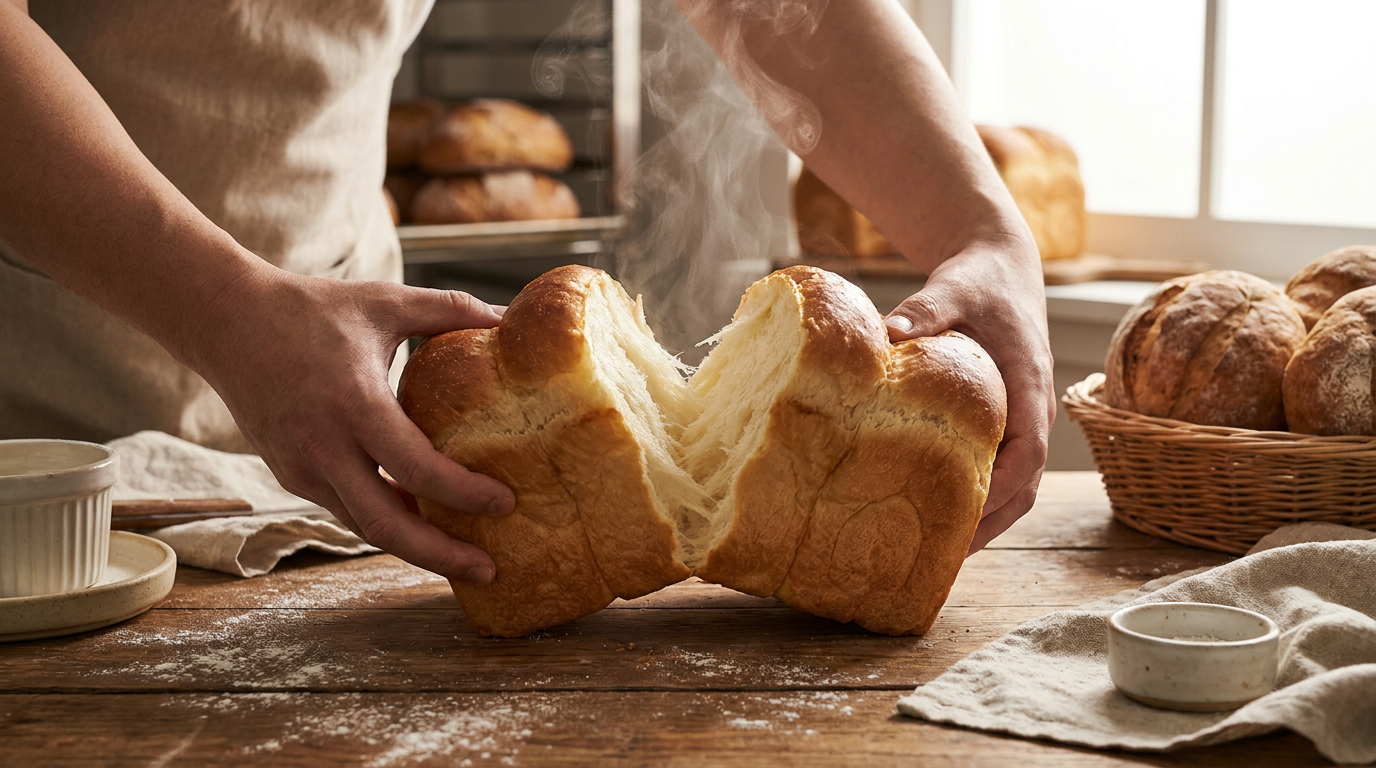
Enter a transformative technique that has quietly revolutionized modern baking: the water roux method, known primarily as tangzhong or yudane. By simply pre-cooking a small fraction of a recipe's flour and liquid before mixing the final dough, bakers can dramatically alter the physical properties of their bread. The result is a loaf that rises higher, boasts a feathery interior, and miraculously resists staling for days longer than conventionally mixed doughs.[1][5]
The origins of this technique trace back to post-war Asia, specifically the Hokkaido region of Japan. Japanese bakers developed the "yudane" (or yukone) method to create incredibly soft, milky loaves that appealed to local palates. However, the technique achieved global fame in the late 1990s when Taiwanese cookbook author Yvonne Chen published "65°C Bread Doctor." Chen popularized the Chinese term "tangzhong" and codified the exact temperature at which the magic happens, sparking a worldwide phenomenon that eventually reached Western test kitchens.[1][2][5]
To understand why tangzhong works, one must look at the microscopic architecture of wheat flour. Raw flour contains tightly packed starch granules that are relatively hard and unyielding. When mixed with cold or room-temperature water, these granules absorb only a modest amount of liquid. But when heat is introduced, the equation changes entirely.[1][7]
The science hinges on a process called starch gelatinization. When a mixture of flour and water is heated to approximately 65°C (150°F), the intermolecular bonds within the starch molecules begin to break down. The granules swell and soften, absorbing up to twice as much liquid as they could in their raw state. The mixture visibly transforms from a milky liquid into a thick, viscous, pudding-like paste.[1][2][3]

This gelatinized paste acts as a moisture reservoir. In a standard bread recipe, hydration—the ratio of liquid to flour—is typically around 60% to 65%. Pushing hydration higher usually results in a sticky, unmanageable dough that is difficult to knead and shape. However, because the liquid in a tangzhong slurry is already securely trapped inside the swollen starch granules, it does not contribute to the dough's stickiness.[1][6]
Consequently, bakers can push the overall hydration of a tangzhong dough to 75% or even higher. The dough remains smooth, elastic, and remarkably easy to handle, yet it carries a massive payload of hidden water into the oven. During baking, this extra moisture converts to steam, providing an explosive "oven spring" that lifts the dough into a tall, airy structure.[1][3][5]

Consequently, bakers can push the overall hydration of a tangzhong dough to 75% or even higher.
The benefits extend far beyond the initial bake. Bread goes stale not simply because it dries out, but because of a chemical process called retrogradation, where the starches slowly recrystallize and expel moisture. Because the starches in a tangzhong loaf are fully gelatinized and saturated, they hold onto their water with incredible tenacity. This fundamentally slows down the retrogradation process, keeping the crumb soft, moist, and mold-free for up to a week.[2][3][6]
While tangzhong and yudane share the same scientific foundation, their execution differs slightly. Tangzhong typically utilizes a 1:5 ratio of flour to liquid by weight. The baker whisks the ingredients together in a saucepan over medium heat—or in short bursts in a microwave—until the whisk leaves distinct lines in the thickened paste. It is then cooled to room temperature before being incorporated into the main dough.[1][3][4]
Yudane, the original Japanese iteration, is even simpler but requires more patience. It uses a 1:1 ratio of flour to boiling water. The boiling water is poured directly over the flour and stirred into a dense, sticky dough. Because the heat is less sustained than stovetop cooking, the yudane must be wrapped tightly and left to rest in the refrigerator for at least four hours, or preferably overnight, to allow the starches to fully hydrate and gelatinize.[3][4]

Both methods yield nearly identical results in the finished loaf, acting as powerful dough improvers. The choice between them often comes down to workflow: tangzhong is faster and can be used the same day, while yudane requires advance planning but saves a few minutes of active stovetop stirring.[4][7]
The applications for these water roux techniques are vast. They are the secret behind the legendary Hokkaido milk bread, characterized by its feathery, shreddable texture. But the method is equally transformative when applied to everyday Western baking. Dinner rolls become impossibly light, hamburger buns hold up to juicy patties without crumbling, and cinnamon rolls remain gooey and tender long after they have cooled.[1][5][6]
Advanced bakers have also begun applying tangzhong to more challenging doughs. Whole wheat bread, which is notoriously dense and prone to drying out due to the sharp bran particles slicing through gluten strands, benefits immensely from the added moisture and softness of a cooked slurry. Even gluten-free baking, which lacks the structural network of wheat protein, relies on pre-gelatinized starches to mimic the chew and moisture retention of traditional bread.[1][3]

However, the technique is not a universal solution for all styles of bread. Because tangzhong introduces so much bound water and slightly restricts gluten formation, it produces a very fine, tender crumb and a soft crust. It is entirely inappropriate for rustic, artisan-style loaves like sourdough, baguettes, or ciabatta, which rely on a chewy, open crumb structure and a thick, crackling crust.[5][7]
For the home baker seeking the ultimate soft loaf, mastering tangzhong or yudane is a revelation. It requires no specialty chemicals, no commercial conditioners, and no expensive equipment—just a few tablespoons of flour, a splash of water, and an understanding of the quiet, powerful science of starch.[6][7]
How we got here
Post-WWII
Japanese bakers in Hokkaido develop the yudane method to create softer, milkier breads suited to local tastes.
1990s
Taiwanese author Yvonne Chen popularizes the tangzhong method across Asia with her book '65°C Bread Doctor'.
2010s
The technique gains widespread traction in Western test kitchens and artisan baking blogs.
Present
Tangzhong becomes a standard technique for home bakers seeking to improve the shelf life and texture of soft breads.
Viewpoints in depth
Baking Science Educators
Experts who focus on the chemical mechanisms of starch gelatinization and dough rheology.
For culinary scientists and test-kitchen developers, tangzhong is a masterclass in manipulating starch behavior. Organizations like the American Society of Baking and America's Test Kitchen emphasize that the technique fundamentally alters dough rheology. By pre-gelatinizing the starch at exactly 65°C, the flour's capacity to absorb and hold water is artificially inflated. This bound water does not contribute to gluten hydration in the same way free water does, allowing bakers to push total hydration to 75% or higher without creating an unworkable, sticky mess. The scientific consensus highlights that this trapped moisture is the primary defense against retrogradation, the chemical recrystallization that causes staling.
Artisan Bakers
Practitioners who focus on the practical workflow and sensory improvements of the technique.
For artisan bakers and recipe developers, the value of tangzhong and yudane lies entirely in the final product and the tactile experience of the dough. Bakers note that while high-hydration doughs are typically slack and difficult to shape, a tangzhong dough feels remarkably strong, cohesive, and elastic. This makes it ideal for intricate shaping, such as braided challahs or tightly rolled cinnamon buns. Furthermore, practitioners often debate the workflow merits of the two methods: tangzhong offers immediate usability for same-day bakes, while yudane requires an overnight rest but eliminates the need for stovetop cooking, making it a favorite for production bakeries.
What we don't know
- While the 65°C gelatinization threshold is well-documented, the exact optimal ratio of pre-cooked flour for different grain types (like rye or spelt) remains a subject of ongoing experimentation.
- The precise difference in long-term staling rates between the stovetop tangzhong method and the boiling-water yudane method is still debated among artisan bakers.
Key terms
- Tangzhong
- A Chinese term for a water roux made by cooking a 1:5 ratio of flour and liquid to a paste, used to soften bread.
- Yudane
- A Japanese technique involving pouring boiling water over flour in a 1:1 ratio to pre-gelatinize starches.
- Starch Gelatinization
- The process where starch granules swell and absorb liquid when heated, permanently altering their structure.
- Hydration
- In baking, the ratio of liquid to flour by weight, which determines the dough's consistency and the bread's crumb.
- Retrogradation
- The chemical process where starches recrystallize after baking, causing bread to become hard and stale.
- Oven Spring
- The rapid rise of bread dough during the first few minutes of baking, driven by expanding gases and steam.
Frequently asked
Can I use milk instead of water for tangzhong?
Yes, milk is frequently used instead of water. It adds fat and milk sugars, which further tenderize the crumb and enrich the flavor of the bread.
Can I adapt any bread recipe to use tangzhong?
Most soft bread recipes can be adapted by taking 5% to 10% of the recipe's total flour and cooking it with five times its weight in liquid from the recipe.
Does tangzhong work for gluten-free baking?
Yes. Because gluten-free baking relies heavily on starches rather than gluten for structure, pre-gelatinizing some of the starch helps retain moisture and improves the texture of the final loaf.
Why is my tangzhong dough so sticky?
If the tangzhong was not cooked to a thick enough paste (reaching 65°C), the starches won't fully gelatinize and trap the water, leaving the excess moisture free to make the dough sticky.
Sources
Source coverage
7 outlets
3 viewpoints surfaced







[1]King Arthur BakingBaking Science Educators
Introduction to tangzhong
Read on King Arthur Baking →[2]American Society of BakingBaking Science Educators
Tangzhong Method
Read on American Society of Baking →[3]The Perfect LoafArtisan Bakers
How to Make Tangzhong
Read on The Perfect Loaf →[4]Chain BakerArtisan Bakers
Tangzhong vs Yudane: Dough Improvers
Read on Chain Baker →[5]America's Test KitchenBaking Science Educators
Techniquely: Tangzhong
Read on America's Test Kitchen →[6]The Chopping BlockArtisan Bakers
The Magic of Tangzhong
Read on The Chopping Block →[7]Factlen Editorial TeamFactlen Editorial
Synthesis by Factlen editorial team
Read on Factlen Editorial Team →
Every angle. Every day.
Get lifestyle stories with full source coverage and perspective breakdowns delivered to your inbox.