
The Rise of Astrotourism: Why Travelers Are Chasing the Darkest Skies on Earth
As light pollution erases the stars for 99% of the developed world, a booming astrotourism industry is turning pristine night skies into a multi-billion-dollar travel commodity.
By Factlen Editorial Team
- Dark Sky Conservationists
- Advocates focused on reversing light pollution to protect ecosystems and human heritage.
- Rural Tourism Boards
- Local economic planners who see the night sky as a sustainable, low-impact resource.
- Luxury Hospitality Sector
- High-end travel brands capitalizing on the demand for exclusive, experiential travel.
- Amateur Astronomers
- Enthusiasts seeking out pristine skies to observe deep-space objects invisible from urban centers.
What's not represented
- · Indigenous communities with traditional astronomical heritage
- · Lighting fixture manufacturers adapting to dark-sky regulations
Why this matters
With artificial light obscuring the Milky Way for most of the population, preserving dark skies has become both an ecological necessity and a massive economic opportunity for rural communities.
Key points
- Astrotourism is rapidly expanding as a multi-billion-dollar travel sector driven by the scarcity of unpolluted night skies.
- Approximately 99% of the population in the US and Europe currently live under skies affected by artificial light pollution.
- The Bortle Scale is used to quantify sky darkness, with Class 1 representing pristine, shadow-casting starlight.
- DarkSky International certifies protected areas, requiring strict lighting management plans to preserve the nocturnal environment.
- Astrotourism provides a powerful economic incentive for rural communities, as stargazers stay overnight and spend significantly more than day-trippers.
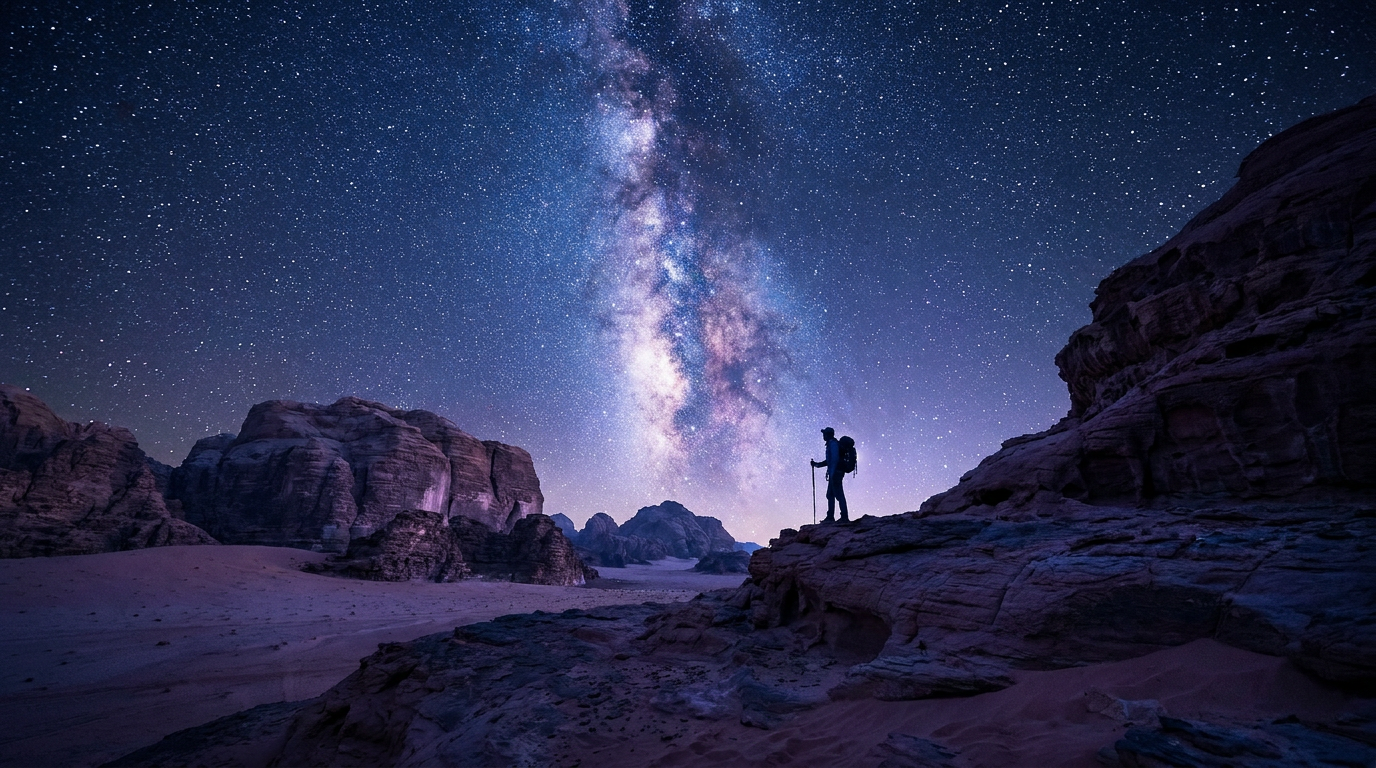
The night sky is quietly disappearing. For most of human history, looking up after sunset meant gazing into a dense, glittering tapestry of stars. Today, the glow of urbanization has erased that view for the vast majority of the developed world.
According to research cited by travel industry analysts, 99 percent of people living in the United States and Europe now reside under skies polluted by artificial light. For eight out of ten North Americans, the Milky Way is entirely invisible from their homes, washed out by the persistent amber and white glare of streetlamps, billboards, and office buildings.[3]
But this loss has sparked a powerful counter-movement. As pristine darkness becomes increasingly rare, it has transformed into a highly sought-after commodity. Welcome to the era of astrotourism—a booming sector of the travel industry dedicated to chasing celestial phenomena and experiencing true, unpolluted night skies.[7]
The numbers behind this trend are striking. The global astrotourism market was valued at $1.18 billion in 2025 and is projected to nearly triple to $3.47 billion by 2034, expanding at a robust annual growth rate of 12.7 percent.[1]

Travel booking platforms are seeing this shift in real-time. Recent industry surveys indicate that 62 percent of travelers are actively expressing interest in visiting darker-sky destinations and participating in "noctourism" experiences.[2][3]
This surge in interest is partly driven by the current astronomical calendar. The sun is currently passing through a "solar maximum" phase, which lasts through 2026 and produces intense auroras visible at unusually low latitudes. Combined with high-profile solar eclipses and a post-pandemic desire for wide-open spaces, travelers are looking upward.[3]
To understand astrotourism, one must first understand how darkness is measured. Astronomers and enthusiasts rely on the Bortle Scale, a nine-level numeric system created in 2001 by amateur astronomer John E. Bortle.[5]
The scale quantifies the observability of celestial objects and the interference caused by light pollution. At the bottom of the scale is Class 9, typical of an inner-city sky where only the moon, a few planets, and the brightest stars can pierce the urban glow.[5]
At the opposite end is Class 1, representing an excellent dark-sky site. In a Class 1 environment, the night sky is so pristine that the Milky Way exhibits complex, dark dust lanes, and the ambient starlight is actually bright enough to cast faint shadows on the ground.[5]

At the opposite end is Class 1, representing an excellent dark-sky site.
Finding a Class 1 or Class 2 sky today usually requires deliberate travel to remote deserts, high-altitude plateaus, or isolated islands. To help travelers find these sanctuaries—and to encourage communities to protect them—an organization called DarkSky International has stepped in.[4][7]
DarkSky International operates a rigorous certification program modeled loosely on the UNESCO World Heritage system. They designate International Dark Sky Parks, Reserves, Sanctuaries, and Communities based on strict criteria for preserving the nocturnal environment.[4]
Earning this certification is not a simple matter of being located far from a city. Communities and parks must implement comprehensive lighting management plans. This involves retrofitting streetlights to point downward, using warmer color temperatures that scatter less in the atmosphere, and committing to ongoing public education about light pollution.[4]
The certification is not awarded in perpetuity. DarkSky International requires regular reviews and sky-quality monitoring, and places can lose their status if they permit new development with non-compliant lighting or fail to maintain their outreach efforts.[4]
For the communities that commit to these dark-sky principles, the economic rewards can be transformative. Astrotourism is proving to be a powerful engine for rural economic development, bringing tourist dollars to remote areas that might otherwise struggle to attract visitors.[6][7]

A comprehensive study of the Colorado Plateau—a region encompassing parts of Arizona, Colorado, New Mexico, and Utah—forecasted that dark-sky tourists will spend $5.8 billion over a ten-year period. This influx of capital is expected to generate $2.4 billion in wages and support more than 10,000 jobs annually in the region.[6]
The economic math of astrotourism is highly favorable for local businesses. Because stargazing inherently requires being on-site after dark, astrotourists are virtually guaranteed to book overnight accommodations. Data shows that these overnight visitors spend at least three times as much as day-trippers, injecting money into local hotels, restaurants, and guide services.[6]
The hospitality industry is rapidly adapting to cater to this lucrative demographic. Luxury properties in places like Chile's Atacama Desert, southern Iceland, and the American Southwest are turning darkness into their most coveted amenity.[2]
It is no longer enough to simply leave a pair of binoculars in a guest room. High-end resorts are now building permanent on-site observatories, hiring resident astronomers to lead guided tours of the cosmos, and even designing suites with glass ceilings so guests can fall asleep under the stars.[2]

Beyond the economic and hospitality impacts, advocates argue that astrotourism serves a deeper ecological and cultural purpose. Artificial light pollution disrupts the navigational instincts of migratory birds, alters the hunting patterns of nocturnal predators, and interferes with the reproductive cycles of amphibians.[4][7]
By assigning a tangible economic value to darkness, astrotourism provides a financial incentive to reverse these ecological harms. It proves that conservation can be profitable, and that sometimes, the most spectacular travel experiences require nothing more than turning off the lights and looking up.[7]
How we got here
2001
Amateur astronomer John E. Bortle publishes the Bortle Scale in Sky & Telescope magazine.
2007
Natural Bridges National Monument in Utah becomes the first certified International Dark Sky Park.
2024–2026
A period of 'solar maximum' increases the frequency of auroras, driving a surge in celestial tourism.
2025
The global astrotourism market surpasses $1.18 billion in valuation.
2034
The astrotourism sector is projected to reach nearly $3.5 billion as demand for dark skies accelerates.
Viewpoints in depth
Dark Sky Conservationists
Advocates focused on reversing light pollution to protect ecosystems and human heritage.
For conservationists, astrotourism is a means to an end rather than the primary goal. Organizations like DarkSky International argue that artificial light pollution is a profound environmental crisis that disrupts nocturnal wildlife, wastes immense amounts of energy, and severs humanity's ancient cultural connection to the cosmos. By certifying Dark Sky Places, they aim to create a global network of protected nocturnal environments. They view the influx of tourist dollars as a necessary financial incentive to convince local governments to enact strict lighting ordinances, proving that darkness has tangible value.
Rural Tourism Boards
Local economic planners who see the night sky as a sustainable, low-impact resource.
Municipalities and regional tourism boards in remote areas view astrotourism as a highly efficient economic engine. Unlike traditional tourism, which often requires massive infrastructure investments in resorts or attractions, astrotourism relies on a resource that already exists: the dark sky. Economic studies, such as those analyzing the Colorado Plateau, highlight that stargazers are inherently overnight visitors who spend significantly more on lodging and dining than day-trippers. For rural communities, this provides a year-round revenue stream that incentivizes the preservation of their natural environment rather than its development.
Luxury Hospitality Sector
High-end travel brands capitalizing on the demand for exclusive, experiential travel.
The luxury travel industry has recognized that true darkness is becoming a rare and premium commodity. High-end resorts in locations like the Atacama Desert, Iceland, and the American West are aggressively marketing 'noctourism' to affluent travelers seeking unique experiences. This sector argues that providing high-quality astronomical experiences—complete with permanent observatories, high-powered telescopes, and resident astronomers—elevates the standard of experiential travel. For these operators, the night sky is a unique selling proposition that differentiates their properties in a crowded global market.
What we don't know
- How the proliferation of low-earth orbit satellite mega-constellations will impact the quality of ground-based astrotourism in the coming decade.
- Whether the economic benefits of astrotourism will be sufficient to convince rapidly urbanizing developing nations to adopt strict light pollution ordinances.
Key terms
- Astrotourism
- A niche segment of the travel industry focused on visiting destinations with low light pollution to observe celestial phenomena like stars, meteor showers, and eclipses.
- Bortle Scale
- A nine-level numeric scale created in 2001 that measures the brightness of the night sky and the severity of local light pollution.
- Light Pollution
- The excessive or misdirected artificial light produced by human urbanization, which obscures the night sky and disrupts ecosystems.
- Solar Maximum
- The period of greatest solar activity during the sun's 11-year cycle, which increases the frequency and intensity of auroras.
- Naked-Eye Limiting Magnitude
- The faintness of the dimmest star that can be seen without the aid of a telescope or binoculars, used to gauge sky darkness.
Frequently asked
What is the Bortle Scale?
The Bortle Scale is a nine-level numeric system used to measure the brightness of the night sky and the interference of light pollution, ranging from Class 1 (pristine darkness) to Class 9 (inner-city skies).
How does a place become a certified Dark Sky Park?
A location must apply through DarkSky International and implement strict lighting management plans, including retrofitting fixtures to point downward and using warmer color temperatures, alongside public education efforts.
Why is astrotourism economically beneficial for rural areas?
Because stargazing happens at night, astrotourists almost always book overnight accommodations. Data shows these overnight visitors spend significantly more money in local communities compared to daytime-only tourists.
Where are the best places for astrotourism?
The best locations are remote areas with minimal light pollution and dry climates, such as the Atacama Desert in Chile, the American Southwest, and certified Dark Sky Reserves around the world.
Sources
Source coverage
7 outlets
4 viewpoints surfaced







[1]Market InteloRural Tourism Boards
Astro Tourism Market Research Report 2034
Read on Market Intelo →[2]ForbesLuxury Hospitality Sector
The Rise Of Astrotourism: 25 Hotels Leading The Stargazing Trend
Read on Forbes →[3]InteleTravelLuxury Hospitality Sector
What Is Astrotourism? The Stargazing Travel Trend You Need to Know
Read on InteleTravel →[4]DarkSky InternationalDark Sky Conservationists
International Dark Sky Places certification program
Read on DarkSky International →[5]WikipediaAmateur Astronomers
Bortle scale
Read on Wikipedia →[6]Missouri State UniversityRural Tourism Boards
Studying Dark Sky Tourism's Potential Economic Impacts
Read on Missouri State University →[7]Factlen Editorial TeamDark Sky Conservationists
Synthesis by Factlen editorial team
Read on Factlen Editorial Team →

Every angle. Every day.
Get travel stories with full source coverage and perspective breakdowns delivered to your inbox.