
Choosing Between a Smart Ring and a Smartwatch for Fitness Tracking
As wearable technology evolves, the choice between a smart ring and a smartwatch comes down to whether you prioritize passive recovery tracking or active workout coaching. Here is how the two form factors compare across accuracy, comfort, and daily utility.
By Factlen Editorial Team
- Data-Driven Optimizers
- Users focused on 24/7 passive tracking, HRV, sleep quality, and minimal digital distraction.
- Active Athletes
- Fitness enthusiasts who rely on real-time GPS, pace tracking, and on-wrist coaching.
- Wearable Analysts
- Tech reviewers and medical experts evaluating the clinical accuracy and long-term costs of both form factors.
What's not represented
- · Traditional watchmakers losing wrist real estate to smartwatches
- · Medical professionals utilizing consumer wearables for remote patient monitoring
Why this matters
Wearables are no longer just step counters; they are sophisticated health monitors that influence how we sleep, train, and manage stress. Choosing the right form factor ensures you actually wear the device consistently enough to gather meaningful, actionable data without introducing unwanted digital distractions.
Key points
- Smart rings excel at passive 24/7 monitoring, offering superior comfort for overnight sleep and recovery tracking.
- Smartwatches remain the dominant choice for active workouts, providing real-time GPS, pacing data, and screen-based coaching.
- Finger-based sensors provide highly accurate resting metrics, while wrist-based sensors are better optimized for high-intensity movement.
- Smart rings typically offer 4 to 10 days of battery life, whereas most full-featured smartwatches require daily charging.
- Many smart rings require monthly subscription fees, making their long-term cost of ownership higher than a standard smartwatch.
- A growing trend sees serious users wearing both: a ring for overnight recovery and a watch for daytime training.
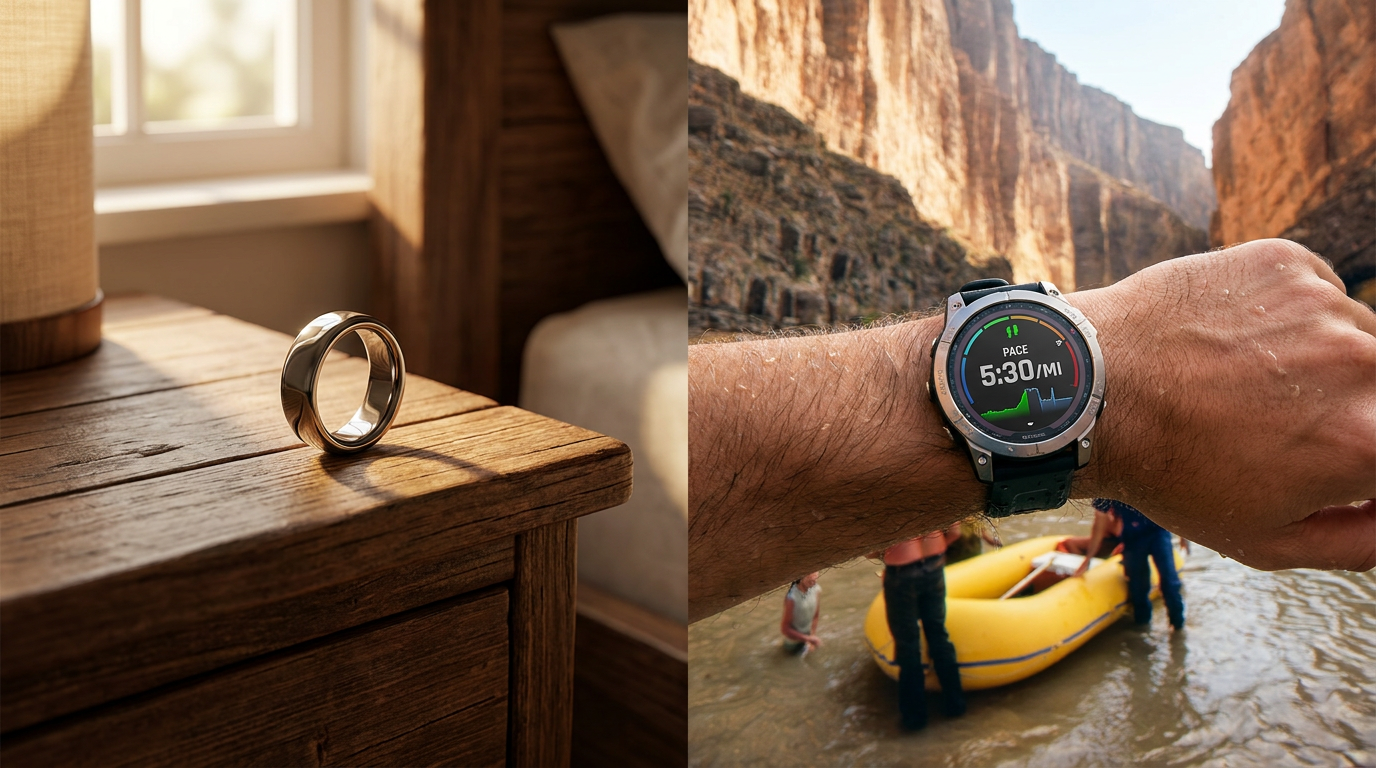
The wearable health technology market in 2026 has definitively split into two dominant form factors: the traditional smartwatch and the rapidly ascending smart ring. While both devices promise to quantify your daily habits, monitor your heart rate, and optimize your recovery, they operate on fundamentally different design philosophies. The conversation among consumers is no longer just about which brand to buy, but which physical footprint best aligns with their lifestyle.[3][6]
At the core of this debate is the distinction between active engagement and passive monitoring. Smartwatches function as comprehensive digital companions, offering real-time feedback, extensive app ecosystems, and robust fitness tracking directly on your wrist. Smart rings, by contrast, take a quieter approach. These screen-free devices focus on gathering data in the background without demanding your attention, prioritizing discretion and continuous wearability over instant notifications.[2][7]
When evaluating the case for smart rings, the primary argument centers on sleep and recovery tracking. The evidence heavily favors the ring form factor for overnight use due to its minimal physical footprint. Weighing between 2.5 and 7 grams, a smart ring is significantly less intrusive than a smartwatch, which typically weighs between 40 and 80 grams. Because fingers move less than wrists during sleep, rings often yield more consistent data, with users far more likely to wear them consistently through the night.[1][6]
Clinical validation supports this preference for overnight ring use. Independent studies comparing wearables have shown that finger placement offers a distinct advantage for measuring resting heart rate, heart rate variability (HRV), and skin temperature—key metrics for determining sleep stages and overall readiness. In fact, recent industry surveys indicate that 82 percent of users prefer wearing smart rings for sleep tracking compared to bulkier wrist-worn alternatives.[4][7]

The argument against using a smartwatch for sleep tracking largely comes down to comfort and digital hygiene. Wearing a watch to bed means strapping a relatively bulky device to your wrist, which can cause skin irritation or physical discomfort for side sleepers. Furthermore, having a screen attached to your wrist all night introduces the risk of sleep-disturbing light and notification distractions, directly counteracting the goal of achieving restful, uninterrupted sleep.[1][5]
Conversely, the case for smartwatches becomes overwhelmingly strong when evaluating active workout tracking. For athletes and fitness enthusiasts, the smartwatch is an indispensable tool that provides real-time pacing, heart rate zones, and GPS routing at a glance. The ability to look down mid-run and adjust your effort based on live data is a feature that a screenless smart ring simply cannot replicate.[2][3]
The evidence for wrist-based workout tracking is rooted in both sensor capability and ecosystem integration. Smartwatches equipped with built-in GPS provide precise distance tracking with accuracy within 1 to 3 percent per mile. During moderate to high-intensity exercise, wrist devices maintain 88 to 97 percent accuracy compared to medical-grade chest straps. Additionally, smartwatches offer dedicated sports profiles, music storage, and the ability to leave your smartphone at home while staying connected.[6][10]
The evidence for wrist-based workout tracking is rooted in both sensor capability and ecosystem integration.
The argument against smart rings for active fitness is their lack of real-time utility and occasional sensor limitations during heavy movement. Without a display, a ring cannot coach you through an interval session or alert you if your heart rate spikes too high during a lift. Furthermore, gripping heavy weights or gripping bicycle handlebars can temporarily disrupt the optical sensors on a finger, making rings less reliable for strength training or intense cycling compared to a tightly strapped watch.[8][9]

Sensor placement science reveals why these devices excel in different environments. Both form factors utilize photoplethysmography (PPG) sensors, which shine light into the skin to measure blood flow. The finger has more consistent blood flow than the wrist, giving ring-based sensors a natural advantage for passive monitoring during rest. However, the wrist provides a larger surface area for complex sensor arrays, allowing smartwatches to incorporate advanced features like electrocardiogram (ECG) capabilities and blood pressure monitoring.[5][10]
Battery life represents another major divergence between the two categories, driven entirely by the presence of a display. Smart rings, unburdened by power-hungry screens and complex processors, typically last between 4 and 10 days on a single charge. This multi-day endurance ensures the device is rarely off your body, leading to more complete health datasets. Most full-featured smartwatches, meanwhile, require charging every one to two days, creating gaps in data collection—often during sleep.[3][6]
When evaluating the financial trade-offs, the true cost of ownership extends beyond the initial retail price. While smartwatches generally cost between $200 and $500 upfront, they rarely require ongoing software fees. Smart rings often boast a slightly lower entry price of $250 to $400, but many leading brands lock their most valuable health insights behind monthly subscriptions ranging from $10 to $20. Over a three-year lifespan, a subscription-based ring can easily become the more expensive investment.[5][8]

Beyond fitness, smartwatches offer daily utility features that rings cannot match. Modern watches function as safety devices, equipped with fall detection, emergency SOS alerts, and cellular connectivity. They allow users to answer calls, reply to messages, and make contactless payments. For professionals who need to stay connected without constantly pulling out their smartphones, the smartwatch serves as a vital communication triage tool.[2][9]
However, this constant connectivity has sparked a counter-movement among consumers seeking to reduce their screen time. Many buyers are turning to smart rings precisely to escape the relentless ping of notifications. By offloading health tracking to a discreet piece of jewelry, users can maintain their wellness goals while wearing traditional analog timepieces or simply enjoying a more minimalist, distraction-free relationship with technology.[7][8]
Interestingly, the wearable market in 2026 is seeing a rise in dual-device users. Rather than choosing one over the other, many serious health optimizers are adopting both form factors. They rely on a smart ring for 24/7 recovery insights, HRV tracking, and sleep staging, while strapping on a dedicated GPS smartwatch exclusively for runs, swims, and gym sessions. This hybrid approach leverages the distinct strengths of both devices without compromising on comfort or data depth.[3][8]
Ultimately, a smart ring fits well when a user prioritizes discreet, 24/7 passive monitoring, values sleep and recovery metrics above all else, and wishes to avoid additional screen time. It is the superior choice for those who want comprehensive health data without changing their personal style. It does not fit well when an individual requires real-time pacing data during a run, needs to leave their phone at home while staying connected, or relies on on-wrist notifications to manage their workday.[2][6]
Conversely, a smartwatch fits well when the wearer is an active athlete who needs live workout coaching, values the safety of cellular SOS features, and wants a comprehensive digital extension of their smartphone. It is the ideal tool for those who treat their workouts as structured training sessions. It does not fit well when the user finds wrist-worn devices uncomfortable to sleep in, suffers from notification fatigue, or prefers the aesthetic of traditional analog timepieces.[2][9]
How we got here
Early 2010s
Basic wrist-worn fitness bands popularize daily step counting and rudimentary sleep tracking.
2015
The launch of the Apple Watch shifts the market toward full-featured, screen-heavy smartwatches.
2018
Early smart rings gain traction among biohackers, proving the viability of finger-based health sensors.
2022
Smartwatches introduce advanced clinical features like ECG and temperature sensing.
2024
Major tech conglomerates enter the smart ring space, validating the form factor for the mainstream market.
2026
The market solidifies into a dual-device ecosystem, with clear use cases dividing rings (recovery) and watches (active training).
Viewpoints in depth
The Passive Tracker's View
Users who prioritize recovery, sleep data, and minimal digital distraction.
For this camp, the best technology is the kind that disappears. Passive trackers argue that the most valuable health metric is consistency, and a device that requires daily charging or causes physical discomfort at night will inevitably be taken off. They point to the superior accuracy of finger-based PPG sensors for resting heart rate and HRV, arguing that a smart ring provides a more holistic view of bodily stress and recovery without the anxiety-inducing constant pings of a wrist-worn screen.
The Active Athlete's View
Fitness enthusiasts who require real-time coaching, GPS, and active workout data.
Active athletes view wearables primarily as training tools rather than passive health monitors. This camp argues that a wearable is only useful if it can actively change your behavior in the moment—such as alerting you that your running pace is dropping or that your heart rate has entered the red zone. They rely heavily on the smartwatch's built-in GPS, music storage, and bright displays, viewing the bulkiness of the watch as a necessary trade-off for actionable, mid-workout intelligence.
The Tech Minimalist's View
Consumers seeking to reduce screen time while maintaining health insights.
Tech minimalists are driving the surge in smart ring popularity as a direct response to notification fatigue. This perspective argues that modern smartwatches have become too intrusive, blurring the line between a health device and a smartphone extension. By adopting a screenless smart ring, these users can still participate in the quantified-self movement—tracking their steps, sleep, and stress—while reclaiming their attention span and returning to wearing traditional, mechanical watches for aesthetic purposes.
What we don't know
- Whether subscription-free models will eventually become the industry standard for smart rings as competition increases.
- How quickly miniaturization technology will allow smart rings to incorporate active feedback mechanisms like haptic pacing or audio cues.
- If upcoming non-invasive blood glucose monitoring sensors will be more effectively deployed on the wrist or the finger.
Key terms
- Photoplethysmography (PPG)
- An optical sensor technology that shines light into the skin to measure changes in blood flow, used by both rings and watches to track heart rate.
- Heart Rate Variability (HRV)
- The variation in time between consecutive heartbeats, used as a key indicator of physical recovery and bodily stress.
- SpO2
- A measurement of blood oxygen saturation levels, which can help detect sleep disturbances like sleep apnea.
- Passive Monitoring
- Health tracking that occurs automatically in the background without requiring the user to interact with a screen or start a workout.
- Form Factor
- The physical size, shape, and design of a hardware device, which dictates how and where it is worn.
Frequently asked
Can I wear a smart ring while lifting weights?
Yes, but heavy gripping can scratch the ring and temporarily disrupt the optical sensors, leading to inaccurate heart rate data during the lift.
Do I need to pay a monthly fee for a smart ring?
It depends on the brand. Some market leaders require a $10 to $20 monthly subscription to view your data, while newer competitors offer subscription-free models.
Which device is more accurate for counting steps?
Both devices are highly accurate for basic step counting, though smartwatches with built-in GPS are far more accurate for measuring actual distance traveled outdoors.
Can a smart ring wake me up in the morning?
Many smart rings feature a gentle vibrating alarm that can wake you up during an optimal sleep stage without disturbing a partner.
Sources
Source coverage
10 outlets
3 viewpoints surfaced










[1]BGRWearable Analysts
Smart Rings vs. Smartwatches: Which Is Better For Sleep Tracking?
Read on BGR →[2]Global SourcesActive Athletes
Smart Ring vs Smartwatch: Features and Comparison
Read on Global Sources →[3]Smart Ring HQWearable Analysts
Smart Ring vs Smartwatch: The Honest 2026 Comparison
Read on Smart Ring HQ →[4]Wearable Wellness GuideWearable Analysts
Compare Stress Trackers: Smartwatches vs Smart Rings (2026 Guide)
Read on Wearable Wellness Guide →[5]RingConnData-Driven Optimizers
FAQs about Smart Rings vs Smartwatches
Read on RingConn →[6]Joint CorpWearable Analysts
Smart Ring vs Fitness Tracker vs Smartwatch: Ultimate Comparison 2026
Read on Joint Corp →[7]Nova RingData-Driven Optimizers
Smart Rings vs Smartwatches: Does Size Matter for Health Tracking?
Read on Nova Ring →[8]Medfy RingData-Driven Optimizers
Are Smart Rings Worth It? The Pros and Cons
Read on Medfy Ring →[9]boAt LifestyleActive Athletes
Smart Ring vs Smartwatch: What are the Main Differences?
Read on boAt Lifestyle →[10]RunmefitActive Athletes
Is a Smart Ring Better than a Smart Watch?
Read on Runmefit →

Every angle. Every day.
Get shopping stories with full source coverage and perspective breakdowns delivered to your inbox.