
Retail Investors Pour Into SpaceX Following Historic $1.77 Trillion IPO
Everyday investors have snapped up nearly $370 million in SpaceX stock in its first three days of trading, though retail buyers face strict 'flipping' penalties that institutional giants avoid.
By Factlen Editorial Team
- Retail Investors
- Everyday traders eager to capitalize on generational tech growth.
- Institutional Funds
- Large asset managers securing massive stakes for long-term growth.
- Brokerage Platforms & Market Makers
- Trading apps balancing retail access with underwriter demands.
What's not represented
- · Venture Capital Firms
- · Space Industry Competitors
Why this matters
For two decades, SpaceX's massive growth was locked behind private equity doors. Now that it's public, retail investors finally have access to the space economy—but they must navigate complex brokerage rules to avoid being locked out of future tech listings.
Key points
- SpaceX's IPO priced at $135 per share, giving the company an initial valuation of $1.77 trillion.
- Retail investors net-purchased nearly $370 million in SpaceX stock during its first three days of trading.
- The retail allocation was trimmed to roughly 20% due to massive demand from institutional investors like BlackRock.
- Brokerages are enforcing strict 15-to-30-day 'flipping' penalties on retail investors who sell their shares too quickly.
- Violating the lockup rules could result in retail investors being banned from future high-profile tech IPOs.
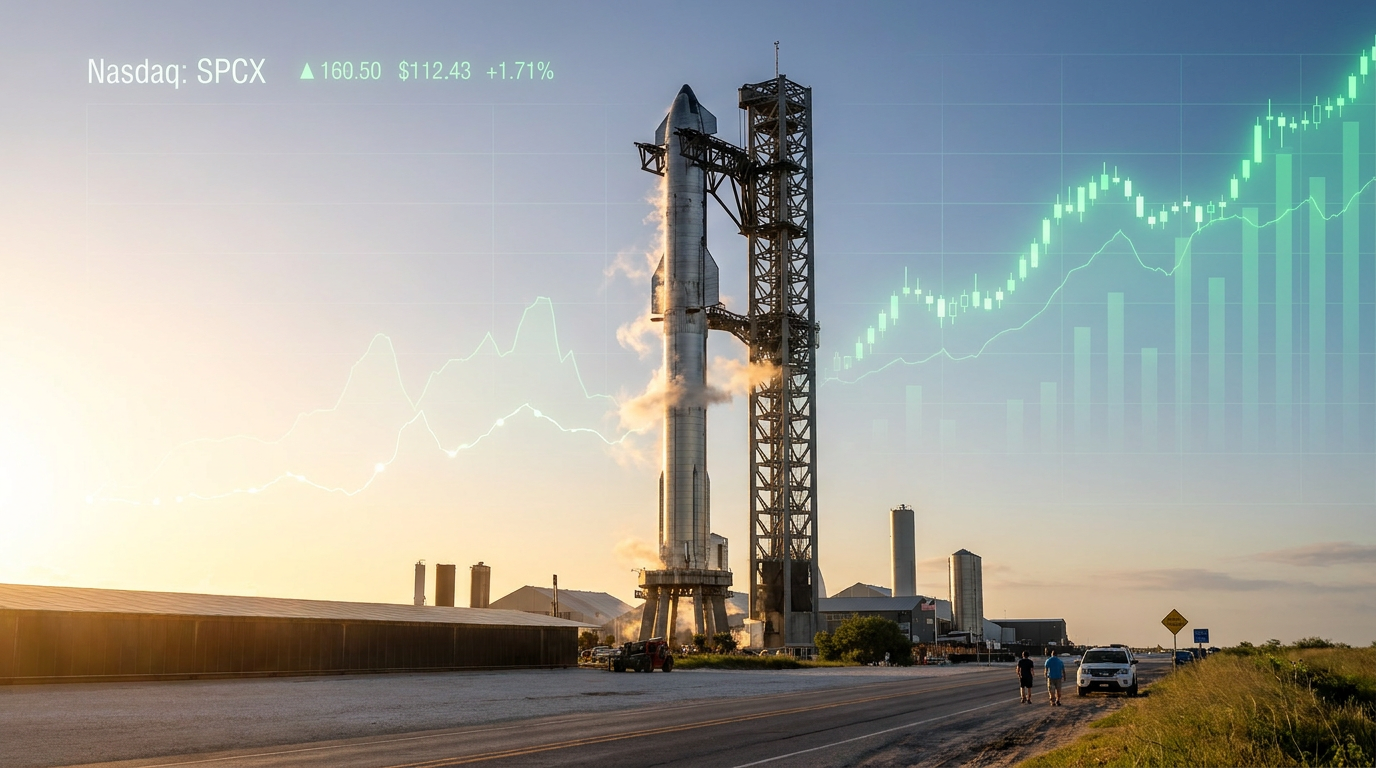
The long-awaited public debut of SpaceX has unleashed a wave of retail investor enthusiasm, breaking records and reshaping the landscape of aerospace finance. After more than two decades as a closely held private juggernaut, Elon Musk's space exploration company listed on the Nasdaq under the ticker SPCX.[2]
The initial public offering priced at $135 per share, cementing a staggering $1.77 trillion valuation. That figure immediately positioned SpaceX as the eighth-largest company in the world, leapfrogging established giants and drawing intense interest from both Wall Street and Main Street.[2]
Retail investors have responded with overwhelming demand. In just the first three days of trading, everyday buyers net-purchased $369.8 million worth of SpaceX stock. According to market data, that retail volume outpaced the combined buying of the "Magnificent Seven" tech stocks over the exact same period.[1]

The sheer scale of the IPO generated more than $100 billion in retail orders leading up to the debut, contributing to a massive $250 billion in total investor demand. However, the immense appetite from institutional heavyweights forced underwriters to adjust the final distribution.[2][7]
Originally, reports suggested that up to 30% of the offering would be reserved for individual investors—a highly unusual allocation designed to build a broad, loyal shareholder base. But as institutional demand surged, with asset managers like BlackRock placing orders for at least $5 billion, the retail slice was trimmed to the low 20% range.[4][5]
Despite the reduced allocation, the 20% share still represents an unprecedented victory for retail access. For years, everyday investors were locked out of SpaceX's exponential growth, watching from the sidelines as venture capital and private equity firms reaped the rewards of the commercial space race.[6]
Despite the reduced allocation, the 20% share still represents an unprecedented victory for retail access.
Now that the doors are open, the stock's early performance has rewarded those who secured shares. SpaceX opened trading at $150—an 11% premium over its IPO price—and quickly climbed above $160, pushing the company's market capitalization past the $2 trillion mark and making Elon Musk the world's first trillionaire.[2]

But the retail frenzy comes with significant strings attached. Individual investors hoping to lock in a quick profit from the "IPO pop" are colliding with strict brokerage rules regarding a practice known as "flipping."[3]
Platforms including Fidelity, Robinhood, E*TRADE, and SoFi have implemented restrictions that penalize retail investors who sell their IPO shares within 15 to 30 days of the debut. The penalties for violating these lockups range from temporary suspensions to permanent bans from participating in future public offerings.[3]
Brokerages enforce these rules to stabilize the stock's price during its volatile early days. Banks managing public offerings prefer to allocate shares to platforms that cultivate long-term holders, ensuring the stock doesn't immediately crater under a wave of retail sell-offs.[3]
The flipping restrictions highlight a stark asymmetry between everyday traders and institutional giants. Hedge funds and large asset managers, who often secure massive allocations at the offer price, face fewer barriers to trading immediately. Their access is largely dictated by the lucrative fees they generate for investment banks, allowing them to capitalize on early price spikes without risking their status in future deals.[3]

For retail investors, the stakes of running afoul of flipping rules are particularly high right now. With highly anticipated IPOs from artificial intelligence leaders like OpenAI and Anthropic looming on the horizon, getting banned from future allocations could mean missing out on the next generation of tech wealth.[3]
Financial advisors are urging caution, reminding investors that IPOs carry inherent volatility. While the initial surge has been lucrative, companies newly listed on the public markets often experience wild price swings as they find their footing, making long-term holding strategies generally safer for retail participants.[6]
Ultimately, the SpaceX IPO marks a watershed moment for the democratization of space investment. By opening its cap table to the public, the company has invited everyday people to take a direct financial stake in the future of satellite connectivity, reusable rockets, and interplanetary exploration.[6]
How we got here
May 20, 2026
The SEC publicly discloses SpaceX's S-1 filing, detailing the aerospace company's plans to go public.
June 11, 2026
SpaceX finalizes its IPO price at $135 per share, cementing a record-breaking $1.77 trillion valuation.
June 12, 2026
SpaceX shares begin trading on the Nasdaq, opening at $150 and pushing the company's market cap past $2 trillion.
June 15, 2026
Brokerages begin enforcing 15-to-30-day flipping restrictions on retail investors attempting to sell their newly acquired shares.
Viewpoints in depth
Retail Investors
Everyday traders eager to capitalize on generational tech growth.
For retail investors, the SpaceX IPO is a long-overdue victory. After watching venture capital firms reap the rewards of the commercial space race for two decades, everyday traders finally have access to the company's exponential growth. However, many are frustrated by the asymmetry of the market, noting that while they face strict penalties for selling shares early, massive hedge funds are often free to trade without the same restrictions.
Institutional Funds
Large asset managers securing massive stakes for long-term growth.
Institutional heavyweights view SpaceX not just as a rocket manufacturer, but as the foundational infrastructure for the future space economy and global connectivity. Firms like BlackRock placed multi-billion-dollar orders, successfully lobbying underwriters to secure the lion's share of the IPO allocation. For these funds, the focus is on long-term value creation, though they also benefit from preferential trading terms granted by the investment banks managing the offering.
Brokerage Platforms
Trading apps balancing retail access with underwriter demands.
Platforms like Robinhood and Fidelity are caught in the middle. They want to offer their retail customers access to highly anticipated IPOs, which drives user engagement and platform loyalty. However, to secure those share allocations from Wall Street underwriters, the brokerages must prove their users won't immediately dump the stock and crash the price. Enforcing strict 'flipping' penalties is their mechanism for maintaining good relationships with the banks managing the deals.
What we don't know
- Whether the stock will maintain its $2 trillion valuation once the initial IPO hype subsides.
- Exactly how many retail investors will face penalties for violating the 15-to-30-day flipping restrictions.
- How the massive influx of public capital will alter SpaceX's internal culture and long-term strategic timeline.
Key terms
- Initial Public Offering (IPO)
- The process by which a private company offers shares to the public for the first time, allowing everyday investors to buy ownership.
- Flipping
- The practice of buying shares in an IPO and selling them almost immediately to capture a quick profit from the initial price surge.
- Underwriter
- Investment banks that manage a company's IPO, determining the initial share price and deciding how shares are allocated to different investors.
- Lockup Period
- A predetermined window of time during which certain investors are restricted from selling their shares, designed to prevent the stock price from crashing.
Frequently asked
Can I buy SpaceX stock right now?
Yes, SpaceX is now publicly traded on the Nasdaq under the ticker SPCX, meaning anyone with a brokerage account can purchase shares.
What is 'flipping' an IPO?
Flipping refers to buying shares at the IPO price and selling them within the first few days of trading to capture a quick profit.
Why do brokerages penalize retail investors for flipping?
Brokerages want to prevent early sell-offs that destabilize the stock's price. Penalizing flippers helps platforms secure more shares in future IPOs from underwriters.
Did Elon Musk become a trillionaire?
Yes, the surge in SpaceX's valuation following its public debut pushed Elon Musk's estimated net worth past the $1 trillion mark.
Sources
Source coverage
7 outlets
3 viewpoints surfaced







[1]MarketWatchRetail Investors
Retail investors have been buying more SpaceX shares than all of the ‘Magnificent Seven’ combined
Read on MarketWatch →[2]ForbesBrokerage Platforms & Market Makers
SpaceX Opens Trading At $150 Following Largest-Ever IPO
Read on Forbes →[3]BNN BloombergBrokerage Platforms & Market Makers
SpaceX Retail Investors Face Flipping Restrictions Amid IPO Frenzy
Read on BNN Bloomberg →[4]CNBCInstitutional Funds
SpaceX Trims Retail Investor Allocation in Highly Anticipated IPO
Read on CNBC →[5]The Wall Street JournalInstitutional Funds
BlackRock Places $5 Billion Order for SpaceX Shares
Read on The Wall Street Journal →[6]Hargreaves LansdownRetail Investors
SpaceX IPO FAQs and Retail Allocation
Read on Hargreaves Lansdown →[7]ReutersInstitutional Funds
SpaceX's IPO has drawn $250 billion in demand from investors
Read on Reuters →
Every angle. Every day.
Get finance stories with full source coverage and perspective breakdowns delivered to your inbox.